Six on Saturday: Rain On My Parade


Actually, this rain ‘is’ the parade. In parts of California, we do not get much of it, so when rain happens, it is worth celebrating. Although this side of the Santa Cruz Mountains gets significantly more rainfall than the chaparral on the other side in the Santa Clara Valley, there are not many more rainy days here. What that means is that when it rains here, it does so with more volume than in the Santa Clara Valley.

Rain is not easy to get pictures of. The first four picture just show water from one of our first major storms of the season. The fifth pictures does not even show that much. The sixth picture is from the most recent storm that came through Sunday night and finished on Monday morning.

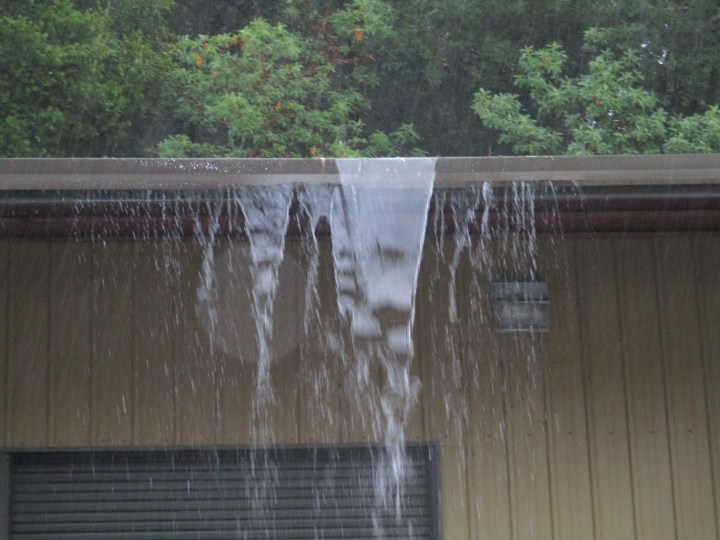
1. This waterfall was flowing both through and over the deteriorated and also clogged gutter on the roof of the shop building across the driveway from the gardening shop at work. The gutter is so deteriorated that I would have expected all of the water to just flow through it. Incidentally, the big roll-up door to the lower left of the picture happens to be that of the plumbing shop.P81222
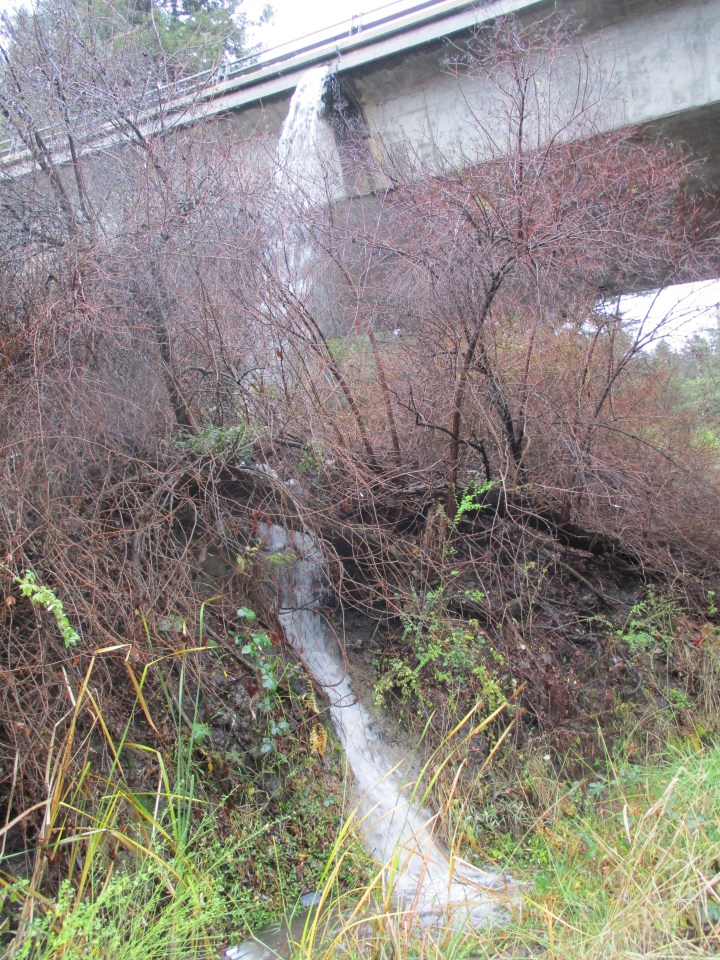
2. This waterfall was flowing through a storm drain on the Mount Hermon Road bridge over Zayante Creek, East Zayante Road, and the railroad tracks in between them.. This section of Mount Hermon Road is known to some as ‘the Bypass’ because it bypassed the older Conference Drive in picture #5. What is not visible in this picture is that the upper part of the waterfall lands in the ditch on the side of East Zayante Road below. It might have seemed like a good idea when the bridge was built, but so much water falls from so high up that it erodes the ditch, and splatters gravel onto cars driving by. The lower part of the waterfall flows into a ditch on the edge of the railroad tracks, and then under the tracks towards picture #3 below.P81222+
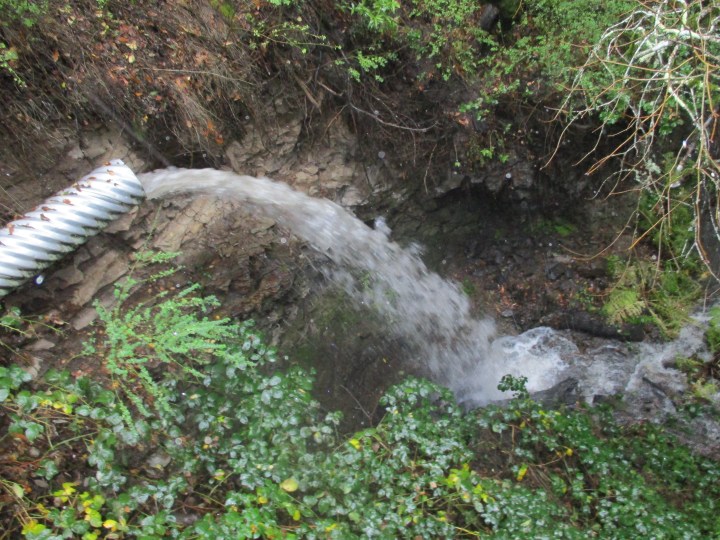
3. This waterfall was flowing out into Zayante Creek from a culvert just downhill from the culvert under the railroad tracks mentioned in #2 above. It is the same water that was falling from the Mount Hermon Road bridge.P81222++
4. These two waterfalls were flowing from the roofs of the local supermarket and adjacent drug store and pharmacy, and onto the newsstand below. What is disturbing about this picture is these drains are merely back up drains that do not allow the flat roofs surrounded by parapet walls to fill with too much water if the main drains get clogged. The main drains are likely at the rear of the building where they can drain discretely and out of the way. These back up drains are on the front of the building so that they get noticed if they start to flow. All this water flowing out of them indicates that the main drains are clogged, and that the roofs are flooded.P81222+++

5. This is the Conference Drive bridge over Zayante Creek, East Zayante Road, and the railroad tracks in between them. It is the bridge that was bypassed by the Mount Hermon Road bridge in picture #2. The big greenwaste pile where I dump debris from the landscapes is directly below the southern edge of this bridge, which is to the left in this picture. You can not see it in this picture that was taken before the rain started, but a bit of water drains from this bridge onto the greenwaste pile. It is not much, but it is enough to be a bother when I am unloading debris in the rain. It falls from so high up, that even if I am avoiding the spot where the falling water lands, the wind can blow it all over me. From that height, any bit of road gravel that falls with it can give me quite a sting.P81222++++

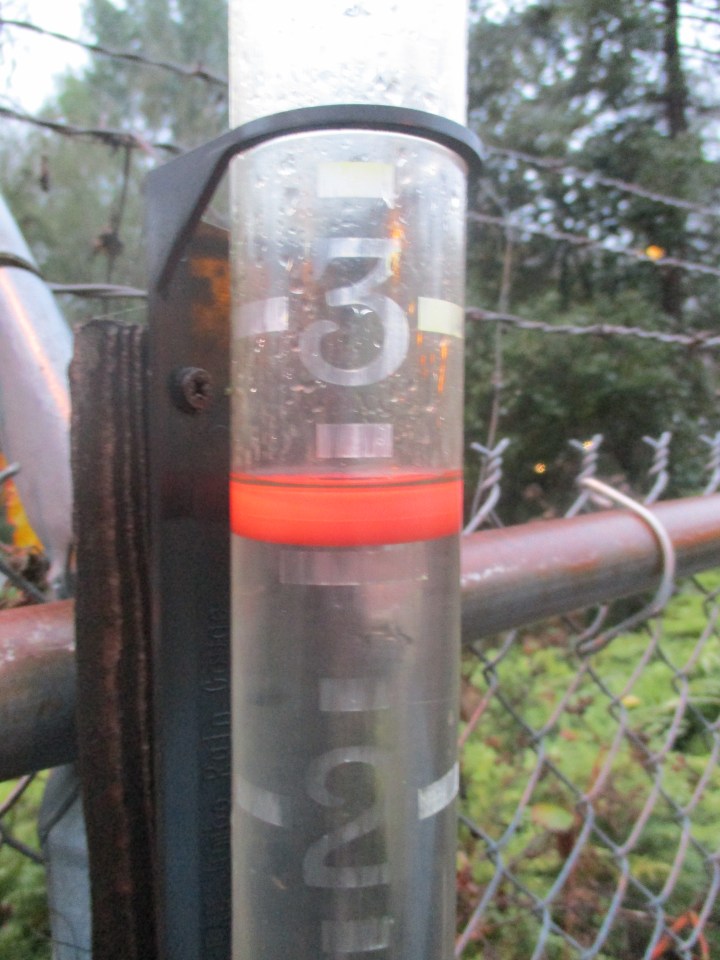
6. The most recent storm finished early Monday morning, after dropping two and a half inches of rain.P81222+++++
This is the link for Six on Saturday, for anyone else who would like to participate:

https://thepropagatorblog.wordpress.com/2017/09/18/six-on-saturday-a-participant-guide/

FINALLY! We have RAIN!

P80103+For those who do not remember what ‘rain’ is, it is, it is those odd drops of water that fall so mysteriously from the sky in other regions. We get it here too, just very rarely, and almost exclusively within a limited season centered around winter. Rain tends to be affiliated with storms. The last storm moved through here last spring.
Rain may not be much to look at, and is nearly impossible to get a picture of, but it adds up to become a very important commodity known as ‘water’. Some believe that California does not have enough water. We natives know that there is actually plenty of water, but merely too many people in need of it, and a few of those many who capitalize on that need. Anyway, I did not even try to get a picture of the rain that is falling so nicely now, but recycled this old picture of a small volume of water in what is known as a puddle, which is merely an accumulation of water within a low spot on a flat surface.
As unpleasant as rain is to work in, we are very pleased to get it. The sky is rinsed of smoke, and despite the unpleasant news that rain will interfere with searching for remains of those killed by the Camp Fire, there is also the excellent news that the rain is falling over a large area, and making forests significantly less combustible. The formerly crispy forest is again lush and damp and sloppy. What had been a Dust Bowl down where we dump greenwaste is now an epic mud pit! Everyone here is delaying other work to clear drains on roads and roofs. The first storm of the season is always something to celebrate.

When It Rains It Pours

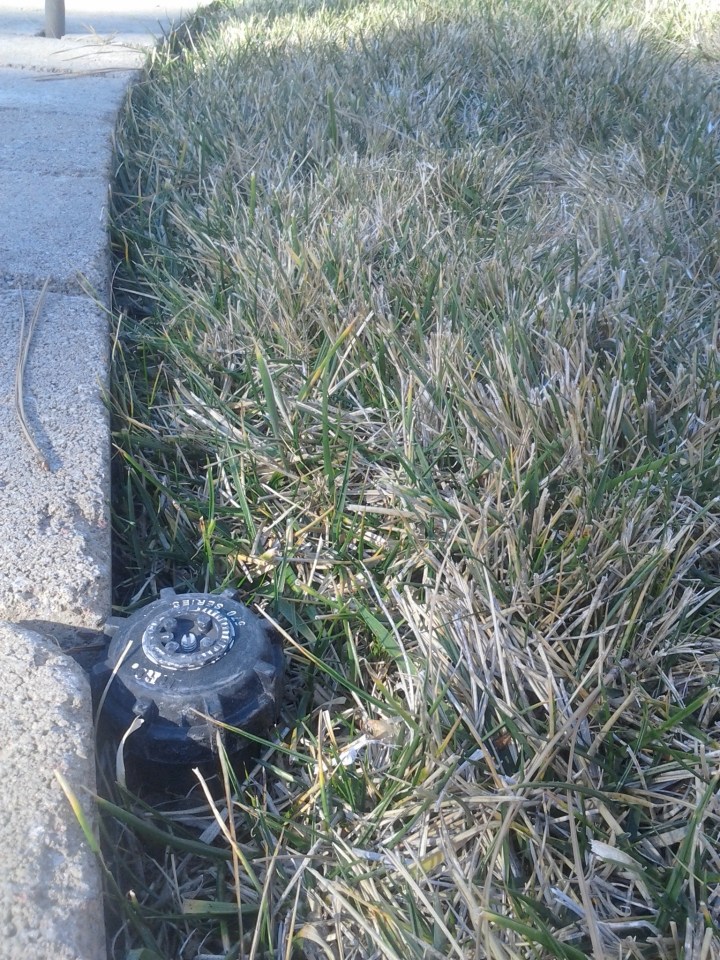
51118thumbFor those who do not remember ancient history, this wet stuff that fell from the sky recently is known as “rain”. It used to be more common, particularly through winter. It has an unfortunate way of getting everything exposed to it quite wet. It makes soil muddy. Yet, rain has many attributes. It is composed of water, so provides much of what irrigation systems have provided for so long in the absence of rain.
Most of us have already been using less water around the garden than in the past. Some plants have suffered, and a some may have died. Surviving lawns are probably not as green as we would like them to be. Just when we think that the garden can not get by with any less, the weather takes over. Even sporadic rain mixed in with mostly sunny weather provides significant moisture.

Not only is more moisture falling from the sky, but the plants and lawns that want it become less demanding through autumn and winter. Evergreen foliage loses less moisture to evapotranspiration (evaporation from foliar surfaces) because it is exposed to less sunlight during shorter days, and because the air is cooler and more humid. Deciduous plants drop their leaves, so do not lose moisture.

Even plants that are sheltered from rain by eaves will need less water because of the cool and humid weather, and shorter days. Some potted evergreen plants that are disproportionately large relative to their pots will likely want to be watered between the rain, only because their roots are so confined. Potted deciduous plants may need their soil moistened if the weather stays dry long enough for the soil to get dry.

Automated irrigation systems need to be adjusted for the changing weather. Some systems may need to be adjusted a few times. By the time the weather gets reliably rainy and cool later in winter, some irrigation systems can be temporarily disabled until the weather gets warmer and drier in spring. Not only does this conserve water; it also makes over-watering and soil saturation less likely.

No Rain

P81006KFor the first time since last winter, a few raindrops were heard on the roof early last Monday morning. It was over by the time I realized that the odd and unfamiliar noise really was that of raindrops. By the time the sun came up, everything was dry. I do not even know if these few raindrops could be considered to be the first rain of the season. There were a few similar raindrops on my windshield a while back, but they were dismissed as such; merely a few random raindrops rather than a confirmed rain shower.
That is how our climate works here. The Santa Clara Valley is in a chaparral climate. Much of Southern California is in a desert climate. We do not get much rain, and it is almost exclusive to a limited rainy season that is centered around winter.
Dust and crud that accumulates on foliage through the long dry season tends to stay there until the rain rinses it away. Oddly, many native plants do not mind, and a few seem to appreciate it. Some have tomentum (fuzz) on their leaves that collects dust, particularly during the warmest and driest summer weather when foliage is most sensitive to desiccation and scorch. Others have sticky foliage that does the same. However, such foliage is remarkably efficient at allowing such crud to rinse away in the first rain. Both deciduous foliage that will be shed shortly after the rainy season starts, and evergreen foliage that will be replaced through winter, seem to prefer to start the rainy season clean. Is this just coincidental, or do the plants intentionally collect dust and crud to shade and insulate their foliage through the harshest summer weather, and then wash up for a good sunning at the last minute?

Horridculture – Drought

P80905It is a way of life in much of California. Many of us grew up with it, or at least believing in it. Many of us never heard the end of it. That is how it lost its meaning.
Drought is a weather condition. It might last one year or a few. Drought can even continue for several years. For us, it entails less than normal rainfall through winter, only because winter is when rain is supposed to fall here.
As a weather condition, drought is not permanent. There have been a many during the past few centuries of recorded history here, and a few of those have been in just the last half century that I can remember. They happen frequently enough that I can not remember the exact years that were drought years, although I can remember a significant drought in the middle of the 1970s. No drought lasts forever.
If drought lasts forever, or at least as long as anyone can remember, then it is not a weather condition, so is therefore not really a drought. It is ‘climate’.
The climate of much of California is naturally arid. San Jose and the entire Santa Clara Valley have a ‘chaparral’ climate, which is classified as ‘semi-arid’. Some areas near the base of the Santa Cruz Mountains get only about a foot of rainfall annually. Los Angles and the region around it in Southern California have a ‘desert’ climate, which is ‘arid’. Parts of the Mojave Desert get less annual rainfall than other climates get from a single storm.
Although droughts happen here, the limited availability of water is due to the natural climate, not weather. Those who came to California a long time ago knew how to use what was available. The problem now is that there are simply too many people wanting too much of a naturally limited supply of water. Way too many expect way too much.

RAIN!?

10914This is not sequel to ‘SNOW!?’ from yesterday.

Nor is it a sequel to any of the other brief article about rain in the past.

I just recycled the picture because I still find it to be amusing.

If you are a native of California like I am, and are wondering what ‘rain’ is; I have already explained it sufficiently in previous articles. Basically, it is those unfamiliar droplets of water that fall mysteriously from the sky and get everything wet. Look it up if you must.

The article that I posted earlier this morning was recycled from this time last year, long before I started posting articles here. Our rain has actually been very deficient. It has rained only a few times this season.

We tend to talk about rain often here because it is so important to us. So much of California gets such a limited supply. Although our annual rainfall is technically sufficient, and has been sufficient longer than anyone can remember, there are millions of people living here who need the water that it provides. Fluctuations of weather are normal, but are somewhat distressful for those of us who are aware of how weather affects the water supplies that rely on rainfall. Much of the population of California gets water from surprisingly remote sources that are much more reliable than local sources. However, some regions rely on local aquifers that are sustained by local rainfall.

The ‘mostly’ good news for now is that is it raining presently. Seriously! It is raining; and is expected to continue raining through Saturday.

I say that this is ‘mostly’ good news because so much rain within a short time is likely to be disastrous to areas burned by wildfires just a few months ago. Floods and mudslides could, and are actually expected to cause significant damage near Montecito and in other areas of Santa Barbara and Ventura Counties. Highway 101 could be closed again.

We just can’t seem to get it right. If we get enough rain, vegetation in wildlands becomes more combustible. If the combustible vegetation burns, the burned area is more susceptible to mudslides and flooding if we get enough rain again in the subsequent season. So, major wildfires, as well as mudslides and floods, are less likely if we do not get enough rain. If we get enough rain, we are more likely to get a messy situation.

Rain Makes Watering Seem Obsolete

IMG_1921Watering has not been much of a concern lately. All the rain has kept our gardens too wet to work in. Some of us have been more concerned with erosion caused by runoff. Automated irrigation systems are probably disabled until the rain stops. Soil can drain somewhat between rain, but will not really dry out until the weather gets warm again. Dormant plants do not draw much moisture.

However, as strange as it may seem, there are a few plants that might want to be watered. Potted plants on roofed porches are sheltered from rain, just like houseplants. They will not dry out nearly as quickly as they would during warm summer weather, but they do eventually get dry if not occasionally watered. Hanging pots and small pots containing big plants typically dry out faster.

Plants that were moved onto porches for shelter from frost can be moved out into the rain if that would be easier than watering them. It is very unlikely that they will be damaged by frost this late. Besides, as long as it is raining, the weather can not get cold enough for frost. (In fact, any frost damage that was left through winter can be pruned away now that fresh new growth is developing.)

Small plants in the ground under big eaves might need to be watered as well, if they have not been in the ground long enough to disperse their roots beyond the eaves. Annuals do not last that long. Mature plants might have dispersed their roots well enough to get enough moisture from outside. They might not notice if the soil inside is too dry, as long as the weather is cool and humid.

Houseplants are of course in a league of their own, and as long as they are inside the home, get no water from rain. They might need less watering in winter if the home stays cooler; or they might need slightly more watering if the home heating system reduces humidity. Regardless, some might enjoy going outside to a spot sheltered from the wind, for a brief rinse from a mild rain shower.

Eventually, the weather will get warmer and drier, and automated irrigation systems will need to be reactivated. When that happens, the emitters and sprinklers should be checked for efficient function. While inactive over winter, they can get grungy or clogged with mineral deposits. Plants will not need much water early in the season. Irrigation increases as spring and summer progress.

The Weather Outside Is Frightful

P80110It is certainly not as cold as it is in other regions at or north of this latitude. Nor is it unusually cold for this time of year. It is not stormy. We got only a few heavy but brief rain showers with a bit of small hail. A slight bit of snow fell only on the Summit of the Santa Cruz Mountains

The problem is that the weather had been so mild earlier, and at times, downright warm. Many plants were coerced into premature bloom. Some started to generate new spring growth. When the weather suddenly became more seasonably cool, many of the flowers and new growth got frosted and ruined.

Fortunately, most of the deciduous fruiting trees seemed to know what they were being set up for, and abstained from bloom. So far, even the early blooming apricots, cherries, almonds prunes and plums are safe. The wild American plums bloomed, but not many of us use their fruit anyway. (I want some – both amber and red – for jelly, but there will be plenty of other fruit.)

Saucer magnolias were just beginning to bloom when the cool weather moved in. Now, some of the big pink flowers are spotting and melting before they open completely. Many of the camellias are succumbing to blight, and falling to the ground shortly after they open.

Weather is always risky, even in mild climates. Actually, our mild climate allows us to grow more of the plants that are sensitive to anomalies of the weather. Perhaps such anomalies would be less of a problem in harsher climates where the weather is naturally more variable. If so, it is probably a fair compromise. The problems with such a mild climate are still less significantly less than the advantages.

Weather To Die For

B80210KDon’t worry. He is not really deceased. He is just making good use of the lawn. The well foliated trees in the distance are a clue that this pictures was not taken recently, although it illustrates the current weather conditions accurately. We all want to be out in it, whether getting lazy in a local park, walking on the beach, or just staying home and working in the garden.

It seems that almost everyone else is contending with less pleasant weather. The summer in much of Australia had been historically hot. Much of Europe got some nasty storms. Parts of the Southeastern United States of America that get snow only on rare occasion got more than they have in recent memory.

We are certainly used to our share of pleasant weather through winter. We can only see snow in the distance on top of Mount Hamilton. Frost only happens a few times through winter. We often get a few consecutive days at of spring weather. What we are not accustomed to is this sort of duration of pleasant weather.

Many years ago, such a long duration of pleasant weather would have been bad for the orchards of the Santa Clara Valley. It would have prompted them to bloom prematurely, only to get the blossoms and developing fruit knocked off by subsequent rain. Although the orchards are gone, many of us still grow similar fruit trees in our home gardens. Apricots, cherries, nectarines, peaches, plums, prunes and almonds are all susceptible to premature bloom.

We really could use some wintry weather about now. Rain here with snow in the watersheds of the Sierra Nevada would be the best. Otherwise, cool weather to delay bloom of fruit trees until after the rain would be the second best option.

Rain Is Necessary But Messy

10914Water is no more scarce in California than it has been in recorded history. The problem with it is that it is a limited resource that must be shared amongst too many people. Likewise, rainstorms are no more torrential than they have ever been. Floods, erosion and wind are only more destructive now because there is so much more infrastructure that can be damaged than ever before.

Rain and wind are perfectly natural. Furthermore, it is natural for the weather to knock down limbs or entire trees. It only seems unnatural when these limbs or trees fall on houses, cars or anything else that gets in their way. Plants actually enjoy rainy weather much more than we do. Some like to be rinsed of dust and debris left from former infestations of mites, aphid, scale or sooty mold.

What plants do not like about rain is erosion. It is bad enough that so many plants in refined gardens are deprived of their own litter to insulate the surface of the soil. It is even worse if the bare soil gets eroded away from fine feeder roots at the surface of the soil. This is something that the rest of us would agree on. We do not want gullies carved into slopes, or drains clogged with mud.

Trees, shrubs and some stout perennials with aggressive roots are useful where the potential for major erosion is a concern, but might not do much for annoying surface erosion. Sprawling and spreading plants that form dense networks of low branches and surface roots are more effective. They soften the splatter of rain, slow the flow of drainage, and catch much of any dislodged silt.

Groundcover plants like ivy, gazania and iceplant are probably the best option for controlling surface erosion. Dense and low shrubbery that spreads over the ground and holds its own debris probably work just as well. These include low junipers, trailing rosemary and dwarf coyote brush. Larger shrubbery can help if it can drag its lowest limbs on the ground, and no one rakes below it.

Mulching limits erosion while new plants grow. Although new mulch needs to be added annually as old mulch decomposes, less will be necessary as plants grow and cover more area. Mulch is also effective where no plants are desired. For large areas, especially where plants are not expected to fill in, landscape cloth below ornamental bark inhibits weeds. However, coarse bark slowly shifts downhill, so replaces one kind of erosion with another, and will eventually need to be raked back uphill.