Six on Saturday: Pet Rock Amongst Redwoods


Macabee Gopher Trap was invented in Los Gatos. So was the Bean Pesticide Sprayer. Both were very useful in the vast orchards that formerly occupied the Santa Clara Valley. Another one of the more famous invention that originated in Los Gatos was not so practical. Actually, it was weirdly impractical. What was weirder was that it became such a craze in 1975 and early 1976.

It was the Pet Rock.

1. Pigeons don’t lay eggs in December. They certainly don’t lay such big eggs, or leave them without a few twigs to keep the from rolling away. Now that I think of it, pigeons don’t live here.P91207-1

2. Oh, it is just a rock, painted by someone named Madeline. Perhaps, it is a Pet Rock named Madeline. It seems to be of impeccable breeding. Form, color and temperament are exemplary.P91207-2

3. Perhaps it was painted by someone named Joy, or it is named Joy. Well, whatever or whoever it is, it seems to be very important. It was put back in the hanging basket of zonal geranium.P91207-3

4. That’s the hanging basket with the zonal geranium in it, right there, second from the left. It is not exactly a good place for a Pet Rock to nest. Notice the plaque over the rail right below it.P91207-4

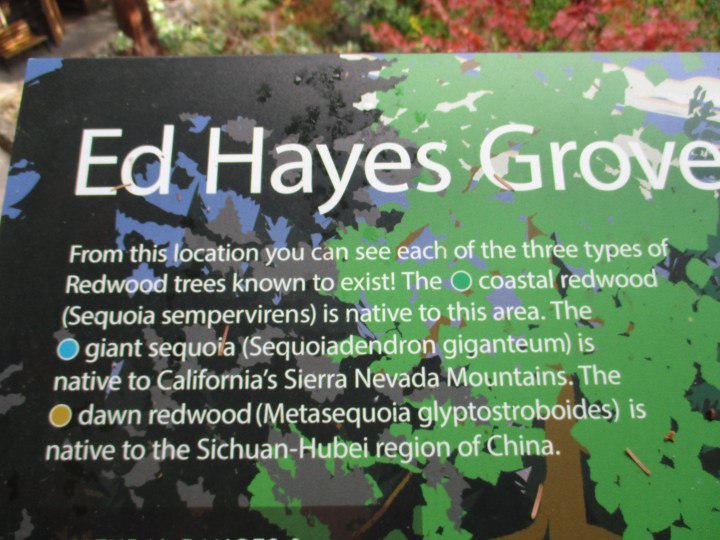
5. The plaque identifies all three species of redwood in the landscape. The green, blue and brown dots next to the names correspond to a diagram showing where each is within the landscape.P91207-5
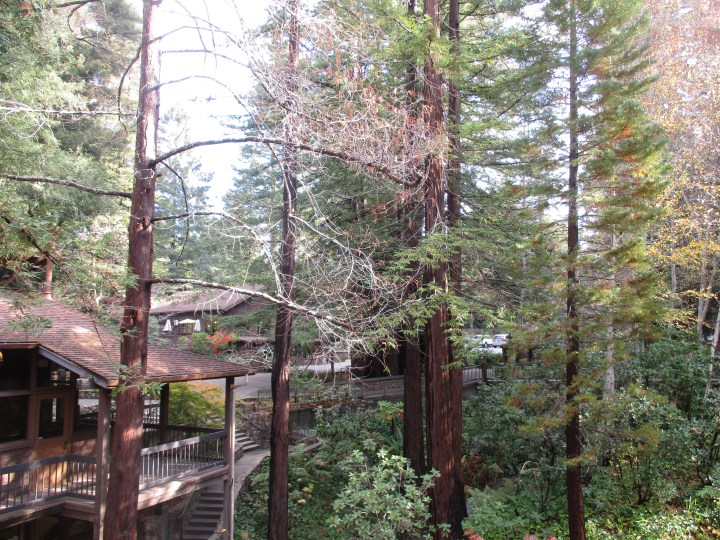
6. The defoliated dawn redwood is to the left. The small giant redwood is to the right. Those in between and in the background are the native coastal redwoods, which grow wild in the region.P91207-6
This is the link for Six on Saturday, for anyone else who would like to participate:

https://thepropagatorblog.wordpress.com/2017/09/18/six-on-saturday-a-participant-guide/

Self Grafted Redwoods

P91019K

Redwoods are some of the most stable trees in the World. That is partly why they can survive for thousands of years. In my entire career, I have seen very few fall, and only inspected two.

Of those two, one fell because it had co-dominant leaders (double trunks) that fell away from each other, which is more of a structural deficiency than instability. The other, which I suspect was demonically possessed, was a small tree less than thirty feet tall, that literally jumped up out of the ground and onto an Astro van more than ten feet away. A rare ‘updraft’ was blamed.

Almost all of the redwoods here regenerated from the stumps and roots of much older trees that were clear cut harvested a century or so ago. Most of those that grew back with structurally deficient co-dominant leaders are very effectively sheltered from wind by their collective groves. Roots systems are very extensive, very resilient, and too intermeshed to be compromised.

The trunks in the picture above are part of a group of several trunks that grew from roots of the same tree that has been gone for a very long time. All are genetically identical and very close together. They happen to be a focal point of a big patio at a conference center. Although the structural integrity of the limbs within their canopy is a concern, the stability of the trunks is not.

Regardless, I am impressed by their attempt to improve stability. The limb that extends horizontally across the middle of this picture from the trunk to the left grafted to the trunk to the right! It is not uncommon for crossing limbs and trunks to rub through their bark to expose the cambium, but how do they stay still long enough to graft together?!

Horridculture – Metasequoia glyptostroboides

P90626The easier name is ‘dawn redwood’. I just used the big and fancy Latin name because that is how landscape designers with something to prove say it. If the big name does not impress clients, an explanation of how rare it is, and that it is one of only a few deciduous conifers, will likely do the job. Even back when it was still a fad, I got the impression that was its main function; to impress clients.
It is not even a particularly practical tree. If it gets too big for its situation, it is difficult to contain without disfiguring the canopy. Because the priorities for most were conformity to a fad and to dazzle a client, not much thought went into their appropriateness to their respective landscapes. Consequently, many went into landscapes that were not big enough for them.
Although deciduous, dawn redwood does not even get good color in autumn. It just turns rusty brown, and quite frankly, looks dead.
It is true that there are only a few deciduous conifers. However, the dawn redwood stopped being rare shortly after it became a fad. I mean, how rare can it be if every landscape designer with something to prove gets to plant one?! Isn’t that what happened to the formerly rare yellow clivia after it became a fad?
The only one that I work with now happened to be planted before dawn redwood became a fad. I suppose that makes it okay. It is quite tall now, and has plenty of space to mature. However, I can not help but notice how silly it looks with all the other surrounding coastal redwoods. Although very different, it is similar enough to look like a coastal redwood with some serious problems, especially when it seems to die every autumn.

Redwoods Are So Tall . . .

P90428Redwoods are SO TALL!
How tall are they?
They are so tall that you can see for yourself if you look in this direction . . . from anywhere in North America.
They are so tall that if you need firewood, I can aim one in your direction as I cut it down.
They are so tall that while they drop foliar debris on the Ford and Chevrolet parked below, they also drop foliar debris on Mercury and Saturn in their respective orbits.
They are so tall that while other trees collect kites and Frisbees, they collect airplanes and satellites.
They are so tall that only a few of their seed survive. Most burn up in the atmosphere on their way down.
They are SO BIG too!
How big are they?
They are so big that some have tunnels cut through them so cars don’t run out of gasoline while driving around.
Okay enough of that for now.
Most of the biggest redwoods here were harvested, leaving only stumps to remind us of how big they were. The few trees that were big enough for harvest a century ago, but were not harvested when those around them were, probably exhibited some sort of defect that made their lumber undesirable.
The tree in this picture happens to be one of the few that is big enough now to suggest that it was likely big enough for harvest when those around it were harvested. The trunk is more that six feet wide. Yet, except for the severe lean, no obvious defects were observed. (The vertical edge of the doorway to the left was included in the picture for comparison with the lean of the tree.)
The tree started to lean only recently. If it had taken several years to develop this lean, the top several feet of the trunk would be curved upward, as it would have continued to grow vertically away from gravity while the trunk below it moved. If it moved suddenly but only once several years ago, there would be a kink near the top of the otherwise leaning trunk, from which, subsequent growth would be vertical.
This tree instead leans with a straight trunk from bottom to top, which means that it grew vertically, and then moved into this diagonal position too recently for new vertical growth to develop. Lateral branches are also diagonal, as they maintained their position perpendicular to the trunk. Although redwoods rarely destabilize, this one really seems as if it is about to fall.
Is this destabilization relative to some sort of deficiency that prevented the tree from getting harvested a century ago? I really should investigate.

Redwoods Are Family Oriented

P90223KCoastal redwood, Sequoia sempervirens, are remarkable stable trees. They rarely fall, which is how they get to be thousands of years old. They prefer to live in groups, where they mesh their roots together, and shelter each other from wind. Those that live outside of a group stay shorter than forest trees, and typically develop multiple trunks that function as a group.

However, they are also remarkably weak in regard to their structural integrity. Limbs are easily broken away from their vertical trunks by wind. Snow, which is rare within their natural range, causes significantly more damage than wind, which is probably why their natural range does not extend into snowy climates. Trees with co-dominant leaders (double trunks that divide from single trunks above grade) have potential to split at the union of the double trunks. Such unions are typically at such acute angles, that the trunks press against each other rather than fuse together through impenetrable compressed bark.

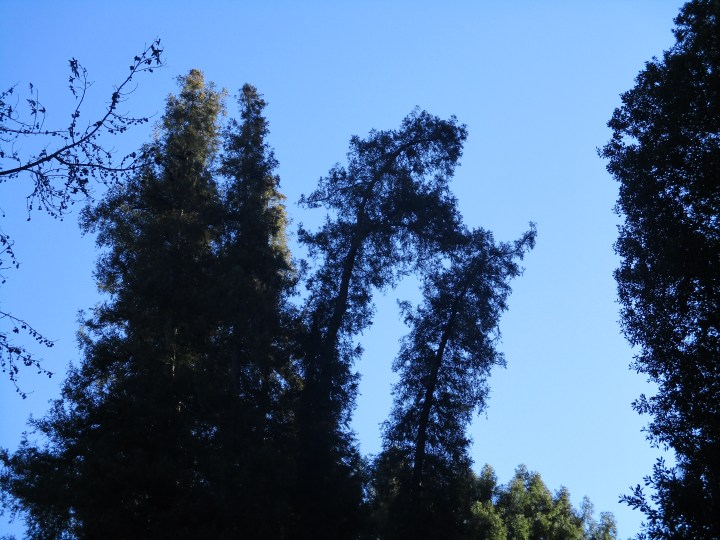
Leaning redwoods such as these that were shown earlier this morning, are potentially hazardous, not because they are likely to fall over, but because they might be likely to break. The trunks are designed to support weight vertically. The asymmetrical distribution of weight supported by these two trunks exerts inordinate lateral tension on the trunks. To make matters worse, the trunk to the left is divided into two co-dominant leaders, although the union does not appear to be at a typically acute angle. (The lower trunk is now behaving more as a big limb than as a secondary trunk.)

I would guess that these two trees are genetically identical trunks from the same root system. Such seemingly pliable trunk structure is uncommon, and it is very unlikely that two such similar trees would just coincidentally appear within such minimal proximity to each other. Redwoods often develop multiple trunks from the same root system, particularly as they regenerate after harvest.

The good news is that these two trunks have survived like this long enough to develop ‘reaction’ wood, which is just like it sounds; a bit of extra wood to compensate for compression on the inside of the bend. Also, they are sheltered from wind by the other redwood in the forest around them.

Six on Saturday: Cabin Fever


Seriously! The flu!, or something like it. I was totally sick for days, with an awful fever. As if that were not bad enough, it happened while I was supposed to be relaxing and on vacation!

Neither was planned. Getting sick never is. The vacation was a total surprise too; a Christmas gift from one of the guys at work! It was totally rad, even if I was sick for it.

You see, we work at one of the most excellent places in the entire universe, where people come from all over for restorative retreats. That by itself is totally rad. What is radder is that we can rent unused rooms or cabins for out-of-town guests or for ourselves if we like. It is very affordable, and like vacationing at work. That may not seem like much fun for those who do not enjoy their work like we do, but like I said, this is one of the most excellent places to work in the entire universe.

So, my colleague got me nine nights in what is classified as an ‘economy’ cabin, but by my standards was very luxurious. I had stayed in a smaller newly remodeled cabin for two nights, and a hotel like room for a night, but had done nothing like this; nine nights in secluded luxury! If one must get sick, this is the way to do it!

Anyway, this is where my six pictures for this week came from.

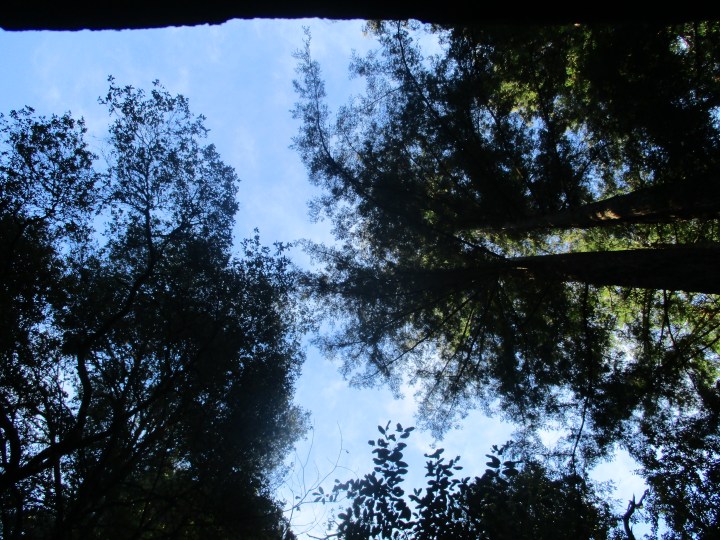
1. This is the upward view from the front door. The black margin at the top of the picture is the edge of the eave. The trees to the left are canyon live oaks and a tan oak. The trees to the right are towering coastal redwoods.p90105

2. This is the same spot. Instead of looking straight up, this is looking outward from the front door. There is no refined landscaping here; only the native trees with the exotic English ivy that is cascading slightly over the old stone wall.p90105+

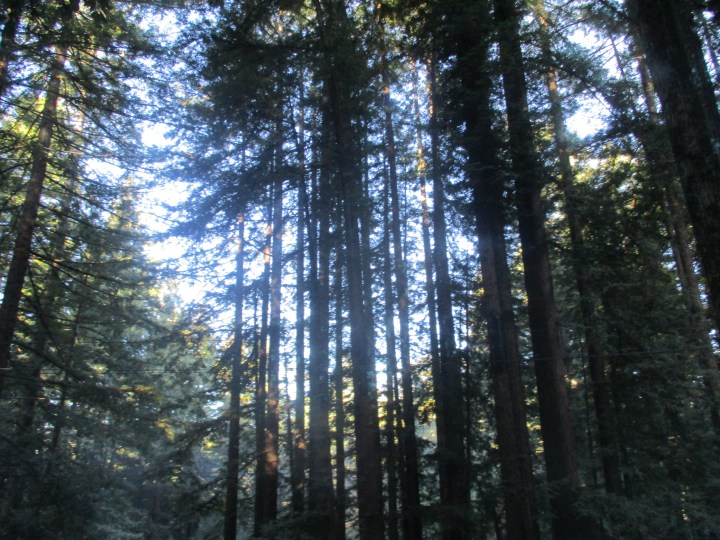
3. These towering coastal redwoods are outside a bedroom window.p90105++

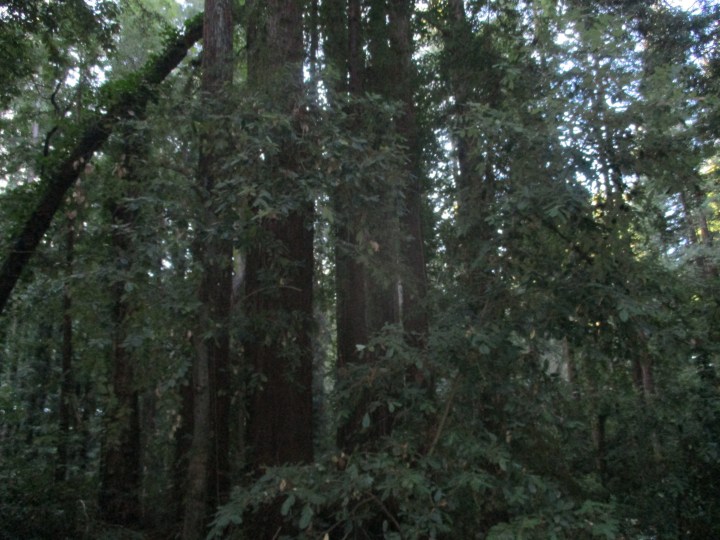
4. These towering and somewhat darker coastal redwoods are outside the bathroom window.p90105+++

5. The artwork on the interior walls are mostly pictures of the local flora and wildlife. Most are rather artistic. Some are pictures of common but exotic flora that, although probably appealing to those who do not recognize them, are not the sort of subject matter that I would have selected. For example, one of the big framed photographs in the bedroom is a closeup of the summery foliage of London planetree, Platanus X acerifolia. Ick! I took this picture of three pictures that I found to be amusing. On the left, we have some interesting lichens and a bit of moss on what seems to be an apple tree. Okay. In the middle, we have foliage of California bay tree, Umbellularia californica. Odd, but again . . . okay. On the right, we have maces from the exotic sweetgum, Liquidambar styraciflua. Now, I would say that is weird, but it really is a cool picture!p90105++++

6. Rhody was not supposed to be on the bed.p90105+++++

This is the link for Six on Saturday, for anyone else who would like to participate:

https://thepropagatorblog.wordpress.com/2017/09/18/six-on-saturday-a-participant-guide/

Six on Saturday: Clearance


Clearance can get one into some interesting situations. Yes, with the necessary clearance, one can get into penitentiaries, protected military facilities, sensitive areas of the White House, or even Area 51.

The sort of clearance that I was concerned with this past week and the week prior was not so interesting. Now that roofs and gutters of the buildings at work are in the process of being cleaned before wintry weather, trees must also be pruned for clearance. As they grew through summer, some got detrimentally close to the roofs and gutters that are getting cleaned, as well as chimneys, windows, outdoor lighting and walkways. Such clearance is a concern throughout the year, but becomes more of a priority as we get ready for winter. No one wants to go back onto the roofs any more than necessary.

1. Before. The redwoods must be pruned for adequate clearance from the roof, chimney, lamppost, and even the umbrella on the patio that can not be opened without pushing a bit of foliage aside.P81013

2. After.P81013+

3. Soot on the tip of one of the redwood limbs demonstrates why clearance from chimneys is so important. Foliage that gets too close to chimneys can ignite and fall back onto the roof below, where it has the potential to ignite any foliar debris that might have accumulated behind the chimney since last year.P81013++

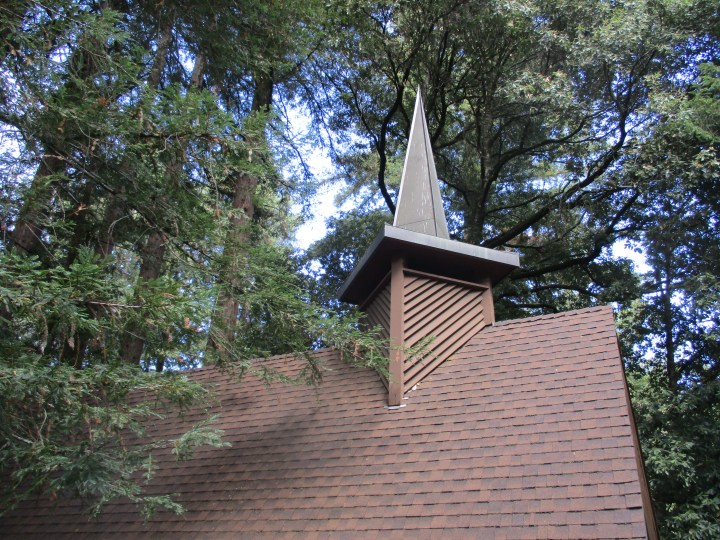
4. The belfry of the chapel next door really bothered me. Clearance was barely adequate. Although I am not worried about the shingles or painted surfaced getting damaged as wind starts to blow during winter, I think that the chapel would look better with more clearance from the encroaching redwood limbs. The problem was that I could not reach the limbs. Because this clearance was not a priority, the pruning here was postponed. A colleague who is not as plump as I am suggested that I get onto the roof through that gap between the top of the louvered sides of the belfry, and the underside of the roof above. Now, even if I could somehow get through that little gap, where would I go on the outside?! Let Quasimodo do it!P81013+++

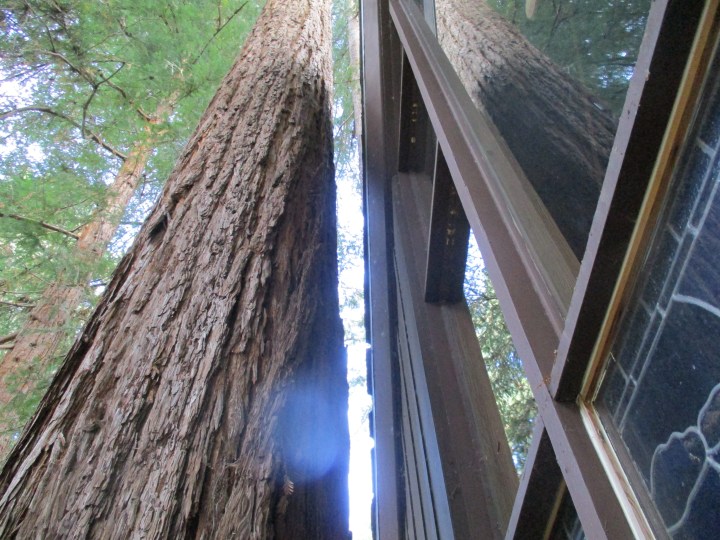
5. The chapel was built among the redwoods, very literally. Expanding trunks are beginning to displace the foundation and utilities. I can not prune for the sort of clearance that is needed here. Because the chapel is such an important building, and the redwoods are such important trees, it would be feasible to move the chapel over onto a new foundation. The problem with that idea is that the redwood trunks are pressing up against the building on three sides! There is no place to move the building without cutting something out!P81013++++

6. Phytophthora ramorum, which is commonly known as Sudden Oak Death Syndrome, or SODS, continues to kill tanoaks, (Notho)lithocarpus densiflorus, and coast live oaks, Quercus agrifolia. These trees do not need to be pruned for clearance, but must be removed before they start to deteriorate and drop limbs onto adjacent buildings or whatever happens to be below.P81013+++++

This is the link for Six on Saturday, for anyone else who would like to participate:

https://thepropagatorblog.wordpress.com/2017/09/18/six-on-saturday-a-participant-guide/

Big Trees

0

They are the biggest. Giant redwoods are revered for their age and size. It was not always like that.
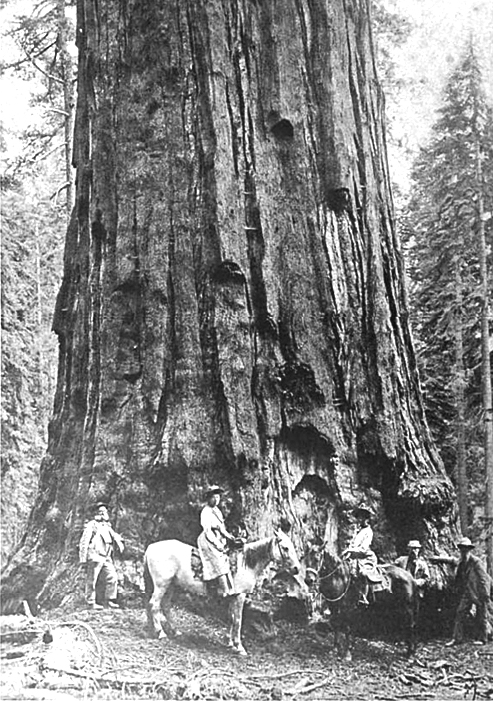
Many of the biggest giant redwoods were killed merely for bragging rights. Whoever discovered the biggest got to arrange to get it cut down, and then pose on the stump for photographs. Some trees were cut down just so the rings could be counted. Many felled trees were just left to rot where they fell. It was not practical to transport the lumber out of the remote regions of the Sierra Nevada where the trees lived. That was at a time when ‘sportsmen’ shot from trains into herds of wild buffalo, only to pose with the biggest dead carcass they could find in the aftermath, and then leave all of the deceased to rot on the prairie.
So, at about the same time in history that the related coastal redwood was being harvested so indiscriminately for lumber, the biggest of the giant redwoods were killed primarily for sport. Even in regions from which lumber could have been transported from, no one could figure out how to get such massive giant redwoods onto the ground without fracturing the lumber within. Because their wood is so brittle, smaller giant redwoods that were harvestable were simply cut and split into shakes, grape stakes, and fence posts and rails. Young and healthy specimens of the biggest trees in the World were used for the smallest and most unglamorous forms of lumber.
The biggest of the giant redwoods are of course protected now, mostly within national parks. They are quite accessible to those who want to visit and admire them. I got this picture with one of my esteemed colleagues in front of the General Sherman tree in wintertime back in the early 2000s.

Six on Saturday: Redwoods Again


Redwoods are such interesting trees. There is always something to write about them. I happen to live and work within the native range of the coastal redwood. I often work with very big redwoods, both in the wild, and in landscaped areas that were formerly wild. There are no other trees that are comparable. The giant redwoods in the Sierra Nevada are bigger, but they are also very different.

1. In most home gardens and landscapes, trees that get cut down get recycled into greenwaste and firewood. Not many are big enough to get recycled into lumber. Even fewer are big enough to get milled into big timbers. This milled redwood lumber is drying before getting milled again into timbers and smaller sizes of lumber that will get used to repair and remodel some of the historical old buildings. A bit of pine lumber is also obtained from the big ponderosa pines nearby.P80825

2. Limbs, foliage, bark and parts of the redwood trees that can not be milled into lumber get chipped. Chips get used as mulch in landscaped areas. After taking this picture, I realized that it is not really a pile of chipped redwood, but is instead chipped wood waste. Chipped redwood is typically green with foliage. Oh well, you get the idea.P80825+

3. The Ewok Village of ‘Star Wars IV – Return of the Jedi’ was in a redwood forest near Fortuna. This is not really an Ewok Village.P80825++

4. It is a Redwood Canopy Tour. People (not Ewoks) can be seen on a platform in the yellow rectangle just above and to the right of the center of the picture. Someone on a zip line can be seen in the white rectangle just below and barely to the left of the center. It looks crazy to me, but many of my colleagues do crazier things at work.P80825+++

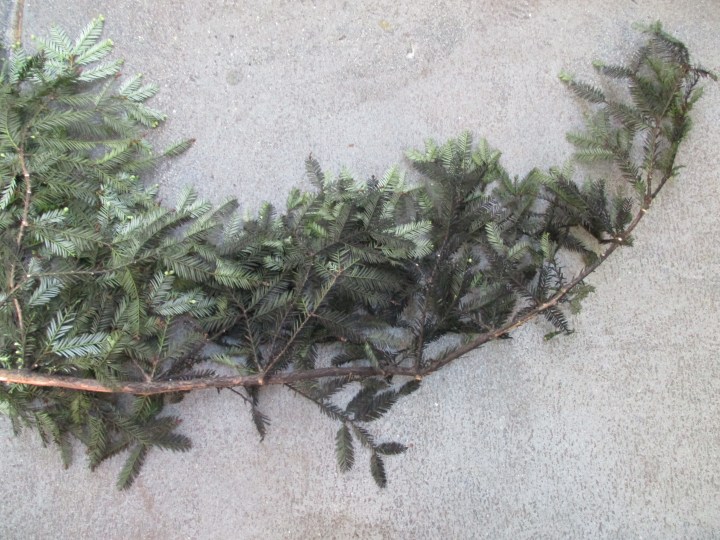
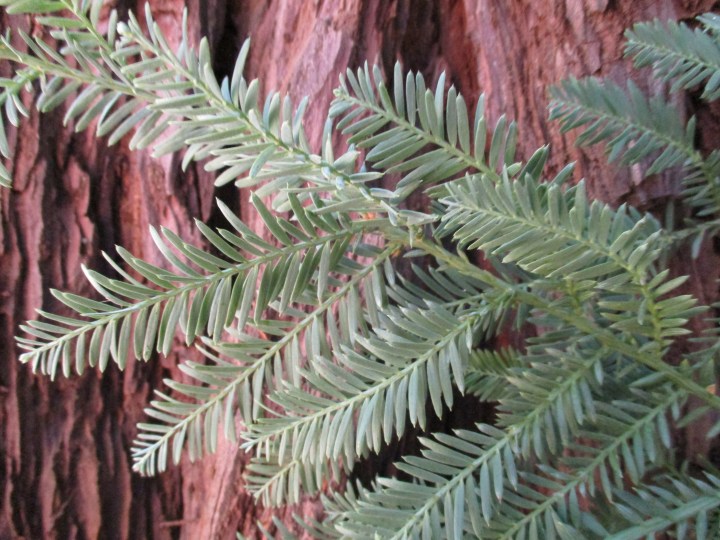
5. Most of us have seen pictures of massive redwood trunks. Most of us have seen pictures of redwood forests. Not so many of us have seen what the foliage looks like.P80825++++

6. This perennial pea has nothing to do with redwoods, but needed to be included as a token flower for this week. Besides it is cool. It is softer pink than the bright purplish pink that is so typical, and is blooming very late.P80825+++++

This is the link for Six on Saturday, for anyone else who would like to participate:

https://thepropagatorblog.wordpress.com/2017/09/18/six-on-saturday-a-participant-guide/

Here are a few links for some of my brief articles about redwood:

https://tonytomeo.com/2018/08/17/dawn-redwood/

https://tonytomeo.com/2018/08/12/general-sherman-tree/

https://tonytomeo.com/2018/08/04/albino/

https://tonytomeo.com/2018/08/04/six-on-saturday-bits-and-pieces-ii/

https://tonytomeo.com/2018/07/14/six-on-saturday-redwoods/

https://tonytomeo.com/2018/05/12/six-on-saturday-tree-ring-circus/

https://tonytomeo.com/2017/10/15/redwoods/

https://tonytomeo.com/2017/10/05/big-tree-in-a-small-town/


General Sherman Tree

0

The biggest, tallest and oldest trees in the World are all native to California. The biggest trees are the giant redwood, Sequoiadendron giganteum. The tallest trees are the coastal redwood, Sequoia sempervirens. The oldest trees are the bristlecone pines, Pinus longaeva. The biggest and the tallest are two of only three specie of redwood in the World, and except for a few coastal redwood that live barely north of the Oregon border, both are endemic only to California. Most of us know that the coastal redwood is the state tree of California. However, some believe that California is the only state with two state trees, which are the two native specie of redwood.

This gives arborists from California serious bragging rights.

Most of the arborists whom I work with are very familiar with the coastal redwood. Not only is it the most prominent tree in the Santa Cruz Mountains, but it is also a common tree in landscapes of the Santa Clara Valley.

The other two specie are not nearly so common. Neither perform well in landscape situations, and certainly not locally. Even if they did, the giant redwood gets much too bulky to fit into urban landscapes, and the bristlecone pine is a bit too irregular for refined landscapes. Because they both live in somewhat remote regions within California, some very experienced arborists have never seen either of them in the wild. Of course, it is not something we talk about much.

I still have not seen bristlecone pine in the wild. The only specimens I have ever seen were bonsai stock that had not yet been cultivated as bonsai specimens.

In the late 1990s, I had not seen giant redwood in the wild either. I had only seen the unhappy specimens that were planted on the sides of roads between San Jose and nearby towns during the Victorian Period before the urban landscape had become so inhospitable to them. One of my respected colleagues who had seen many of the more interesting trees of California in his travels had not seen them either.

Fortunately, it was nothing that a good old fashioned road trip could not fix. Without much planning at all, we drove out to Sequoia National Park and met with the General Sherman Tree. There was too much snow to get very far, so we did not get similarly acquainted with the General Grant Tree farther up the road. It was one of the most compelling horticultural trips of my lifetime, right up there with going to see the native California fan palm, Washingtonia filifera, outside of Palm Springs, or the Joshua tree, Yucca brevifolia, outside of Palmdale. I know that the picture above is not a good picture of my colleague with the General Sherman Tree. It is from a time when cameras still used film. Getting pictures transferred to a compact disc was merely an option back then. The sepia toned picture below is even older, but it is not mine.00