Nix

Buick / Lincoln

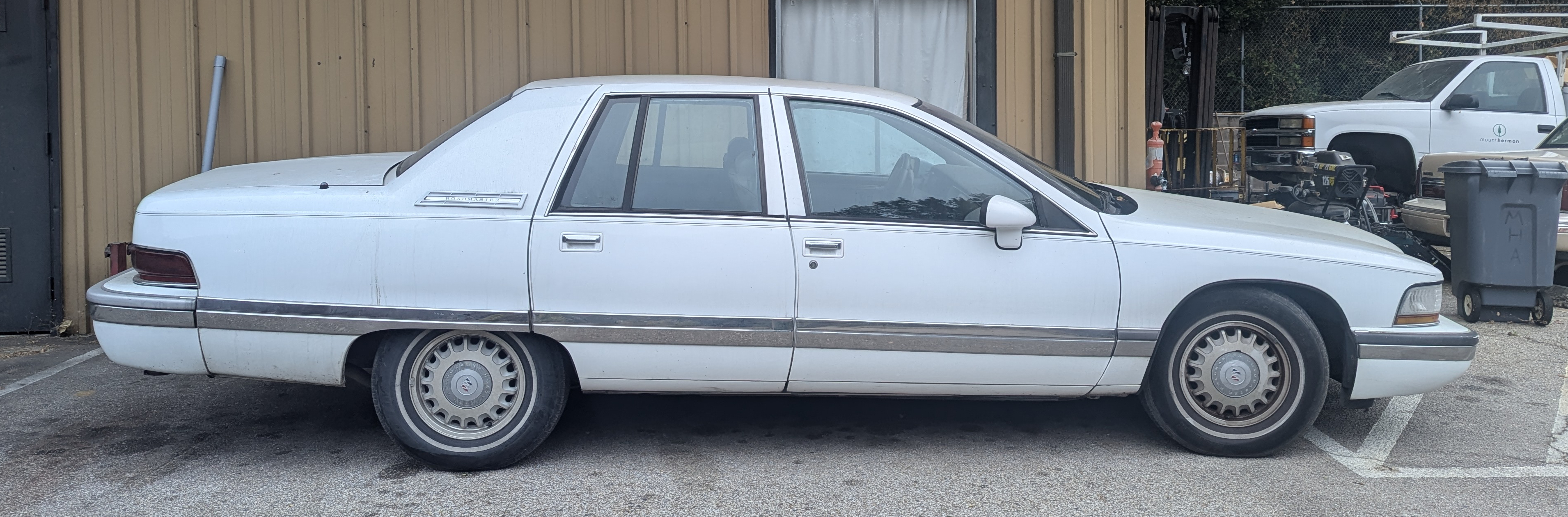
Carson, Rhody’s Roady, is a 1994 Roadmaster. Although Chevrolet Caprice, Oldsmobile Ninety-Eight and Cadillac Fleetwood are the same sorts of contemporary sedans, Buick Roadmaster is somehow designated as the last great American Sedan. All are very rare, likely because they were already so old fashioned when they were new. Finding Carson was no easy task. In the process, and to be a responsible consumer, I investigated other options, including Mercury Grand Marquis from about the same time. Ultimately, I really wanted a Buick, which is a bit more refined than a Chevrolet, but not quite as vain as a Cadillac. Although all options were very tempting, I have been completely pleased with Carson. A few weeks ago though, this 1992 Lincoln Town Car was acquired by the fleet at work. Because most of who work here are young people who lack appreciation for real sedans, particularly such totally awesome luxury sedans, this Town Car will be sold. Because such sedans are even more old fashioned than they were when they were new decades ago, it will not be sold for much. Goodness! It is extremely tempting. Town Car is the luxurious Lincoln version of the Mercury Grand Marquis. This particular Town Car is of the Cartier Edition, which would be a bit too froufrou for me if I could see what identifies it as such. I believe that his name is Nix, but I just refer to him as the Town Car to avoid getting too familiar or attached. His trunk is nearly as spacious as Carson’s, so can bring more plant material back from Southern California or the Pacific Northwest than a modern compact pickup, which was one of the justifications for investing in a sedan that I have no practical use for rather than a modern pickup.

Horridculture – African

Delegates from Arabia, Africa, Germany Pakistan and (almost) Turkey

‘The Rescuers’ is an animated movie for children from 1977 that features the Rescue Aid Society, which is an international organization of mice. (I am trying to be very brief with this description. Besides, I do not know much about it.) Delegates of the Rescue Aid Society represent various countries, such as Arabia, Germany, Pakistan, Turkey and Africa. Yes, ‘Africa’. Although one can assume that ‘Arabia’ refers to Saudi Arabia, it could refer to the entire region, which includes several countries. Similarly, although one can assume that ‘Germany’ refers to West Germany, it could refer to both West Germany and East Germany, which were still separate countries in 1977. ‘Africa’, though, is not so easily dismissed. It is an entire continent, which includes more countries than any other continent. Horticulturally, Africa does not get much more regard. African sumac, African daisy, African iris, African violet and African tulip tree are all from Africa, but their names reveal no more than that about their origin. Italian cypress, English holly, French lavender, Norway spruce and Grecian bay all have names that are more descriptive about their European origins. Similarly, the names of Japanese boxwood, Chinese elm, Korean fir, Burmese honeysuckle and Indian laurel describe their Asian origins. The names of California fan palm, Oregon grape, Virginia creeper, Texas bluebonnet and Arizona cypress are even more descriptive, by designating individual States within the United States of America, which is within the continent of North America. Here in California, some common names are even more regionally descriptive, such as Monterey pine, Santa Cruz cypress, Santa Barbara daisy, San Francisco campion and Montara manzanita. Although most of these examples are unknown or rare beyond their native ranges, a few are quite common elsewhere. Yet, somehow, most of what was exported from Africa is merely ‘African’.

Travel

This does not happen often. Actually, it is quite rare, which is one of the consequences of enjoying my horticultural professions a bit too much. I almost never crave travel as I have been lately. Why should I? I live and work in such an excellent region which is excellent for horticulture and just about anything else. It is the sort of region that those who are not here travel to. Furthermore, there is nothing here that I want to get away from. In order to travel, I must first make obligations where I intend to travel to. Then, I can not change my plans for such travel. Even then, some of my obligations are horticultural pursuits, as if I must make work where I intend to go to compensate for my inability to take all of my work with me. I prune apple trees when I go to the Pacific Northwest. I procure regionally rare species where they are more available when I go to the Southwest. While vacationing in the region of Los Angeles last May, I spent a day greeting guests at one of Brent’s three landscapes that were featured on ‘Blooms With a View’, the Spring Garden Tour of View Park and Ladera Heights. I have no such plans anywhere yet. Now that it is late summer, it would be inconvenient to leave here for more than three days anyway. So, why should I so arbitrarily want to travel? I do not know. I suppose that I could go to the region of San Luis Obispo for Monday and Tuesday. I would like to find a pup of the regional variety of Hesperoyucca whipplei spp. whipplei that I first encountered while studying horticulture at Cal Poly there. But of course, I need no excuse to travel.

North & South

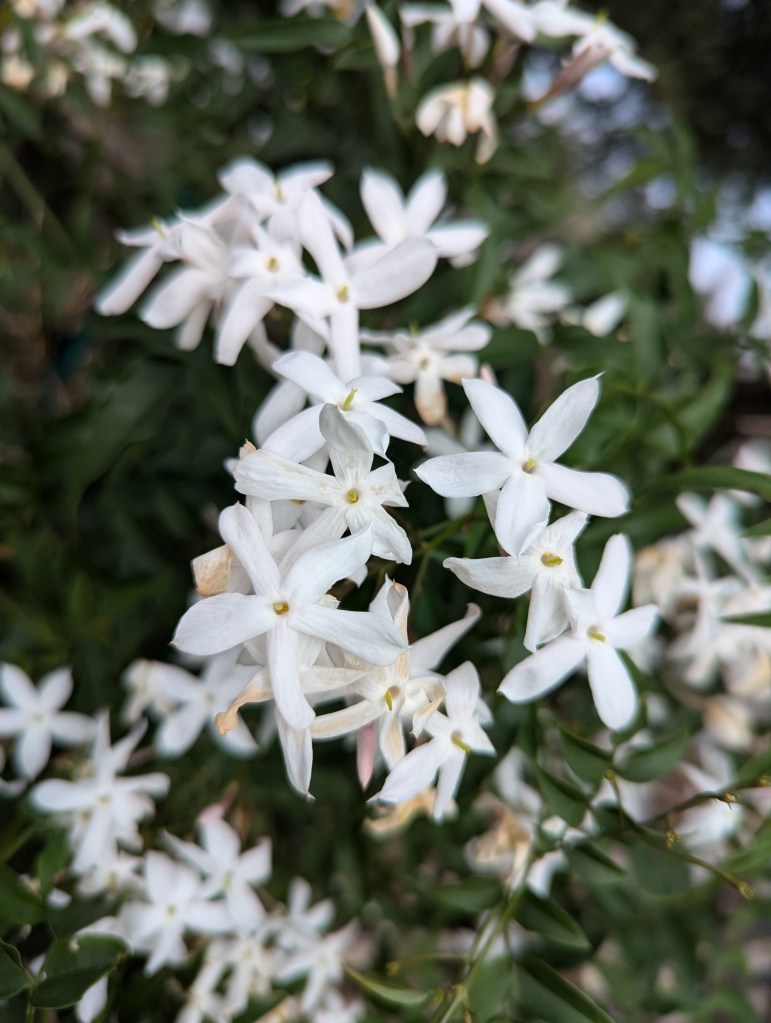
pink jasmine, Jasminum polyanthum

Brent and I studied horticulture through the second half of the 1980s at California Polytechnic State University at San Luis Obispo, which is known more simply as Cal Poly. San Luis Obispo is exactly halfway between where each of us came from. He came from the region west of Los Angeles, two hundred miles to the southeast, which is considered to be south by the standards of California. I came from the region west of San Jose, two hundred miles to the northwest, which is considered to be north by the standards of California. He considered San Luis Obispo to be within Northern California. I considered it to be within Southern California. Consequently, when either of us encountered a species with which we lacked prior experience, we assumed it to be regionally popular within the respectively unfamiliar half of California. Such assumptions were accurate for some species. For example, Brent was as fascinated with redwoods as I was with desert fan palms. He knew that redwoods are more popular here than in Southern California, and eventually went to experience them growing wild within their native range near Santa Cruz. I knew that desert fan palms are more popular in Southern California than here, and eventually went to experience them growing wild within their native range near Palm Springs. Pink jasmine, Jasminum polyanthum, was an odd one. Because Brent had never encountered it before, he assumed that it had been popular in Northern California. Because I had never encountered it before, I assumed that it had been popular in Southern California. In actuality, it only became commonly available throughout California at about the time that we encountered it, so had previously been popular neither here nor there. Nonetheless, to Brent, it is still as northern as it is southern to me.

Mild Seasons

P00307K-2
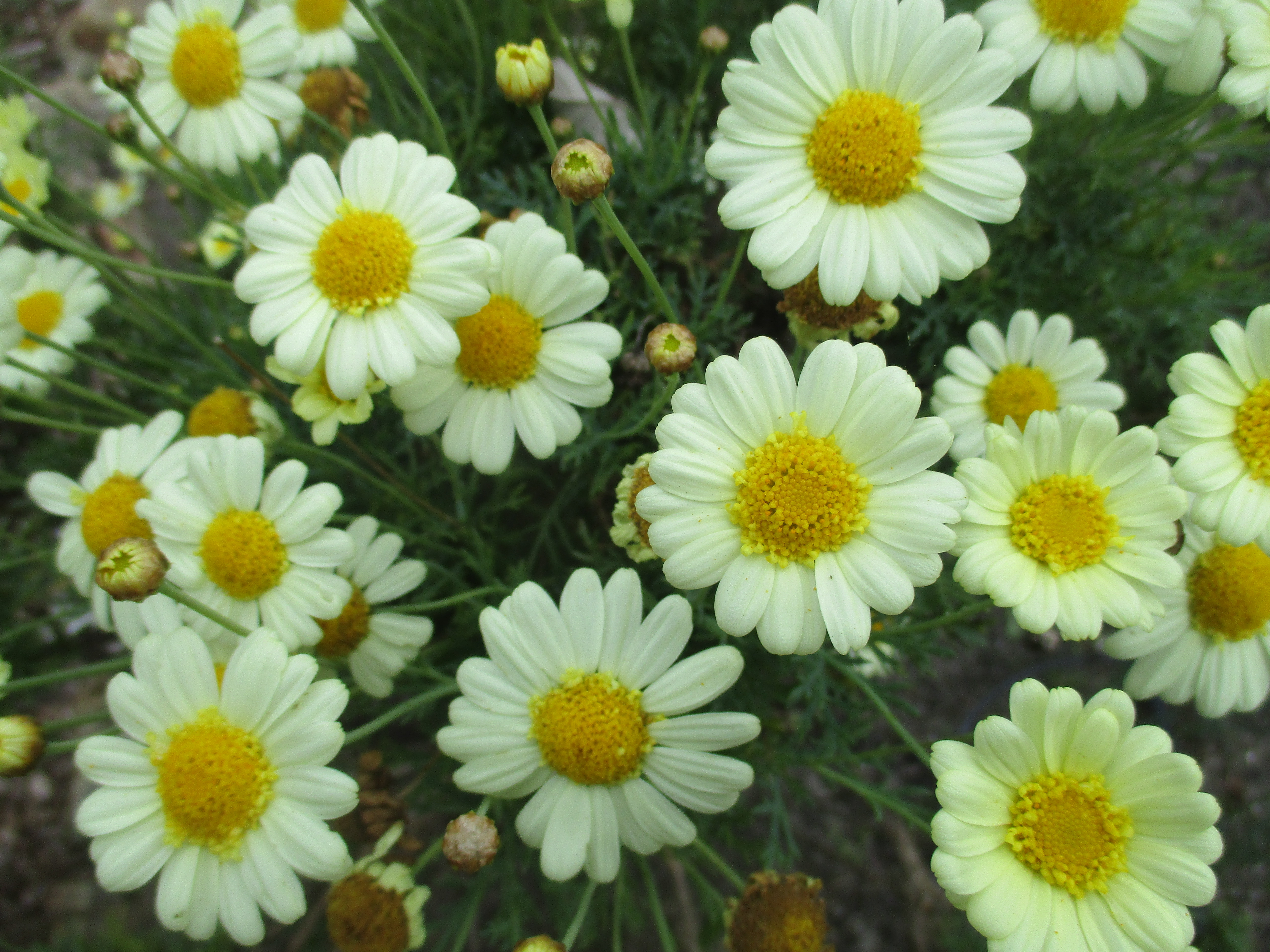
These daisies are rarely without some degree of bloom.

There is not as much difference between the seasons here like there is in other climates. It might seem like we get only summer, with a briefly cooler and slightly rainy time of ‘not summer’. I can recognize the changing of the seasons because I am familiar with them. Those acquainted with more normal climate mind find our subdued seasons to be rather boring, and restrictive.

People from climates with more extreme weather and more pronounced seasons might not expect mild weather and mild climate to be restrictive or limiting. They tend to notice what grows here that would not survive out in gardens through colder winters, such as bougainvilleas, tropical hibiscus and so many of the popular succulents. Even more tropicals survive farther south.

What they do not notice are what does not do so well here. Although stone fruit does remarkably well here, and many apples and pears are more than adequately productive, there are many cultivars of apple and pear that prefer more chill than they could get here. Lilac gets sufficient chill to bloom well here, but not enough to bloom as splendidly as it does in the Upper Midwest.

For example, some might be impressed by the perennial daisies that bloom sporadically whenever they want to throughout the year here. These daisies take no time off for winter, and are rarely damaged by frost every few years or so. They are so rarely without bloom that it is not often possible to shear off deteriorating bloom without removing some of the unbloomed buds.

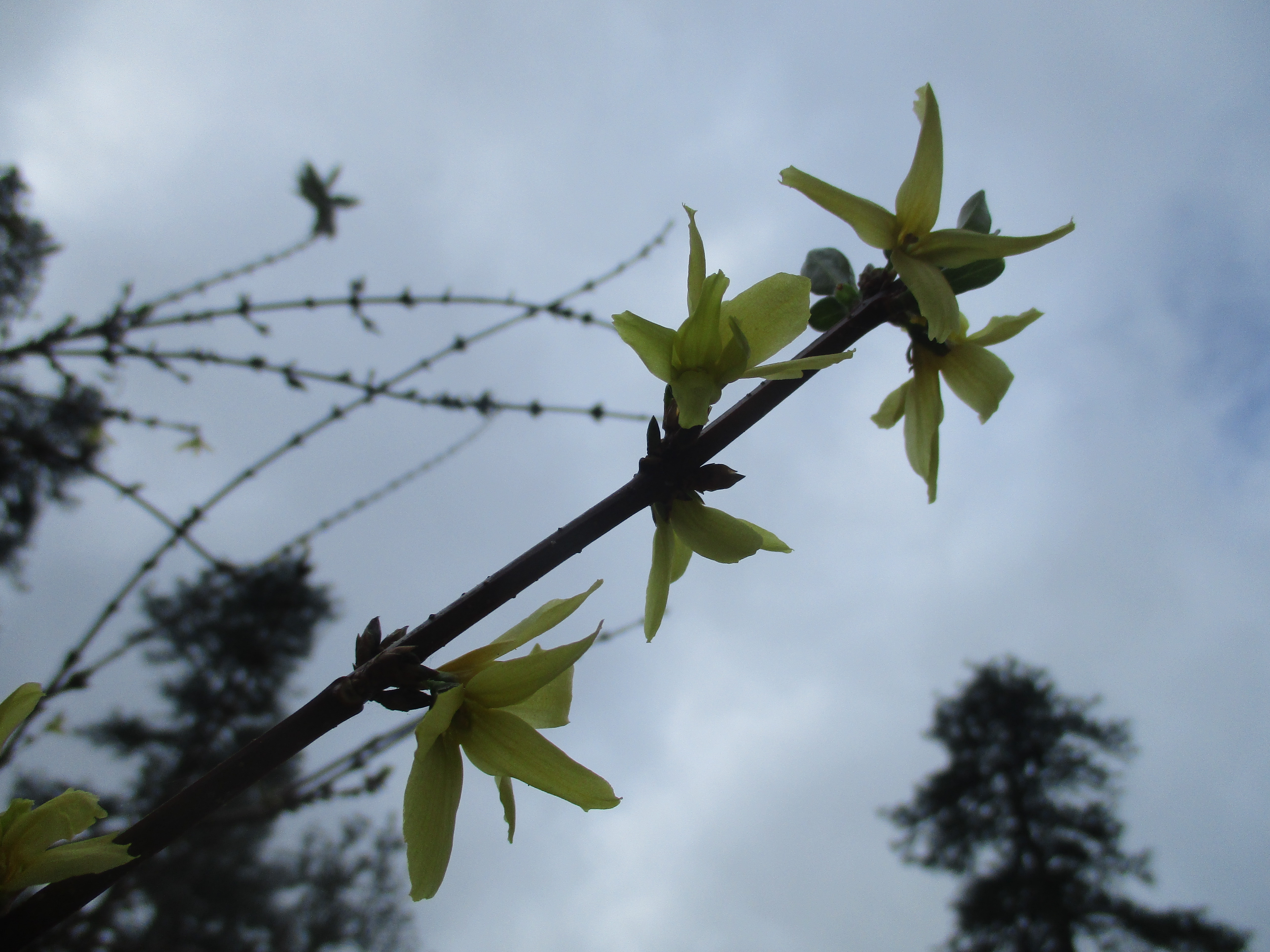
What goes unnoticed is the potentially subdued bloom of the forsythias, which are so reliably prolific where winters are cooler. Some are real duds this year, and all are blooming notably late. This is one of the consequences of a mild climate.

P00307K-1
Forsythia, with twigs that are still bare in the background, is not much to brag about.

Pink Trumpet Tree

P90615K

This is why I do not often use pictures that my colleague, Brent Green, sends to me. He frequently tells me what I should feature in my gardening column, and sends me what he considers to be good pictures for such topics. This picture would have been good for writing about the sky over Los Angeles, or the neighbors’ driveway, since those are two of the most prominent features here. Where did all the smog go?

Chimneys in Los Angeles seem silly to me. Even if the weather got cool enough for a fire in a fireplace, there is no firewood to burn. The chimney to the far right certainly seems to be original to the house, but how did it survive all the earthquakes since the house was built, probably in the 1940s or 1950s? There have been a few moderate earthquakes since then.

Those signs that warn potential criminals of non-existent home security systems are even sillier, and just cluttering otherwise nice landscapes. There is nothing official looking about them. There are bins of them for sale in the local big box stores. Shouldn’t we all assume that since the home on the left is in Los Angeles, that it is outfitted with home security system that is more impressive than that silly, irrelevant and unwelcoming sign?

I would guess that what Brent really wanted to send a picture of was the big pink trumpet tree, Tabebuia heterophylla. After all, it does happen to be sort of in the middle of the picture. It really was spectacular while blooming late last winter. However, even if Brent had sent a good picture of it, I would not have featured it. Most of those who read my gardening column are not within regions where pink trumpet tree blooms like this.

Upgrade Today

P80624This is it; the big day. I will delay it no longer. I said that I would upgrade quite some time ago, but had not yet done so. https://tonytomeo.wordpress.com/2018/06/24/upgrade/

Will this upgrade improve anything? I really do not know. I tried to do a bit of research in regard to the advantages of an upgrade, and could find very little of the information that I was looking for. It seems to me that upgrading will initiate more work for me, but will not necessarily make my articles more accessible or appealing. I will need to make improvements to the presentation of my articles on my own. Upgrading makes these improvements possible, but does not execute improvements without my efforts and direction. Nor does it change the content to improve accuracy for a broader audience. My articles will still be half a year late-or-early for Australia and all other places in the Southern Hemisphere. Harsh summer heat and winter cold will still be topics that will be lacking merely because the climate here lacks such variables. Upgrading can do only so much.

After my minimal research, I determined that the most efficient means by which to determine if an upgrade would be beneficial is to try it.

Something should be done. The newspaper group that I started writing for nearly twenty years ago no longer features my gardening column. Other newspapers that feature it only do so occasionally. Some do it monthly. Some do it when space is available. One of the larger newspapers features it weekly, but only for their online version. It is not easy to justify writing my articles if they are not being distributed like they had been.

By the time you read this, the upgrade will have been initiated. We will see what happens.

25 Yrs

Fiercely Local

P80624There are two terms that I avoid using within the context of my writing:

1. SILICON VALLEY – The name of the main newspaper group that I had been writing for since 1998, almost twenty years ago, is the Silicon Valley Community Newspapers. As much as I enjoyed writing for the small local newspapers of the group, I hate the name. I find the term ‘Silicon Valley’ to be offensive. It exemplifies that which destroyed the idyllic culture and lifestyle of the Santa Clara Valley, which is also known as the Valley of Heart’s Delight. I have never written the term until now.

2. BLOG – It is the contraction of ‘web log’. The ‘log’ in ‘blog’ is not what bother me. It implies a chronological journal, perhaps documenting experiences that are relevant to a designated topic. It is the ‘b’, or more specifically, the ‘web’ in ‘blog’ that is the problem. It implies that information posted on a ‘blog’ gets shared on the World Wide Web. The reason that I avoided sharing my gardening article on the World Wide Web for so long is that they are written very specifically for the Santa Clara Valley. Although some of them are rather universal to gardening, and some are relevant to regions with similar climates and soils, some are not relevant and perhaps inaccurate for other regions.

My gardening column started with the Silicon Valley Community Newspapers, which at that time was ‘fiercely local’. I always thought that was an odd term, but it makes sense. It means that each of the local newspapers features news that is relevant to their specified local communities. Los Gatos Weekly Times was for the news of Los Gatos. Saratoga News was for the news of Saratoga, and so on. When I started writing my gardening column, I wrote about gardening within our local climate and local soils. I could write about local gardening events and even the weather it it happened to be particularly relevant to gardening at the time.

As the gardening column was added to other newspapers in other regions, I was no longer able to write about local events or weather. I was very fortunate early on that all of the newspapers that used the column happened to be within the same climate zones. However, when it was added to the Canyon News of Beverly Hills (in the region of Los Angeles), and a bit later to the related San Francisco News, it became necessary to modify some of the articles to accommodate for differences of climate. Articles that were universally applicable needed no modification. However, those that were too specific to our local climate needed to be edited for the other two climates. For example, when writing about bare root fruit trees, I deleted discussion of apple and pear trees from the copy of the article that was sent to the Canyon News, and replaced it with discussion of bare root plants that are popular and appropriate in that particular region.

Over the years, I realized that my articles became too available online. Not only were they posted within the context of the online versions of the newspapers that had access to it, but they could be inadvertently opened from other related online newspaper . . . or just about anywhere. Someone in Oklahoma, Pennsylvania, Australia or anywhere in the World could click onto one of my articles just as easily as a local article, and could do so without knowing that it was written for a completely different climate or hemisphere!

I explain in my ‘About’ section that the articles are written for the Santa Clara Valley, but I doubt that means much to those who find the articled without seeing that explanation. I will continue to write my article for the newspapers that still use them, and will continue to post those articles, as well as ‘elaborations’ articles on my ‘blog’. Like so many other gardening articles that are out there nowadays, they will be inaccurate for some regions. Those reading them will need to use their own discretion.

What is sad about all this is that I started writing my garden column precisely because I was so frustrated with what was being published in the San Jose Mercury News at the time. It was typically written quite well, and by professional writers, but was very often very inaccurate because those writing it were either writing for other regions, or simply knew nothing about horticulture. I was so pleased with the opportunity to write accurate information about gardening for our region. Yet, after all these years, I feel like I am now doing exactly what I found to be so frustrating twenty years ago.
Upgrade

P80624.jpgThis autumn, it would have been twenty years that I have been writing my weekly gardening column for the Silicon Valley Community Newspapers, affectionately known as SVCN. It would have been excellent if it had lasted that long, but it was discontinued a few months ago. There was no warning, although we all know the direction that such media is going nowadays, and that such changes are abrupt. Nothing is like it was nearly twenty years ago.

My weekly gardening columns will continue for the other newspapers that still use it, even if they do not use it for their print versions. Again, due to the way such media operates nowadays, I have no idea of which newspapers who have access to it actually use it, or if they use it for their print versions or merely their online versions.

I could elaborate on the history of my garden column and its inclusion into the various other newspapers that continue to use it, but that can just as easily be another topic for another time. Perhaps I will merely put a bit of that information in my ‘About’ section if I ever get around to updating it. I have another topic to discuss now.

I would like to upgrade this blog. I would like to make it as fancy and user-friendly as some of the other blogs that are out there. I know that the last thing I need right now is more work, but I also want to maintain this as an venue for my weekly gardening column, particularly if other newspapers are likely to discontinue using it in the future.

Upgrading will include selling add space, or at least making add space available to advertisers who can use it. Newspapers pay very minimally for my weekly gardening column, and the newspaper group that payed the most for it no longer uses it. Advertisements might help to justify the work that goes into writing a new gardening article weekly. Hopefully, no one will be to bothered by these changes. I have enjoyed writing my weekly gardening column for almost twenty years, and would like to be able to continue doing so for a while longer.