Only riparian and aquatic vegetation tolerates sustained soil saturation. Chilean rhubarb, Gunnera tinctoria, almost qualifies as such. It enjoys such generous irrigation that it may perform well on a bank of a pond or stream. However, it should be sufficiently high on its bank to avoid constant saturation. Otherwise, it can rot, likely during its winter dormancy.
Chilean rhubarb is a spectacular foliar plants. Its humongous lobed leaves may grow six feet wide and eight feet tall. Although they succumb to mild frost, they regenerate quickly from rhizomes for spring. Leaves and petioles have a rather raspy texture, with small soft spines. Odd conical floral spikes that bloom about now might grow nearly three feet high.
Although not related to real rhubarb, Chilean rhubarb is as edible as its name implies. Its big petioles only need peeling to remove the raspy exteriors. Locally, Chilean rhubarb is more of a striking ornamental perennial. It is as appropriate to woodsy gardens as it is to sleek modern gardens. The absence of its bold foliage for winter is the main disincentive for its usage.
There are too many bridges to count here. Several roads and trails, and a historic narrow gauge railroad cross over two creeks and two streams within a relatively confined area. This particular suspension bridge is for a hiking trail that crosses over Zayante Creek at the downstream edge of its confluence with Bean Creek. Bean Creek, which is to the upper right in the picture below, flows through the farm on the outskirts of Scotts Valley. Zayante Creek, which is to the left in the picture below, flows through my neighborhood on the outskirts of Los Gatos. Ferndell Creek, which is just a stream from a nearby spring, also flows into this same confluence, but is not visible to the right of the picture below.
All of these creeks and streams sustain even more diverse ecosystems than those of the redwood forests above, and the chaparral pine forests a bit father above. Redwoods grow like weeds here. The redwood in the picture below is what is known as a ‘virgin’ because it was not harvested for lumber when most others were clear cut harvested to sustain development of the San Francisco Bay Area, and to rebuild San Francisco after the Great Earthquake and Fire in 1906. It was most likely rejected because it was too small to bother with at the time. Only a century later, it is massive! The cables that are now embedded into its bark formerly supported an older suspension that the newer bridge replaced many years ago. Although redwoods are not necessarily a riparian species, and can actually be resilient to drought, they do enjoy this abundance of moisture. The many other trees that inhabit these ecosystems with them grow very tall to compete for sunlight, and in some situations are excluded by their dense growth.
Western cottonwood is better in the wild than within refined gardens.
The brilliantly clear yellow autumn color of Western cottonwood, Populus fremontii, is best in the higher elevations and inland areas of its extensive range, which spreads from the coast of California to the Rocky Mountains and as far south as Mexico. Although it thrives in local riparian areas, particularly Coyote Creek and Guadalupe River, mild temperatures in both summer and winter do not allow it to get as colorful as it does in Nevada. It is almost never planted intentionally, but has a sneaky way of sometimes growing from seed in well watered gardens.
The bad news is that Western cottonwood grows big, fast and aggressively. The shallow roots displace pavement, compete with other desirable plants and damage septic and drainage systems. Large trees produce an abundance of annoyingly fuzzy seeds that adhere to anything. After causing so much damage, Western cottonwoods survive only a few decades, leaving big deteriorating carcasses that need to be removed before collapsing. Consequently, Western cottonwood is really suitable only for large open areas or in the wild.
Mature trees can be more than fifty feet tall and more than half as broad. Their somewhat thick leaves are almost triangular, with paired angular lobes on the sides and blunt tips. ‘Nevada’ is a male cultivar that does not produce fuzzy seeds.
Kurt Cobain was here. So was I. That is how I got this picture of this English holly in this awkward situation within Kurt Cobain Memorial Park, on the muddy banks of the Wishkah River. I wrote about other pictures from there at my other presently discontinued blog, ‘Felton League’, a bit more than a year and a half ago. This particular picture was omitted because it was irrelevant to that particular post. It is more relevant to this horticultural blog.
‘From the Muddy Banks of the Wishkah’ is, incidentally, the second album that the band Nirvana recorded without Kurt Cobain.
English holly is more naturalized on the muddy banks of the Wishkah River and throughout coastal regions of the Pacific Northwest than it is here. There are not many ecosystems that it can not migrate into there. Here, it can infest only ecosystems that retain sufficient moisture through summer to sustain it, such as riparian or coastal ecosystems. Even within such ecosystems, it would not likely survive on top of a piling such as this specimen.
Some of the most prominent vegetation of the coastal ecosystems of the Pacific Northwest is surprisingly similar to vegetation here. Douglas fir, which is sporadically native here, is the most prominent species within the forests there. Bigleaf maple is likewise more common there than here. Naturalized Himalayan blackberry is even more common and more wicked there!
However, to me, the entire region seemed to be riparian. Nothing was far from some sort of waterway. I encountered nothing that resembled a familiar chaparral ecosystem. Someone who is more familiar with the region could distinguish between the various local ecosystems. I should be more observant about the diversity of the ecosystems and their associated vegetation, both native and exotic, when I return late next winter.
Sweet flag is a riparian perennial that performs well in saturated soil.
After many centuries of being grown for use in herbal medicine, sweet flag, Acorus gramineus, is still a popular evergreen perennial; but is now appreciated more for its low mounds of grassy foliage. ‘Ogon’, one of the most popular cultivars, has light yellow variegated foliage that contrasts well with deep green foliage, or brightens partially shaded spots in the garden. Individual clumps grow quickly to about eight inches tall and broad, and then spread slowly by producing more shoots. New plants are easily propagated by division. Sweet flag likes plenty of water, and does well in partially submerged pots in koi ponds, or poorly drained spots.
The biggest lawn where I work for part of the week was formerly a pond. It was installed above an extensive drainage system to compensate for the natural saturation of the soil. A relatively small pond remains at the lowest corner of the large lawn to contain some of the runoff, which gets pumped back onto the lawn for irritation. However, this pond had drained and became overwhelmed by vegetation many years ago. Only recently, after the removal of the overwhelming vegetation, the pond was restored by the simple closure of its drainage gate. It is developing into a different sort of riparian ecosystem from what it was for the past several years, which was different from what it was before that.
1. Cattail and Himalayan blackberry overwhelmed this area many years ago. We knew it as the corn dog orchard because of the cattail bloom. This is what remains of the cattail.
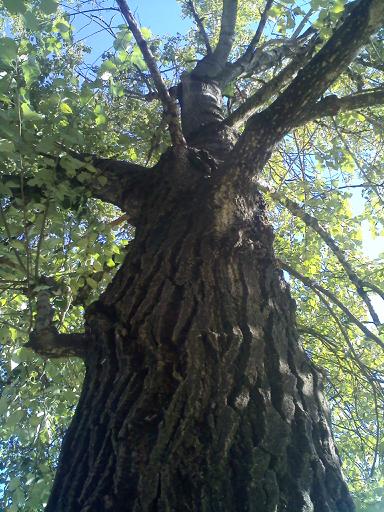
2. Cottonwood appeared several years ago. They grew in a small grove of several slender trunks, perhaps from a single root system of a primary tree. These two are flooded now.
3. Knotweed proliferated on the margin of the newly flooded pond. Some got submerged where it grew while the water was lower. I hope that it dies like the submerged bramble.
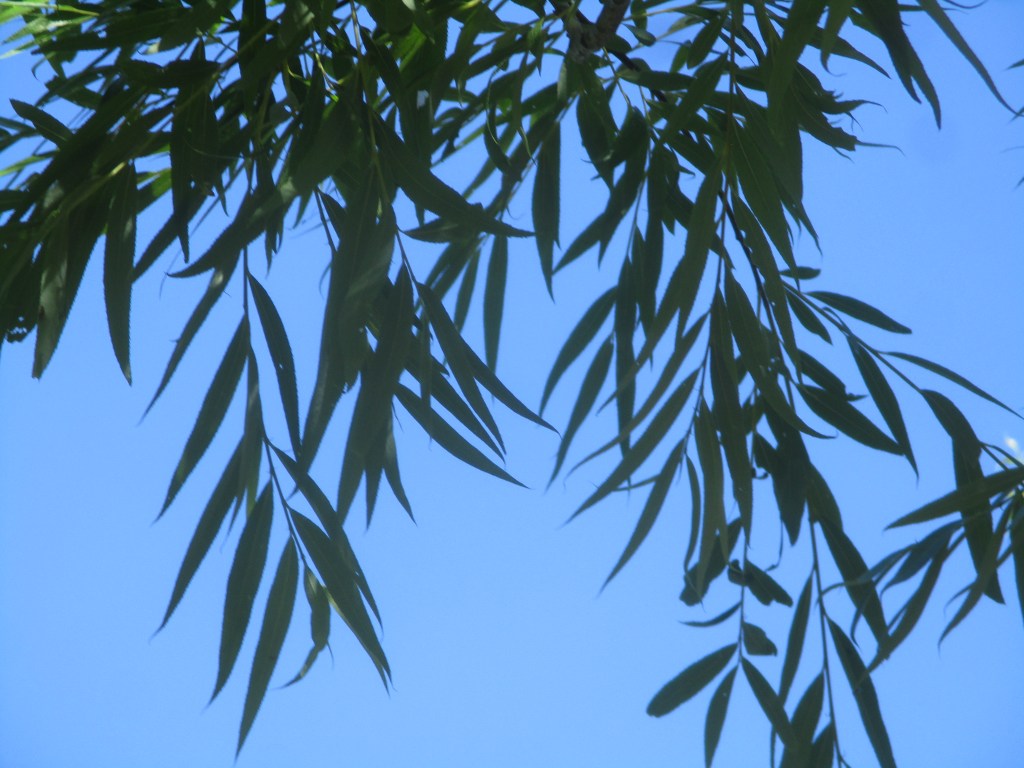
4. Weeping willow enjoys the swampy situation here. The newly flooded pond might not bother it much. The soil is naturally saturated within a minimal depth from the surface.
5. Water lily seems happy here too, although one of the six that were installed is missing. One specimen has about twenty leaves. I could not take a picture of it without reflection.
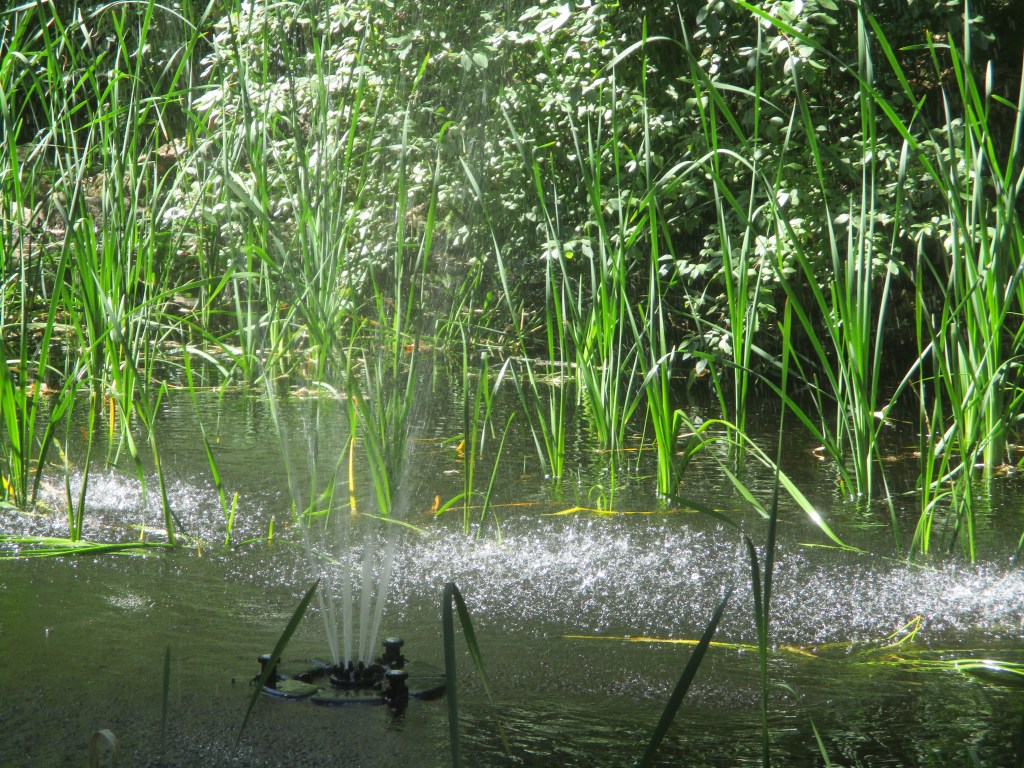
6. Fountains are supposed to dissuade proliferation of mosquitoes. I do now know what to think of it. Everyone else (except mosquitoes) likes it though. That is more important.
Ferns are an odd group. They lack the color or fragrance of flowers, or the branch structure of shrubbery, trees or vines. Very few turn color in autumn. They provide only green foliage. Yet, as simple as this seems, the generally evergreen foliage that ferns provide is some of the most distinctive foliage that can be found in the garden.
With few exceptions, ferns are richly deep green. Only a few are lighter green or almost yellowish. The leaves, which are known as ‘fronds’, can be soft and papery, or coarse and tough. The fronds of most ferns are pinnately divided into neatly arranged leaflets; and many ferns have leaflets that are intricately lobed. Some ferns have leaves with more palmate symmetry. A few ferns actually have undivided leaves.
(Pinnate symmetry involves a central midrib or midvein to each leaf, or a central rachis that supports lateral leaflets. Radial symmetry involves multiple midveins or rachi that radiate outward from the centers of individual leaves.)
The Australian tree fern is the largest of the common ferns. It develops a broad canopy of long fronds on top of a trunk that can launch it as high as a two story home. Both the fronds and trunk of the Tasmanian tree fern are shorter and stouter. Other tree ferns are rare. The trunks are not really stems, but are thick accumulations of roots dispersed through decomposed stem tissue.
The staghorn fern is an epiphyte that naturally clings (nonparasitically) to trunks and limbs of trees. The flared upper fronds collect foliar litter that falls from the trees above to sustain the roots within. In home gardens, it is popularly grown on wooden plaques or hung like hanging potted plants, but without a pot.
Some ferns can be grown as houseplants like the classic Boston fern, which cascades softly from a hanging pot. Maidenhair fern is popular for intricate foliage on wiry rachi (leaf stems). Squirrel foot fern has lacy foliage and interestingly fuzzy rhizomes that creep over the edge of a pot.
Since almost all ferns are understory plants that naturally live on or near a forest floor below a higher canopy of trees, they are generally quite tolerant of shade. In fact, most prefer at least some sort of partial shade. This is quite an advantage for spots in the garden that are too shady for other plants. Also, many ferns can disperse their roots into soil that is already occupied by more substantial plants, even if the more substantial plants happen to also be making the particular spot too shady for other plants. In other words, they play well with others.
However, many ferns are more demanding than other plants are in regard to soil quality and watering. They perform best with rich and well drained soil, and regular watering. Sickly ferns generally respond well to fertilizer; but too much fertilizer can burn foliage. Old leaves may need to be groomed out if they do not naturally get overwhelmed by new foliage.
Brent Green, my colleague down south, is a renowned landscape designer of the Los Angeles region. His landscapes are spectacular. You might not know it by all the mean things I say about Brent and his work, but his clients know otherwise. He makes the outdoor spaces around their urban homes seem like they are in serene and thickly forested jungles hundreds of miles away.
Well, . . . generally. That is what the landscapes look like to me. Some clients prefer simpler or sunnier gardens. What I often perceive as superfluous vegetation is there to obscure adjacent residences or other undesirable scenery. It is not as if neighboring residences are unsightly. They are obscured merely to provide privacy and a sense of solitude in a very crowded region.
While designing a landscape that is appealing to the senses, it is helpful to eliminate or at least obscure some of what is unappealing. This applies to more than visual aspects. In some urban areas, ambient noise is a constant reminder of all the hectic chaos just outside of a landscape. Dense vegetation that obscures undesirable scenery muffles some or even most, but not all of it.
That is why Brent incorporates what he refers to as ‘water features’ into many of his landscapes. The noise of the splashing water partly obscures ambient noise. Because Brent’s home is just a block from the Santa Monica Freeway, there are four small ‘water features’ in the gardens! That is excessive of course, and more than what larger landscapes in quieter neighborhoods get.
These water features seem silly to me. I find the mostly monotonous noise of the Santa Monica Freeway to be no more annoying than the sound of the splashing water. I might appreciate water features more if they did my laundry. However, there are a few water features where I work, even though ambient noise from the outside is rather minimal. There are no freeways.
Fern Dell Creek in the video above flows into the confluence where Bean Creek flows into Zayante Creek. Zayante Creek Flows into the San Lorenzo River just a short distance away. Two Redwood Springs Creeks, which are comparable to Fern Dell Creek, flow into Bean Creek just a short distance upstream from the confluence with Zayante Creek. All this water can get noisy.
Fern Dell Creek and the two Redwood Springs Creeks are short streams that flow from springs, so their minimal flow does not fluctuate much at all, even after heavy rain. Bean Creek and Zayante Creek have more substantial watersheds and carry significantly more water, especially after heavy or prolonged rain. Unlike Brent’s water features, we can not turn any of them off.






 Tony Tomeo