Florist Quality And Landscape Quality

Chrysanthemums are available out of season.

Roses from a home garden are not quite the same as roses from a florist or market. They mostly bloom on stems that are relatively thinner and shorter. Floral and foliar blemishes are more likely. As they unfurl, they can get a bit wider and disperse more fragrance. One of the more obvious differences is their seasonality. They are unavailable through winter.

Florist roses are likewise different from garden roses. They are not as limited by season, so are available at any time of year. Their elegantly straighter stems are relatively longer and a bit heftier. Blemishes are rare. Buds are generally plumper and likely to last longer, but may not unfurl completely. They are typically relatively narrow and a bit less fragrant.

Environmental factors cause most of the differences. Home garden roses develop with a relatively natural exposure to weather. Florist roses develop within synthetic greenhouse environments without natural weather. However, genetics cause some of the differences. Florist roses are not the same cultivars that are available from nurseries for landscaping.

The same applies to several florist quality potted plants. They also grow within unnatural environments. They also are cultivars that perform well for their specific purpose. Some cultivars are impractical for landscapes. Some take quite a while to adapt to landscapes. Many that are seasonally popular for particular Holidays may not last for long afterward.

Most azaleas and hydrangeas are landscape cultivars. Some are florist cultivars though. Landscape cultivars that grew outside in nurseries adapt efficiently to landscapes. Florist cultivars that grew in greenhouses take more time or may not adapt. Those that do might bloom with lavishly large florist type flowers. Such bloom may not be resilient to weather.

Several cultivars of florist carnations and chrysanthemums are also landscape cultivars. Florist lilies are the same that are seasonally available as dormant bulbs from nurseries. Adaptation to a garden can be stressful, especially for those that bloomed out of season. However, once they adapt, they might perform for several years as short term perennials.

Six on Saturday: No Rhododendrons

Rhody’s rhodies were spectacular in bloom. This year, I refrained from posting too many pictures of them by posting none at all. I thought that I might get a few at the end of the season; but now find that the few that remain are either shabby or difficult to get a good picture of. There is plenty of other bloom though, even without exploitation of the warm season annuals. Now that daylilies are blooming, they will continue until autumn. Roses continue at least as late, but bloom in phases since most are partially shaded. All but one of these six species were recycled, although one was recycled by remaining where it was.

1. Daylily is not actually a lily. With all the bickering amongst botanists, its classification remains vague. This surplus from thinning a congested colony now borders the iris bed.

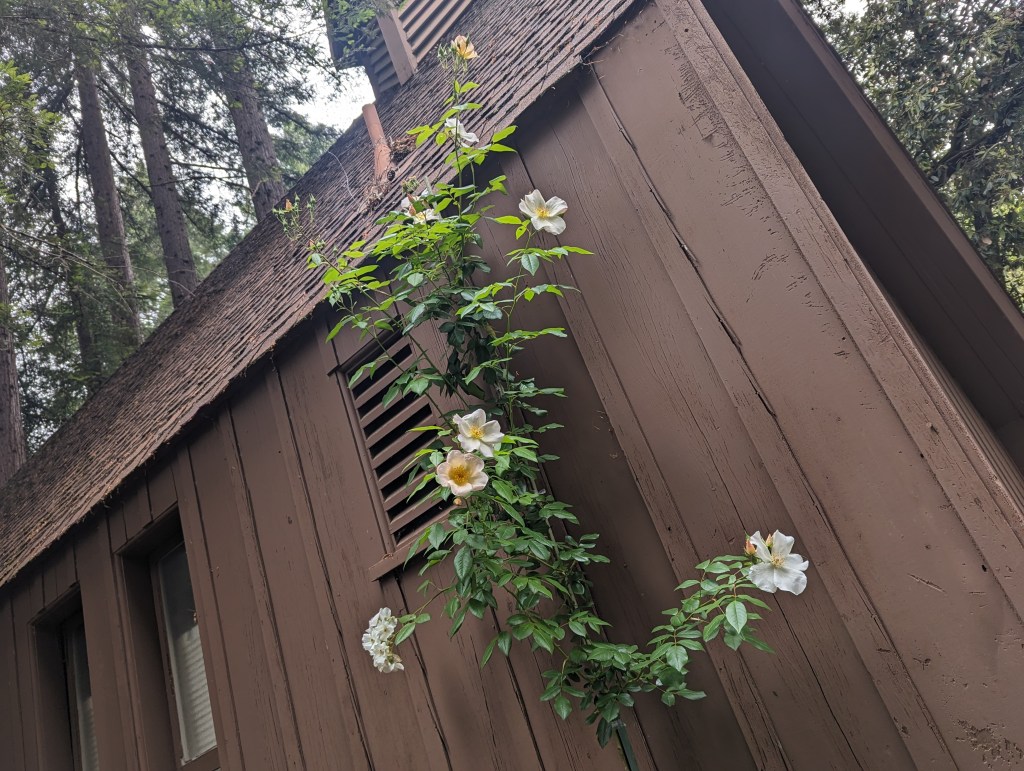
2. White climbing rose that was removed from the garden of a renovated cabin has been relocated to el Catedral de Santa Clara de Los Gatos, where merely white flowers bloom.

3. Rose lily that was plumply budded for Six on Saturday two weeks ago is now finishing. It recycled itself from a previous froufrou garden as the rose garden was installed over it.

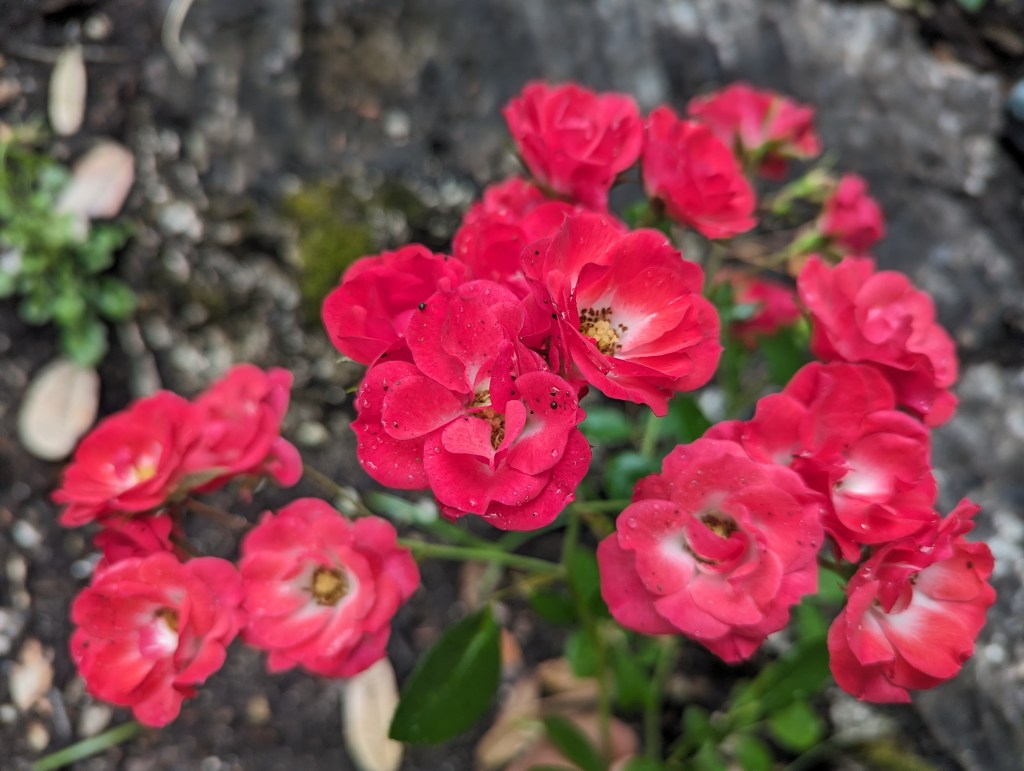
4. Carpet rose was originally too close to a walkway, so was relocated to a wide roadside embankment. I am none too keen on carpet rose, but it is appropriate for its application.

5. Easter lily that was left from a wedding at el Catedral de Santa Clara de Los Gatos was added to the perennials across the road, but could have remained with the white flowers.

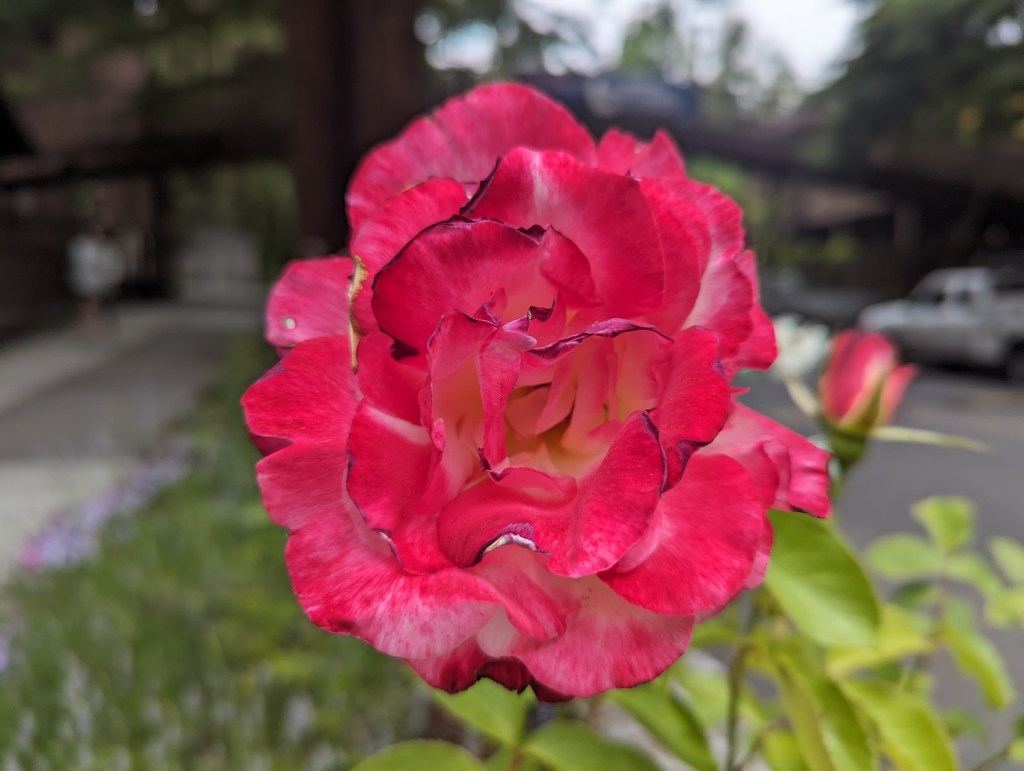
6. Unidentified hybrid tea rose, which had the color but not the form of ‘Double Delight’ before it began to fade, blooms in the rose garden, which was installed over the rose lily.

This is the link for Six on Saturday, for anyone else who would like to participate: https://thepropagatorblog.wordpress.com/2017/09/18/six-on-saturday-a-participant-guide/

Volunteering at the San Jose Heritage Rose Garden

The San Jose Heritage Rose Garden is the most complete collection of ancestral roses in the World!

(This article is recycled from several years ago, so information about events is now outdated.)

            No matter how careful I am to avoid spending any money at Spring in Guadalupe Gardens, I have never escaped without purchasing something, or a few or even several somethings that I did not need but really wanted for my garden. My plunder was relatively meager this year, but did include three climbing roses from Liggett’s Rose Nursery.

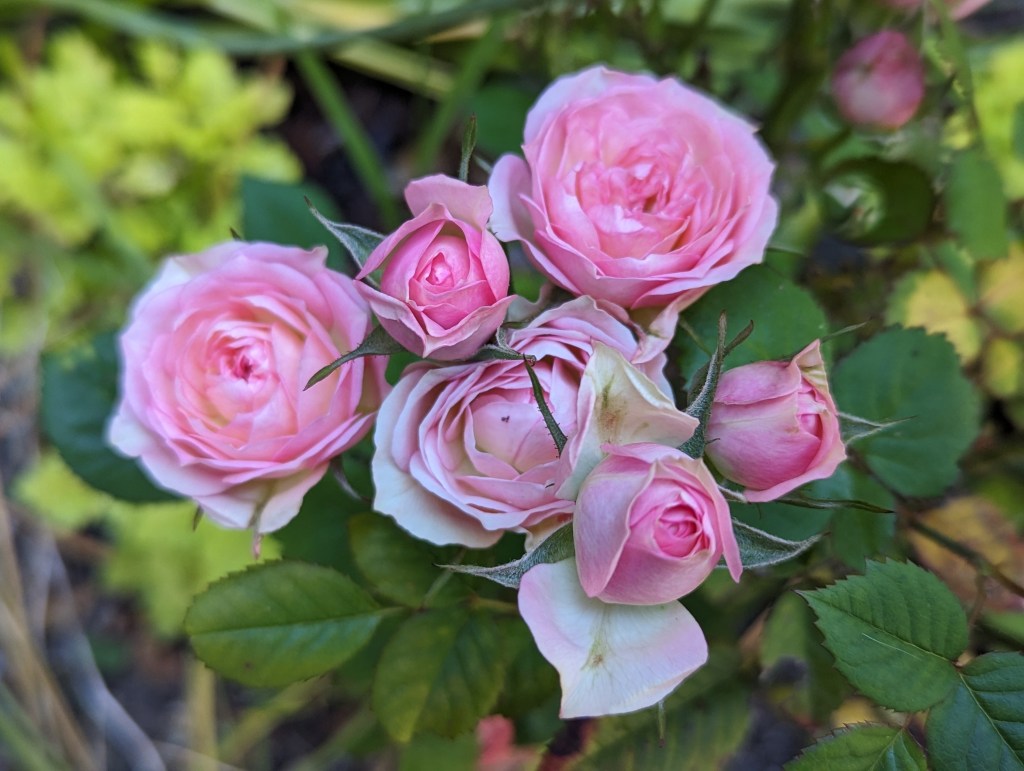
            One is a ‘Renae’ rose that blooms all summer with remarkably fragrant pale pink blooms. Its fragrance is so obnoxiously strong though; that I gave the plant to my neighbor, and told him that it ‘smells good’. It really does smell good, albeit from a distance, such as in my garden.

            The other two roses are ‘Lamarque’, with abundant fluffy white blossoms all summer. The robust fragrance is fortunately more tolerable. I really like the monstrous canes that are already reaching out to cover a bare embankment.

            The two ‘Lamarque’ roses are manageable so far. I really do not know how manageable they will be next year though. It would be nice if they could go wild, and only get pruned as they encroach into trees and the driveway. However, roses perform best if properly maintained. I will want to be able to prune off deteriorating flowers to promote subsequent bloom. This process of ‘dead heading’ will not be so easy if I can not reach all the canes.

            The Heritage Rose Garden has a similar challenge. Although most of the plants are within reach of anyone wanting to prune them, there are simply too many plants for a herd of goats to remove all the spent blooms from. Since goats are not such a feasible option in a rose garden, volunteers are invited to attend a Rose Deadheading Blitz from 5:00 to 7:30 p.m. every second Tuesday of each month, beginning June 8 and continuing until September 7.  

            No experience is needed, either for deadheading the roses or for swilling the ice cream served afterward. Volunteers should bring shears and gloves, and wear closed-toe shoes. Shears are available from the staff if necessary. 

            The Heritage Rose Garden is located on Taylor Street at Spring Street, just east of Coleman Avenue in San Jose. Volunteers can get more information or sign up by contacting Volunteer Coordinator, Lucy Perez by telephone at 298 7657 or by email at lperez@grpg.org

            My bounty from Spring in Guadalupe Gardens of past years includes many succulents, particularly a few specie of Crassula that were frozen by frost early last winter. Their recovery has been delayed by the lingering cool and rainy weather through spring. Now that I am removing the last of the sludge that remains from the previously frozen leaves and stems, I am finding where snails have been hiding and breeding. Even though the sludge is harmless, the snails within are not. I probably should have cleaned it out earlier.

            Foliage of fruit trees, roses or other plants that has been infected with peach leaf curl, powdery mildew or any other disease should likewise be removed and disposed of. Either next spring or later this year, secondary infection is much more likely without sanitation.

Six on Saturday: Crosswalk

A crosswalk connects a rose garden at work to a fancy perennial and annual bed across a narrow road. As much as I would like to maintain certain standards within both of these two distinct gardens, neither is perfect. Each is inhabited by something that should be of the other. One stays because of its justification for being there. The other stays because I can not easily separate it from the roots of what moved in over it, and because we sort of like it there now. Anyway, I added another picture from Arizona a month ago, and one of Brent’s useless pictures, just because they are too pretty to discard without sharing here.

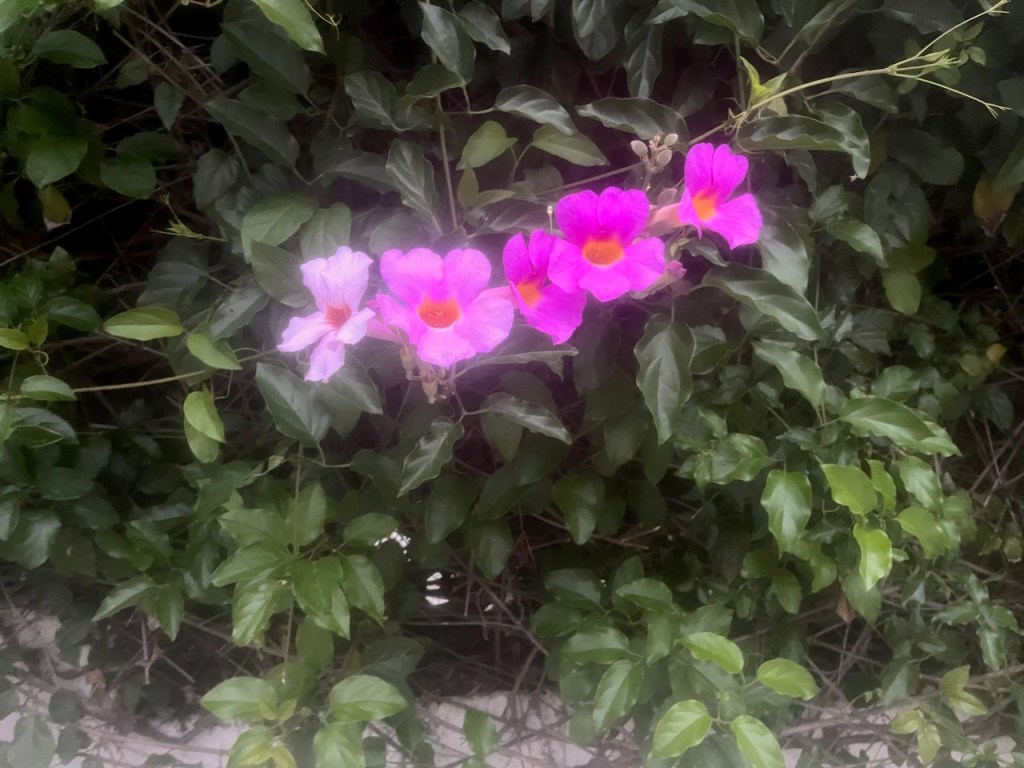
1. Distictis riversii, royal trumpet vine demonstrates that, no matter how much he wants to get one of his pictures into his local Canyon News, Brent does not provide a good one.

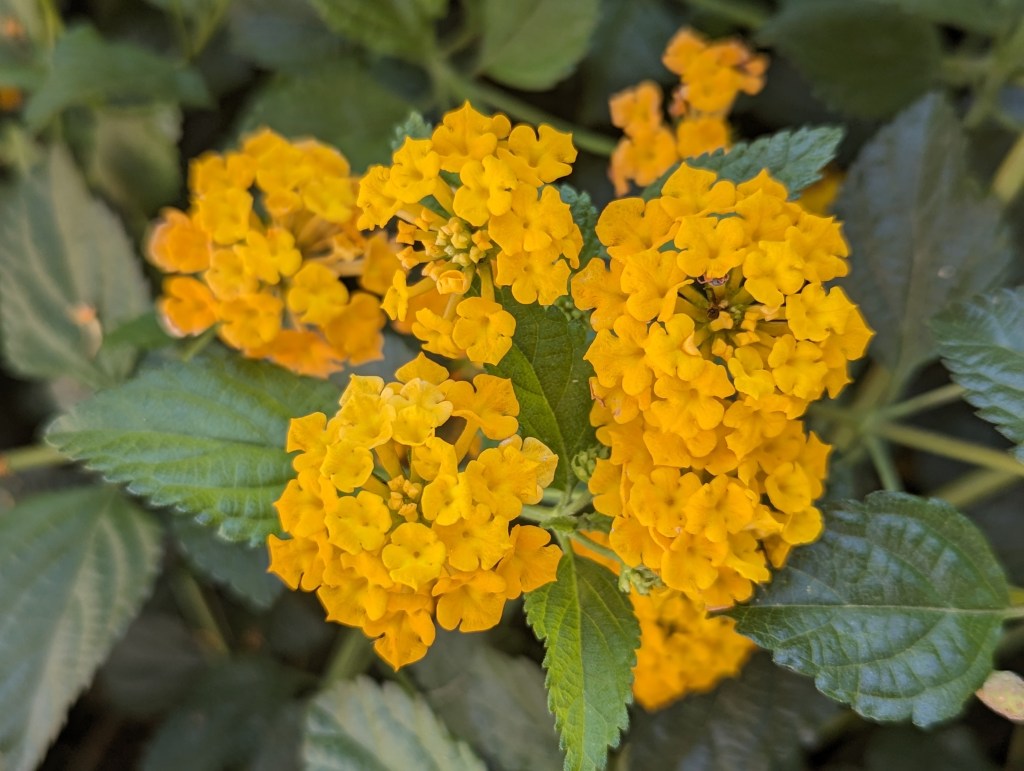
2. Lantana camara, which is known simply as lantana, bloomed within the same garden as the orange cultivar of last Saturday; so this picture is from a month ago near Phoenix.

3. Rosa, which is an unidentified miniature rose, is designated as the lily rose because of its stubborn occupancy of a former lily colony within a garish perennial and annual bed.

4. Although pretty, it really should be in the rose garden across the road. I can not move it over there, because of its sentimental significance for the person who installed it here.

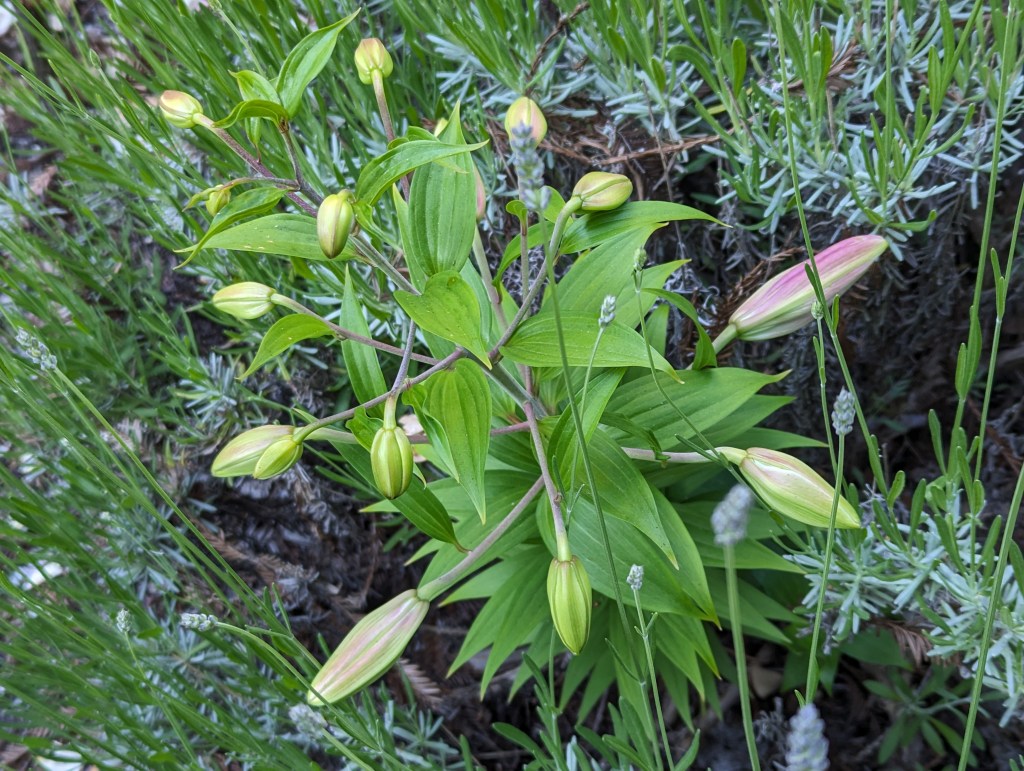
5. Lilium, which is an unidentified Oriental lily, is designated as the rose lily because of its stubborn occupancy of a former perennial and annual bed that is now a rose garden.

6. Although pretty in bloom, it really should be with this colony of abundant lilies, which I shared a picture of last Saturday, in a garish perennial and annual bed across the road.

This is the link for Six on Saturday, for anyone else who would like to participate: https://thepropagatorblog.wordpress.com/2017/09/18/six-on-saturday-a-participant-guide/

Spring in Guadalupe Gardens & Wildflower Show (2010)

(This article is from 2010, so contains irrelevantly outdated information.)

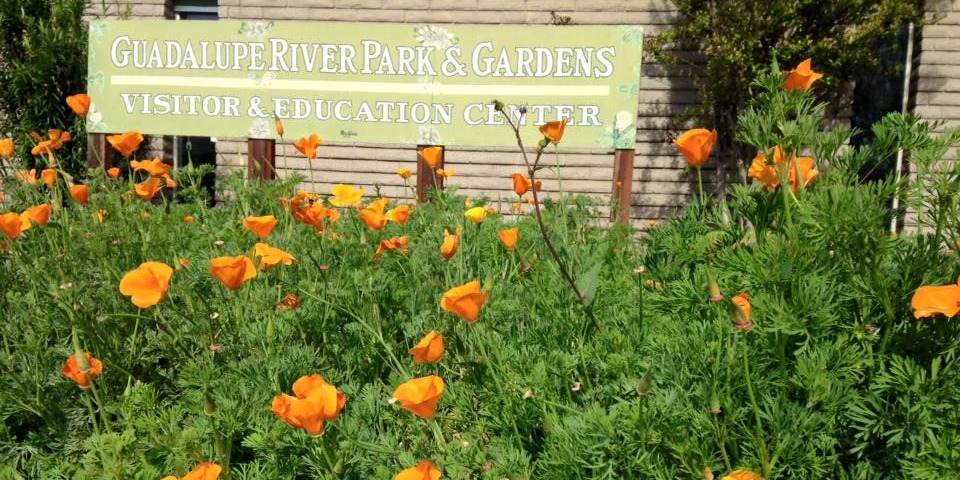
Now that the world renowned San Francisco Flower and Garden Show is over, it is time for an even more important horticultural event; Spring in Guadalupe Gardens, on April 24, between 10:00 a.m. and 3:00 p.m.. This celebration of Guadalupe Gardens, Earth Day and the Great Outdoors may not be as big and as fancy as some of those ‘other’ shows, but it is so much more important because it is local, centered around the Guadalupe Gardens Visitor and Education Center, which is located at 438 Coleman Avenue in San Jose.

My favorite part of Spring in Guadalupe Gardens is all the vendors of unusual plants. In past years, I found several fuchsias, aloes, cacti and weird tomato plants at Spring in Guadalupe Gardens. I never know what to expect until I get there. I hope to find unusual fig trees this year.

Spring in Guadalupe Gardens is also a great opportunity to meet with representatives of all sorts of gardening clubs. Gardening questions can be brought by the Master Gardeners of Santa Clara County’s Gardening Advice booth, where I will be working throughout the day. There will be workshops and lectures, music and entertainment, as well as fun activities for children.

Spring in Guadalupe Gardens happens to be at the same time as the peak of bloom in the Heritage Rose Garden, which is the largest public garden in the United States of America dedicated to the preservation of old roses. There will be tours in other gardens and trail walks too. If I did not need to work at the Gardening Advice booth, I would want to tour the Historic Orchard, which is literally a tree museum of the many fruit trees that once filled the vast orchards of the Santa Clara Valley.

Earth Care Recycling will host a free electronic waste drop off at the Visitor and Education Center to collect all sorts of computers, keyboards, monitors, televisions, stereos, radios, printers, fax machines, telephones, cell phones, DVD players and VCRs. (I thought mine was the last of the VCRs!) Proceeds benefit the Guadalupe River Park Conservancy.

Admission and parking are free. Just follow the signs from Coleman Avenue or West Taylor Street. More information about Spring in Guadalupe Gardens can be found at www.grpg.org or by telephoning 298 7657.

The unfortunate news about the Wildflower Show organized by the Santa Clara Valley Chapter of the California Native Plant Society and the Mission College Biological Sciences Department is that it will be at the same time (with another hour until 4:00 p.m.). The fortunate news is that it will continue the following day on April 25, so we all can attend both events! The Wildflower Show will be at Mission College in Santa Clara. Parking in lot C and admission are free.

More than four hundred specie of wildflowers and native plants will be displayed and accurately labeled. There will be free classes for native plant identification and wildflower gardening, and nature activities for children. Books, posters, seeds and note cards will be available for purchase. More information can be found at www.cnps-scv.org, or by telephoning 650 – 260 3450.

California Wild Rose

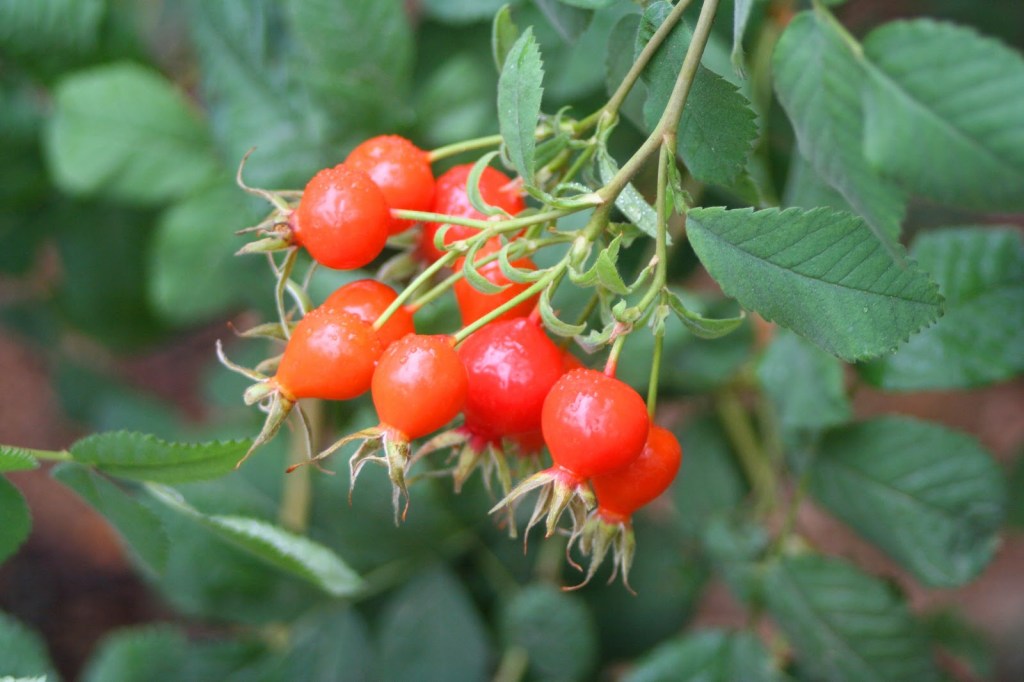
Even if bloom is not much to brag about, the rosehips can be pretty and useful.

Prickly thickets of California wild rose, Rosa californica, are not often much to look at, even while adorned with small and sparse pink roses in spring and summer. The fragrant flowers can actually range in color from white to rich pink, and may have more petals, but are not abundant enough to be very impressive at any one time. In autumn though, all the flowers that bloomed in the previous few months leave bright orange or red fruiting structures known as ‘hips’, that linger on the bare canes through winter.

The rose hips of California wild roses had historically been used to make herbal tea because they contain so much vitamin C and have a pleasant flavor. (California wild rose is a ‘tea’ rose but not a hybrid ‘T’ rose.) They can also be made into jelly or sauce. The only problem is that birds like them too, so often take them before anyone else has a chance to.

Modern Roses Require Dormant Pruning

Aggressive dormant pruning promotes spring and summer bloom.

(This recycled article posted in 2012, so some information within is now outdated.)

Just about anyone can plant roses in the garden, and care for them for at least the first year. Pruning them properly while they are dormant in winter in order to get them to perform satisfactorily every subsequent year is what most of us who grow roses have difficulty with. Like deciduous fruit trees, roses should not be planted and expected to perform with minimal attention. They certainly should not be pruned with hedge shears!

The once modern, but increasingly old-fashioned, hybrid T roses have traditionally been the most common victims of inadequate pruning, since they need such aggressive pruning every winter to prevent overgrowth that interferes with healthy cane growth and bloom. More modern cultivars (cultivated varieties) designed to resemble older roses, as well as reintroduced old fashioned roses are generally not so demanding, but likewise perform best with proper dormant pruning. There are slightly, and not so slightly, different ways to prune the different types of roses. Even the ‘low maintenance’ carpet roses should be pruned to some degree.

Fortunately for those of us who are just learning about roses, the first of several free rose pruning lessons in the San Jose Heritage Rose Garden began this morning, January 4. These hands-on lessons continue at 9:00 a.m. every Wednesday and Saturday until late February. Participants meet in the center of the Garden. The minimum age to attend is sixteen; but minors without parental supervision require a signed minor release form that can be obtained from the Guadalupe River Park Conservancy.

Participants should bring bypass shears, leather gloves, closed-toe shoes and preferably a water bottle. Those who lack shears or gloves can borrow what they need at the Garden. The Heritage Rose Garden is located on West Taylor Street near Walnut Street in San Jose. Parking can be found on Seymour, Taylor or Walnut Streets. More information can be obtained by email to Emily of the Guadalupe River Park Conservancy at emily@grpg.org  or by telephoning 298 7657.

The Heritage Rose Garden is the most complete collection of old world roses, the ancestors of modern roses, in the world! Although it lacks modern cultivars, it exhibits a remarkably extensive variety of roses, with all sorts of growth habits. There really is no other garden where one can prune roses with the same basic techniques in so many different ways.

Incidentally, modern hybrid T roses derive their designation from the ‘T budding’ technique employed to attach the scion (upper blooming portion) to the understock (roots), not because the rose hips (fruiting structures) are used to make tea. However, all sorts of roses, including floribundas, polyanthas, grandifloras and all sorts of climbing roses, are budded by the same means; and many hybrid T roses are actually grown on their own roots and not budded onto understock at all. The designation of hybrid T seems somewhat out dated, but is still effective.

Bareroot Season Begins With January

Bare roots are dormant for winter.

Christmas trees and associated items are no imposition for nurseries. They are seasonal while not much else is appealing to a retail market. They occupy retail area that summer and autumn commodities relinquished earlier. Then, they relinquish their same space as bareroot stock becomes seasonable. The chronology is very coincidentally very efficient.

Bareroot season is not actually contingent on the end of Christmas tree season. It begins with winter dormancy of bareroot stock. This dormancy merely and fortuitously coincides with Christmas. It is as effective as anesthesia for surgery. Basically, dormant stock goes to sleep on a farm, and awakens in a new home garden. Timing of the process is critical.

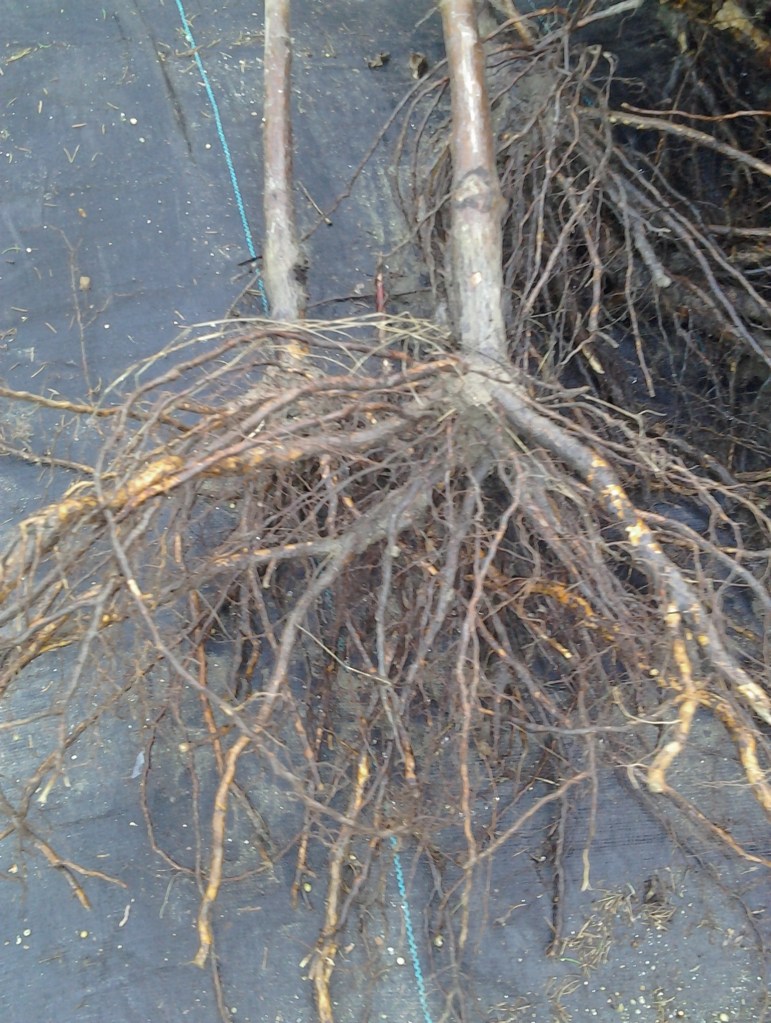
Bareroot stock initially grows in the ground rather than within nursery cans. Separation of its roots from the soil they grew is harmless during dormancy. Both roots and stems need simultaneous pruning. Then, stock is ready for transport without soil. Some gets packing of moist sawdust in plastic bags. Most awaits resale from bins of moist sand at nurseries.

Bareroot stock has several advantages to more familiar canned nursery stock. It is much less expensive. It is also much less cumbersome. So, not only are more items affordable, but also, more fit into a car at the nursery. Their relatively small roots systems are easy to install. More importantly, without binding, their new roots disperse much more efficiently.

Deciduous fruit trees are the most popular bareroot stock. This includes stone fruits such as apricot, cherry, plum, prune, peach and nectarine. Also, it includes pomme fruits such as apple, pear and quince. Roses and cane berries are likely the second most popular of bareroot stock. Persimmon, pomegranate, fig, mulberry, and nut trees are also available.

Some of the more unusual bareroot stock is available only from online catalogues. More variety seems to become available locally though. Elderberry has only been available in California for the past several years. Currant and gooseberry are variably available here. Artichoke, asparagus, rhubarb and strawberry are perennials that are available bareroot. Cultivars of blueberry and grapevines are available.

Horridculture – Long Stem Rose

I grew a nearly exemplary long stem rose!

Well, I did not exactly do it myself. One of three specimens of ‘Proud Land’ hybrid tea rose that I installed into the rose garden in about 1984 did all the work. I was quite pompous when I found it though. After all, I maintain this particular specimen in a can here until it relocates into another rose garden.

I certainly did not expect such a bloom only a week before November. Although roses can bloom until winter dormancy, the latest are generally on short stems. Increasingly cool weather decelerates formerly vigorous growth.

This particular rose bloomed on a stem that was more than three feet long! It would have been ideal for Miss Piggy of the Muppet Show! Goodness, it could have been too good for Miss Piggy!

‘Proud Land’ hybrid tea rose

The flower might have lacked perfect form, and the foliage might have been slightly blemished, but with such an awesome stem, they were inconsequential. Perhaps I should have stripped the foliage and cut the flower off, in order to most effectively display the near perfection of this most astounding stem!

After cutting it, I removed the thorns and lower foliage, and put it in water outside the lounge at work. According to tradition, unless someone else is presently experiencing marital tension of some sort, the first of the gentlemen with whom I work to find roses there takes them to his wife. This was only a single rose, but was very special. It was gratifying to know that someone with whom I work was about to experience a very special evening, although I gave it no more thought than that.

Then, the gentleman who claimed it mentioned that it was too long, and before I could protest, he cut the stem in half.

the discarded half

Proud Land

Proud Land

‘La France’, in 1867, was the first hybrid tea rose to be hybridized. ‘Peace’, in 1945, was the first hybrid tea rose to be classified as a hybrid tea rose. Yes, it took quite a while.

Afterward, hybrid tea roses became very popular both for the cut flower industry and home gardens from the 1950s through the 1980s. Because of their single bold flowers that bloom on tall and sturdy stems from spring until autumn, they are still very popular as florist flowers. However, more florific floribunda roses became more popular for home gardens through the 1990s. Since the turn of the Century, all sorts of simpler shrubby roses, such as carpet roses, became more popular than all of the other types of roses. Hybrid tea roses and other types that produce comparably exemplary cut flowers require more specialized maintenance than most people want to commit to. Sadly, hybrid tea roses are now passe.

‘Proud Land’ was the first of the hybrid tea roses that I installed into my mother’s new rose garden in 1984. It came from Jackson & Perkins while Jackson & Perkins was still based out of Medford in Oregon. Unfortunately, it suckered so profusely during its first season that I wrote a letter to Jackson & Perkins about it. Jackson & Perkins generously replaced it for the following season. Also, my mother, who was unaware of the replacement, purchased another replacement. As if that were not enough, I managed to abscise all sucker and burl growth from the original while it was dormant for the following winter. So, three individual specimens of ‘Proud Land’ bloomed at the center of the small rose garden for 1985, which was the year that I graduated high school.

Technically, hybrid tea roses are at their best after about five years, but should probably be replaced before about ten years. ‘Proud Land’ continued to perform though, with no indication of deterioration, until I finally removed them in 2020. They live here now. I grew a few ungrafted copies from their pruning scraps. I should properly graft a few copies also. Realistically, there is no need to retire the originals.

Some consider hybrid tea roses to be passe. I consider them to be historical.