New View

It may not look like much, but it gets annoying, especially at night.

The industrial shop buildings at work are not exactly visually appealing. Fortunately, they are partially obscured from the roads outside by wild forest trees within the adjacent Zayante Creek and a roadside ditch. One road is on the opposite side of Zayante Creek. The other is on the opposite side of the roadside ditch that is perpendicular to Zayante Creek. Their intersection with associated traffic signals is therefore right outside. I added five Arizona cypress trees to the forested area of the roadside ditch, and three Monterey cypress to the forested area of Zayante Creek, to obscure the buildings more in the future. Unfortunately, though, some of the trees beyond needed to be removed for renovations of a major water main for Santa Cruz. One was a mature Monterey cypress between one of the shop buildings and the intersection of the two roads outside. Not only did this reveal the view of the backside of the building from the roads and intersection, but it revealed the view of the intersection from the few windows of the building. Now, from where I do much of my writing, I can see this traffic signal monotonously change from green to yellow to red.
Change of Scenery

I am certainly no landscape designer, but I think that I sort of dig this.

Window boxes annoy me. They were originally developed to contain aromatic herbs that dissuaded mosquitoes from entering small windows, likely before the invention of window screens. They remained popular while window screens were expensive, and to grow culinary herbs where garden space was limited in old European cities. None of that is useful to me. Mosquitoes are not much of a problem here, and if they were, window screens are not expensive. There is plenty of space for herbs in the garden. Furthermore, window boxes eventually rot as a result of the irrigated medium within, and share their rot with the wooden walls that support them.

The small shelf that I suspended below this window was intended for eleven small tissue culture plugs of various cultivars of banana. I wanted to shelter them from minor frost last winter. I intended to remove the shelf after winter. Obviously, I did not.

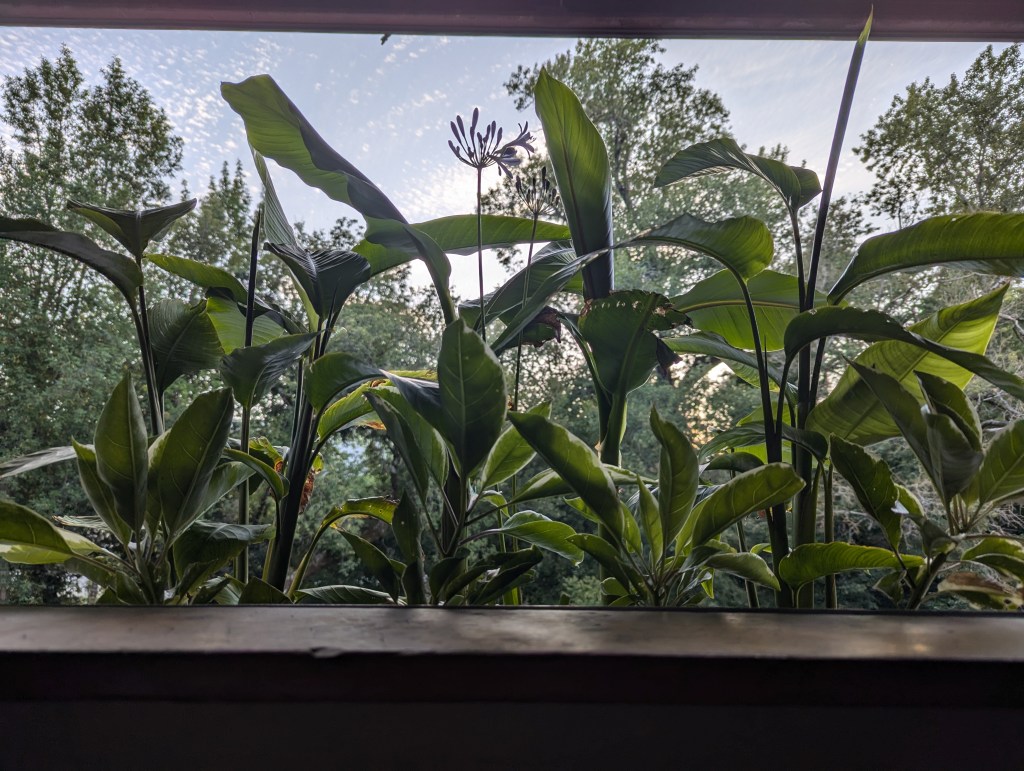
Without a plan, I moved eleven small specimens of various species from the nursery onto the shelf just to see how their composition could develop. I typically do not like to obscure scenery or obstruct sunlight from windows, but thought I could make an exception for this window. The scenery is not particularly appealing, with a busy roadway nearby. Through summer, a bit of shade from the warm late afternoon sun might be nice.

I did not want the grassy texture or bronzed foliar color of the sugarcane right outside the window. Nor did I want the disorganized texture of any of the gingers. I am rather pleased with how these few other species work though. They are nearly half as high as the window, but as I mentioned, for this window, I do not mind. They look rather jungley.

The eleven small specimens here are in eight #1 cans and three 4″ pots. The three 4″ pots are nestled into the gaps in between two rows of four #1 cans. A pair of young plugs of Cucurma longa, turmeric, in two of the three 4″ pots are not visible to the left and right. Only two blooms of a small specimen of Agapanthus africanus ‘Peter Pan’ lily of the Nile in the middle 4″ pot are visible. Four rooted cuttings of Solandra maxima ‘Variegata’ cup of gold vine are in the closer row of #1 cans. A pair of large specimens of an unidentified cultivar of Heliconia psittacorum, parakeet flower, are to the left and right in the rear row. A pair of pups of Musa acuminata ‘Golden Rhino Horn’ banana are in the middle of the rear row. This is so very inconsistent with my style, but I am getting to like it.

Six on Saturday: Blooms With a View

Blooms With a View Spring Garden Tour of View Park and Ladera Heights happened to be on the day after I arrived late in Los Angeles. That is why I stayed another day late to help exhibit one of Brent’s three landscapes that were featured in the Tour. I did nothing more than answer a few questions, discuss random horticultural trivia, and share copies of a list of some of the other easily visible neighborhood landscapes that Brent designed.

1. Phoenix canariensis, Canary Island date palm is, as its common name indicates, from the Canary Islands, rather than, as its botanical name suggests, from Phoenix in Arizona that I left only last Saturday. Years ago, it was the second most common palm in the Los Angeles regions. Now, in this garden, it was the second most popular topic of questions.

2. Solandra maxima, cup of gold vine was the third most popular topic of questions as a result of this single bloom. It was about six inches wide. I wanted to get a better picture. Eriobotrya japonica, loquat was the most popular topic of questions. I took no pictures.

3. Aeonium arboreum ‘Albovariegatum’, variegated common houseleek is precisely what it sounds like. Most cultivars of common houseleek are as different in form as in foliage.

4. Salvia longispicata X farinacea ‘Mystic Spires’ is like the heftier version of mealycup sage. It provides splendid blue color, and is more reliably perennial than mealycup sage.

5. Bougainvillea X buttiana ‘Barbara Karst’ frames this arched parlor window colorfully. Anigozanthos rufus ‘Big Red’ kangaroo paw below tries to not obscure the outside view.

6. After all, this view is why this is View Park. Los Angeles has certainly grown up since I first saw it in about 1986, and it has grown much more since the old residence was built.

This is the link for Six on Saturday, for anyone else who would like to participate: https://thepropagatorblog.wordpress.com/2017/09/18/six-on-saturday-a-participant-guide/

Felton Covered Bridge

Ha! This old article shows how less uptight I was about blogging three years ago.

tonytomeo's avatarTony Tomeo

04Now that I have been watching a few other blogs for three months, I notice that some people write some very interesting or at least entertaining articles about topic that are not directly related to the main topic of their respective blogs. Most are just like old fashioned slide shows (remember those?) with cool pictures from around the neighborhood, travels, home projects, or whatever might be interesting. I have not done this yet; but I happen to have a bit of free time at the moment, so thought that I would post these three pictures of the historic Felton Covered Bridge. Although I am technically from Los Gatos, my home is in the Santa Cruz Mountains between Los Gatos and Felton. I also have history in Felton, since my grandparents and my Pa used to live here.

In an attempt to keep this post relevant to horticulture, I should mention…

View original post 326 more words

Six on Saturday: Another Quarter

Getting there is half the fun, but only half of that fun was illustrated last week. This it the remaining half of half the fun, . . . which is technically a ‘quarter’. The pictures are not very colorful. Mine are very often like that for Six on Saturday. I am sorry that I got no picture of Rhody.

1. Rhody’s meadow next door was a baseball field. It may eventually be restored. For now, compost piles occupy the edge of right field. The railroad bridge of last week is in the background.

2. Toasted leaves remain evident in undisturbed areas. There has been no rain to accelerate decomposition. It is disconcerting to see so many amongst combustible dried vegetation like this.

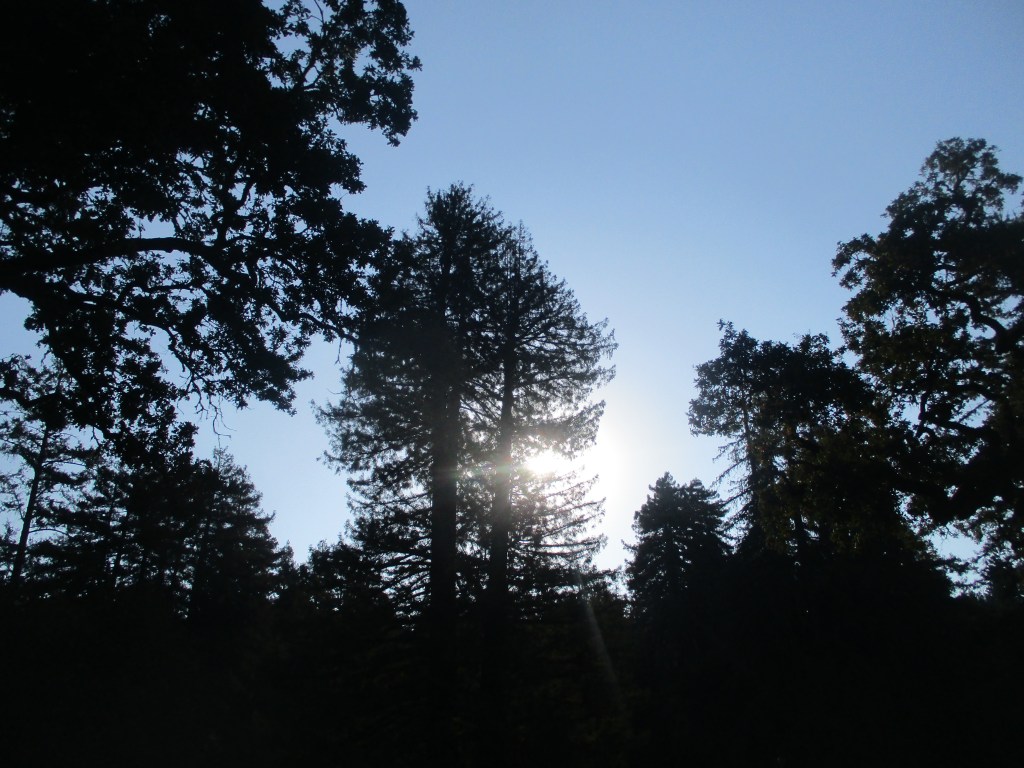
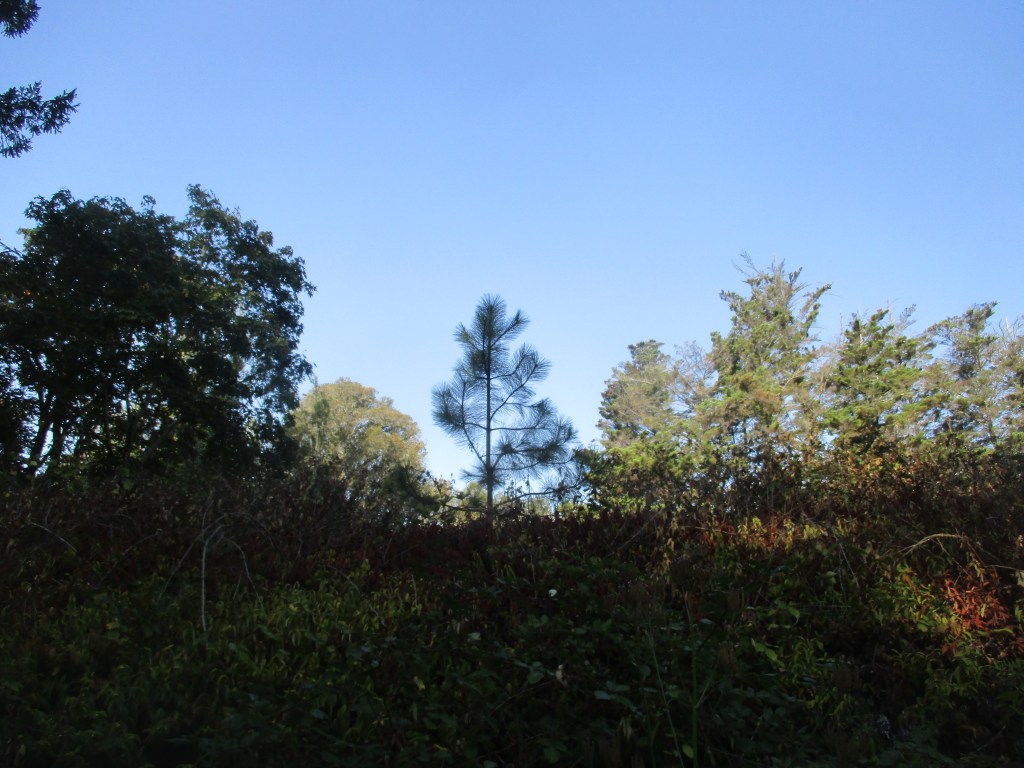
3. Charlie Brown’s Christmas Tree lives here. It is a baby ponderosa pine, which seems out of place among redwood forest. Those are sickly Monterey cypress in the background to the right.

4. Trinity Tree was about this tall in historic pictures from more than a century ago. It is only plumper now. It may have been rejected from earlier harvest because it is so thickly branched.

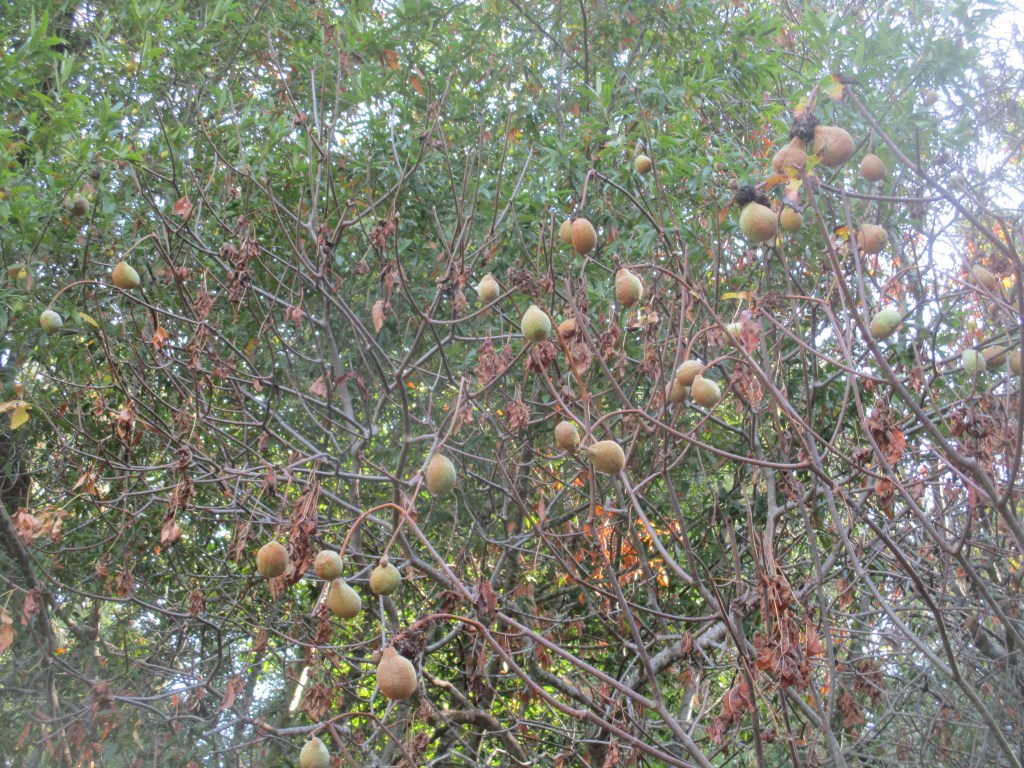
5. California buckeye seed pods, or whatever they are, look even sillier than what the English know as conkers of red horse chestnut, because they linger after summer defoliation. This is an odd species that defoliates during the arid warmth of summer, refoliates for late autumn, and defoliates again after it gets frosted in winter, only to foliate late in winter to repeat the process.

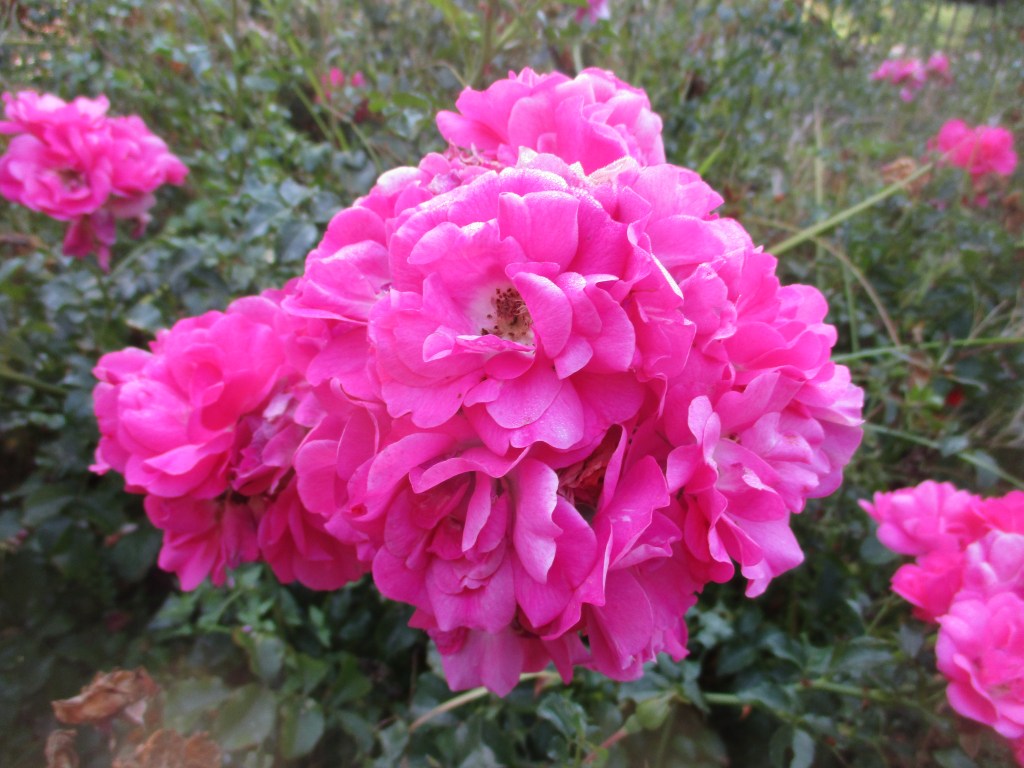
6. Yuck! I detest carpet roses. Besides this pink colony at the Depot, there is a red hedge in another landscape. Without a picture of Rhody, it seems polite to add at least one colorful picture.

This is the link for Six on Saturday, for anyone else who would like to participate:

https://thepropagatorblog.wordpress.com/2017/09/18/six-on-saturday-a-participant-guide/

Horridculture – Dumpster View

P00722
Location – Locations – Location

Rather than addresses, most of the guest cabins at the conference center where I work for part of the week, have delightfully horticultural names; such as Camellia, Lupine, Holly, Dogwood, Huckleberry, Strawberry and Cottonwood. Others have names that are suggestive of idyllic locations, such as Meadowbrook, Creekwood and Rustic Dell. Then, . . . there is ‘Dumpster View’.

Dumpster View is not actually a guest cabin, or a lodge, or any building that any of the guests would ever see. It is part of our maintenance shops buildings. Although large, these building are outfitted with only a few windows. The largest building has only a single window for an office. The smaller building has only four windows. Two of the windows have a view only of dumpsters.

The picture above shows the view from the window in the galley. It was what I saw as I made coffee for the crew in the mornings back when we all were still working. As many as fifteen big dumpsters have congregated in that herd, right outside, beyond the spider plant. Because the area is a paved driveway with significant traffic, I can not even plant a tree to obscure the view.

No amount of houseplants bigger than the spider plant can obscure this view without becoming obtrusive. Hanging pots outside the window might detract from the outer scenery, but would require more attention than I want to devote to them. Curtains would be the most practical solution, but would get grungy in this particular situation. Besides, no one else here really notices.

Horticulture is not for everyone, and can not fix everything. No one stays in the shops buildings long enough to notice how horrid the views are anyway. We all leave to go to work in scenery that others vacation in.