Pittosporum tobira ‘Variegata’

Pittosporum tobira ‘Variegata’ makes good hedges.

Almost all pittosporums appreciate sunlight and warmth. Pittosporum tobira ‘Variegata’ is no exception. However, it tolerates a bit of more partial shade than most. Furthermore, its grayish and creamy white variegation brightens shady situations. Its distinctively convex and glossy leaves are a bit flatter and broader where shaded. Shade inhibits bloom also.

Pittosporum tobira ‘Variegata’ is more popular as a foliar hedge anyway. Its small trusses of pale white flowers are neither prominent nor colorful. They can be delightfully fragrant in abundance, though. Stems are quite stout and can eventually grow more than six feet tall. They are resilient to frequent pruning and hedging, and can be cut back if necessary.

Pittosporum tobira ‘Variegata’ seems to lack a common name that is genuinely common. That is why its botanical name is most popular. Some know it as mock orange, but this is also a common name of Philadelphus. Some know it as Australian laurel, but it is neither a laurel nor from Australia. Regardless of name or origin, it is content with local climates. Once established, it is undemanding, and may need no watering.
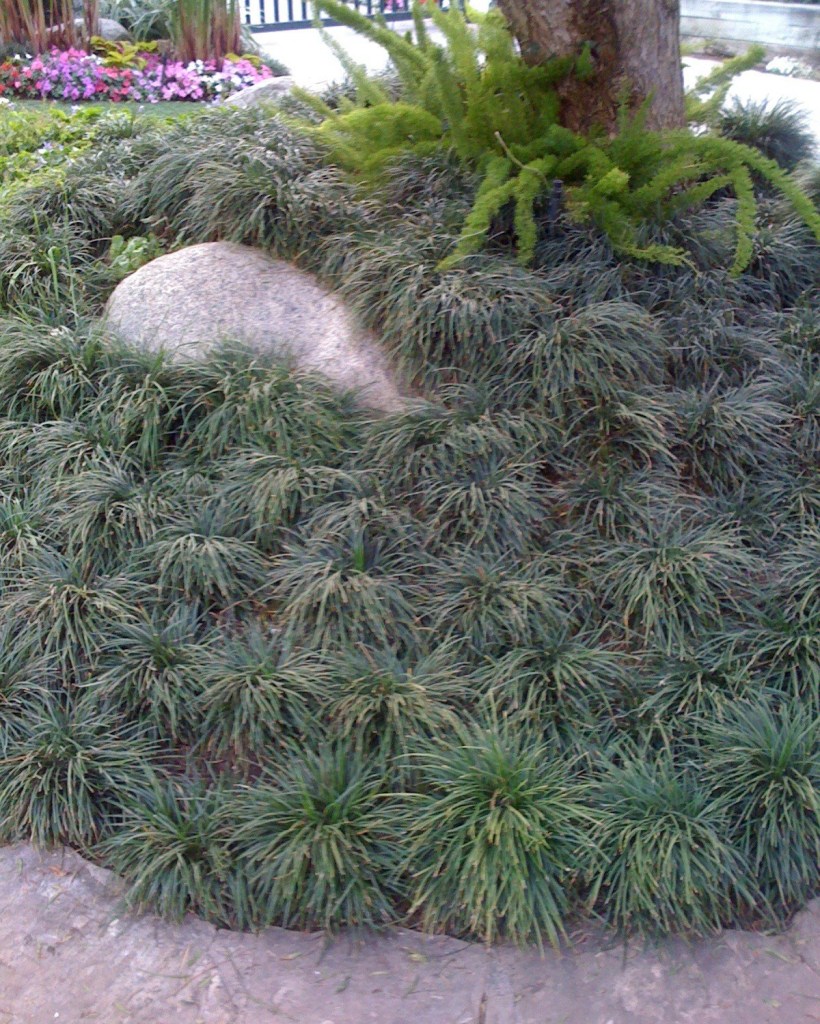
Too Much Mix & Match Gets Sloppy

Conformity has practical application even in casual landscapes.

A combination of modern horticultural apathy and too many choices was probably the demise of conformity in home gardens. Formal hedges or even informal screens of several of the same plants are nearly obsolete. Ironically, long and low barrier hedges and so called ‘orchards’ of identical trees planted in regimented rows or grid patterns have become common in large landscapes in public spaces

Those of us who still crave formal hedges, paired trees or any such symmetry in our home gardens must be more careful with the selection of the plants that need to conform than would have been necessary decades ago when there was less variety to complicate things. It is just too easy to get different varieties of the same plant. Only plants with matching cultivar (cultivated variety) names will necessarily match. (Yet, on rare occasion, even these are inaccurate.) For example, ‘Emerald’ arborvitaes will match other ‘Emerald’ arborvitaes, but will not match ‘Green splendor’ arborvitae, no matter how they resemble each other in the nursery.

Plants that are identified by their characteristics instead of by cultivar name are riskier. Blue lily-of-the-Nile could be any one of many different cultivars with blue flowers. It is therefore best to obtain all lily-of-the-Nile for any matching group from the same group in the same nursery at the same time. What will be available next week may actually be a different variety with a different shade of blue and different foliar characteristics. Nurseries bring stock in from so many different growers.

Adding new plants to replace those that have died within established hedges or streets flanked with the same trees can be particularly difficult, especially if the old varieties are no longer available. The old fashioned yellowish Japanese boxwood that was so common for small hedges in the 1950’s has not been common in nurseries for several decades. Replacement plants are darker green. Some are even compact cultivars or different specie like English boxwood. When lined up and shorn together, they make ‘calico’ hedges.

New York Times

(This article is copied from my other discontinued blog at Felton League. It is not about horticulture, but links to another article about hedges, and features Brent’s garden.)

This is why I have never stayed at Hotel del Flores.

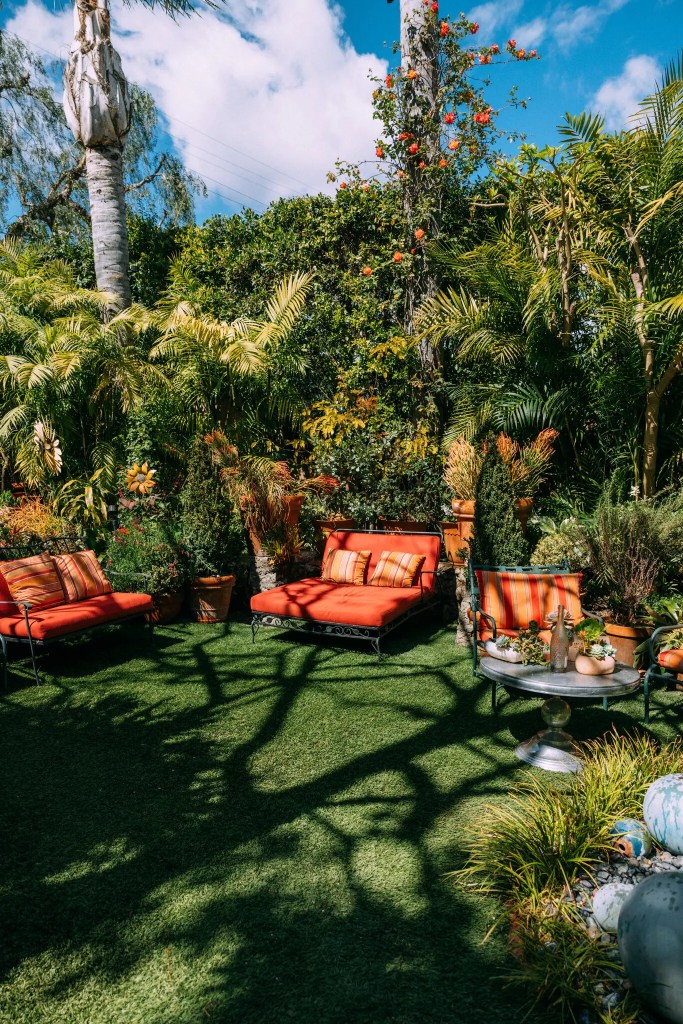
The New York Times featured a picture of my homeless camp! It is the third illustration of this article about landscape hedges. It shows where I camp while in Southern California, including the orange garden daybed where I sleep, and, as the primary topic suggests, a portion of the surrounding hedges.

This illustration should demonstrate why I enjoy being homeless in Southern California. It is quite luxurious. The weather is exemplary for camping. I wake amongst lush tropical foliage and palms, to the gentle sounds of small fountains and wild parrots. It is about as excellent as camping within one of my gardens, but very different, and special because I do it for less than three cumulative weeks annually. For many years, I have been wanting to stay at the famously eccentric Hotel del Flores nearby, but will not do so without inhospitable weather to dissuade homelessness.

Seeing this particular illustration reminds me of why this Felton League blog has been discontinued. For quite a while, there has not been much to write about that would not be intrusive to those involved. Societal difficulties as well as personal difficulties within society certainly remain, but are not as prominent as they had been. My own experience with faux homelessness, albeit within another Community, is strangely appropriate as an illustration for an unrelated article within the New York Times.

Most of those who experienced unemployment, poverty, homelessness or related difficulties here in the past are now enjoying major improvements to their personal situations. Many of those who are not yet benefiting from such improvements appreciate support from this graciously compassionate and generous Community. This has always been a good place to be in a bad situation. Perhaps, now that I no longer blog here, I should write a book about my experiences.

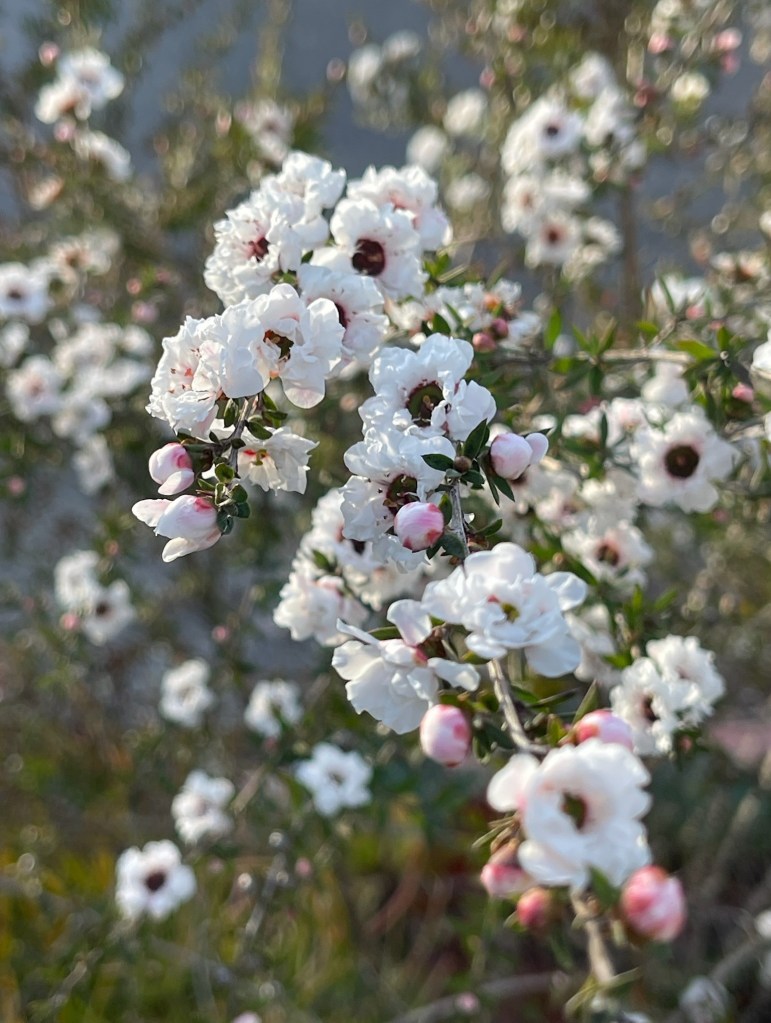
New Zealand Tea Tree

Frequent shearing might interfere with bloom.

Bloom should probably be most profuse for late spring or early summer. In actuality, New Zealand tea tree, Leptospermum scoparium, blooms whenever and however it wants to. Now that it seems to be blooming prematurely, it might continue to bloom in phases until autumn. Minor bloom phases might even continue randomly through autumn and winter.

Floral color is white, pink or red, including deep ruby red. The tiny flowers are sometimes sporadic but sometimes quite profuse. A few cultivars have plump double flowers. Foliar color is olive drab green or bronze green. The finely textured evergreen foliage is slightly scratchy. Its tiny leaves have pointed tips. The fibrous brown bark is handsomely shaggy.

New Zealand tea tree works very well as a blooming informal hedge. Frequent shearing of formal hedges compromises both bloom and natural form. Elimination of lower growth exposes appealingly sculptural trunks supporting little trees. Some modern cultivars will not reach first floor eaves. Some reach second floor eaves. All demand sunny exposure.

Pittosporum eugenioides

Pittosporum eugenioides leaves have distinctively wavy margins.

Large shorn hedges or informal screens are the more popular functions of Pittosporum eugenioides. It works like a modern and more relaxed option to privet. What few garden enthusiasts know is that it can alternatively be allowed grow into a small tree, either as a standard (on a single trunk) or with multiple trunks. It grows rather efficiently to more than twenty feet tall and about half as broad while young, and as it matures, can eventually get about thirty feet tall and broad.

The glossy leaves have appealingly wavy margins and distinctively pale midribs. The slightly fragrant flowers are only pale yellow, and are not abundant among young trees. Big old trees often bloom enough in autumn to be pleasantly fragrant. Stems and foliage are lemony fragrant when pruned or shorn. However, the common name of ‘lemonwood’ (or tarata) is not so common locally for Pittosporum eugenioides.

Hopbush

Hopbush makes a nice small tree.

Johnny jump up and jumping cholla have no more than amusing names in common with hopbush, Dodonea viscosa. Neither a dangerous cactus nor a docile annual, hopbush is an elegantly upright and evergreen shrub. It is very popular for both informal and formally shorn hedging. With pruning, it can become a small tree with handsomely furrowed bark.

Hopbush has potential to get about as tall as a two story house, particularly with pruning for tree form. Conversely, with only occasional pruning for hedge form, it is just as happy to stay just six feet tall. Trees with single and straight trunks fit nicely into narrow spaces. Trees with a few irregular trunks that lean outwardly are more sculptural for larger areas.

The narrow evergreen leaves are about two or three inches long, with light bronzy color. ‘Purpurea’ has purplish bronze color, but does not grow as vigorously. Most hopbush are female, and generate interestingly papery seed. Bloom and seed production are variable though, and some specimens become male. Roots should be complaisant with concrete.

Shearing Can Not Fix Everything

Shearing enhances foliar density without bloom.

Mowers are for mowing lawns and shallow ground cover. Blowers are for blowing debris from pavement, decking and other flat surfaces. The names of these tools suggest these particular functions. Those of us who use such tools tend to be aware of their limitations. Why are simple concepts of shearing and the associated tools so difficult to understand? 

‘Mow, blow and go’ gardeners are not so bad if they simply mow, blow and go. They tend to the two most significant but also least pleasurable tasks in the garden, and then leave before causing problems. Most are also qualified to add bedding plants or shear hedges. However, some will shear anything that is within reach of their powered hedge trimmers.  

Shearing is for hedges or shrubbery that is strictly foliar. There are few exceptions. Such shearing should be performed properly, and only for the few plants that are conducive to it. The process promotes foliar density, but also generally inhibits bloom. For hedges that function as living fences in the background of more interesting plants, this is no problem.

Otherwise, shearing plants that are not conducive to it ruins appealing form, and inhibits or prevents appealing bloom. Privet and photinia perform well as shorn hedges because their dense evergreen foliage is their primary asset. Their bloom is actually undesirable. Their natural forms are unremarkable, but their shorn forms can be remarkably practical.

Frequent or untimely shearing prevents lemon bottlebrush and oleander from blooming. However, shearing immediately after a bloom phase stimulates new growth to bloom for a subsequent phase. New growth only needs an opportunity to mature and bloom before removal. Such potentially blooming stems need extra space to extend prior to blooming.

As practical as it is for hedges, shearing ruins the foliar texture of other plants. Heavenly bamboo is worthlessly shabby without its naturally intricate foliar texture. Juniper retains good color, but becomes boringly plain. Rhododendron and hibiscus become disfigured and can not bloom. Each of these plants and all others are discriminating about pruning. Few are agreeable to shearing.

Horridculture – Fences

P00429
This is not exactly visually appealing.

Fences are necessary. They contain children, dogs and minor livestock. They exclude deer, cattle and others who are unwanted within an enclosed space. Some obscure unwanted scenery. However, even the more ornate sorts are more functional than aesthetically appealing.

That is why hedges are popularly grown to obscure fences that obscure outside scenery. Climbing vines take up less space than hedges, but are likely to damage the fences that they are intended to obscure.

Where I lived in town, the garden in back was surrounded by fences. I loathed them. I grew a grapevine on one. Another one was outfitted with a trellis of twine for pole beans to climb. Tall zonal geraniums obscured at least the lower half of the fence behind the laundry yard. I would have preferred no fences at all.

There were no children or dogs to contain. Nor were there cattle or deer to exclude. Except for the laundry and trash yards, there was no unwanted scenery to obscure. Nonetheless, the neighbors wanted fences, probably because they all believed that backyards should be fenced. It was just how it had always been.

Some urban fences are more like high and solidly constructed walls. Batons cover the seams between planks. Where local ordinance limits the height of fences, lattice is commonly added on top to (sort of) lawfully increase height. It is difficult to grow much on the shady north side of such tall fences.

I am fortunate that I do not work with many fences anymore. However, an area at work is surrounded by cyclone fences. It is necessary and practical, but would be very unappealing around landscape situations. I put pole beans on one, and two grape vines on another. If I must contend with them, I may as well take advantage of them.

Lineup

P00426
The usual suspects.

There is significant traffic right outside. It is one of the three busiest roads around. No one here really minds, because we are mostly too busy with something else while we are here. We are accustomed to it as part of the ‘scenery’. The noise sometimes makes it necessary to shout to each other, or take a telephone call somewhere else, but is not too much of a bother otherwise.

However, the scenery that those in the traffic see from the road might be slightly less than appealing. Industrial buildings surrounded by pavement, building materials, work vehicles and all sorts of associated items are all that are in here. Next door, there is a herd of dumpsters! It is a view worth obscuring. Bay trees and box elders that used to screen the view are too tall now.

I should have planted these five Arizona cypress in a row along the road last autumn. If I were to plant them now, I will need to water them occasionally until next autumn, not that I would mind. After their first winter, they would be happy on their own. They would start to obscure the view within only a few years, and unlike box elders, would stay evergreen through winter.

They really should have been planted a long time ago. They have been in the same cans for so long that the medium within has decomposed and collapsed. Without staking, their lean trunks became disfigured in confinement. They really would not have needed to be staked if they had been planted sooner and been able to grow more vigorously. Fortunately, they should recover.

A Monterey cypress will be planted at the low end of the row next Saturday, even if these Arizona cypress are not planted until autumn. I will explain later.

Karo

91211Of all the popular pittosporums in Western landscapes nowadays, the karo, Pittosporum crassifolium, is certainly not one of the most familiar. It might have been one of the earliest to have been popularized here though. Because of its resiliency to coastal climates, it was a common hedge in San Francisco during the Victorian Period. With minimal watering, it did well farther inland too.

Karo are nice fluffy evergreen shrubs that can get fifteen feet tall. They excel both as informal screens and refined hedges, and can be staked as small trees on single straight trunks. Alternatively, lower growth of big shrubby specimens can be pruned up to expose a few delightfully sculptural trunks. ‘Compactum’ is a densely foliated mounding cultivar that might stay less than three feet tall.

The Latin name, Pittosporum crassifolium, is quite descriptive. The literal translation is “sticky-seed thick-leaf”. The two or three inch long leaves are not really thick, but their slightly grayish upper surfaces and more grayish tomentous (fuzzy) undersides make them seem almost succulent. Small and round seed pods eventually split open to reveal dark seed glued together with sticky resin.