Six on Saturday: Autumn Or Not?

Some vegetation is responding to cooler autumn weather as it should while some refuses to concede. Autumn foliar color is not so spectacular this season.

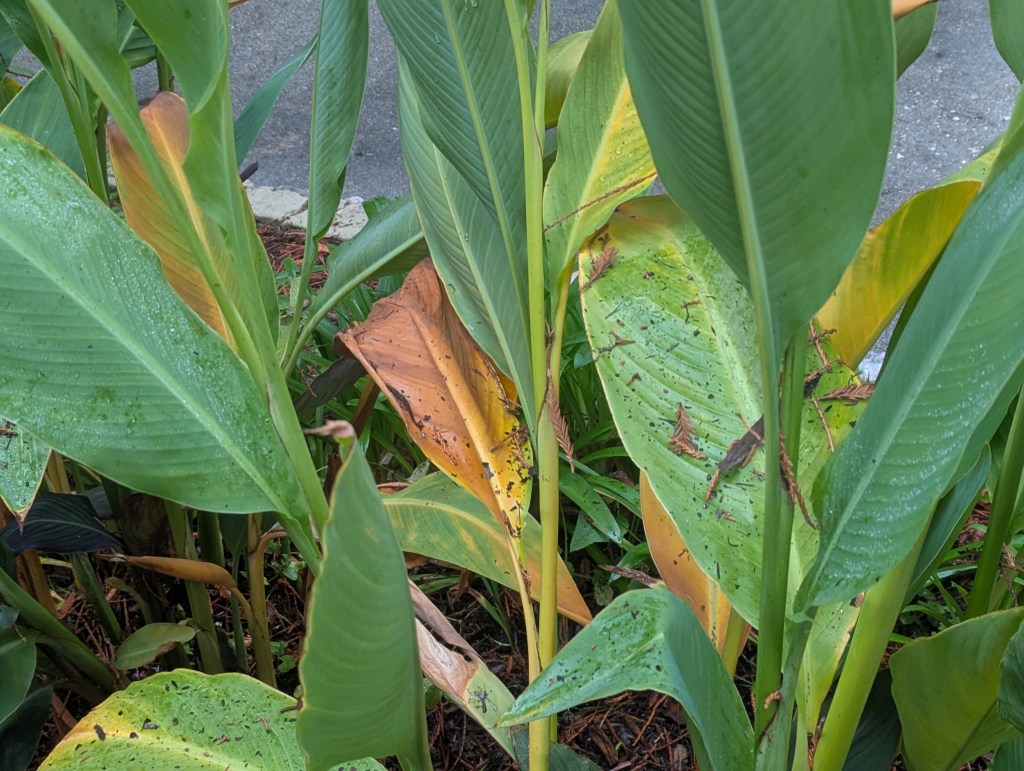
1. Canna musifolia, canna foliage is beginning to discolor in response to cooling autumn weather. I will groom such foliage out through the season until there is nothing left of it.
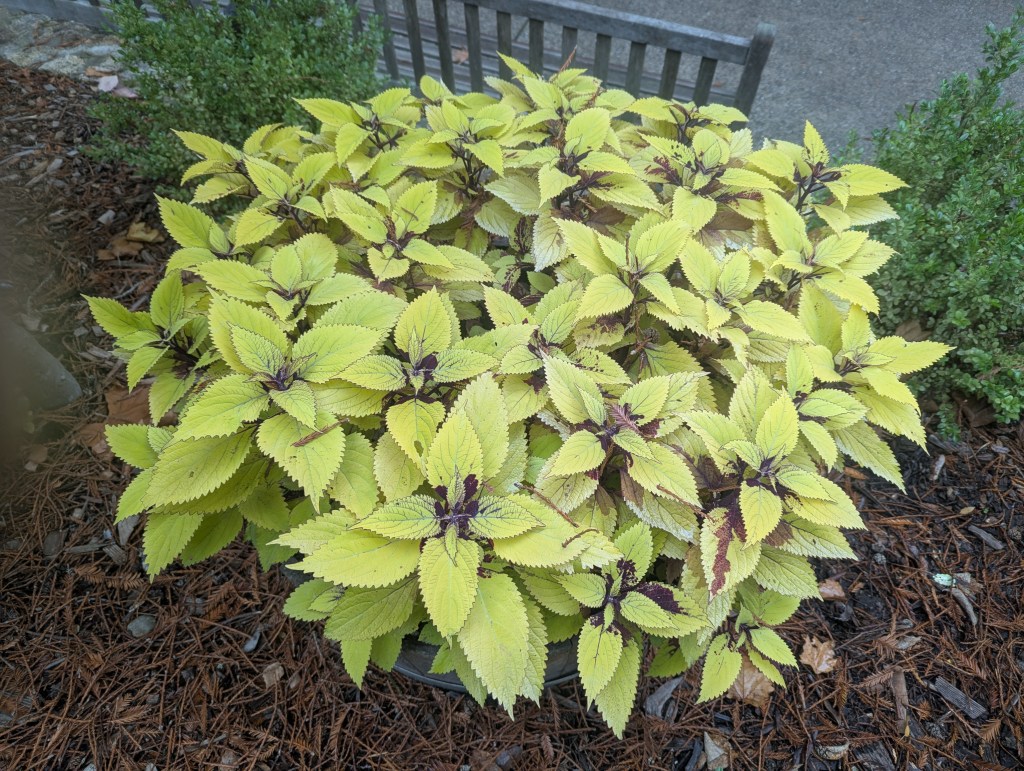
2. Plectranthus scutellarioides, coleus is not so easily convinced that it really is autumn. It is as vigorous now as it was for summer. I suspect that it will not last for long like this.
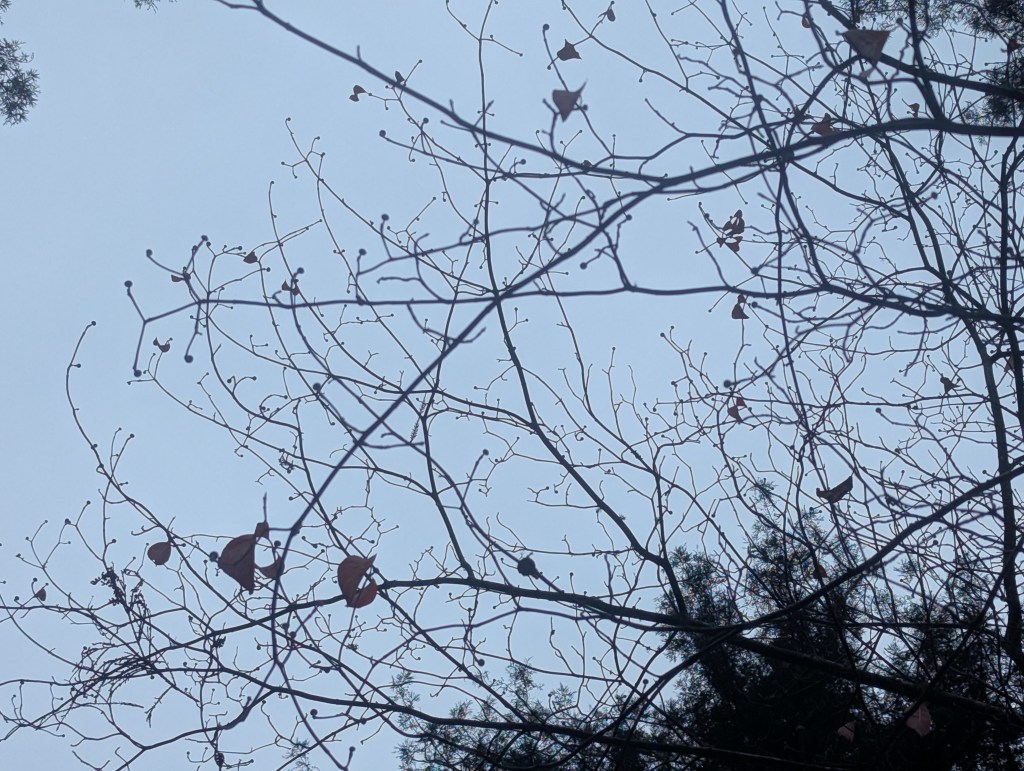
3. Cornus florida, flowering dogwood is already defoliated, and it did so quickly without much color. Others were somewhat more colorful, and were retaining their color better.
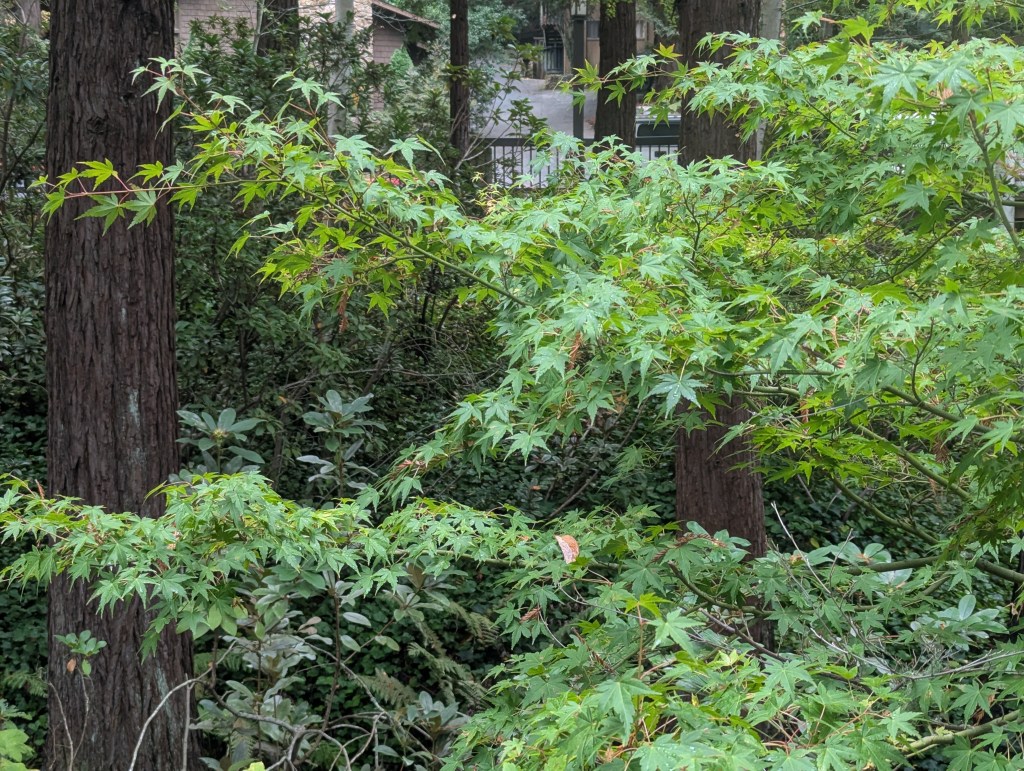
4. Acer palmatum, Japanese maple, like coleus, is not convinced that it really is autumn. This particular specimen is as green as it was for summer. Others are beginning to color.
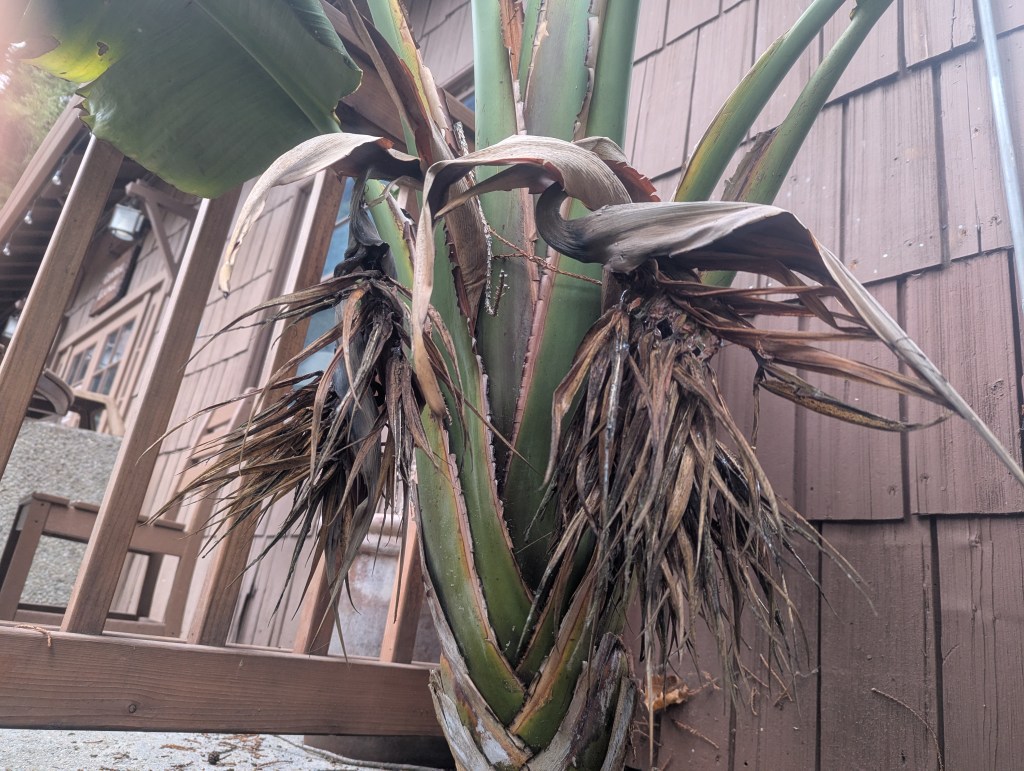
5. Strelitzia nicolai, giant bird of Paradise supposedly blooms randomly. However, ours prefers to bloom through summer and finish about now, so is actually right on schedule.
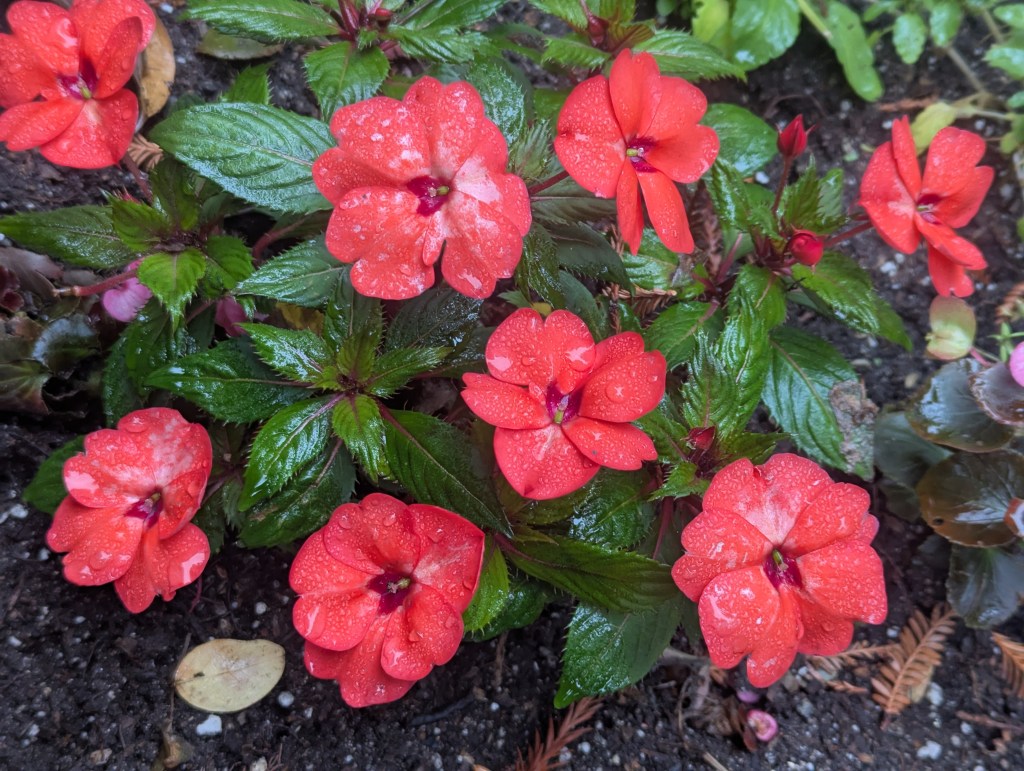
6. Impatiens hawkeri, New Guinea impatiens, like coleus and Japanese maple, is not yet convinced that it is autumn. It will likely succumb to autumn chill when the coleus does.
This is the link for Six on Saturday, for anyone else who would like to participate: https://thepropagatorblog.wordpress.com/2017/09/18/six-on-saturday-a-participant-guide/

Autumn Tasks

Gardening tasks may be a bit less demanding now, but are no less important.

With cooler and rainy weather, and shorter days, gardening is not what it was a few months ago. It is more comfortable to stay inside when the weather is not so pleasant. Besides, gardening when the garden is too wet gets muddy, and can damage lawns and bedding areas. Even while the weather is pleasant, there is not enough daylight left to get much done at the end of the day.

The good news is that gardening is not as demanding in autumn and winter as during spring and summer. Plants are either dormant or are growing only minimally. Pruning and hedging is therefore not so necessary. Lawns likewise do not need to be mown as often. Without much blooming, there is less need for deadheading. With rain bringing more moisture than the garden needs, and cooler temperatures inhibiting evaporation to take moisture away, watering is rarely a concern.

The bad news is that there are a few things than should be done in autumn and winter that should not be delayed to spring. For example, early spring blooming bulbs should be planted as they become available in nurseries so that they can get a good chill through winter and disperse their roots as soon as possible. Also, evergreen trees that may be a bit awkward on their trunks should be staked before winter winds. (Deciduous trees do not get blown around much without their foliage.) 

Eventually, or sooner, the weather will get cold enough to necessitate protection from frost. Marginal plants are probably safe under eaves or taller evergreen trees. Sensitive plants that are not in pots that can be moved to shelter should be tented when threatened by frost. Tenting can be as simple as tarps suspended above the foliage by stakes, and only needs to shelter plants from exposure.

As deciduous fruit trees lose their foliage, they will be ready for winter pruning. This is very important for apricot, peach, cherry, nectarine, plum, prune, apple, pear and related trees, since they should not be pruned once they start to bloom in spring. Maples and birches should also be pruned while completely dormant in winter, since they bleed so profusely if pruned in spring or summer.

Weed seedlings may start to appear with winter rain. They do not grow as rapidly now as weeds do in spring, but have a sneaky way of growing in more places because of the uniform availability of water in places that would be dry without rain. Fortunately, they are easy to pull while the soil is damp. Seedlings of any desirable plants should be identified first so that they can be distinguished from weed seedlings and not pulled.

Falling leaves should be raked from lawns and ground cover, not because they are unappealing in the garden, but because they block out sunlight and promote rot. Raking should not be done immediately after rain though, since lawn and ground cover are so easily damaged while soil is wet and muddy.

Horridculture – Traditional Delay

Rhody and his Roady, . . . still waiting to leave.

This article is scheduled to post at midnight between March 19 and March 20, which is precisely when we were scheduled to leave for the Pacific Northwest. We were supposed to arrive on the Kitsap Peninsula late in the afternoon, and likely continue to the coast the following morning. Now, we will not leave until midnight between Sunday, March 24 and Monday, March 25. I know that it is only five days later, but it changes the entire schedule. I should still be there in time to prune the apple trees prior to bloom. I do not know when we will return now, but it will likely be about Thursday, April 4.

Then, two and a half weeks later, we leave again for eleven days in Beverly Hills in Los Angeles County, and Buckeye near Phoenix in Arizona. That would involve leaving Wednesday, April 24, and returning on Saturday, May 4. That should be before the weather gets too warm in Arizona to prune the mesquite trees there comfortably. I suppose that the second trip does not necessarily need to be delayed just because the first trip was. We could still leave on Wednesday, April 17 and return on Saturday, April 27 as originally planned, even if that leaves less time between the two trips. Perhaps I should not worry about this until we return from the first trip!

This seems to happen annually. Regardless of how intent I am on leaving on time, we encounter a delay of some sort of another. Ultimately, we leave at about the same time annually, but only after planning to leave about a week earlier, just as we planned for the previous few years. I can not complain, of course, since the delay is justified, but that is another topic for another post.

Abutilon

Bloom may become more scarce with cooling weather.

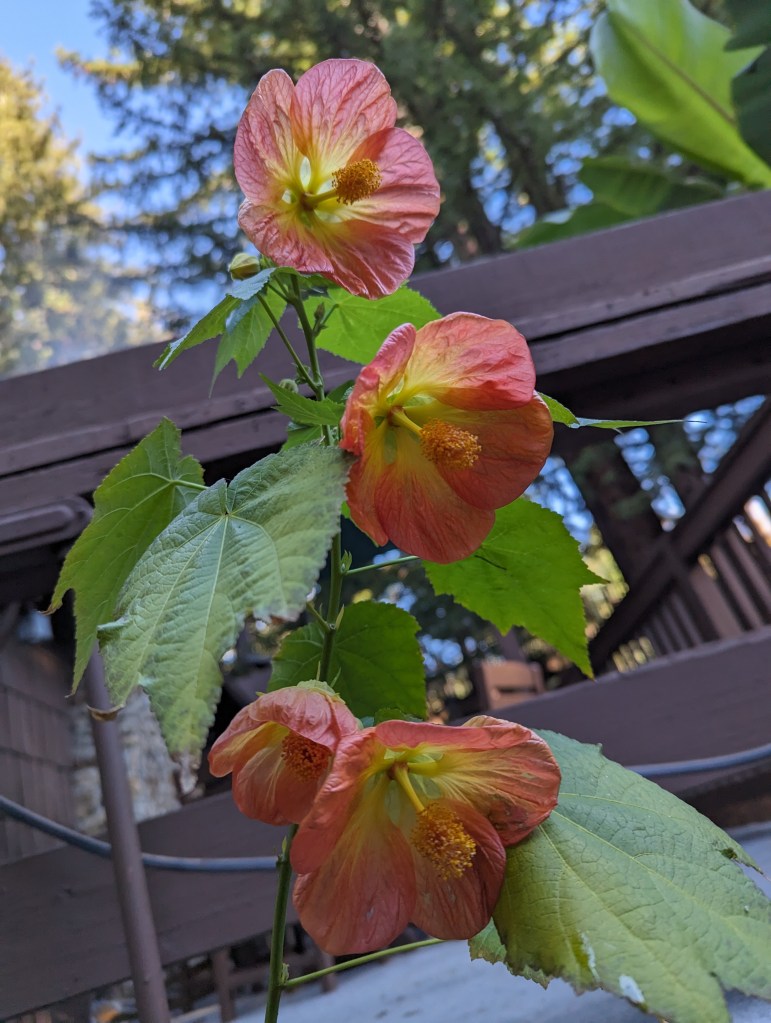
Abutilon X hybridum grows wild from seed within some of our landscapes. Although not prolific enough to be naturalized, dispersion of any viable seed seems odd for hybrids, since most hybrids are sterile. Of course, I do not know for certain if their ancestors were actually Abutilon X hybridum. They could have been other simple species of some sort. Besides, the name seems to apply to any cultivar of unknown parentage, including a few that are not actually hybrids.

Furthermore, even those that are generally sterile hybrids only needed to produce a single viable seed to start the process. Such a seed would likely grow into something that is more genetically stable, and therefore less sterile than its parents. Regardless of their supposed genetic stability, or because of their lack of it, their individual floral color is delightfully variable.

I am no more certain about the common name of this genus, species or group of hybris, which I know simply as flowering maple. Some know it as Chinese lantern. A few may know it as Indian mallow or parlor maple.

I am not so keen on the flowering maple, or whatever it is, for refined landscapes. However, the landscapes here are not so refined, and some are quite rustic. They benefit from the relaxed style, sporadic bloom, and open form of whatever this is.

Bloom is always sporadic, but is a bit more abundant during warm weather. Conversely, it can get scant while the weather is cool through winter. I am impressed by the few flowers that continue to bloom on this particular specimen. So are the hummingbirds. Bloom will likely become more scarce now that the first mild frost occurred last night. Also, foliage may get sparse until warmer weather next spring initiates regeneration to continue the seasonal cycle.

Cool Season Vegetables Eventually Replace Warm Season Vegetables

Peppers do not grow in cooling autumn weather.

Just as warm season annual flowers that bloomed through spring and summer get removed to relinquish their space to cool season annuals, summer vegetable plants need to vacate the garden for cool season vegetables. Fortunately, removing vegetable plants is not as unpleasant as removing the pretty flowers might have been, because most have finished producing whatever it is that they were grown to produce.

Besides, cool season vegetables are even cooler than warm season vegetables, since some have distinctive foliage that is appealing beyond the vegetable garden, in borders, pots and mixed plantings, out in the landscape. Swiss chard is a striking foliar plant, whether it gets eaten or not. The outer leaves can get eaten without compromising the appeal of the inner leaves that continue to grow and fluff outward to replace them. Arugula, kale, mache, loose lettuce (non heading) and collard, mustard and turnip greens do the same.

This ability to function in more places in the landscape is a definite advantage since cool season vegetables are not quite as productive as warm season vegetables are. They would certainly like to be as productive, but grow slower through cool weather.

Most cool season vegetables should be sown into the garden as seed. Root vegetables, like beet, carrot and radish, might be available as seedlings in cell packs, but do not recover very well from transplanting. Besides, seedlings of such plants in cell packs are either too abundant and crowded, or to sparse to produce much. Leek, loose leaf lettuce and most of the greens likewise grow best if sown as seed in rows instead of planted in tight clumps as they are grown in cell packs.

Only greens that are grown as individual big plants, like chard, kale and collard green, can be as productive from cell pack seedlings as from seed. However, each cell pack produces only six plants, maybe with some extras. A package of seed costs about the same, but contains more seed than most gardens can accommodate.

Actually, the only cool season vegetables that might be more practical to grow from cell pack seedlings than from seed are broccoli, cauliflower, cabbage and Brussels sprout. These vegetables grow as even larger plants, so minimal quantities, like one or two or perhaps three cell packs, are sufficient.

Like so many of the warm season vegetables, many cool season vegetables should be planted in phases every two to four weeks to prolong harvest. By the time the first phase finishes, the next phase will be ready. The frequency of phases depends on the growth rate and duration of production of the particular plants. For example, chard has a long duration of production, so does not need many phases.

Six on Saturday: Totally Missed It

Goodness! For the first time in a very long time, I neglected to collect six pictures for Six on Saturday. Furthermore, after frantically assembling these random pictures that I had no use for otherwise, I posted them later than typical. I have a good excuse though. I am on vacation. Actually, I happen to be in Ilwaco in Washington. I will be meeting with the blogger of Tangly Cottage Garden later in the morning, so should have more interesting pictures for next week. I realize that I said that last week in regard to Rhody’s Roady, but as I mentioned, I presently have other very important priorities. By the way, I do intend to explain Rhody’s Roady!

1. After clearing away thickets of Himalayan blackberry and cattail, this drainage pond is allowed to fill for the first time in years. We might add lily pads and other aquatic plants.
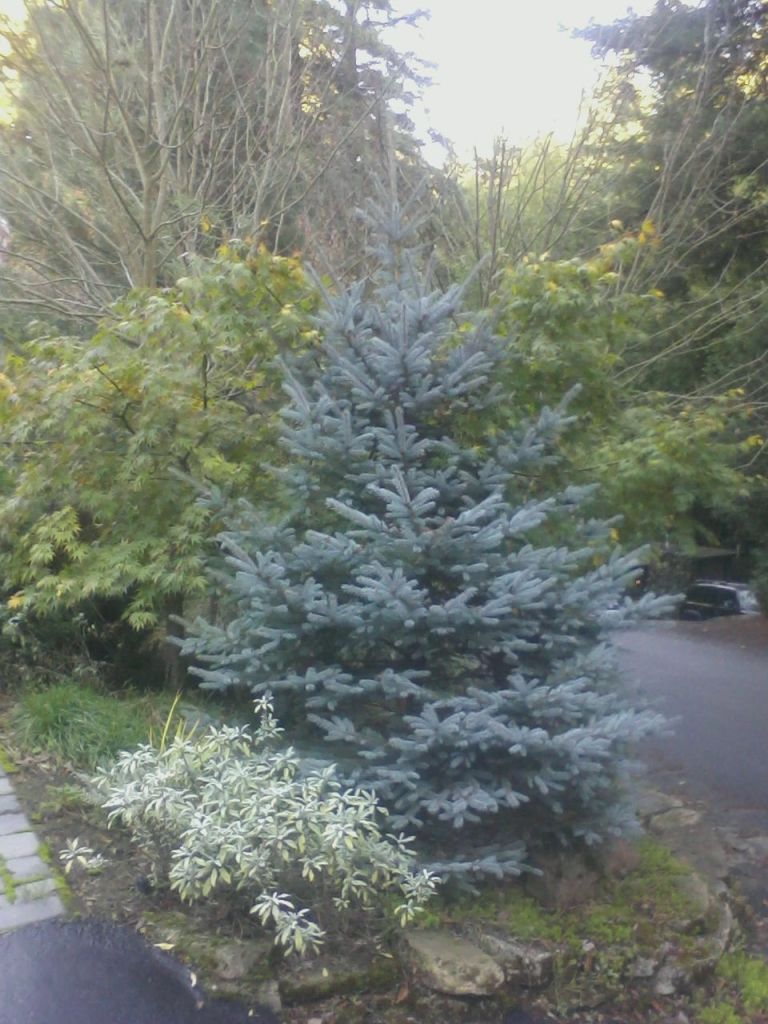
2. Conical conifers that were available for live Christmas trees from nurseries go on sale after Christmas. This happy blue spruce, although expensive, was discounted by a third.
3. Flowering cherry continue to bloom. This picture was taken quite a while ago, but the particular tree and others like it were still in bloom on Wednesday. One was still in bud.
4. Camellia continue to bloom as well. Of course, many or perhaps most finished a while ago. Nonetheless, several often bloom rather late, or at different times from year to year.
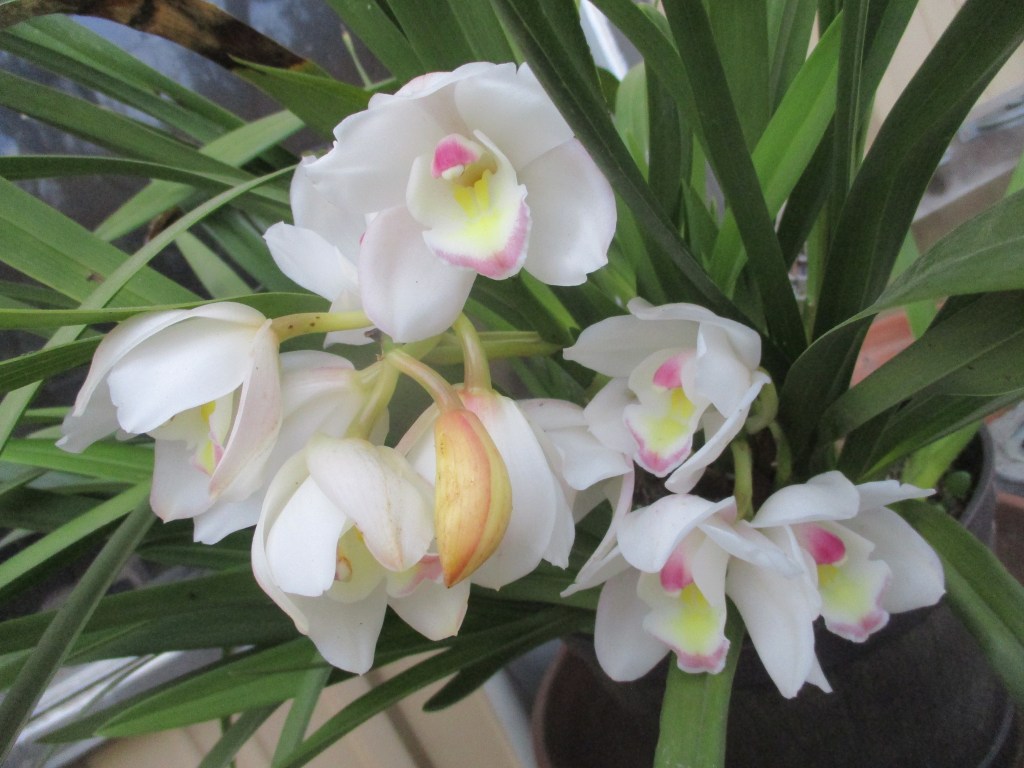
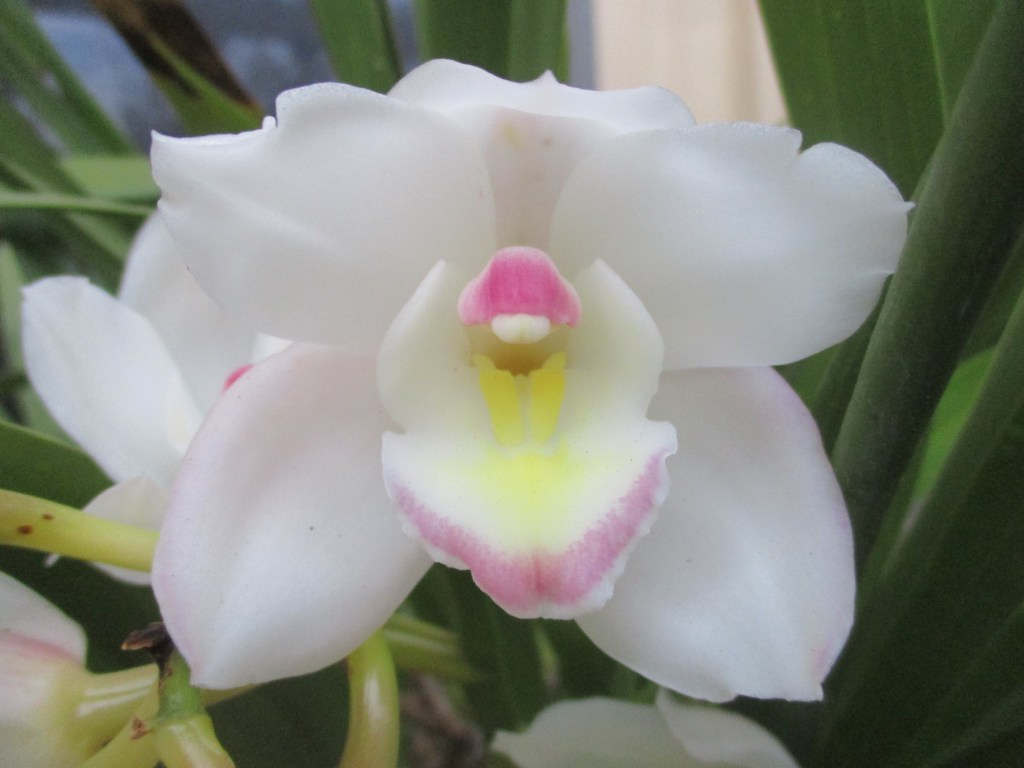
5. Cymbidium orchid bloomed right on schedule, but its flowers last for such a long time that it seems to be right in the middle of the process. There are four spikes on this plant.
6. Collective bloom is spectacular, and individual flowers are compelling. It is pleased to bloom like this for minimal attention. I merely water it, then display it proudly in bloom.

This is the link for Six on Saturday, for anyone else who would like to participate: https://thepropagatorblog.wordpress.com/2017/09/18/six-on-saturday-a-participant-guide/
Poinsettia

After their distinctive and colorful bracts are gone, poinsettias can become handsome foliar houseplants or tall and lanky blooming shrubbery.

The tiny, yellow buds at the center of poinsettia (Euphorbia pulcherrima) blooms are actually the unimpressive flowers. The colorful red, white, pink or rarely pale orange bracts surrounding these flowers are merely colorful leaves. Some varieties have marbled, blotched or spotted bracts. Compact potted plants that are mostly less than two feet tall and broad can get quite lanky and taller than ten feet in the garden. The dark green leaves are about three to five inches long.

Christmas Leftovers

Blue spruce is a good choice for a living Christmas tree, since it can be happy for years in containment.

Just three weeks after Christmas, many of us are already wondering what to do with poinsettias, cyclamens, Christmas cacti, hollies and living Christmas trees. Christmas cacti and hollies are perhaps the easiest of these to accommodate. Christmas cacti do not even need to leave the home as their flowers eventually deteriorate, since they are happy as foliar houseplants or potted on sheltered porches, and with good sun exposure, will bloom annually. Hollies make handsome shrubbery where their prickly foliage will not be a problem. Since some hollies get quite large, and others stay low and compact, it is helpful to know which variety any particular holly plant is.

Cyclamens are popular as cool season bedding plants as well as blooming potted plants. Gardeners typically dispose of those grown as bedding plants as if they were mere annuals. However, they are actually cool season perennials that go dormant through summer. If they are not in the way of warm season annuals in spring, and are among other plants that will cover for them during their dormancy, they can be left in the garden to regenerate and bloom again next winter. Individual potted plants that get too tired to be appealing in the home can be retired to partly shaded shallow ground cover or mixed perennials for a bit of winter color.

Poinsettias are a bit more complicated, which is why so many people simply discard them as they slowly lose their color after Christmas. They can keep their color for many months, and be happy as houseplants, but rarely bloom again in the home once their first bloom is gone. Alternatively, they can be planted into sheltered and partly shaded spots in the garden after frost. Through summer, they develop taller scrawny stems that bloom early in January or so. (Yes, they bloom ‘after’ Christmas.) They are sensitive to frost, so like to be under eaves.

Of all the popular potted plants associated with Christmas, living Christmas trees are the most problematic, not because they are difficult to care for, but because they so often get planted in bad situations. Only the compact conifers, like spruces, junipers and Scots pines, can stay potted to function as Christmas trees for a few years or more. Almost all other pines grow too vigorously to be happy for long in containers. After Christmas, they should instead get their circling roots severed, and then be planted into the garden.

The problem is that most living Christmas trees are Italian stone pines or Canary Island pines, each of which gets much too large for confined garden spaces. If there is not enough space for such a tree to grow to maturity without causing trouble, it best to find another home for it, or to discard it when it outgrows containment.

Dormancy And Defoliation Are Advantageous

Hostas go dormant and defoliate for winter, and regenerate for spring.

Many plants are deciduous in autumn and winter, which means that they defoliate or die back, and then refoliate or regenerate in spring. Many others are evergreen, which simply means that they are always foliated through all seasons. What many people do not realize is that evergreen plants replace their foliage just like deciduous plants do. They just do not do it in such distinct phases of defoliation, dormancy and refoliation.

Tropical plants like cannas and some of the various begonias really have no need for formal defoliation, since they are from climates that lack winter. In the wild, they continually and systematically shed old stems as they produce new stems. Locally, they tend to shed more than they grow during late autumn and winter. The large types of begonias tend to keep their canes for so many years that it is not so obvious. Where winters are colder, cannas freeze to the ground, only to regenerate from their thick rhizomes as winter ends.

Zonal geraniums may seem rather tired this time of year for the opposite reason. They expect late autumn weather to include frost that would kill them back to the ground where they would stay relatively dormant until warmer weather after winter. Just because their foliage is instead evergreen through winter does not mean that it should be. It lingers and often becomes infested with mildew and rust (fungal diseases) that proliferate in humid autumn weather.

However, zonal geraniums need not be pruned back just yet. Even if they eventually get damaged by frost, pruning should be delayed so that the already damaged older foliage and stems can shelter the even more sensitive new growth as it emerges below. They can get cut back after frost would be likely.

Evergreen pear can get very spotty once the warm weather runs out because the same damp and cool weather that inhibits its growth also promotes proliferation of the blight that damages and discolors the foliage. The damaged foliage eventually gets replaced as new foliage emerges in spring, but will remain spotty and discolored until then. Photinia does not get as spotty, but holds blighted foliage longer into the following summer. Ivy can be temporarily damaged by a visually similar blight.

Many Perennials Want Seasonal Grooming

Where frost is not a major concern, old canna foliage can be cut back as new growth develops.

Here on the west coast, autumn and winter weather is so mild that the native coral bells are already starting to develop new foliage on top of the old foliage from this last year. Technically, they are evergreen, so the old foliage does not need to be shed; but if it is not too much to ask, some types look better with a bit of grooming.

Other perennial plants that are from climates with stronger seasons and colder winters are not quite so evergreen. Many shed all of their foliage and are completely bare for at least part of the winter. Only a few, like cyclamen, are at their best through autumn and winter.

Dried watsonia foliage should be removed now if it has not been removed already. It is not so easy to pluck off like gladiola foliage is, so it should be cut off with shears. Because new foliage for next year develops before the old foliage of this past year is completely brown, it is often necessary to cut the old a few inches above the ground in order to avoid damaging the new.

The so called ‘evergreen’ daylilies can be even messier. New foliage is rather delicate, so it is easily tattered by the removal of old foliage. The ‘deciduous’ types may seem to be less appealing because they are bare for part of autumn and winter, but are so much easier to groom by simply removing all of the deteriorating old foliage as soon as it separates easily from the roots.

Deteriorating flowers can be removed from cannas; but their lush foliage can stay until it starts to deteriorate later in winter. Even if it survives winter, it should eventually be cut to the ground as it gets replaced by new growth in spring.

The many different iris have many different personalities. Most should be groomed sometime between summer and late autumn, although Dutch iris were groomed much earlier. Bearded iris that do not get divided can be groomed simply by plucking off big old leaves to expose smaller new shoots below.

Some dahlias bloom until they get frosted. Most though, are already finished. They do not need to be cut back all at once, but can be cut back in phases as leaves and stems dry and turn brown.