Gaura

Gaura seems to be a wildflower.

Although not native, gaura, Oenothera lindheimeri, can almost naturalize as if it were. All it needs is occasional watering through summer. It performs better with regular watering. Individual specimens live for only about four years. Some may last for only a single year. However, their abundant progeny are likely to replace and perhaps overwhelm them first.

Gaura prefers sunny and warm exposure. Shade causes sloppy form. Naturalized gaura has potential to become weedy or invade other vegetation. Seedlings relocate efficiently. Cutting back old growth as it deteriorates through winter promotes vibrant spring growth. Concurrent removal of the shabbiest old specimens favors vigorous younger specimens.

Collective growth is mostly less than five feet deep, with wispy and lightly foliated stems. Basal leaves are bigger than tiny upper leaves. Airy flowers are only about an inch wide. Floral color is mostly pale pink. Seedlings of cultivars with white or richer pink bloom are not necessarily true to type. Neither are seedlings of cultivars with richly bronzed foliage. Bloom continues from very early spring until cooler wintry weather.

Is Phlox A Weed?

Phlox seems to be right at home here now.

When it first appeared within one of the landscapes at work four years or so ago, I was not sure of its identity. I guessed that it was some sort of phlox only because it resembled phlox that I had seen in mail order catalogs many years earlier. No one knows where it came from or how it got there. Some sort of Campanula arrived within the same garden only a year or so earlier, and worked out nicely. Therefore, we decided to give what we thought was phlox the same chance to perform.

It performed splendidly! It matured rather quickly, and happened to fill a prominently bare spot. Its bloom is pure white and delightfully fragrant. After getting cut back for winter, it regenerated for spring.

Then, we started noticing that it had seeded while no one noticed. A few seedlings were appearing nearby. At first, we were pleased, but also concerned that it could become invasive. I pulled a few seedlings up from where I did not want them to grow, and was able to relocate them to better situations, but was not sure if I should have done so.

Fortunately, like the campanula, this new plox seemed to want to cooperate. After getting established, it did not seem to be invasive.

Now, it is one of my two favorite perennials within its particular landscape, along with Gladiolus papilio. I am confident that we can allow it to bloom fully without dispersing too many seed afterward. I am very fond of the strikingly bright white bloom and its rich fragrance. It would be great if more feral species developed as assets to their gardens instead of as weeds. I am pleased that we gave this phlox its chance to perform, and will likely relocate more to other landscapes.

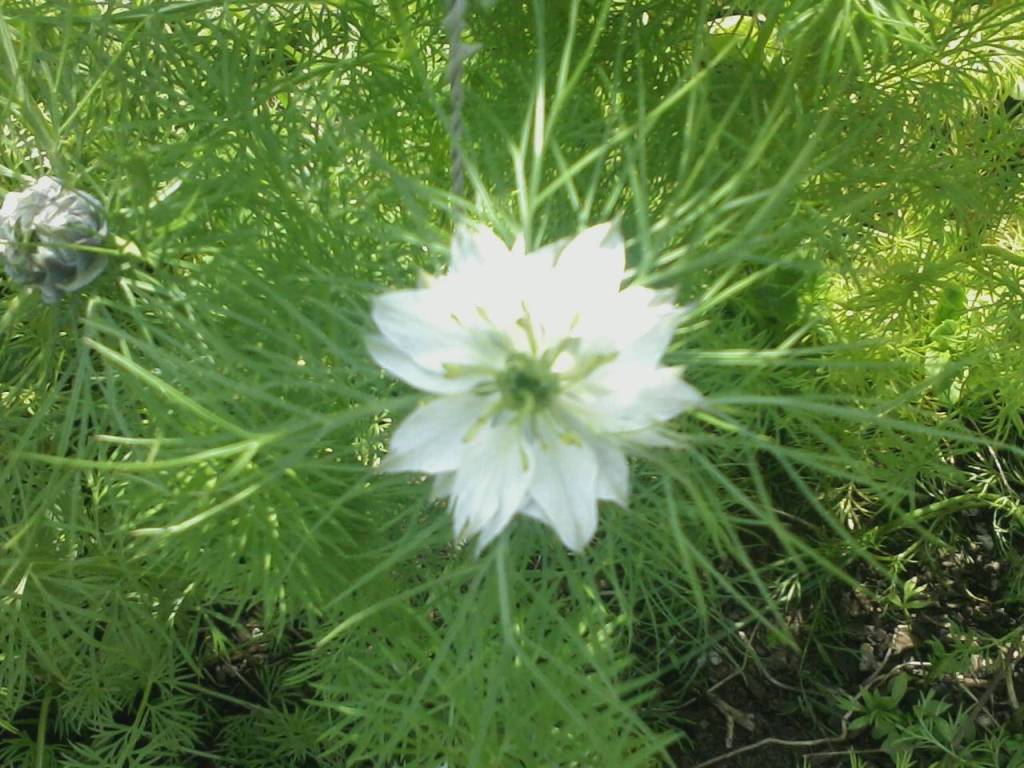
Nigella

Nigella is more typically blue, but can alternatively bloom white, pink or lavender.

Those who crave blue for the garden probably know nigella, or ‘love-in-a-mist’, Nigella damascena. It blooms in May and June, typically with various shades of pastel blue, or can alternatively bloom pink, lavender or white. The lacy flowers are surrounded by lacier bracts, and suspended on thin stems among delicate pinnately lobed foliage, with very narrow (‘thread-like’) lobes. The plump brown seed capsules that appear over summer after bloom are commonly used as dried flowers. The plants can be half a foot to a foot and a half tall. Although annual, nigella self sows easily, so can grow in the same location for many years if allowed to.

Between A Rock And A Hard Place

P00509K
Where does this delightful columbine think it is?!

Columbine does not do well here. I do no know why. It does well enough in Colorado to be the Official State Flower there. Yet, the mildest of climates is Colorado are harsher than the climate here. It does not get too terribly warm in summer here. Humidity is minimal, but not as minimal as in much of Colorado. Nor does it exceed that of other regions where columbine does well.

We have certainly tried to grow columbine. It just does not work. Some of it succumbs to powdery mildew. Some succumbs to rust. The last batch just succumbed. Because it was expected, I did not bother to investigate. I got the impression that it was taken out by both powdery mildew and rust. Flowers that bloomed so delightfully when planted went to seed on their way out.

That should have been the end of it. I would not mind if someone tries again to grow columbine for next spring, even if it last for only a short while. I just do not expect to see it ever perform well here. None was planted this year. Even if someone had considered it, there was no need to add any prior to furlough, while cool season annuals for winter continued to bloom so happily.

What I certainly did not consider was the few seed that the last batch of columbine tossed almost a year ago. Apparently, at least one of those seed fell from the ledge where its parent plants lived briefly in now absent planter boxes, and into the edge of a small landscape below. It grew into an exemplary specimen of columbine, which is happily blooming as if it were in Colorado!

It is surrounded by a concrete retaining wall, a perpendicular granite wall and a big granite boulder!


Unidentified Cyclamen

P00112
What species is this naturalized Cyclamen? hederifoliumcoum – feral persicum – or something else?

Could this be Cyclamen hederifolium? Perhaps it is some sort of Cyclamen coum, or possibly feral Cyclamen persicum. I really do not know. Common florists’ cyclamen is the only cyclamen that I have any experience with. I grew it as a perennial when I was in high school, but never saw any feral colonies growing from self sown seed. I have never met the other species before.

Several colonies of this naturalized species of Cyclamen grow wild in the garden of a colleague. No one knows how they got there. I noticed them while procuring specimens of what might be other species that I have been wanting to grow, even though I am not certain of their identities either. I suspect that one could be Sorbus americana, and that another could be Rhus glabra.

I have been wanting to try growing Cyclamen hederifolium or Cyclamen coum since I saw it in pictures of home gardens in other regions. It looks something like common florists’ cyclamen that I enjoyed growing so many years ago, but more natural and relaxed. As much as I like florists’ cyclamen, the brightly colored flowers look a bit too synthetic for naturalistic landscapes.

Even though interesting species of Cyclamen have been available online and from mail order catalogs for at least the past several years, I have been hesitant to try any. I just do not know if they would be happy in forested landscapes where I want to grow them. Not many perennials perform well with so much overwhelming and mildly toxic debris from redwoods and live oaks.

Now I can see that they perform well enough here to naturalize, even under big and messy coast live oaks. In fact, I am now concerned that they have potential to become invasively naturalized in surrounding forests.

Rose Campion

80606Rarely planted but often found where the wildflowers grow, rose campion, Silene coronaria, has a way of sneaking in like California poppy or sweet alyssum do. It is so rarely planted that young plants are rarely available in nurseries. Seed is somewhat more available in nurseries, and quite available online. Although they self sow freely if allowed to go to seed, they are not really invasive.

The velvety gray foliage is pretty alone, and becomes a perfect backdrop for the surprisingly bright magenta, regal red or pure white flowers that bloom through early summer. Most of the foliage forms low mounds not much more than a foot wide, while flowering stems stand almost twice as tall. Flowers are ideal for cutting. Hummingbirds enjoy magenta and red flowers more than white.

Individual plants can last for a few years as short term perennials, but because they seed profusely enough to replace themselves annually, they are often grown as annuals, and pulled up before new seedlings appear. Those who last for a second year should probably be groomed. If seedlings are crowded, some can be pulled up and relocated while young. Rose campion wants full sun.

Epiphyte

P71108A plant that clings to another plant for support without parasitizing it is an epiphyte. Some do it to get a bit more sunlight closer to the ceiling of a dense forest. Others do it to get up off of the forest floor to avoid competition with conventionally terrestrial plants. Maybe some just want to avoid grazing animals. It is often difficult to determine why plants do what they do.
Spider plants, ephiphyllums and many types of orchids, bromeliads and ferns are some of the more familiar epiphytes. Most do not actually cling to trees. They instead live in the crotches of limbs where debris from the foliar canopy above accumulates. Either way, they do not need much organic matter in which to disperse their roots, and some need none at all. Many collect what they need from the air and precipitation.

This is not about an epiphyte.

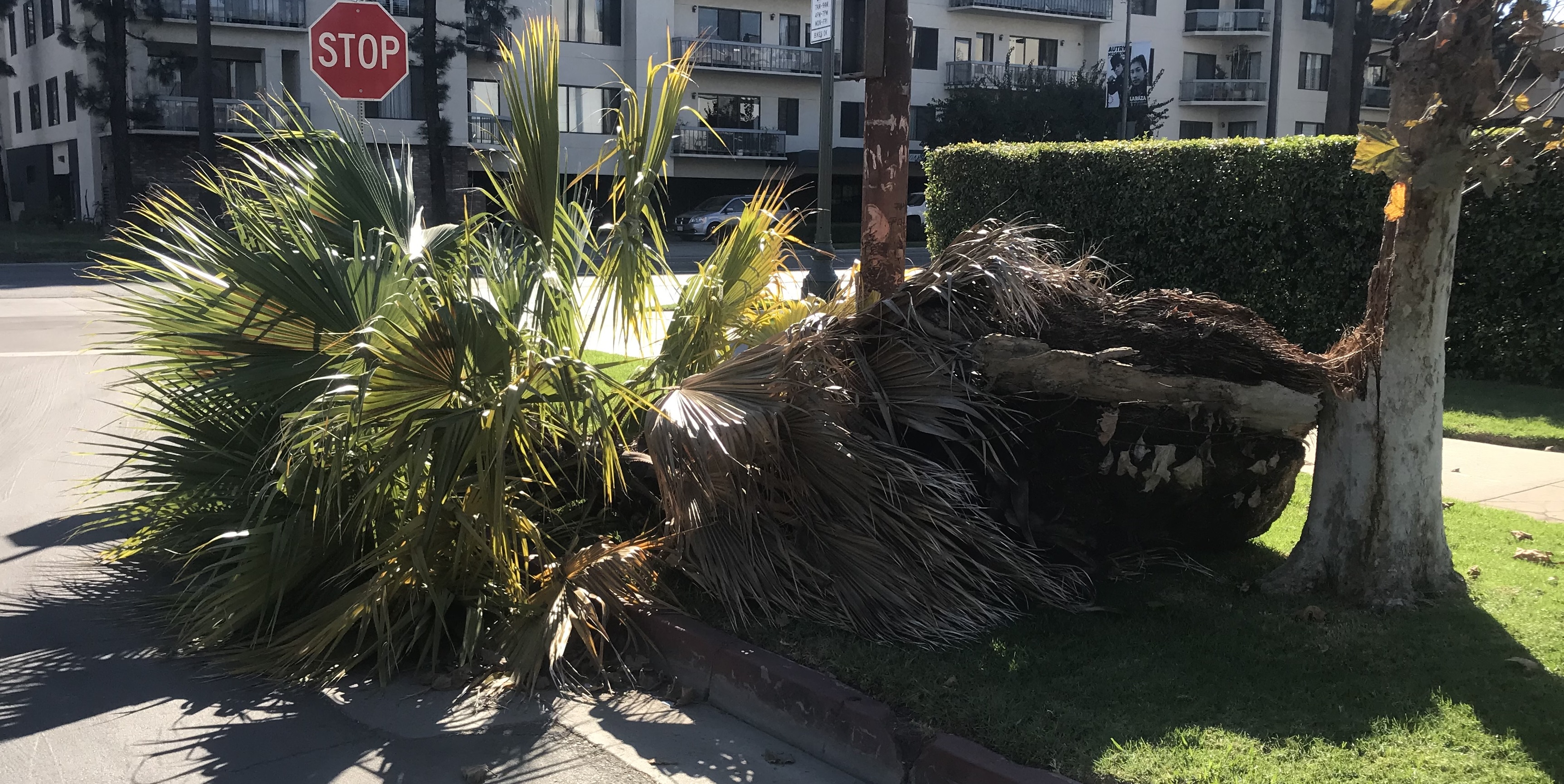
It is about a Mexican fan palm that thought it was epiphyte.

You might have though that the picture above depicts a common Mexican fan palm next to a surly London planetree. With closer inspection, you will notice that the palm lacks a trunk at ground level. The utility pole visible below the palm is not attached to it, and does not support it. Yet, the palm does not just hover there. It grew from a cavity in the London planetree.

Most of us know how many plants self sow in weird places. Sometimes they appear where they are welcome. Usually, they end up in pots with other plants, too close to pavement, or in rain gutters that have not been cleaned out enough. Of course, big trees commonly appear under utility cables. Once in a while something self sows in a decaying cavity of a tree.

Most of us have enough sense to remove self sown trees and plants that appears where they can not live for long without causing problems. Those of us who hire gardeners tend to trust and hope that the gardeners would exhibit the same sort of common sense. After all, that is part of what they are payed significant money for.

Unfortunately, Mexican fan palms are not epiphytic. They are just too heavy, even when young.

P71108+