Where it grows wild in the eastern half of North America, honey locust, Gleditsia triacanthos, may not seem like it would be such an appealing shade tree. It is too thorny and messy to make many friends. As it matures and grows nearly seventy feet tall and half as broad, the thorny stems stay overhead and out of the way. However, a larger canopy makes more messy and sometimes unsightly foot long seed pods.
Modern cultivars of the thornless form Gleditsia triacanthos inermis are friendlier and not so messy. Mature trees only grow about half as tall as wild trees. Their main problem is their buttressing roots, which can displace pavement, but stay tolerably low for lawns. Honey locust is actually a good shade tree for lawns (if minor buttressing is not a problem) because it makes just enough shade without getting too dark for a lawn or other shade tolerant plants below. Pods are rare.
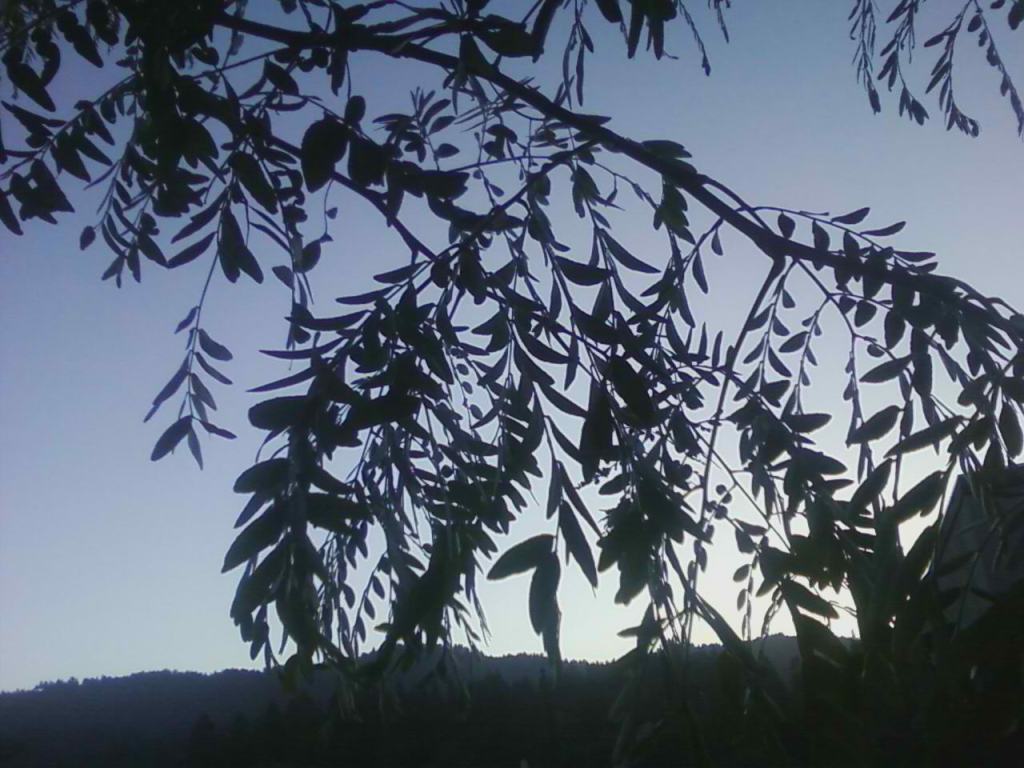
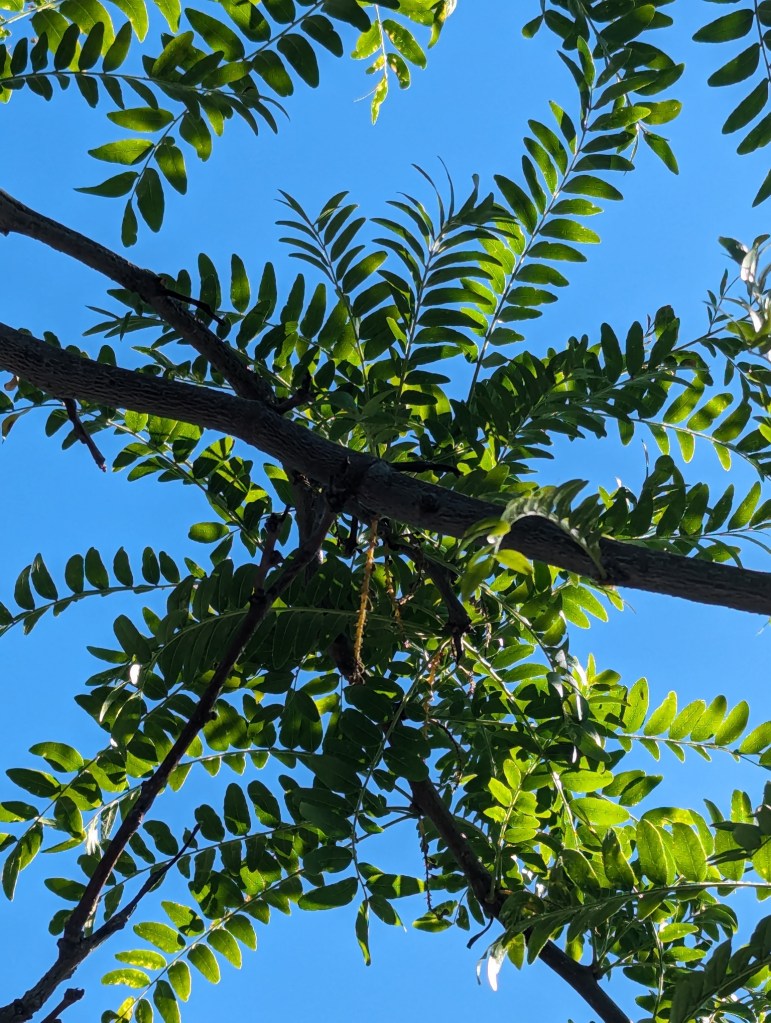
The big eight inch long leaves are bipinnately compound, which means that each leaf is divided into smaller leaflets, which are also divided into even smaller leaflets that are about half an inch long. Although individual leaves are actually quite large, the collective foliage is pleasantly delicate and lacy. This foliage turns yellow early in autumn and disintegrates as it falls, leaving minimal debris to rake. New foliage develops somewhat late in spring, along with inconspicuous flowers.
Understory plants, which tolerate various degrees of shade, are more popular than ever. Basically, smaller modern gardens amongst larger modern homes are shadier than ever. Densely evergreen trees that provide privacy for such gardens also provide more shade. Sunlight can be scarce. It may be helpful to know where to locate optimal sun exposure.
The sun moves from east to west as each day gets warmer. It does so more or less to the south of vertical. It is a bit farther to the south for winter than for summer. Such orientation and motion determine sun exposure within home gardens. Each side of a house, garage or fence faces one of such exposure or another. Eaves might provide shade from above.
Eastern exposure is good for plants that crave some direct sun exposure but not warmth. Azalea, rhododendron, andromeda and hydrangea prefer such exposures. They receive enough sunlight to bloom, but not so much that their foliage scorches. They enjoy partial shade before sunshine gets uncomfortably warm. Eastern exposures are sunny but cool.
Northern exposure is good for plants that do not require much sun exposure. Hydrangea may be somewhat lanky within such situations. Clivia, elephant ears, philodendrons and ferns may be better options. Upper floors and eaves significantly enlarge the shadows of northern exposure. Shadows are also larger in winter while the sun is lower to the south.
Western exposure is good for plants that crave both direct sun exposure and warmth. It is the opposite of eastern exposures, but is certainly no less sunny. It is merely warmer. Lily of the Nile, lavender, oleander and bougainvillea enjoy such sunny warmth. Some types of ferns and elephant ears may scorch with such exposure. Eaves delay direct exposure.
Southern exposure is good for plants that crave full sun exposure, but tolerate heat. Most plants that enjoy western exposure can also enjoy southern exposure. Many vegetables, with regular watering, are more productive with such exposure. Eaves provide shade for the warmest summer weather. They provide less shade while the sun is lower for winter.
Pavement necessitates trees with complaisant roots.
Trees of substantial size are not as popular as they had been among old home gardens. Modern landscapes of bigger homes on smaller parcels can not accommodate as many. Clearance from various infrastructure is now more of a concern than shade. Within many modern urban gardens, most available space is in front. Such is the realm of street trees.
This is not because of a lack of obstacles, such as infrastructure that requires clearance. It is more because such obstacles are closer to the ground with more open space above. Many street trees must actually be more adaptable to certain constraints than other trees. Selection of such trees, if allowable by their municipalities, necessitates diligent scrutiny.
Street trees are, most simply, trees between curbs and sidewalks. Some inhabit medians while others are adjacent to curbside sidewalks. Many municipalities prescribe particular trees for particular situations. Anyone who is uncertain of such limitations should inquire. Many municipalities permit property owners to install any trees they prefer, or none at all.
For those who can select street trees, such trees must be appropriate to their application. They must grow high enough to not obstruct sidewalks or roadways. Both sidewalks and roadways require minimal clearances. So do street signs, streetlamps and traffic signals. However, street trees should not grow too large for the confined spaces that they inhabit.
This includes their roots. Aggressive roots of willows, poplars and sweetgum are likely to displace pavement. Oaks, although too big for confined situations, are more docile. Their roots are less likely to displace adjacent infrastructures. Crape myrtle has become overly common because it is too small to cause damage. It does not make much shade, though.
Crape myrtle might also get rather messy, which is another consideration for street trees. It drops flowers during summer, and can get infested with scale, which exude honeydew. Magnolias drop flowers that can be a slipping hazard. Whether deciduous or evergreen, street trees should be reasonably tidy. Over roads, they should not need much attention.
Shade influences every ecosystem. Where it is scarce, some vegetation adapts to harsh exposure to sunlight. Some develops glaucous foliar color to reflect some of the sunlight. Some develops tomentum, or foliar fuzz, to shade its foliar surfaces below. Where shade is abundant, understory vegetation adapts as efficiently. Essentially, it is made for shade.
Understory vegetation naturally grows beneath larger trees and shrubbery. It is therefore more tolerant of partial shade. Some tolerates significant shade. Ferns that inhabit forest floors beneath shady redwood trees are notable examples. So are most houseplants that originated from tropical rainforest. Naturally, most live in the shade of bigger forest trees.
Not all understory vegetation is diminutive. Some Japanese maple trees can grow rather large. However, they naturally inhabit forests of trees that grow larger. Some palms begin as understory vegetation to become the tallest trees of their gardens. Their foliage simply adapts as it becomes more exposed. Banana and tree fern foliage might adapt similarly.
Such adaptation is an advantage now that home gardens are becoming shadier. Modern homes are taller, so produce bigger shadows than older homes. They are closer to other tall homes with comparable shadows. Fences are higher to compensate for the proximity of homes. Garden spaces are more compact, with less space that is not partially shaded.
No vegetation survives without sunlight. Understory vegetation is simply more tolerant of partial shade than most other sorts. It is adapted to it, just as some vegetation is adapted to extreme exposure. Generally, understory vegetation is deep green, to absorb as much sunlight as possible. For the same reason, individual leaves are typically large and lush.
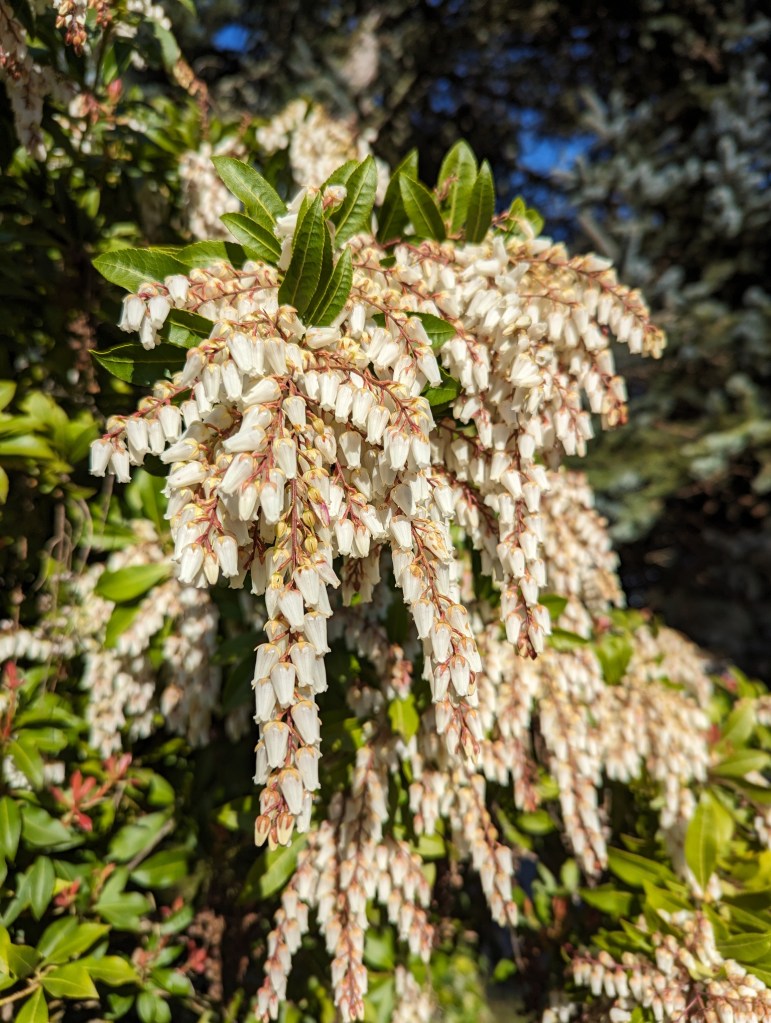
Cast iron plant seems to tolerate more shade than any other understory vegetation. Kaffir lily and hosta tolerate almost as much shade as some ferns. Rhododendron, azalea and andromeda prefer only partial shade. Excessive shade inhibits bloom. The same applies to camellia and hydrangea. Realistically, all species of understory vegetation are unique. Each tolerates a particular degree of shade that it is adapted to.
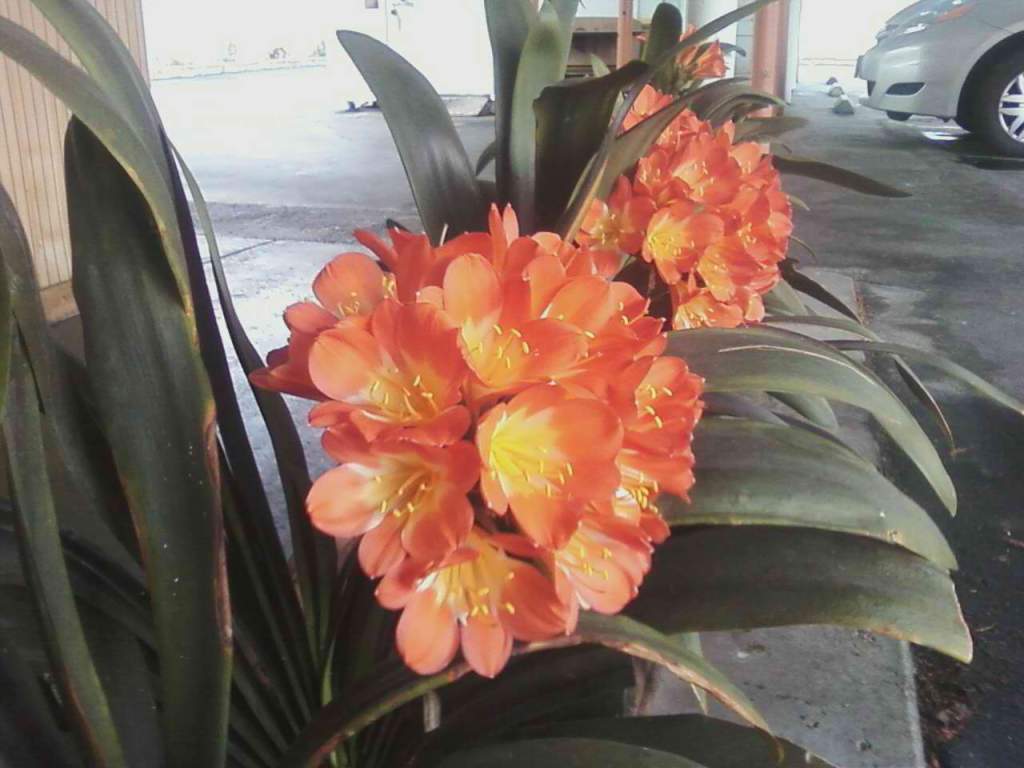
Kaffir lily may look like a bright orange lily of the Nile.
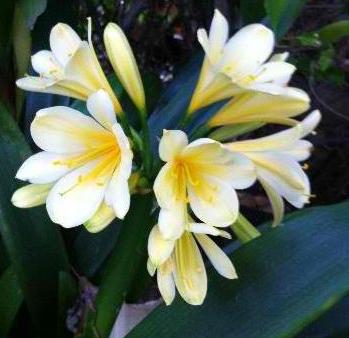
Not much more than a decade ago, Kaffir lily, Clivia miniata, was known almost exclusively for big rounded trusses of boldly bright orange flowers at the end of winter or beginning of spring. Relatively recent breeding has extended the color range to include some softer shades of orange as well as many shades of yellow and reddish orange. Solomone Hybrids are various shades of yellow. ‘Flame’ is brilliant reddish orange. Some varieties bloom earlier in winter. Others bloom later in spring.
Individual tubular flowers are actually rather small, but are clustered like hydrangea flowers on strong stalks that stand as tall as a foot and a half. Bright red berries sometimes appear after flowers fade. The rather rubbery foliage is deep green. The individual strap shaped leaves are rather wide and can be nearly a foot and a half long. Belgian and French hybrids have heftier flower stalks and wider leaves. Established plants do not like to be disturbed, but may get too crowded to bloom well if not dug and divided every few years or so.
Most gardens have some sort of shade. Those that are not shaded by substantial trees likely have shadows from houses or fences. Big eaves of ranch architecture make big shadows. So do tall Victorian houses. Yet, the disproportionately small gardens of bulky modern homes with high fences are shadiest.
There are not many trees that do well in shade. Most of those that do are rather small ‘understory’ trees that naturally prefer to be in the partial shade of taller trees. The many different Japanese maples are perhaps the most familiar. Vine maple is a similar maple from North America. Many dogwoods are likewise understory trees.
Eastern redbud, parrotia, strawberry tree, sweet bay and various podocarpus are not necessarily understory trees, but are quite tolerant of partial shade. However, stems that reach beyond the shade are likely to thrive at the expense of shaded parts if not pruned for confinement. For example, a fern pine (podocarpus) can be happy on the north side of a house, but can develop such a thick canopy where it gets good sun exposure on top, that lower growth gets shaded out. All palms tolerate significant shade while young, but most eventually grow beyond it.
There is more shade tolerant shrubbery to choose from, since shrubbery is naturally lower and more likely to be shaded by trees. Rhododendron, azalea, camellia, hydrangea, pieris, fuchsia, aucuba and Japanese aralia are about as familiar as Japanese maple is. Heavenly bamboo (Nandina spp.), Oregon grape, mountain laurel, flowering maple and various hollies are also worth investigating.
Because low growing perennials are naturally lower than both trees and shrubbery, many are naturally more tolerant to shade. Bear’s breech, cast iron plant, perwinkle, tradescantia, arum and forget-me-not can be so happy in shade that they can actually be invasive. Kaffir lily, bergenia, hosta, lily turf, ginger lily, coral bells and various ferns are much better behaved.
Foxglove, cyclamen and balsam (Impatiens spp.) are good annuals for shady spots. Cyclamen is actually a perennial that deteriorates during warm summer weather, but can regenerate as weather gets cool in autumn, to bloom through winter and early spring. Balsam does just the opposite, thriving through warm weather, but deteriorating with frost. Caladium and coleus can provide remarkably colorful foliage until frost. (Foxglove is actually biennial. Caladium grows from bulbs, but is rarely perennial.)
Despite their reputation as being aggressively invasive, both Algerian and English ivies can be resilient ground covers in significant shade. Baby’s tears likewise spreads as far as it gets water. Star jasmine is more complaisant, but only tolerant of moderate shade, and will not bloom as well as it does with better exposure.
Hellebore may not tolerate much arid warmth, but is impressively tolerant of partial shade.
Suburban gardens are becoming shadier. More modern homes are taller than a single story, so make larger shadows. Taller and more fortified fences likewise create more shade. Smaller garden spaces of modern homes, or of older homes that have been added onto, have less sunny area away from the shadows of the associated homes and fences. Even large gardens of low profile homes lose sunlight as shade trees grow.
Most plants that prefer or at least tolerate shade are ‘understory’ plants; which means that they naturally live in the shade of larger plants. Consequently, most of the few trees that tolerate shade do not get very tall. Vine maple, dogwood, Japanese maple, Eastern redbud and many podocarpus are small to medium sized trees. All palms tolerate some shade, although most grow tall enough to eventually get above it.
Aucuba, boxwood, euonymus, Japanese aralia, holly, Heavenly bamboo and some pittosporums are among the evergreen shrubs that provide foliage in partial shade. Andromeda and Oregon grape have both appealing foliage and flowers. Sarcococca, daphne and gardenia flowers are not quite as showy, but are remarkably fragrant.
Rhododendron, camellia and mountain laurel provide some of the most colorful flowers in partial shade, and have good evergreen foliage while not blooming. Fuchsia and abutilon are rather lanky shrubs, but do have interesting flowers. Hydrangeas are deciduous, so can have good fall color after providing nice foliage and big billowy blooms through summer.
Both Algerian and English ivies, as well as star jasmine, are climbing vines that enjoy partial shade. (Although the ivies cling to whatever they climb, so should be confined to where they will not ruin paint or siding). Star jasmine does not bloom as well or nearly as fragrantly in shade as it does in sunny areas, but has good foliage nonetheless. Any of these vines, as well as periwinkle, is good ground cover for shady spots.
Cast iron plant and arum are not only tough perennials that produce rich deep green foliage in the shade, but can actually become invasive and are difficult to eradicate once established. Bear’s breech is comparable, with the advantage of striking flowers, but the disadvantage that it defoliates through warm summer weather. Various ferns are perhaps the most familiar and complaisant foliar perennials for shade. Lily turf is an evergreen flowering perennial, but realistically, has better foliage than flowers.
Clivia miniata, bergenia and hardier begonias are grown for their colorful flowers as much as for their rich foliage. Clivia miniata is like lily-of-the-Nile for the shade, but blooms with shorter bright reddish orange, red or yellow flowers instead of soft blue and white on tall stems. Some of the various campanulas are delicate shade tolerant perennials with pale blue or white flowers.
Cyclamen, primrose, viola, pansy, forget-me-not, foxglove and impatiens are seasonal annuals that do not mind partial shade. Cyclamen and primrose are actually perennials that can survive through summer to resume bloom the following autumn. Impatiens is actually a warm season annual for summertime that can survive as a perennial through winter.
Sunshine promoted bloom to the left. Shade inhabited bloom to the right.
Naked ladies like exposure. Amaryllis belladonna can certainly survive and actually develop lushly healthy foliage in partial shade. However, it needs sunshine to bloom. This picture above, which was recycled from yesterday when I mentioned that I might elaborate on it later, demonstrates how discriminating this species is. As mentioned yesterday, a row of naked lady bulbs extends completely across the picture from left to right. It does not extend only from the left to the middle of the picture, as the bloom might imply. Now that bloom is finishing, foliage will develop throughout the entire row, including the portion of the row that currently lacks bloom, so that the extent of their herd will be more apparent. The lack of bloom to the right is the result of the shade of a densely foliated coast live oak above. Because coast live oak is evergreen, it shades the area below its canopy through winter, when naked lady is also foliated and storing resources for subsequent late summer bloom. Those that do not get sufficient sunshine to initiate bloom within any particular season will be unable to bloom for the beginning of their subsequent season. When we installed these recycled bulbs here, we considered that bloom would likely be inhibited below the coast live oak, and that we would relocate bulbs that were too shaded to bloom, but we expected more of a transition between the shaded area and the sunnier area. This is so blunt, with bloom to the left, but none to the right. At least we now know precisely which bulbs to relocate while they are dormant next summer. Although there is technically no need to relocate them, and they can be adequately healthy here, they would be more appealing within a sunnier situation that would promote bloom.
Poor man’s rhododendrons is less colorful but more perennial than the more popular busy Lizzie Impatiens walleriana.
The nursery industry is so innately unsatisfactorily lucrative, that to us nurserymen, a ‘poor man’s rhododendron’ is any rhododendron that we grow. To everyone else, it is Imaptiens sodenii, a tender perennial that gets to six feet tall and wide or even larger on plump, softly succulent stems. It succumbs to even mild frost in winter, but regenerates rapidly by summer. It prefers partial shade, and can roast if too exposed to direct sunlight on warm days. Too much shade is rarely a problem.
The two inch wide flowers are typically very pale shades of pink, lavender or slightly blushed white. At least one modern variety has brighter white flowers with reddish pink centers. Bloom continues as long as weather is warm. The seed capsules are not much to look at, but explode to disperse their seeds when disturbed. The soft, rich green leaves are about three to six inches long.
Within its native range, wild thorny honey locust, Gleditsia triacanthos, is a nasty tree! Its wicked thorns are typically as long as four inches but can be twice as long. Some branch into many thorns or thick clusters of thorns. Thickets of many trees can be impenetrable. Female trees produce a messy abundance of brown pods that are about half a foot long.
Fortunately, its cultivars are much more docile. Most are exclusively male, so produce no pods. Old fashioned cultivars that might produce pods as they mature are now rare. More importantly, cultivars are thornless. That is why their common name is now honey locust rather than thorny honey locust. They are as remarkably resilient as the simpler species.
Most cultivars of honey locust grow no taller or wider than fifty feet here. Some grow only half as tall. Some of the more popular cultivars are brightly yellowish green for spring. At least one is ruddy bronze for spring. The finely textured foliage provides dappled shade. Leaves are pinnately and bipinnately compound, and turn yellow for autumn defoliation. Individual leaflets are less than an inch long, so can be difficult to rake.




 Tony Tomeo