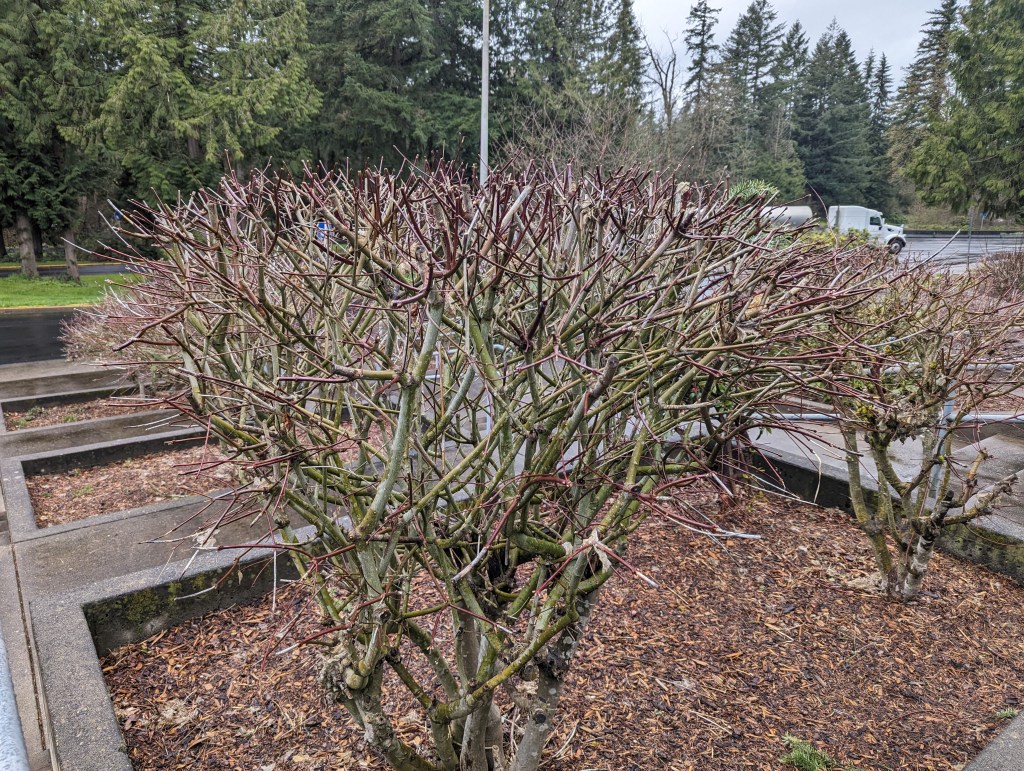
Shear Abuse

an . . . extreme example

Rosemary happens to be one of the many plants that is perhaps too versatile to be respected. Low ground cover forms and sculptural upright forms are probably at their best without much attention. Shrubby forms can instead be shorn strictly into neat formal hedges.

The problem is that most rosemary eventually gets shorn and deprived of natural shape and texture, whether it needs it or not. Those that should be upright and sculptural become rounded over like bean bag chairs. Ground cover forms without their naturally soft texture are like flattened hedges. Those that should be shorn are seldom shorn properly for confinement, so become distended and obtrusive.

The many different kinds of juniper are similarly disgraced. Instead of becoming sculptural small trees, Hollywood juniper and Eastern red cedar more commonly get shorn into nondescript shrubs. Shrubby types get shorn so often that their appealing textures are  never appreciated. Only a few of the densely foliated and compact junipers are conducive to formal shearing.

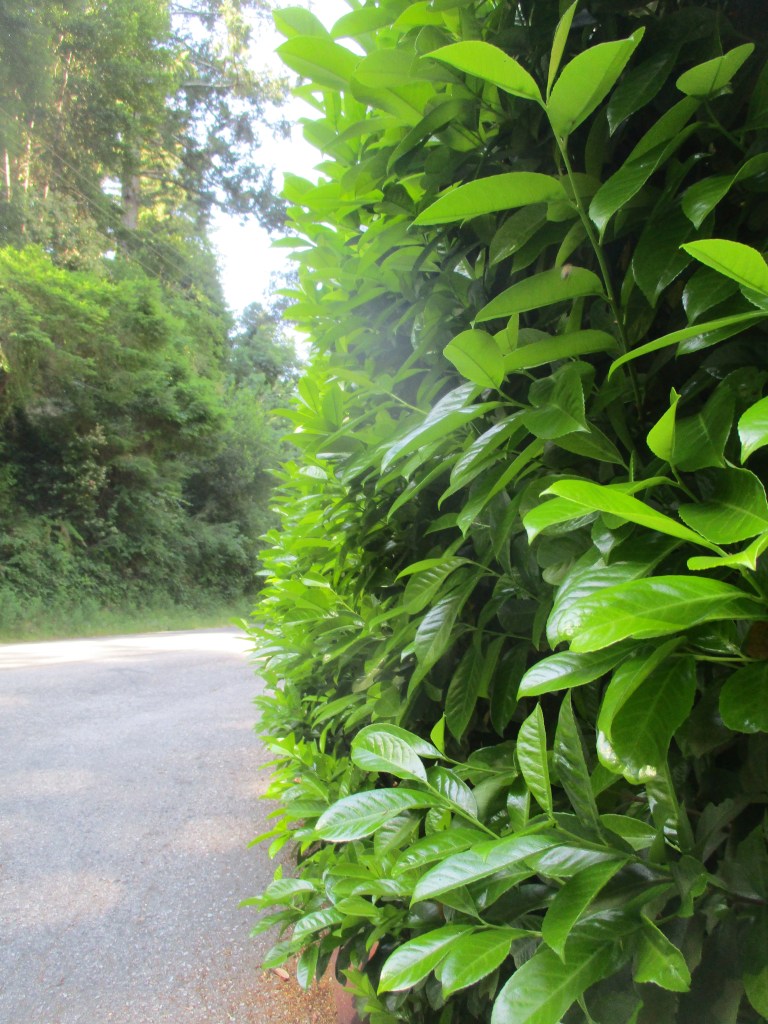
Shearing is certainly practical where formal hedges are desired, and for plants that have sufficiently dense and finely textured foliage. Yet, it is still important to shear such plants properly. Hedges should be slightly narrower at the top and wider at the bottom, so that lower foliage gets good sun exposure. Vertical surfaces are acceptable; but hedges should not be wider on top and narrower on the bottom.

Hedged or shorn plants should not be allowed to sneak out of their confinement to become obtrusive to usable space. For example, hedges along a driveway should not become so deep (from front to back) that they occupy usable space where cars could otherwise park. They function just as well if three feet deep as they would if they were eight feet deep!

Most hedged plants that should not have been hedged can be salvaged with a bit or work. Unfortunately, the process can be quite involved and makes the shorn plants unappealing while they recover. Overgrown privet hedges can simply get cut back to bare limbs (late in winter) and allowed to sprout back. They should be cut back farther than they need to so that new growth has room to expand.

Overgrown photinias are not so tolerant to severe pruning, so need to be cut back selectively to allow sunlight into the interior. The largest and most obtrusive growth can be cut out completely at first, as long as some lower growth remains to sustain recovery and shade interior stems. As new growth emerges from within, more of the overgrown outer growth can get removed until it is replaced.

Alternatively, overgrown photinias, as well as oleanders, osmanthus, large junipers and some pittosporums can be allowed to grow wild on top if their obtrusive lower growth gets pruned away. Such overgrown plants often have appealing trunks within. The only problem is that hedges pruned up into rows of small trees do not obstruct lower views as they may have been intended to do, unless they get pruned up only on one side.

Remember that shearing is not the only option. Properly pruned plant are allowed to grow into some spaces, but not where they will get in the way. Natural growth habits should be exploited instead of oppressed.
Shearing Is Not For Everyone

So much lost potential

Back before gardening was cheapened to the degree that it is now, and before most of everything within reach was shorn into submission, many plants were pruned, or not pruned, as necessary to enhance their naturally appealing characteristics. New Zealand flax got planted where it had room to reach out, and only got ‘plucked’ as shoots ventured too far from the center. Lily-of-the-Nile got ‘chopped’ where it crept too far, and ‘thinned’ where it got too crowded to bloom.

Only hedges were shorn; and they were shorn properly, to be slightly narrower on top. Trees actually grew as trees above, and got pruned for clearance below. Vines were selectively groomed, but allowed to climb their trellises. Deciduous fruit trees got the specialized pruning that they require in winter.

Many different kinds of plants that produce generally vertical stems from the base were maintained by a pruning technique known as ‘alternating canes’. This procedure is almost opposite of removing watersprouts or suckers (watersprouts that develop below a graft union) to favor a primary stem. It is actually the removal of primary stems as they get replaced by their own basal watersprouts.

For example, glossy abelia is naturally rather limber with upright growth that spreads outward. Without pruning, it can become an overgrown mounding thicket. However, shearing deprives it of its naturally appealing form, and interferes with bloom. Instead, the technique of alternating canes removes older canes as they begin to deteriorate, allowing new canes to grow more vigorously, arching gracefully outward from the center.

Elderberries and pomegranates may not actually require regular pruning, but are easier to manage if some basal stems are allowed to mature and replace tall and awkward older trunks. The newer growth is more productive (after the first year), easier to reach, and simply looks better. Alternating canes also promotes bloom while preventing thicket growth of mock orange and lilac, particularly since they produce such abundant basal growth.

Heavenly bamboo (Nandina spp.) and real bamboo are two completely different and unrelated plants that both benefit from alternating canes. Heavenly bamboo likes to get its deteriorating or floppy older stems cut to the ground, to allow more space for fresh new foliage to unfurl. Bamboo simply needs old canes cut out as they die.

Horridculture – Queen Nefertiti

Ancient Egyptian influence within a modern landscape

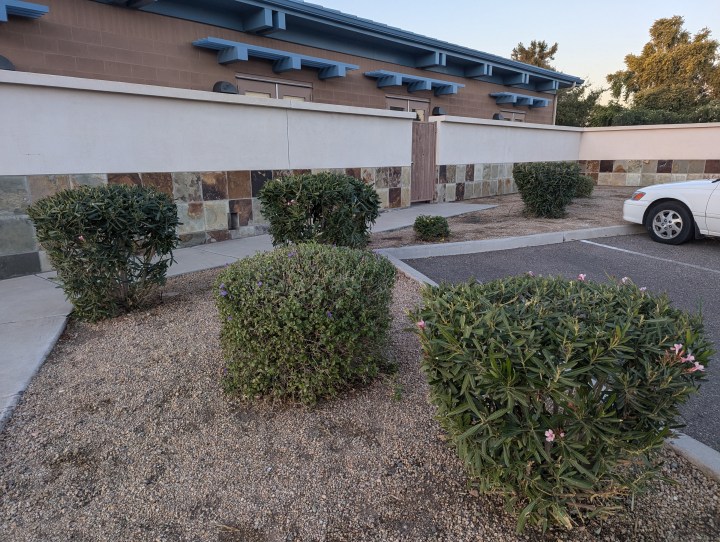
Queen Nefertiti, during the fourteenth century BC, was the most famous and most influential Queen of Ancient Egypt. She wore a cool hat too. It was sort of cylindrical shaped, but also tapered so that it was wider on top, sort of like a funnel. So, not only was Queen Nefertiti very influential during her time, but she remains influential in modern mow, blow and go gardening. So-called ‘gardeners’ everywhere still shear shrubbery into the shape of Queen Nefertiti’s cool hat! Not many species of shrubbery are exempt. Just about any get shorn into a sort of cylinder shape that is wider on top, sort of like a funnel, but also tilted in one direction or another, just like Queen Nefertiti’s hat tilts toward the back. Such shearing typically deprives blooming shrubbery of its bloom, but bloom is apparently not a priority, as long as the ancient Egyptian form is maintained. The picture above includes four oleanders, a Texas sage and what seems to be two trailing lantana. The Texas sage and trailing lantana are more cylindrical than hat shaped, but the hat shape of the three oleanders is impossible to deny. It is such a universal technique that is performed so precisely wherever vegetation is maintained by mow, blow and go gardeners that it seems to be taught in classes as standard procedure. I am significantly more educated in horticulture than most mow, blow and go ‘gardeners’, but I somehow missed this in my curriculum. Instead, I learned that vegetation should be allowed to exhibit its natural attributes, such as form, texture, bloom and so on. If I wanted a herd of ancient Egyptian hats in my garden, I would probably construct something that resembled ancient Egyptian hats from an inert material that never needs shearing or irrigation.

the Original
a modern version of an ancient Egyptian fashion show

Many Pruning Techniques

Proper pruning enhances performance rather than compromise it.

If gardeners can reach it, they will most likely shear it. They do not mind if it was intended to be a shade tree, a flowering shrub or even a sculptural succulent. Few will take the time to prune and groom properly. Ironically, formal hedges that actually need to be shorn are rarely shorn properly! 

Most of us fortunately are not gardeners, but merely enjoy our gardens. We know the importance of proper pruning, and that various plants need different pruning techniques. The main difficulty is determining which techniques are best for each type of plant in our gardens.

Shearing is primarily for hedges; which by the way, should be slightly narrower up high, and slightly wider down low in order to optimize sun exposure to all parts. Generally, plants that are grown for their flowers, fruit or natural form should not be shorn regularly.

Fruit trees and modern roses need the most specialized pruning while dormant in winter, so are not recommended for ‘low maintenance’ gardening. Their specialized pruning thins out superfluous growth, concentrating resources for fruit and flower production. Pruning also removes suckers (from below graft unions) and the ‘four Ds’; which are Diseased, Damaged, Dying and Dead stems. 

Most trees eventually need some sort of pruning to direct their growth. Limbs that are too low need to be pruned away to maintain adequate clearance from roadways, sidewalks, chimneys, roofs and anything else that they should keep their distance from. Lighting, road signs and views from cars coming out of driveways should not be obstructed. As larger trees mature, they eventually need the attention of professional arborists to maintain their health, stability and structural integrity.

Small trees like Japanese maple, Hollywood juniper and pineapple guava look much better with selective pruning and thinning to expose their natural forms. If they become obtrusive, such trees are very often pruned back for confinement. They should instead be pruned to direct their growth up and out of the way, so that lower obtrusive stems get removed, and upper growth can develop naturally.

Nandina, abelia, various bamboos, old fashioned lilac and other plants that produce new stems from the ground benefit from another type of thinning known as ‘alternating canes’. This involves cutting older canes to the ground as they begin to deteriorate or become overgrown. Alternating canes without any other pruning allows nandina to keep its distinctive foliar texture, and abelia to develop its distinctive arching branch structure.  

Horridculture – Graffiti

Is this some sort of abstract art?!

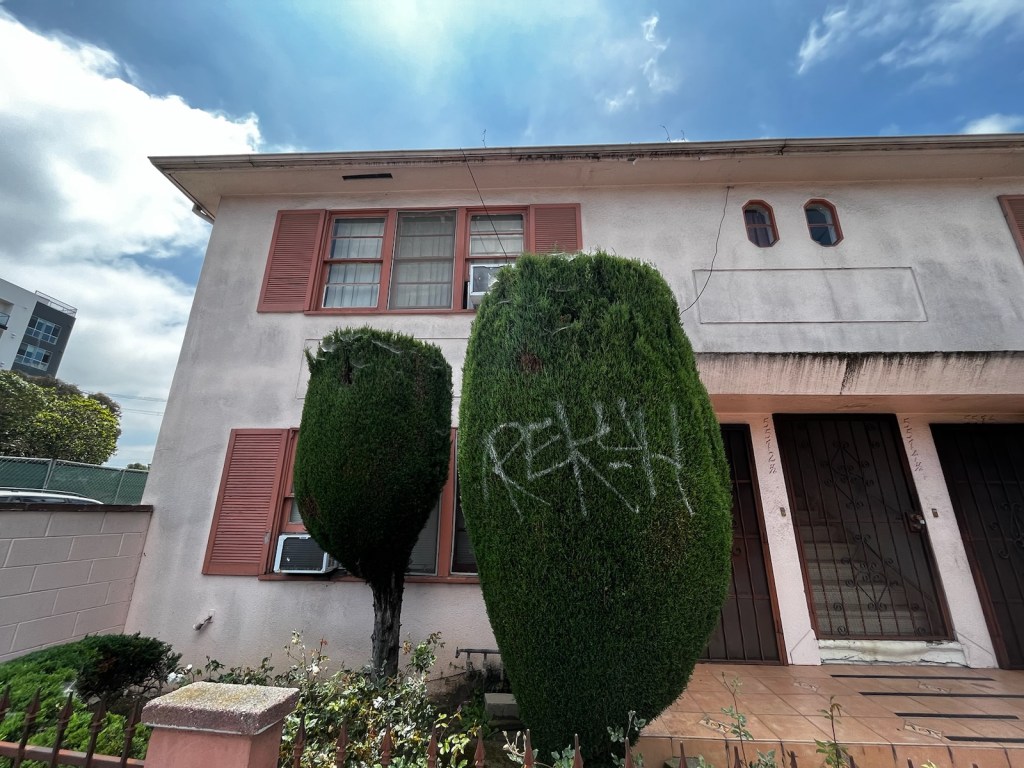
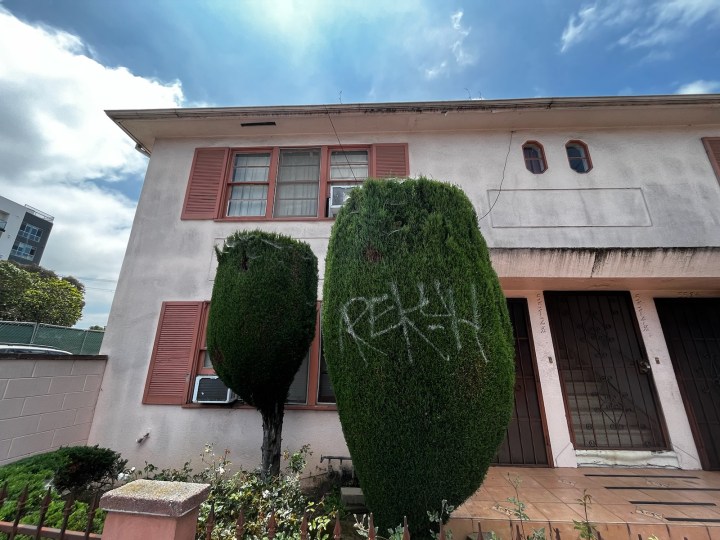
This picture is all sorts of wrong! Brent sent it to me from Los Angeles. He has a habit of sending obnoxious pictures such as this.

Firstly, why would anyone install Italian cypress in such pointless situations?! The specimen to the left is centered on a prominent window. It is an unsightly obstruction to the window, and would be just as unsightly and obstructive to the window above if only it had not been so severely disfigured. Although the larger specimen is a bit farther from the window, it is just as unsightly, obstructive and pointless.

Secondly, why would anyone disfigure Italian cypress by topping them like this?! It would be more practical to remove them if their naturally upright form is undesirable for this particular situation. Then, some other preferable vegetation could be installed instead, or perhaps nothing at all.

Thirdly, why would anyone maintain these already disfigured Italian cypress like this?! Just remove them already! They are unsightly! Seriously, someone obviously puts quite a bit of effort into shearing them so systematically. Are they that important?! Does someone actually like these pathetic trees in this pathetic condition?! Am I missing something here?!

Finally, or fourthly, how could someone make this situation any worse by defacing the larger of these two Italian cypress with graffiti?! Seriously, that takes a bit of effort also. Cut the trees down already! Why do these trees not simply die of embarrassment?! Is this supposed to be some sort of conceptual or abstract art?! Is this here merely to see what sorts of reactions it gets?! Can anyone even read what that graffiti says?! Perhaps it translates to “PLEASE CUT THESE TREES DOWN!” This picture leaves me with way too many unanswered questions. Well, if nothing else, these sad Italian cypress were strangely entertaining.

Improper Pruning Is More Work Than Proper Pruning

Vine maples should be small trees, not . . . this.

In the short time it took me to run to the back yard to get some big stakes and something to pound them into the ground with, the unfortunate deed had been done. I had come home to find that one of my neighbor’s new Canary Island pine trees had blown down. I also noticed that the gardeners were there; so I wanted to get the tree staked properly before the gardeners got to it. Sadly, as I returned with stakes, ties and a mallet, I found that the gardeners were faster. Instead of standing the small tree up and staking it, they had already shorn the formerly well structured canopy into a globular mound that was about the same size and shape as most other items throughout the landscape, for no other reason than it was within their reach.

This same landscape had egg shaped African iris ‘bushes’ that only rarely bloomed if they happened to get an errant flower stalk out between shearings, and short, round trumpet vine ‘bushes’ in front of hefty  but bare trellises that they were never allowed to climb. Everything that was within reach was shorn, even the underside of an elegant Chinese elm that really should have been pruned properly by an arborist. The landscape was actually well designed, but could not perform as planned because of the shear abuse.

I really do not mind proper shearing of particular shrubbery that is intended to be shorn. I actually like old fashioned privet or boxwood hedges. However, even hedges need to be shorn properly; and realistically, not much else should be shorn as often. If it needs to be shorn regularly, but is not a hedge, it is probably not the right plant material for the job.

Properly selected plant material is proportionate to its particular application. This certainly does not mean that it does not need to be pruned. Most deciduous fruit trees and roses need to be pruned aggressively every winter, and almost all plant material needs to be pruned in some manner at one time or another. The difference is that shearing is indiscriminate pruning of outer growth without regard for foliage, bloom or branch structure. This is fine for hedges, but disfigures many other plants, and deprives them of their blooms and natural foliar textures that they were planted for.

For example, wisteria is an abundantly blooming robust vine that becomes a gnarled shrub that cannot bloom if shorn. Heavenly bamboo (nandina) is grown for its graceful and colorful foliage, but becomes a grungy rigid thicket of tattered leaves and stems with shearing. Although some shrubby junipers can make nice low hedges, frequent shearing deprives them of their feathery texture.   

This is why it is so important to know what the various plants in the garden need. They can only perform as intended with the proper care and maintenance, which includes proper pruning. Hedges may only need to be properly shorn, but almost everything else needs to be selectively pruned, thinned, elevated (raised), divided, groomed, trimmed, trained or even cut back. 

Horridculture – Green Walls

It would have been easier to paint the wall green.

Foundation plantings were quite functional while eavestroughs and downspouts were prohibitively expensive prior to about the Victorian Period. They dispersed rain water as it fell from eaves above, in order to limit surface erosion and muddy splatter onto foundations, basement windows, and lower portions of walls.

Most foundation plantings were tough perennials, such as lily of the Nile, or low and densely evergreen shrubbery, such as English boxwood or Indian hawthorne. Some did not stay so low though. Long after eavestroughs and downspouts became common, some foundation plantings grew into obtrusive hedges in front of exterior walls. Some even obscured windows. Instead of dispersing moisture, they retain moisture and damp detritus that promotes rot of associated walls and infrastructure. Furthermore, they require maintenance, such as shearing. It would be more practical to paint a wall green than to leave overgrown foundation planting pressed up against it.

Vines are no better. They can be practical on reinforced concrete and cinder block, but not much more. Not only do they promote rot, but some destroy paint, siding and stucco. Vermin can get anywhere that vines provide access to.

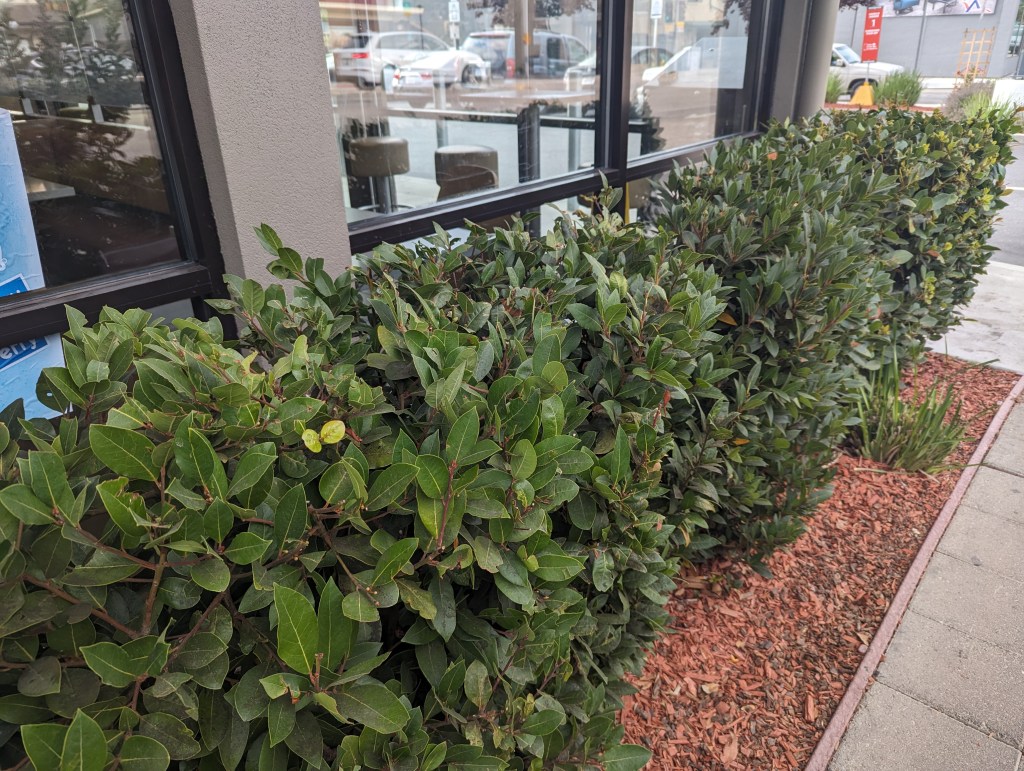
This is neither about vines nor foundation planting though. It is about this hedge in front of this glass facade. It got my attention because it did not grow slowly into this form from overgrown foundation planting, but was intentionally installed and shorn as such. Then, I realized that it is actually practical. It did not require modification of the wall. It is shorn to maintain a slight bit of clearance from the glass facade, to facilitate cleaning of the glass, and inhibit accumulation of detritus against the glass. Therefore, it does not look so bad from within. Perhaps it is comparable to painting the glass wall green, but is actually more visually appropriate.

Hedge Pruning Straight And Narrow

Hedges should not overwhelm their landscapes.

There are rules to hedging. Many hedges violate some of such rules. Formal hedges are the most egregious offenders. Their uniformity, symmetry and form require compliance to relatively strict standards. Relatively relaxed standards of informal hedges or screen are standards nonetheless. Almost every hedge eventually needs maintenance of some sort.

The primary difference between formal and informal hedges is uniformity. A formal hedge involves only a single variety of a species. Spaces between individuals of such a hedge are all the same. An informal hedge can involve more than one species. Spacing may be variable, even if for a single variety. Informal pruning is less strict than formal shearing.

Both types of hedges are generally utilitarian, as well as aesthetically appealing. Many provide privacy. Many obscure undesirable scenery. Some divide gardens into distinct spaces. Size and shape is very relevant to how effectively a hedge serves its purpose. Unfortunately, most hedges are significantly larger than necessary. Many are obtrusive.

This happens because their depth, from front to back, is easy to ignore. A healthy facade of dense foliage conceals wasted space within. It can slowly expand outwardly as each subsequent shearing procedure allows. Expansion is faster above than below, which is why so many hedges are wider on top. Distended tops shade and inhibit lower growth.

Obtrusive hedges are difficult to restore. Most require removal of their appealingly dense foliar facades. Such a procedure exposes unappealingly bare stems within. This should be temporary for most hedges. They efficiently refoliate to develop new facades with less depth. Such renovation is impractical for junipers, which can not refoliate so efficiently.

Renovation of obtrusive hedges is unpleasant and temporarily unsightly. However, it can recover formerly useless space. A hedge that was six feet wide can be as effective if only a foot wide. There is no need for it to extend over usable spaces, such as walkways and patios. Other vegetation will likely appreciate better exposure to sunlight. Mild weather delayed but did not eliminate the need for seasonal maintenance of hedges.

Shear Abuse

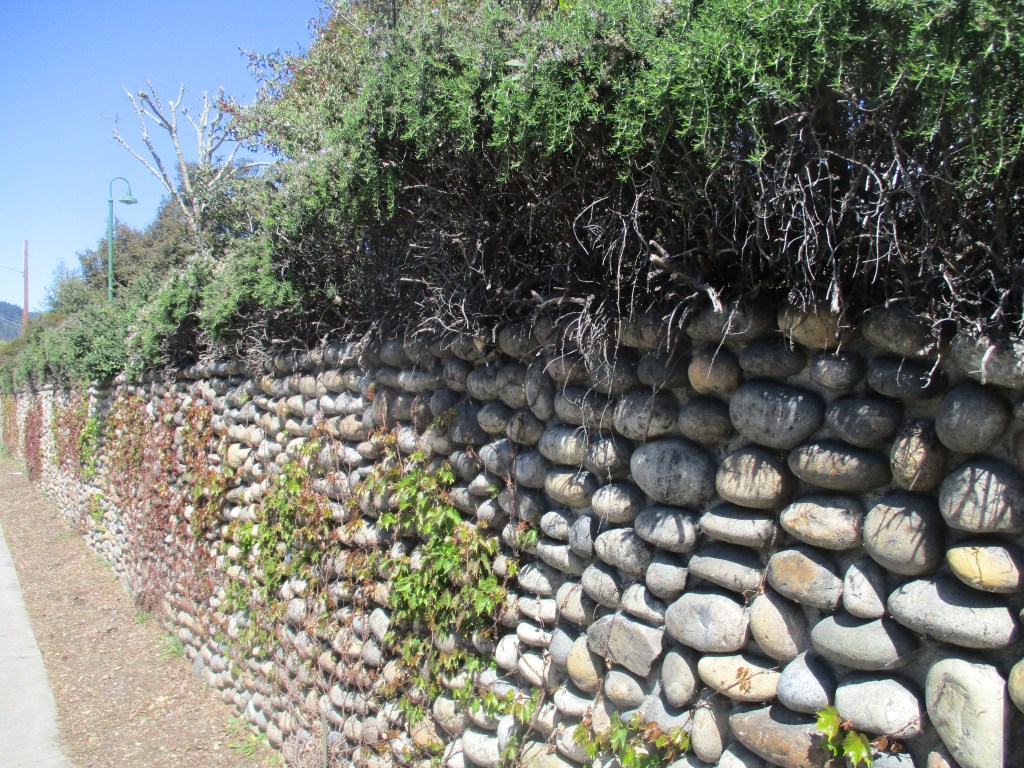
Cascading rosemary should actually cascade rather than get shorn into submission. (For this situation, it is subordinating to the climbing Boston ivy below.)

You can make fun of the decadent hair styles of the 1980s all you like; but you must admit that they were better than what came later. Back then, the assets of each particular type of hair were exploited instead of destroyed; sculpted instead of chopped into submission. Sadly, landscape maintenance evolved in a similar manner.

So many trees, shrubs and ground covers are either shorn too much to develop their naturally appealing forms, or not pruned severely enough to allow space for resulting new growth to mature and bloom like it should. Gardeners are notorious for shearing anything within reach. However, they are also notorious for allowing certain ground covers to get too deep and overgrown.

Trees that are short with multiple trunks when they first get planted are more likely than taller trees with single trunks to be shorn into nondescript shrubs. Olive, Japanese maple, tristania (laurina) and crape myrtle are commonly victims of this abuse. They are not only deprived of their form, but their grace and foliar appeal as well. Shorn crape myrtle may never be able to bloom.

Oleander, bottlebrush, arborvitae and various pittosporums that make nice informal screens in their natural forms are likewise very often shorn inappropriately and needlessly into all sorts of odd geometric shapes. Fortunately, pittosporums tend to make excellent formally shorn hedges as well as informal screens. Yet, when shorn without a plan, they more often develop into herds of noncontinuous geometric shapes. Oleander and bottlebrush, like crape myrtle, may never bloom if shorn too frequently.

Ground cover more often has the opposite problem. It does not get mown enough, or otherwise pruned down to stay shallow. This may not be a problem in most of the space covered by ground cover, but does make for hedge-like edges where the ground cover meets walkways, with all the problems of improperly shorn hedges. These edges can be softened if sloped inward and rounded off on top. However, lantana, star jasmine, acacia redolens and the ground cover forms of ceanothus do not bloom on these shorn edges unless the shearing procedure gets done at the right time to allow for enough new growth to mature in time for the blooming season.

There is certainly nothing wrong with properly planned and properly shorn formal hedges; but not everything needs to be shorn. Plants should be selected to be proportionate to their particular application without abusive shearing. Like the hair styles of the 1980s, the assets of each particular plant should be exploited instead of destroyed.

Shear Hedges Seasonably And Properly

Scheduling is important to hedging too.

There are rules to hedging. For example, hedges should be uniform and exclusive to just a single cultivar. A modern ‘Green Beauty’ boxwood will never conform within a hedge of more yellowish old fashioned boxwood. Hedges should also remain within confinement. It is important to shear them back from obtrusion into walkways and other usable spaces.

It is not as simple as it seems to be. That is why so few hedges get proper maintenance. Almost all occupy and therefore waste more space than they need. Most have wide tops that shade out narrower lower growth. Moreover, many plants that are not components of hedges all too commonly succumb to inappropriate shearing too. It is sheer shear abuse!

Even if done properly, only hedges and a few other plants are conducive to shearing and hedging. It is an aggressive procedure that compromises form, texture and bloom cycles of involved plants. For hedges, that is not a problem. They need not bloom, and adapt to a refined hedged form, which is more desirable than their natural shrubby form would be.

However, it is important to not unnecessarily shear plants that bloom, or provide intricate foliar texture or form. Shearing deprives rhododendron of young floral buds. It ruins foliar texture of Heavenly bamboo, and foliar form of Japanese maple. It is acceptable to shear boxwood only because it responds by generating such appealingly uniform foliar growth.

With proper scheduling, it is possible to shear only a few blooming plants without ruining all of their bloom. Aggressive shearing after the early bloom of oleander and bottlebrush leaves them with space to grow enough to bloom again during autumn. Without sufficient space to grow, they will require subsequent shearing, which will ruin subsequent bloom.

It is better to shear some of the simpler hedges, such as privet and boxwood, shortly after winter. They regenerate lush growth immediately afterward, and do not mind two or three annual shearings. The last shearing should be early enough to allow a bit of growth prior to autumn. Photinia generates appealingly bronzed new growth in response to shearing. Also, frequent shearing inhibits potentially undesirable bloom.