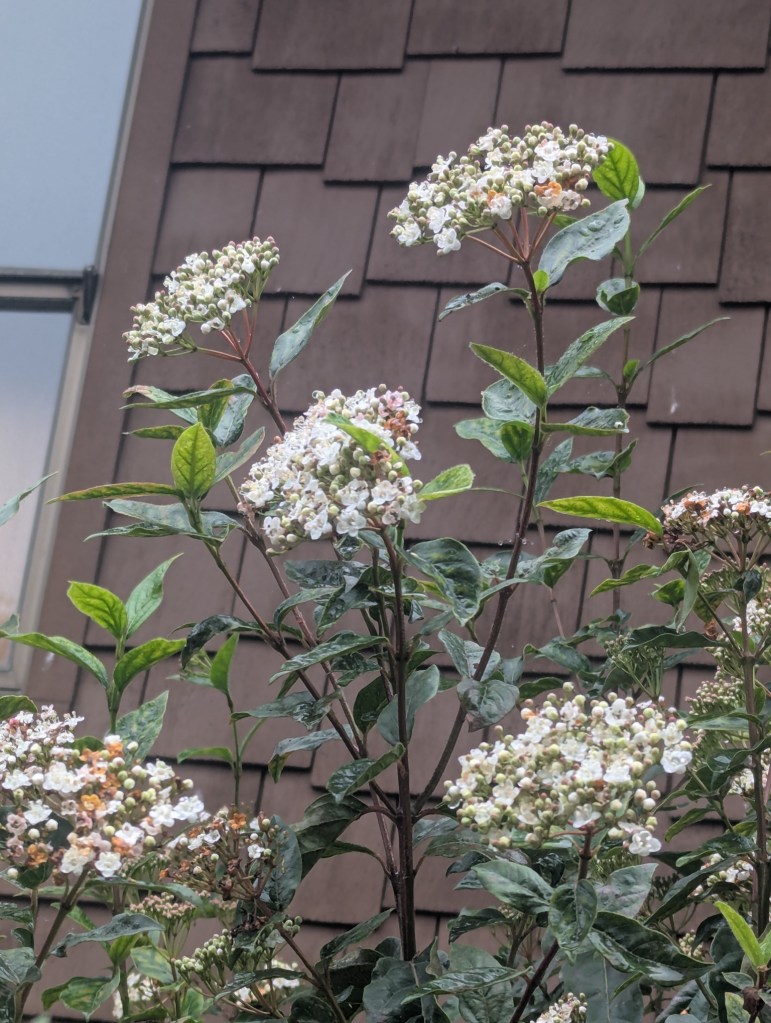
Winter bloom may or may not be an benefit of laurustinus, Viburnum tinus. Most grow as regularly shorn hedges that are unable to bloom much between shearing. Those that do bloom often generate a floral fragrance that some find to be objectionable. Nonetheless, with only timely pruning, laurustinus does bloom for winter. Many consider this an asset.
Flowers are small and white or blushed with pink. They huddle together in dense cymes, which are about two or three inches wide. Their dense evergreen foliage is forest green. Individual leaves are paired, about two or three inches long, and half as wide. They have a very slightly raspy surface texture. Mature laurustinus can sucker from their basal roots.
If bloom is not a concern, laurustinus can be a dense shorn hedge, only several feet tall. Otherwise, it can become a dense small tree more than twenty feet tall and ten feet wide. Once established, it does not need much water and can actually survive with just rainfall. It is not very discriminating about soil quality. Mites or mildew can become problematic in damp coastal climates, particularly among shaded or very congested specimens.
Although it classifies as a tree, mugo pine, Pinus mugo, is more like shrubbery. Old trees may be only a few feet tall, and maybe twice as wide. Not many are more than eight feet tall. Their form is densely rounded. Foliage is deep forest green. Stiff paired needles are only about one to two inches long. Plump cones are not much longer, and are quite rare.
Mugo pine, although native to the Alps, is a traditional feature of Japanese gardens. Yet, it is rare within other types of gardens. It does not grow fast or big enough to be practical for much more than aesthetic appeal. It does excel at that, though, by developing such a distinctly rounded form. It can work well as foundation planting or a short informal hedge.
Mugo pine is not particularly discriminating about local soils or climates. It merely craves sunny and warm exposure. Mature specimens do not need much water, but are healthier with occasional irrigation. Mugo pine appreciates room for unrestricted growth. Shearing deprives it of its natural form and texture. If necessary, selective pruning may be tedious.
Its silly name is actually justifiable. The papery fruits of Hopbush, Dodonea viscosa, can be useful as a substitute for hops. Almost all hopbush are female, so produce such fruits. However, bloom and subsequent fruit production is variable. Vigorous plants are likely to produce less fruit. Also, some specimens might become male, and therefore be fruitless.
Hopbush is most popular as an informal evergreen hedge. It also works well as a formal hedge. With selective pruning, it can become a small tree with shaggy bark on sculptural trunks. It develops a narrowly upright form while young, but may eventually grow ten feet wide. It grows about twice as tall. Overgrown specimens are quite conducive to pruning.
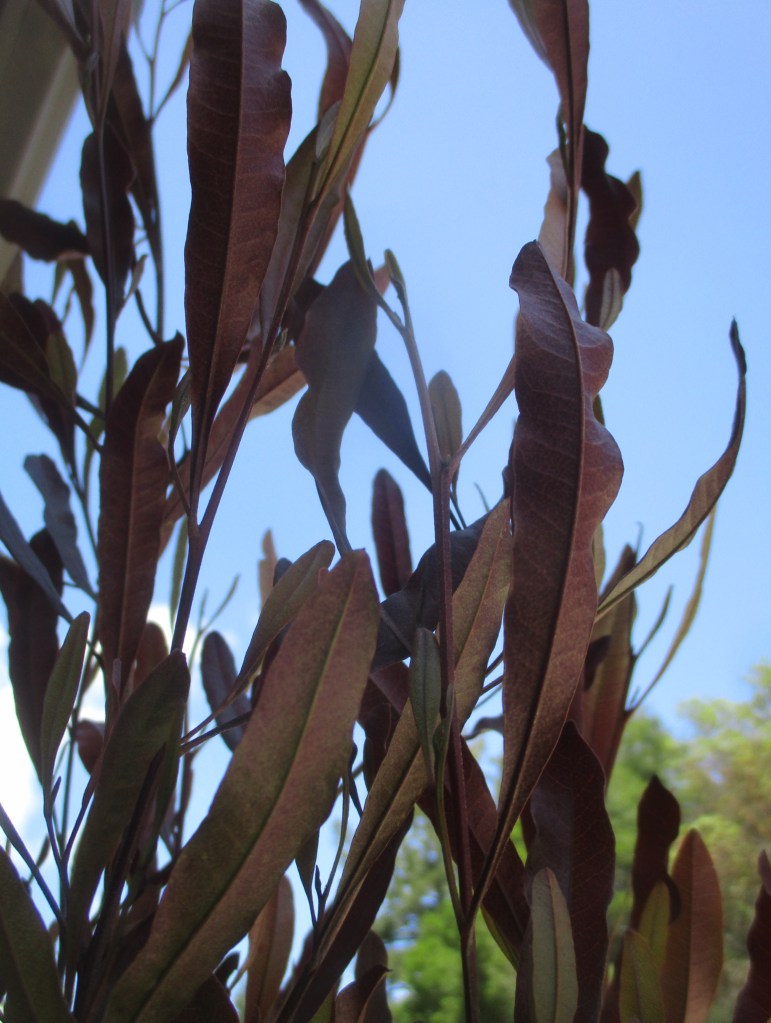
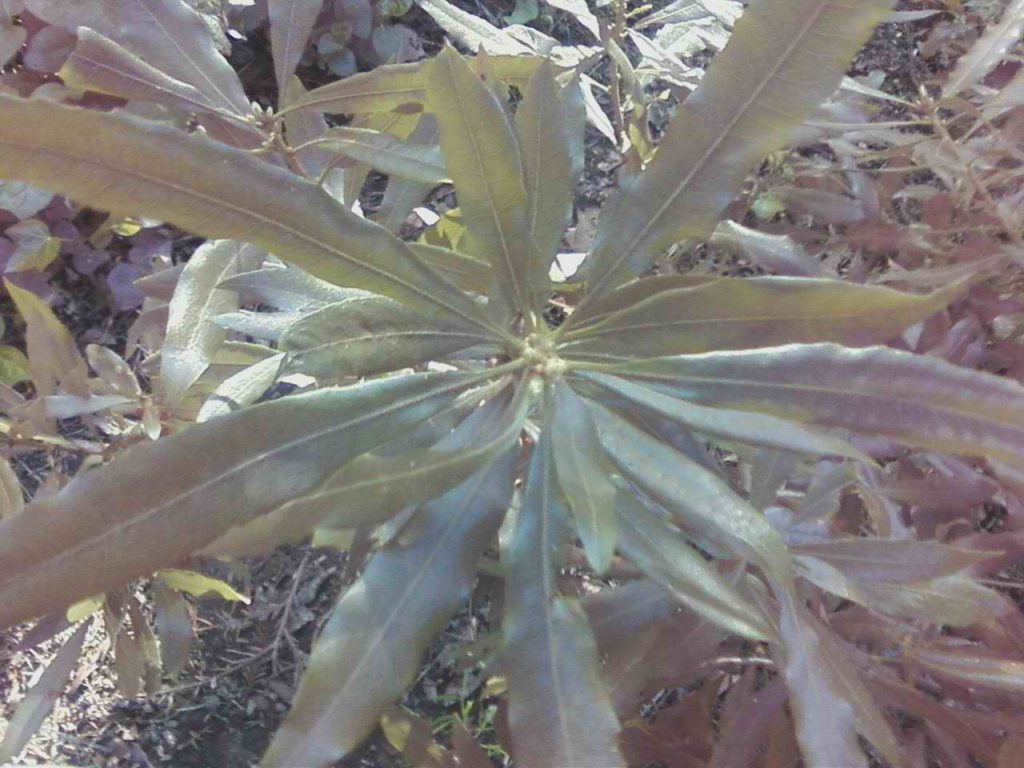
Hopbush exhibits a uniformly fine foliar texture. Individual leaves are two or three inches long, but narrow. Foliar color is soft bronzy green. ‘Purpurea’ is more purplish bronze, but is not quite as vigorous. Roots are very complaisant, but do not disperse well if irrigation is too generous. Established hopbush is undemanding, so does not require much water. It tolerates soil of inferior quality too.
Sawara false cypress cultivars do not develop into real trees.
Just like other types of false cypress, the Sawara false cypress, Chamaecyparis pisifera, naturally gets much larger than its many cultivars that are sometime grown in gardens for their colorful and interestingly textured foliage. Although not large trees, they can get nearly thirty feet tall in wild groves in Japan. Most garden varieties stay less than ten feet tall, and some stay much shorter.
‘Cyano-Viridis’ (‘Boulevard’), with feathery blue green foliage, is one of the more popular cultivars. It grows slowly to more than six feet tall and broad. ‘Filifera’ has very different foliage, with tightly fitting scale leaves on limber cord shaped branches. It stays a bit shorter but can get a bit broader. ‘Mops’ is similar to ‘Filifera’, but stays about a foot and a half tall and broad. ‘Filifera Aurea’ and ‘Golden Mops’ are just like ‘Filfera’ and ‘Mops’, but with yellow foliage.
Reflected glare or harsh exposures can burn foliage. Full sun is not a problem, unless enhanced by glare from surrounding pavement or lightly colored walls. Partial shade is not a problem either, but compromises foliar color, particularly yellow.
Shearing or major pruning deprives false cypress of their naturally appealing forms and textures. They should therefore get plenty of space for their mature size, and get trimmed lightly for shape only when necessary.
Many dwarf plants are very practical. The many different dwarf cultivars (cultivated varieties) of false cypress that are grown for their interesting forms, textures and foliar colors are much more proportionate to home gardens than similar specie in the wild, which are big enough to get harvested for timber. Oranges are easier to reach on dwarf trees than on standard trees, which get as big as shade trees.
However, not all plants should be bred to be dwarfs. Dwarf Southern magnolias certainly have their appeal for tight spots, but do not make as much shade as larger trees do. Compact cultivars of crape myrtles (although not actually dwarfs) take too much time to grow above truck traffic to be practical as street trees.
Many classic annuals and perennials are likewise bred to be too compact to be as practical as they were in the past. Annie of Annie’s Annuals in Richmond refers to this all too common practice as ‘boinkification’. It makes many blooming plants more marketable and resilient to shipping and installation, but deprives them of their natural form and elegance.
Short annuals and perennials certainly have their place. Lobelia, sweet alyssum, dwarf marigolds and petunias are fine along walkways and in pots with other larger plants. They also work well as bedding plants for a profusion of color. Yet, there is all too often too much of a good thing. Some flower beds are simply so big and plain, that it would be just as colorful to paint an area orange instead of planting so many marigolds.
Taller flowering annuals like nicotiana (flowering tobacco), cosmos and zinnias add depth behind lower growing annuals. Dahlias are perennials that can accomplish the same thing. Some of the older and less common varieties of familiar bedding plants that have not been so boinkified also work well. There are even petunias that can get two feet tall and wide! These taller plants also provide cut flowers; which is something that boinky plants are not so good at.
Boinkification also compromises fragrance and aroma. Bedding dianthus have almost no fragrance at all; unlike the old fashioned dianthus and carnations that had such distinctive spicy fragrance. Modern zonal geraniums are more colorful than classic varieties, but their foliage is not quite as aromatic.
Not only does increased foliar density of boinky plants promote the proliferation of many diseases and pests; but the genetic violations necessary for boinkification interfere with resistance to diseases and pests!
Meriwether Lewis of the Lewis and Clark Expedition encountered the western native mock orange, Philadelphus lewisii, in 1806, and gave it his own name. It inhabits an extensive range that reaches from the northern Sierra Nevada to southern British Columbia to western Montana, but is somewhat sporadic within its natural range. It is the state flower of Idaho, and is commonly planted in state, national and even some county parks within its range and throughout the rest of California.
Partial shade is not a problem for mock orange, but full sun exposure promotes more abundant bloom. The simple, strikingly white flowers that bloom in spring are less than two inches wide with only four petals. However, their remarkably rich orange fragrance is unexpectedly powerful. The two inch long, forest green, deciduous leaves on arching limber stems are a nice backdrop. ‘Goose Creek’ has double flowers.
Because regular pruning or shearing of outer growth inhibits bloom and compromises natural form, mock orange is best where it has plenty of space to grow wild, or at least where the upper canopy can spread out naturally if the lower canopy gets pruned away to form a small tree with multiple trunks. After bloom, older deteriorating stems can be pruned out, to favor newer stems emerging from the base. Overgrown plants can be cut to the ground in winter, and will regenerate over the following summer to bloom in the second spring. Mature mock orange gets nearly ten feet tall and broad.
Pacific wax myrtle is the native version of bayberry.
From Washington to Southern California, the Pacific wax myrtle, Myrica californica, is native to coastal regions. It is the western counterpart to the bayberry, Myrica pen(n)sylvanica (or caroliniensis), of the East Coast. It makes a nice informal hedge with only occasional shearing, or an informal screen that only gets trimmed back when it gets too big. Mature plants can get nearly thirty feet tall in sheltered areas, but rarely get half as tall and wide, even if allowed to grow unimpeded. The glossy three inch long leaves are narrow with slightly undulate margins with small teeth.
Pacific wax myrtle functions something like glossy privet or some of the pittosporums that make good hedges, but is not so resilient to frequent shearing. Big stems that get cut back to not always produce new growth. The advantage of Pacific wax myrtle is that it is native, so does not want much water once established, so is happy in out of the way places that do not get watered or maintained. Like privets and pittosporums, Pacific wax myrtle can be pruned up as a small tree with multiple exposed trunks.
Almost all pittosporums appreciate sunlight and warmth. Pittosporum tobira ‘Variegata’ is no exception. However, it tolerates a bit of more partial shade than most. Furthermore, its grayish and creamy white variegation brightens shady situations. Its distinctively convex and glossy leaves are a bit flatter and broader where shaded. Shade inhibits bloom also.
Pittosporum tobira ‘Variegata’ is more popular as a foliar hedge anyway. Its small trusses of pale white flowers are neither prominent nor colorful. They can be delightfully fragrant in abundance, though. Stems are quite stout and can eventually grow more than six feet tall. They are resilient to frequent pruning and hedging, and can be cut back if necessary.
Pittosporum tobira ‘Variegata’ seems to lack a common name that is genuinely common. That is why its botanical name is most popular. Some know it as mock orange, but this is also a common name of Philadelphus. Some know it as Australian laurel, but it is neither a laurel nor from Australia. Regardless of name or origin, it is content with local climates. Once established, it is undemanding, and may need no watering.
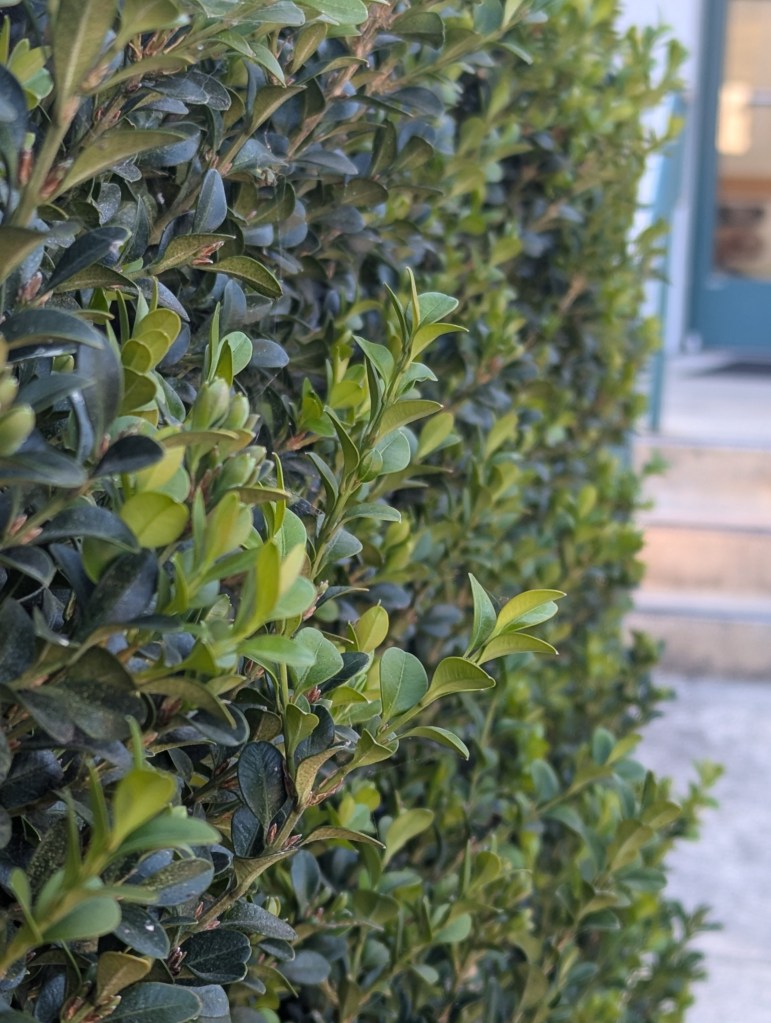
Motorized hedge shears are the most overused home garden power tools. They are very useful for hedging evergreen shrubbery into hedges and privacy screens. However, they too often shear vegetation that requires different types of pruning. They are fast and easy but not appropriate for all pruning applications. Even hedging is a specialized technique.
Unfortunately, the rules of hedging are too often ignored. Hedges are utilitarian features. Many provide privacy. Many obscure unwanted scenery. Some divide large gardens into smaller and cozier spaces. Most continue to function as they should even without proper maintenance. Consequently, problems associated with maintenance may not be evident.
Unshorn informal hedges are mostly simpler to maintain, but only if they remain unshorn. Ideally, they use species or varieties that mature to a desirable size and form. Therefore, they should not become too large or Obtrusive. Only a few wayward stems need pruning. Of course, species or varieties that grow too large for such application will need hedging.
Shorn or formal hedges are more likely to develop problems. They need regular hedging to maintain their size and strict form. Yet, even with the most diligent maintenance, many become overgrown. Many gain depth from front to back, to become obtrusive. Many gain more height than they should. Most become distended up high while subdued down low.
This happens because pruning cuts can be slightly farther out than they were previously. They are a bit farther out higher up because that is where most growth is. Hedging within former cuts can renovate overgrowth, but damages hedge facades. Fortunately, damage should be temporary. Severely overgrown hedges might require severe pruning, though.
As mentioned, hedges are utilitarian. They should perform their primary purpose without encroachment into usable spaces. Their typically evergreen foliage is generally external. Their interiors are generally bare stems and empty space. Therefore, a hedge can be as effective whether two or four feet from front to back. Four feet is merely a waste of space.
Flowering quince and forsythia set a precedent. Bridal wreath spiraea, Spirea prunifolia, somehow became old fashioned too. All three are only beginning to regain popularity. All are deciduous, so defoliate for autumn and remain bare through winter. They then bloom spectacularly on bare stems for late winter or early spring. Foliage develops after bloom.
Bridal wreath spiraea, like forsythia, develops many upright and arching basal stems. Its stems can grow taller than eight feet, although they are typically a bit shorter. Removal of old stems after bloom promotes growth of new stems, which bloom better. Indiscriminate pruning ruins their naturally upwardly flaring form. A slight bit of partial shade is tolerable.
Almost all bridal wreath spiraea are of the cultivar ‘Plena’. Their double flowers are fluffy but tiny, between just a quarter and a half inch wide. The simple species, and the variety ‘simpliciflora‘ with single flowers, are rare. Regardless of floral form, floral color is limited to white. Foliage might develop yellow color for autumn where autumn weather is cooler.





 Tony Tomeo