Pacific wax myrtle is the native version of bayberry.
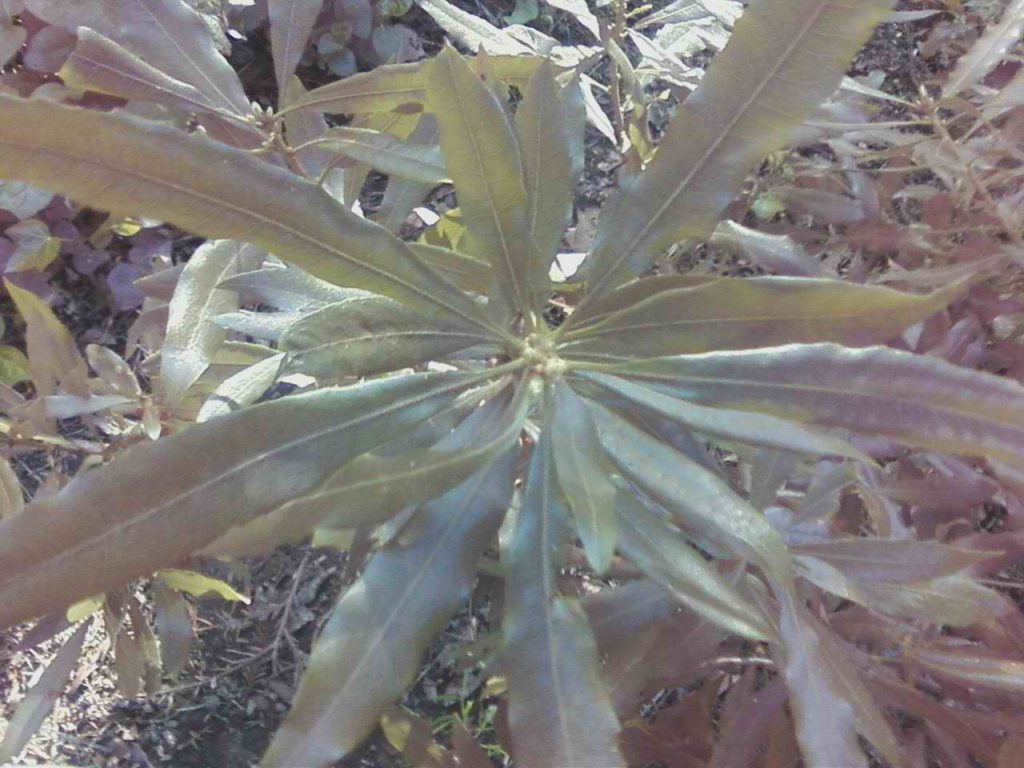
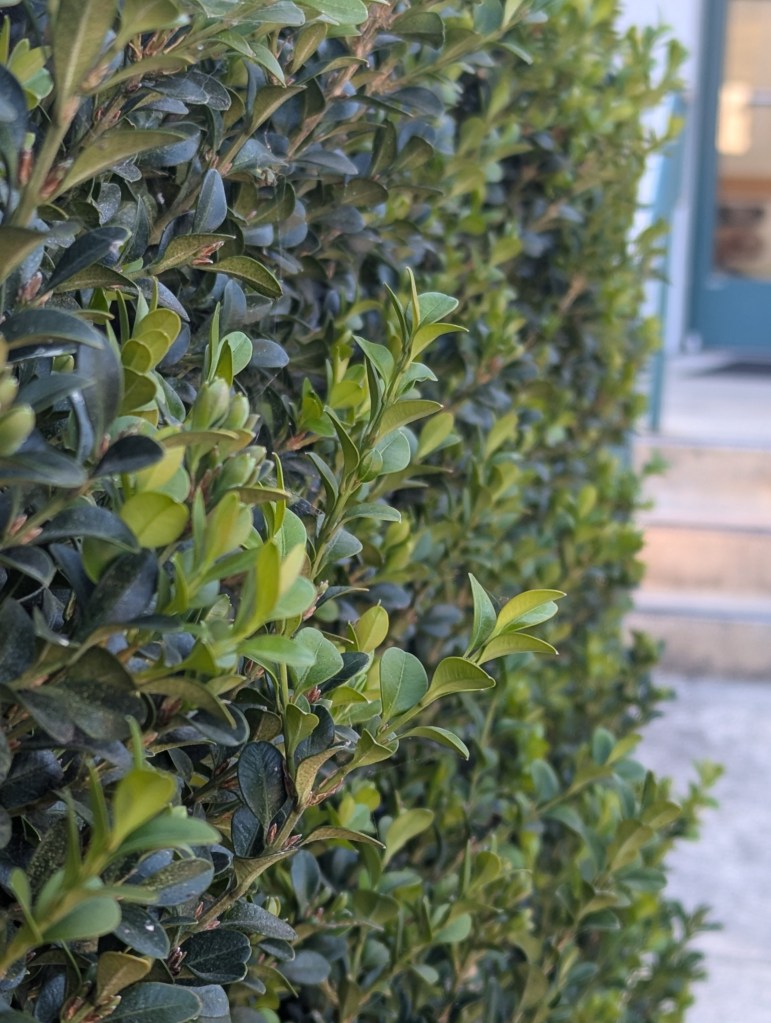
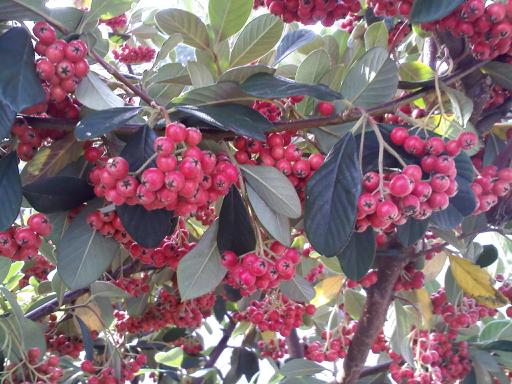
From Washington to Southern California, the Pacific wax myrtle, Myrica californica, is native to coastal regions. It is the western counterpart to the bayberry, Myrica pen(n)sylvanica (or caroliniensis), of the East Coast. It makes a nice informal hedge with only occasional shearing, or an informal screen that only gets trimmed back when it gets too big. Mature plants can get nearly thirty feet tall in sheltered areas, but rarely get half as tall and wide, even if allowed to grow unimpeded. The glossy three inch long leaves are narrow with slightly undulate margins with small teeth.
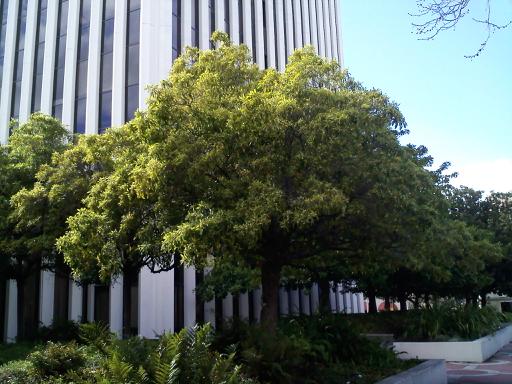
Pacific wax myrtle functions something like glossy privet or some of the pittosporums that make good hedges, but is not so resilient to frequent shearing. Big stems that get cut back to not always produce new growth. The advantage of Pacific wax myrtle is that it is native, so does not want much water once established, so is happy in out of the way places that do not get watered or maintained. Like privets and pittosporums, Pacific wax myrtle can be pruned up as a small tree with multiple exposed trunks.
Almost all pittosporums appreciate sunlight and warmth. Pittosporum tobira ‘Variegata’ is no exception. However, it tolerates a bit of more partial shade than most. Furthermore, its grayish and creamy white variegation brightens shady situations. Its distinctively convex and glossy leaves are a bit flatter and broader where shaded. Shade inhibits bloom also.
Pittosporum tobira ‘Variegata’ is more popular as a foliar hedge anyway. Its small trusses of pale white flowers are neither prominent nor colorful. They can be delightfully fragrant in abundance, though. Stems are quite stout and can eventually grow more than six feet tall. They are resilient to frequent pruning and hedging, and can be cut back if necessary.
Pittosporum tobira ‘Variegata’ seems to lack a common name that is genuinely common. That is why its botanical name is most popular. Some know it as mock orange, but this is also a common name of Philadelphus. Some know it as Australian laurel, but it is neither a laurel nor from Australia. Regardless of name or origin, it is content with local climates. Once established, it is undemanding, and may need no watering.
Motorized hedge shears are the most overused home garden power tools. They are very useful for hedging evergreen shrubbery into hedges and privacy screens. However, they too often shear vegetation that requires different types of pruning. They are fast and easy but not appropriate for all pruning applications. Even hedging is a specialized technique.
Unfortunately, the rules of hedging are too often ignored. Hedges are utilitarian features. Many provide privacy. Many obscure unwanted scenery. Some divide large gardens into smaller and cozier spaces. Most continue to function as they should even without proper maintenance. Consequently, problems associated with maintenance may not be evident.
Unshorn informal hedges are mostly simpler to maintain, but only if they remain unshorn. Ideally, they use species or varieties that mature to a desirable size and form. Therefore, they should not become too large or Obtrusive. Only a few wayward stems need pruning. Of course, species or varieties that grow too large for such application will need hedging.
Shorn or formal hedges are more likely to develop problems. They need regular hedging to maintain their size and strict form. Yet, even with the most diligent maintenance, many become overgrown. Many gain depth from front to back, to become obtrusive. Many gain more height than they should. Most become distended up high while subdued down low.
This happens because pruning cuts can be slightly farther out than they were previously. They are a bit farther out higher up because that is where most growth is. Hedging within former cuts can renovate overgrowth, but damages hedge facades. Fortunately, damage should be temporary. Severely overgrown hedges might require severe pruning, though.
As mentioned, hedges are utilitarian. They should perform their primary purpose without encroachment into usable spaces. Their typically evergreen foliage is generally external. Their interiors are generally bare stems and empty space. Therefore, a hedge can be as effective whether two or four feet from front to back. Four feet is merely a waste of space.
Flowering quince and forsythia set a precedent. Bridal wreath spiraea, Spirea prunifolia, somehow became old fashioned too. All three are only beginning to regain popularity. All are deciduous, so defoliate for autumn and remain bare through winter. They then bloom spectacularly on bare stems for late winter or early spring. Foliage develops after bloom.
Bridal wreath spiraea, like forsythia, develops many upright and arching basal stems. Its stems can grow taller than eight feet, although they are typically a bit shorter. Removal of old stems after bloom promotes growth of new stems, which bloom better. Indiscriminate pruning ruins their naturally upwardly flaring form. A slight bit of partial shade is tolerable.
Almost all bridal wreath spiraea are of the cultivar ‘Plena’. Their double flowers are fluffy but tiny, between just a quarter and a half inch wide. The simple species, and the variety ‘simpliciflora‘ with single flowers, are rare. Regardless of floral form, floral color is limited to white. Foliage might develop yellow color for autumn where autumn weather is cooler.
Pittosporum undulatum is a large shrub that can become a small tree.
Shrubbery behaving badly can be a problem. Many seemingly innocuous shrubs get planted in situations where they do not fit, and soon get too big for the space available. Others do not get shorn or pruned as they should, or simply get neglected, and eventually get overgrown. Many others have sneaky ways of sowing their seeds in awkward places where they would not otherwise get planted by anyone who knows better.
Most home improvement shows on television would simply recommend removing obtrusive, overgrown or inappropriate shrubbery and replacing it with something more proportionate, appropriate and stylish. What a waste! Hidden within overgrown shrubbery, there are sometimes potentially appealing small trees that only need to be released from thickets of overgrowth.
Overgrown Australian tea tree, sweet olive (Osmanthus fragrans), xylosma, glossy privet, ‘Majestic Beauty’ Indian hawthorn, and larger types of oleander, holly, pittosporum, cotoneaster and juniper are often easily salvaged by aggressive selective pruning rather than indiscriminate pruning for confinement. Lower growth that has become obtrusive, disfigured or otherwise unappealing can be thinned or removed to expose substantial sculptural trunks within. Upper growth that is out of the way can be left intact or thinned as necessary, but should not shorn or pruned indiscriminately. This creates informal small trees with distinctive trunks from what had been overgrown shrubbery.
Some shrubbery may need some time to grow out of its former confinement, and may be somewhat unsightly during the process. As they develop though, they should require less maintenance, since most of their growth should be up out of the way instead of where it is in constant need of pruning for confinement.
Many small trees that often get shorn into shrubbery would similarly do better with selective pruning to enhance natural branch structure and eliminate congested thicket growth. Japanese maples, redbuds, smoke tree, English hawthorn, crape myrtle, parrotia, loquat, strawberry tree, Pittosporum undulatum, and small types of magnolias, acacias, and yew pines (Podocarpus spp.) are notorious for getting shorn into unmanageable shrubbery. Pineapple guava, photinia, toyon, hop bush, larger types of bottlebrush and smaller types of melaleucas are more conducive to being shorn and pruned as large shrubbery, or can be pruned into small trees if preferred.
Cotoneaster berries can be as colorful as hawthorn berries, but with evergreen foliage.
Unlike the more popular low growing cotoneasters that are grown as groundcover, the large Cotoneaster lacteus can be grown as large informal hedges or small sculptural trees with multiple trunks. Their limber arching branches can get more than eight feet high and broad. Cotoneaster lacteus are at their best where they have space to grow wild and unshorn, since indiscriminate pruning deprives them of their naturally graceful form; although selective pruning of lower growth exposes trunks and enhances the forms of those grown as small trees. Once established, they do not need much attention or watering anyway.
Abundant two inch wide clusters of small white flowers in spring are not remarkably showy, but develop into comparably abundant clusters of bright red berries in autumn and winter, much to the delight of overwintering birds. The simple two inch long leaves of Cotoneaster lacteus have pale green and slightly tomentose (fuzzy) undersides.
Ancient Egyptian influence within a modern landscape
Queen Nefertiti, during the fourteenth century BC, was the most famous and most influential Queen of Ancient Egypt. She wore a cool hat too. It was sort of cylindrical shaped, but also tapered so that it was wider on top, sort of like a funnel. So, not only was Queen Nefertiti very influential during her time, but she remains influential in modern mow, blow and go gardening. So-called ‘gardeners’ everywhere still shear shrubbery into the shape of Queen Nefertiti’s cool hat! Not many species of shrubbery are exempt. Just about any get shorn into a sort of cylinder shape that is wider on top, sort of like a funnel, but also tilted in one direction or another, just like Queen Nefertiti’s hat tilts toward the back. Such shearing typically deprives blooming shrubbery of its bloom, but bloom is apparently not a priority, as long as the ancient Egyptian form is maintained. The picture above includes four oleanders, a Texas sage and what seems to be two trailing lantana. The Texas sage and trailing lantana are more cylindrical than hat shaped, but the hat shape of the three oleanders is impossible to deny. It is such a universal technique that is performed so precisely wherever vegetation is maintained by mow, blow and go gardeners that it seems to be taught in classes as standard procedure. I am significantly more educated in horticulture than most mow, blow and go ‘gardeners’, but I somehow missed this in my curriculum. Instead, I learned that vegetation should be allowed to exhibit its natural attributes, such as form, texture, bloom and so on. If I wanted a herd of ancient Egyptian hats in my garden, I would probably construct something that resembled ancient Egyptian hats from an inert material that never needs shearing or irrigation.
the Original
a modern version of an ancient Egyptian fashion show
Dwarf Alberta spruce is more like a strictly conical shrub than a small tree.
Unlike other related white spruce, which get more than fifty feet tall, dwarf Alberta spruce, Picea glauca albertiana ‘Conica’, stays smaller than its Latin name, rarely getting more than seven feet tall. It is so dense and conical that it should never need to be pruned. Shearing only damages its short light green to grayish green needles. Dwarf Alberta spruce is compact enough to live in large tubs or urns, as long as its sensitive roots are well insulated. (Concrete or wooden planters are well insulated, so do not transfer too much heat to the roots within. Ivy or ground cover cascading over and shading planters also helps.) Foliage should be sheltered from harsh exposure, since it can be desiccated by warm breezes or reflected glare, like from large windows or light colored south facing walls.
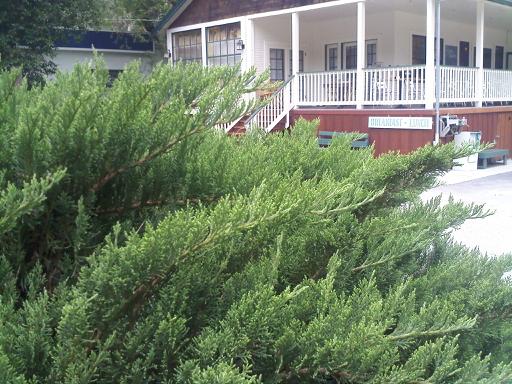
As much as I like junipers, even I have my limits. The tamarix juniper or tam, Juniperus sabina ‘Tamariscifolia’, is the juniper that gave junipers a bad name decades ago by being too common in too many of the wrong situations, and remains one of the most commonly planted junipers. What I do not like about it is that it is classified as a ‘ground cover’ juniper and can sprawl more than eight feet wide, but actually piles up more than two feet deep! However, I have noticed that it can be practical for certain situations as a ‘sprawling shrub’ instead.
Even without the foliar color or sculptural branch structure of other shrubby junipers, the dense dark green foliage and compact branch structure give the tam its own appeal and practicality. It can be shorn into low informal hedges as frequently as annually. It readily recovers its feathery texture if shorn as the weather starts to get warm in spring. All it wants is sunlight and infrequent but deep watering in summer.
Andromeda might be more familiar by its Latin name of Pieris. A few of its seven species, and a few of their hybrids, are popular for home gardens. All are evergreen shrubs. A few do not grow much taller and wider than three feet. Few can grow a bit more than ten feet tall and wide. In the wild, some might grow as small trees that are almost twenty feet tall.
Andromeda has glossy evergreen foliage. Individual leaves are lanceolate, perhaps with serrated margins. They are between one and three inches long, and half to an inch wide. New growth of most cultivars is as rich cinnamony red as that of photinia. A few cultivars have more pinkish or simple green new growth. A few cultivars are variegated with white.
Andromeda blooms with somewhat pendulous racemes of tiny pendulous flowers. Floral racemes are between two and four inches long. Individual flowers are between a quarter and half an inch long. Most are white. Some are pink. Most have green rachi. Some have pink rachi. Bloom is abundant for the middle of spring. Andromeda prefers partial shade.