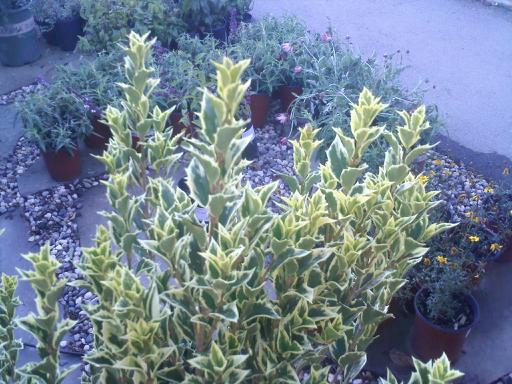
Holly-Leaf Osmanthus

Holly-leaf osmanthus resembles both English holly and Euonymus.

English holly happens to be one of my all time favorite plants, even though it rarely produces the abundant berries that are expected of hollies. Its deep rich green foliage is so glossy and distinctively textured. Because English holly does not mind partial shade, the variegated varieties can add a bit of color where it is too dark for most other plants to bloom. I really do not mind that it is so prickly.

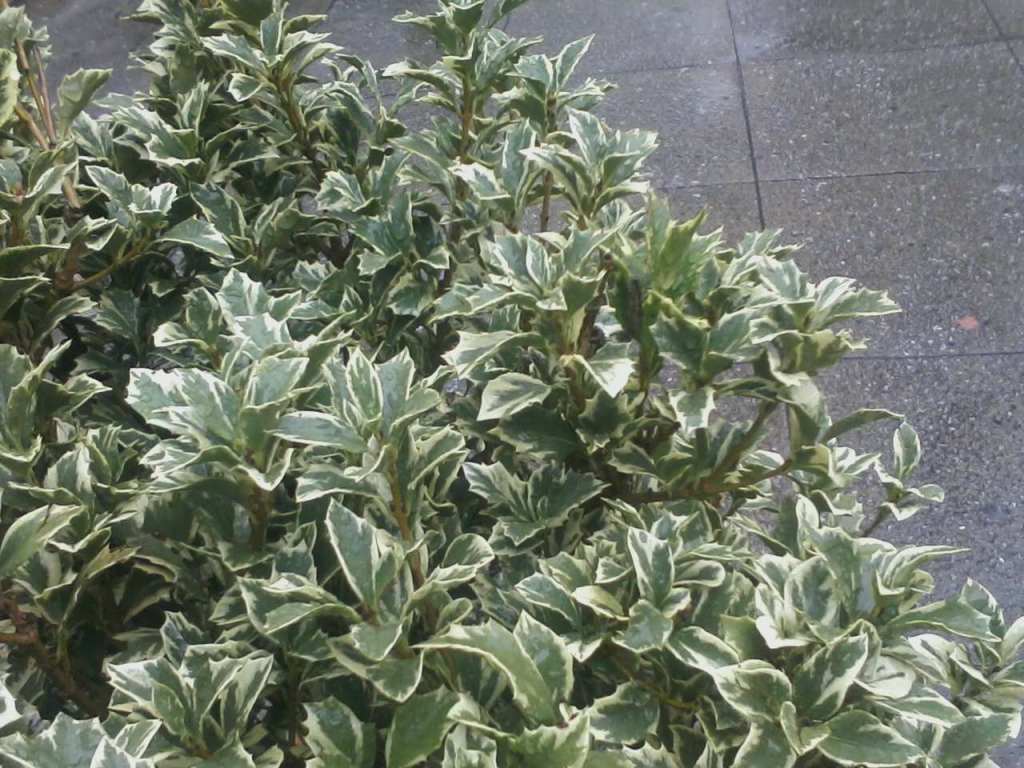
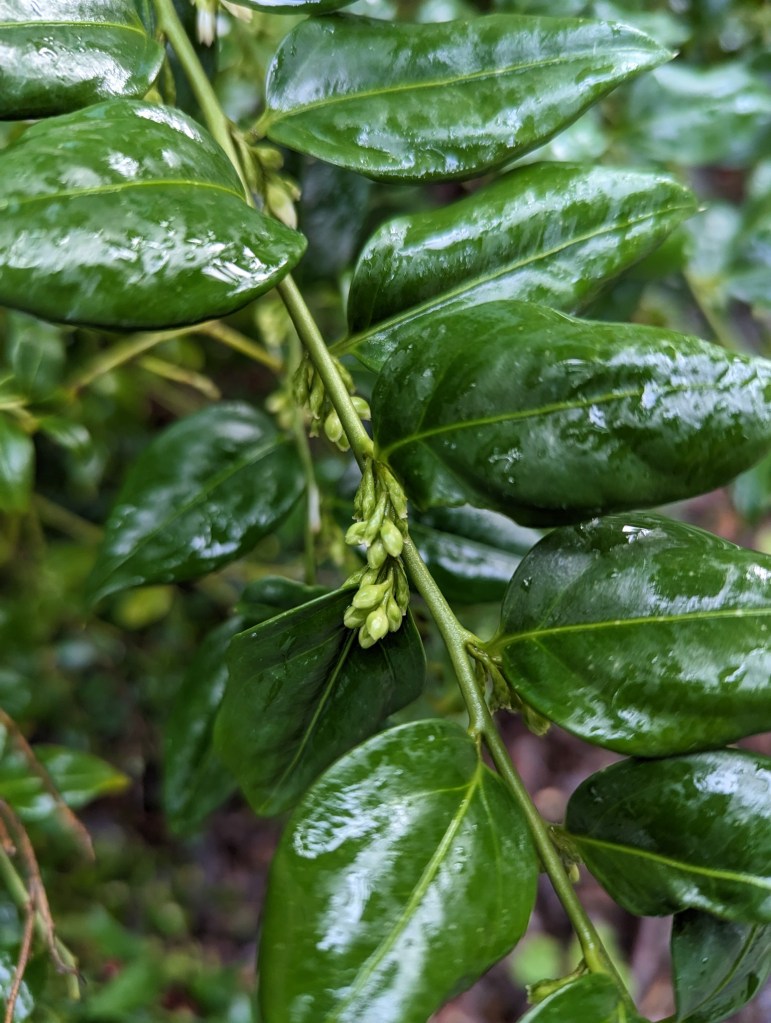
For those who do mind, the holly-leaf osmanthus, Osmanthus heterophyllus (or ilicifolius) is a worthy substitute for English holly that is just as happy with partial shade. The foliage is very similar in appearance, but a bit less glossy, and much less irritating. Holly-leaf osmanthus is sometimes mistaken for English holly, but can be distinguished by its opposite leaves. English holly has alternate leaf arrangement.

Mature holly-leaf osmanthus can get as large as English holly, but rarely does. It is more often less than 10 feet tall and wide, and is somewhat more adaptable to shearing into hedges. ‘Variegatus’, the most popular variety with pale white leaf margins, grows a bit slower and stays more compact, and actually looks better in partial shade than out where it is too exposed. Holly-leaf osmanthus flowers that bloom about now are not much to look at, but produce a delicate fragrance if the weather gets warm.

flowering maple

Flowering maple should finish bloom soon.

The identities of the many different garden varieties are vague. Most are likely hybrids. A few might be simple species. Some that seem to be hybrids are really cultivars of simple species. Regardless, most flowering maples collectively qualify as Abutilon X hybridum. If all were hybrids, as their name implies, none would generate viable seed, as some do.

Flowering maple can grow somewhat fast, but tends to be lanky if it does so. It should be a bit fuller with slower growth or minor tip pruning. Several cultivars grow no higher than doorknobs, but others reach first floor eaves. Flowering maple demands regular watering and rich soil. It enjoys humid warmth, but may roast in arid heat with harsh sun exposure.

Bloom is sporadic from late spring until frost. The flowers resemble those of hibiscus, but are no more than three inches broad. Most are pastel tints of yellow, orange or pink, with prominently richer veining. Some are red, burgundy red or creamy white. The light green or variegated foliage may get a bit sparse through winter. Foliar lobes are quite variable, or lacking.

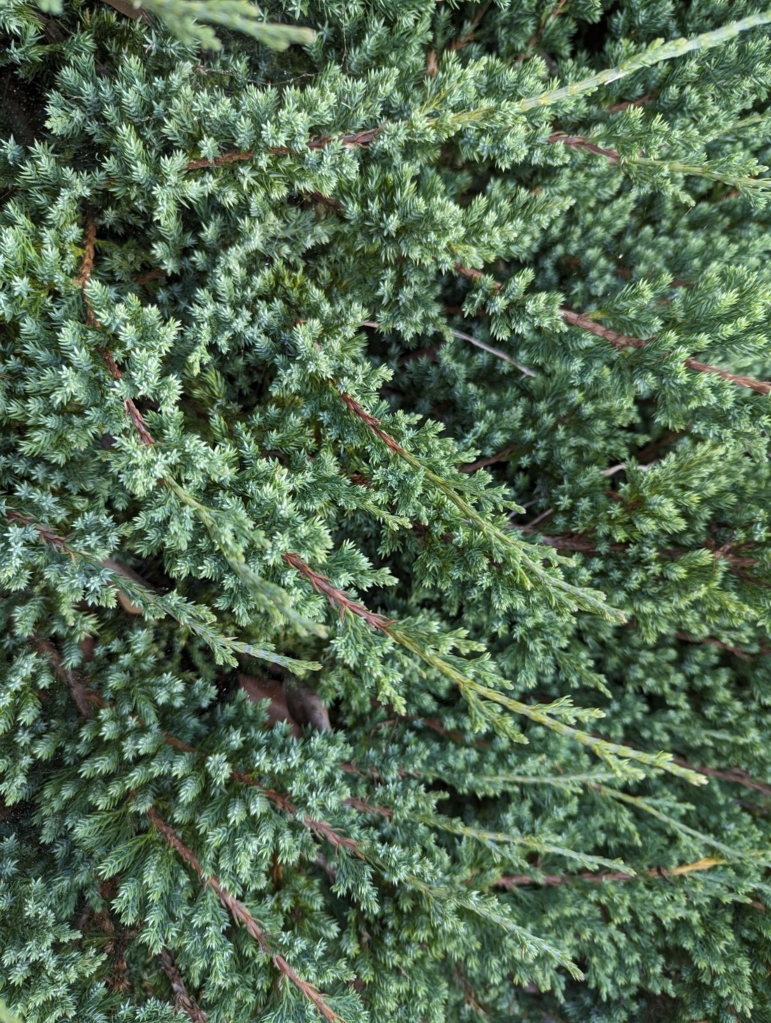
Japanese Garden Juniper

Japanese garden juniper stays relatively low.

With adequate time, this prostrate juniper slowly evolves from ground cover to shrubbery. Japanese garden juniper, Juniperus procumbens, can sprawl more than ten feet. Without obstruction, it might do so without getting higher than a foot. It grows higher as it depletes space to expand, or reaches its maximum width. It may eventually grow a few feet deep.

The evergreen foliage of Japanese garden juniper is elegantly grayish or bluish green. It contrasts splendidly with deep green junipers or other rich green foliage. The tiny leaves display a visually fine texture, but are actually rigid and prickly. New stems are short and somewhat pointy until they widen with new foliage. Foliar density excludes most weeds.

Like most junipers, Japanese garden juniper is challenging to prune. Because foliage is so dense, it does not extend far below its outer surface. Consequently, there is not much growth to prune back to. Exposed inner stems are unlikely to foliate efficiently. Shearing, although effective, temporarily compromises natural form. Frequent light pruning is best. ‘Nana’ is the more compact cultivar.

Euonymus fortunei

Euonymus fortunei can be shrubby or vining.

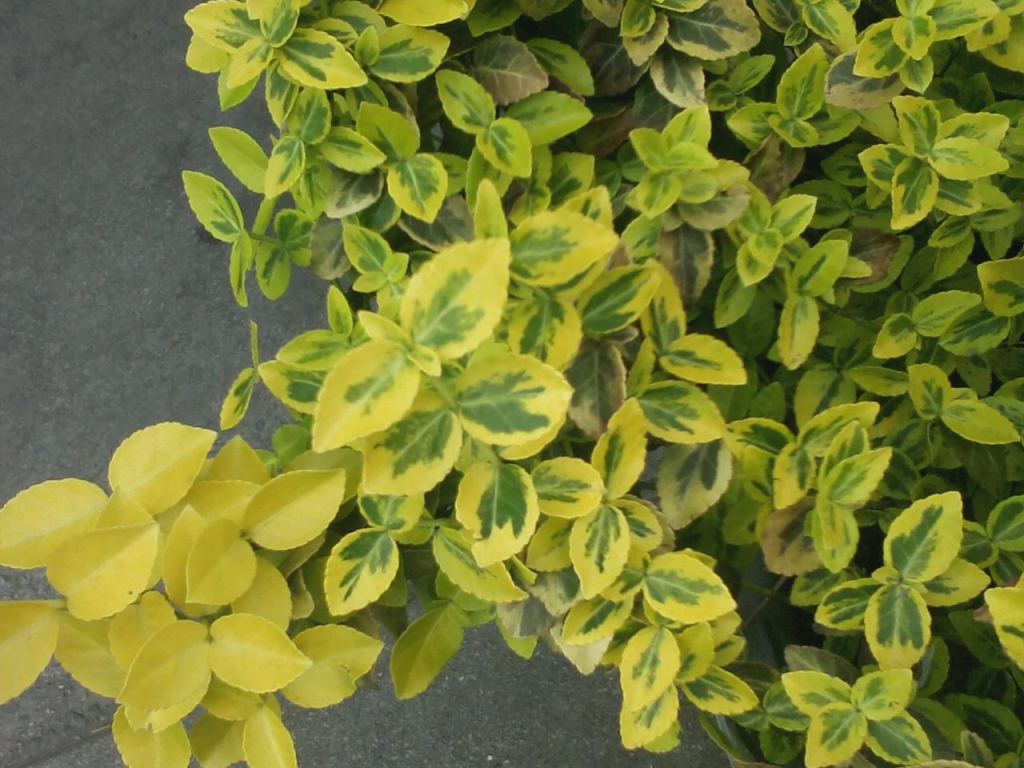
Like ivy, Euonymus fortunei creeps along the ground while juvenile, then climbs as a clinging vine where it finds support, and finally produces shrubby adult growth that can bloom and produce seed when it reaches the top of the support. Most cultivars (cultivated varieties) are juvenile plants that make good small scale ground cover that will eventually climb and mature to adulthood if not contained. As vines, they work nicely on concrete walls, but should not be allowed to climb wooden walls or painted surfaces that they can damage with their clinging rootlets. Cultivars that are grown from cuttings of adult growth are strictly shrubby.

The finely serrated, paired leaves are about three quarters to two inches long and about a quarter to one inch wide. The most popular cultivars of Euonymus fortunei that are grown for their variegated or yellow foliage do not grow too aggressively or get too large. Those with green, unvariegated foliage can slowly but eventually climb more than three stories high. Docile variegated plants can sometimes revert to unvariegated and become more aggressive. (Reversion is mutation to a more genetically stable state.)

Holly Olive

Holly olive resembles English holly.

If the foliar spines (teeth on the margins of the leaves) of English holly are too nasty, holly olive, Osmanthus heterophyllus, might be a more docile option. It lacks the occasional bright red berries and the very glossy finish on the leaves, but is much easier to handle than real holly is, since the spines are not nearly as sharp. If you look closely, you can see that the one to two and a half inch long leaves have opposite arrangement (are in opposing pairs along the stems) instead of alternate arrangement (are single along the stems) like those of holly.

The more popular varieties of holly olive have some sort of variegation of white or gold. Variegation can be spots, blotches or more refined margins. Most of the modern variegated varieties prefer to stay less than six feet tall. The old fashioned unvariegated holly olive can get more than twenty feet tall when very old, but the upper foliage lacks the distinctive foliar spines of lower foliage. The tiny and mostly unnoticed flowers are pleasantly fragrant.

Sweet Box

Sweet box should bloom for winter.

Floral fragrance is likely the primary asset of sweet box, Sarcococca ruscifolia. However, the splendidly glossy and evergreen foliage is as appealing as that of any of the various boxwoods. It is darker and richer green, with orderly arrangement on nimble and arching stems. Individual leaves are small but larger than boxwood leaves, and with pointier tips.

Sweet box blooms during winter, with deliciously fragrant but tiny pale white flowers that are not much to see. They are unlikely to get credit for their impressive fragrance without close investigation for its source. Vigorous plants may produce a few rich maroon berries that contrast delightfully with the rich green foliage. Cut stems work well with cut flowers.

Because it is naturally an understory species, sweet box not only tolerates partial shade, but actually prefers it. Harsh exposure fades its foliage. The dense foliage on wiry stems adapts to low hedging. It is better with alternating cane pruning to remove old stems and promote fresh basal growth. Overgrown specimens respond quite favorably to coppicing. They grow to three feet high.

Sweet Olive

Sweet olive hides its fragrant bloom.

It may not seem like much to take notice of. Sweet olive, Osmanthus fragrans, resembles glossy privet, but is neither as glossy nor quite as richly green. The dense and evergreen foliage can work about as well for a formal hedge though. It is even better as a small and billowy tree. It gets at least as high as ground floor eaves, and can reach upstairs eaves.

The primary allure of sweet olive is its delightfully pervasive and fruity floral fragrance. Its small and slender clusters of tiny pale white, yellow or gold flowers are mostly obscured by foliage. For those who are unfamiliar with it, the fragrance might be difficult to identify. Bloom is most abundant before and after summer. Sporadic bloom happens at any time.

Because sweet olive is more olfactorily appealing than visually appealing, it works quite nicely as in informal hedge behind prettier plants. It can stay narrow between windows of neighboring homes that are a bit too close together. If enough flowers are available, they might flavor tea and confectionery. A cultivar with variegated foliage is unfortunately rare.

Firethorn

Firethorn is a familiar wintry berry.

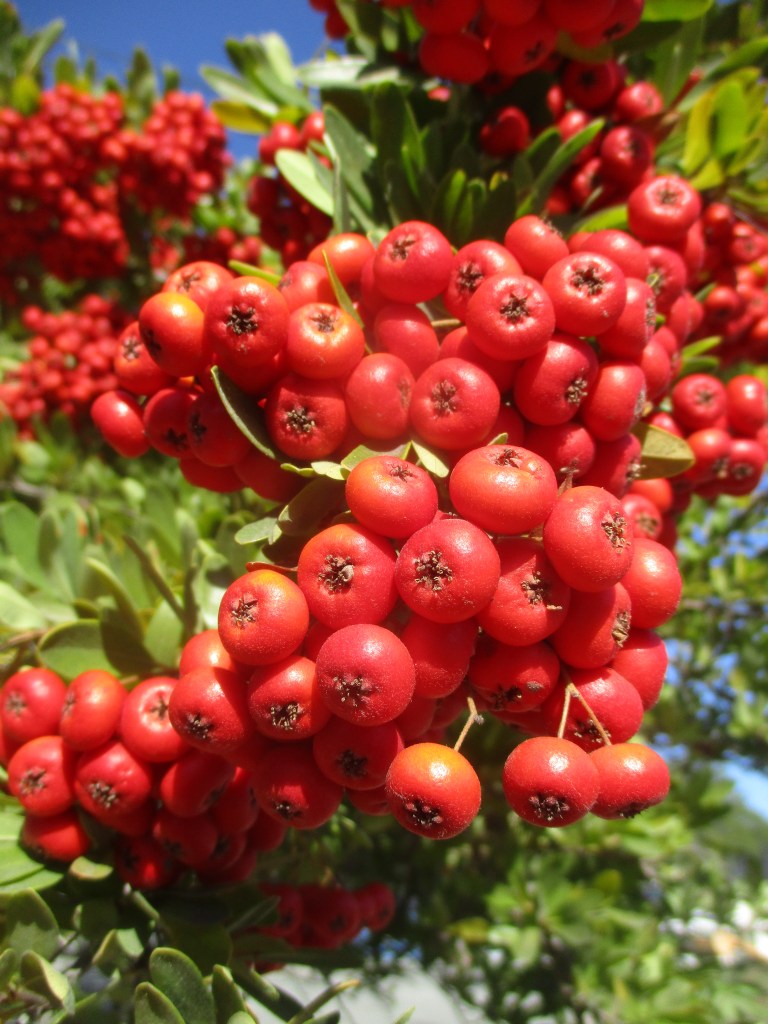
Its name says it all. Firethorn, Pyracantha coccinea, produces an abundance of fiery red berries on unavoidably thorny stems. A few old fashioned cultivars produce equally fiery orange berries. Cultivars with fiery yellow berries are now rare. Berries ripen for autumn, in time to feed migratory birds. Late berries can last longer after migratory birds are gone.

The rigid and wickedly thorny stems of firethorn work well as impenetrable hedges. They are rather difficult to prune and handle without impalement though. Unfortunately, simple shearing deprives formal hedges of some of their new growth that blooms and fruits most abundantly. Selective pruning is tedious and more hazardous, but might enhance bloom.

Shrubby cultivars of firethorn can grow higher than first floor eaves. Mature and vigorous hedges with hefty interior trunks at such height can generate spirelike growth that almost reaches second floor eaves. With pruning, some cultivars that sprawl close to the ground can stay quite low. Without pruning, some slowly form thickets that are several feet deep.

Holly Leaf Cherry

Holly leaf cherry fruit looks better than it is. The flavor is good; but there is very little pulp around the big seeds.

Since it is native to coastal chaparral between Monterey and the middle of the Baja California Peninsula, holly leaf cherry, Prunus ilicifolia, is right at home in local gardens of the central and south coasts. Although it can be a nice refined hedge if not shorn too frequently, it is better where it has space to grow wild into a mounding shrub, and can eventually grow into an undemanding informal screen as high and broad as fifteen feet. Width is easier to limit with selective pruning than with shearing. Besides, unshorn plants bloom with clusters of minute white flowers in spring, and produce interesting deep red or purplish red cherries in autumn. Unfortunately, the cherries have very big pits with only minimal sweet pulp. The small glossy leaves have somewhat bristly teeth almost like those of some hollies.

Rocky Mountain Juniper

Rocky Mountain junipers get rather large.

Hollywood juniper had formerly been the only popular juniper of tree form. As it became less popular during the past few decades, cultivars of the once obscure Rocky Mountain juniper, Juniperus scopulorum, became more popular. Also, a few more modern cultivars became available. Now, the once overly common Hollywood juniper is quite uncommon.

Rocky Mountain juniper is naturally rather grayish for protection from the harsh exposure of the high elevations which it inhabits. Cultivars are grayer, bluish or silvery, and mostly develop symmetrically conical form. Old specimens that were initially conical eventually grow as small trees with rounded and relatively dense canopies, perhaps on bare trunks.

‘Skyrocket’ and ‘Blue Arrow’ are very narrow like Italian cypress that grow only fifteen feet tall. ‘Wichita Blue’ and ‘Moonglow’ are stoutly conical. ‘Blue Arrow’ and ‘Wichita Blue’ are bluish green. ‘Skyrocket’ and ‘Moonglow’ are silvery gray. Established specimens do not require much water, but develop better foliar color with warmth and occasional watering.