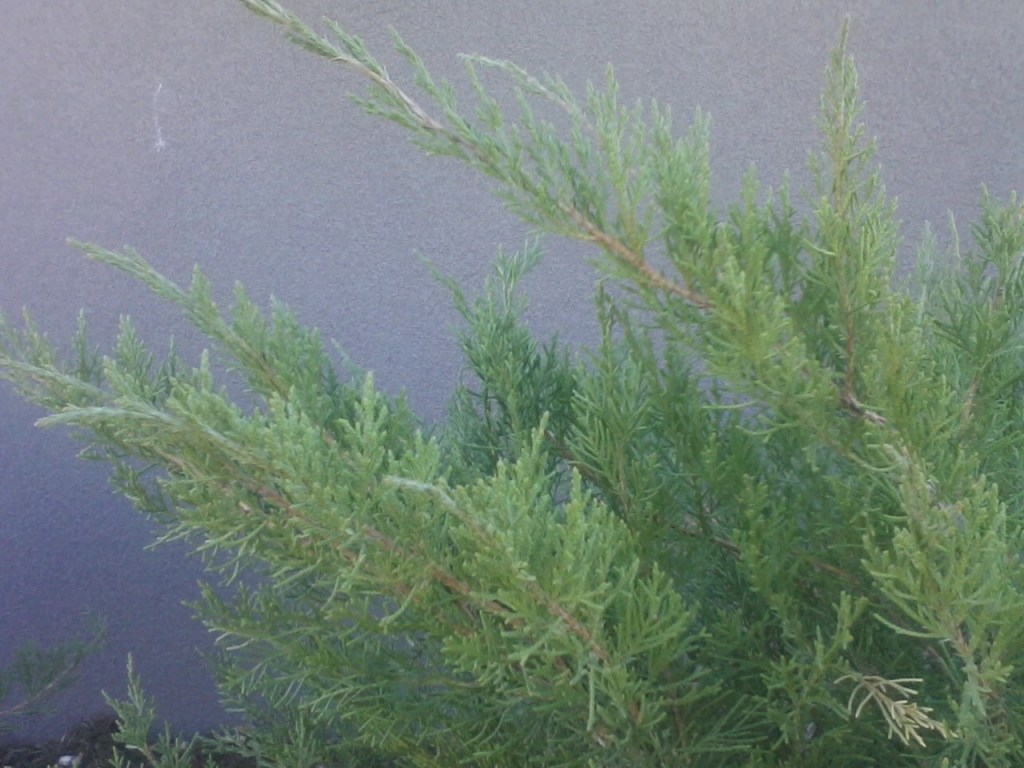
Of the several junipers that were too common decades ago, the golden pfitzer juniper, Juniperus X pfitzeriana ‘Area’, was the one outfitted with cheery, bright yellow new foliage each spring. Similar but more compact varieties that are more popular now were rare back then, or simply not yet invented. Contrary to the stigma, golden pfitzer juniper is a very tough shrub, which is why so many from decades ago remain in older gardens, and new plants can sometimes be found in nurseries. Once established, they need very little water, or none at all. A bit of partial shade is tolerable, but inhibits color. Angular branches radiate outward, with the finely textured foliage drooping only slightly at the tips. Mature plants get wider than six feet, and taller than four feet. Crowded plants can stand taller than six feet. Golden pfitzer juniper can technically be shorn as hedges, but are so much more appealing if selectively pruned to maintain their natural form. They are at their best where they have space to spread out naturally without pruning.
Almost all photinia in local landscapes is Fraser’s photinia, Photinia X fraseri, which is a thornless and fruitless hybrid of two species that are now rare. Some of the old fashioned photinia are thorny. Some produce copious berries that can get messy, or feed birds who can get messy. More modern cultivars of Fraser’s photinia are becoming more available.
Fraser’s photinia is popular as a shorn evergreen hedge. New foliage that develops after shearing is richly reddish bronze, and fades to dark green. Bronze color is best in spring, after late winter shearing. Summer shearing stimulates a repeat performance, although it may not last as long before the foliage fades to green. Shearing enhances foliar density.
Unshorn photinia can develop into small trees as tall as fifteen feet, with new growth that is a bit less richly colored than that of shorn photinia. It also blooms, often profusely, with big and rounded trusses of tiny creamy white flowers. Bloom is not impressively colorful. Floral fragrance is objectionable to some. All photinia types are susceptible to fire blight.
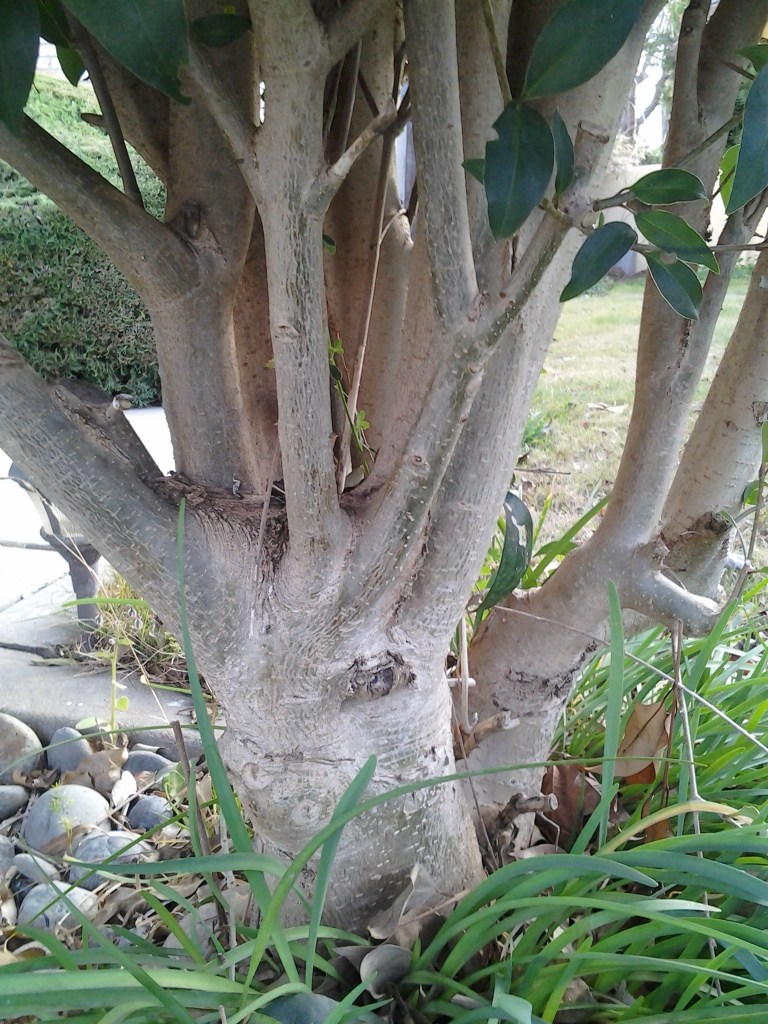
Where it had been left to develop naturally in old freeway landscapes, shiny xylosma, Xylosma congestum, grew as small trees. The largest are significantly taller than twenty feet. They can be pruned up to expose their nicely flaking bark on sculptural trunks and stems. The evergreen foliage is shiny and rather yellowish green, somewhat like that of camphor tree. The slightly serrate leaves are about two inches long or a bit longer. The tiny and potentially fragrant flowers are rarely seen, and not worth looking for. In refined landscapes, shiny xylosma is popular as a shorn hedge. Xylosma congestum ‘Compacta’ has denser growth, and can be kept only a few feet high if necessary. Vigorous shoots can have nasty thorns hidden in their deceptively gentle foliage. Once established, shiny xylosma does not need much water. It prefers full sun exposure, but will tolerate a bit of shade.
All the wrong plants get shorn. Mow, blow and go gardeners are known for shearing everything that they can reach into creepy and unnaturally geometric shapes, usually flared out at the top, and bulging obtrusively into otherwise usable space. Yet, functional formally shorn hedges are passe and almost never shorn properly.
First of all, a formal hedge should be uniform, which means that all the plants that comprise it should be the same, and planted at the same distance from each other. Any plants within a formal hedge that die should be replaced with the same plant. A single English boxwood plant added to a Japanese boxwood hedge will always stand out with a different shade of green and growth pattern. Seedlings of other plants that grow up into a hedge should be removed before they become part of it.
Secondly, a formal hedge should be contained within defined boundaries. It should get neither too tall, nor too deep (from front to back). A fat hedge wastes space. There is no excuse for a hedge to encroach obtrusively over walkways, driveways or patios.
The vertical faces of a hedge should be completely vertical or slope very slightly inward at the top, but should certainly not slope outward to shade lower growth. A slight inward slope is more important on a northern face of plants that are sensitive to shade.
Hand pruning hedges (with hand shears) produces the best finish, but takes quite a bit of time for big hedges. Shearing with typical hedge shears cuts leaves as well as stems, so can cause foliage with large leaves to look a bit tattered for a while. Hedges that grow fast may need to be shorn twice or more annually. Some hedges can get shorn back aggressively once annually, and then allowed to fluff out evenly through the rest of the year. Bottlebrush and escallonia hedges can bloom nicely and evenly if shorn only once annually.
Glossy and wax leaf privet are among the most traditional of formal hedges. Glossy privet can get quite tall, but wax leaf privet actually has glossier foliage. Photinia and shiny xylosma have a bit more color, but want a bit more space (from front to back). Boxwoods make very nice small hedges. Pittosporums are available in various shapes and sizes. Pittosporum eugenioides gets quite tall, and can be kept quite lean. Pittosporum tobira is shorter and wider.
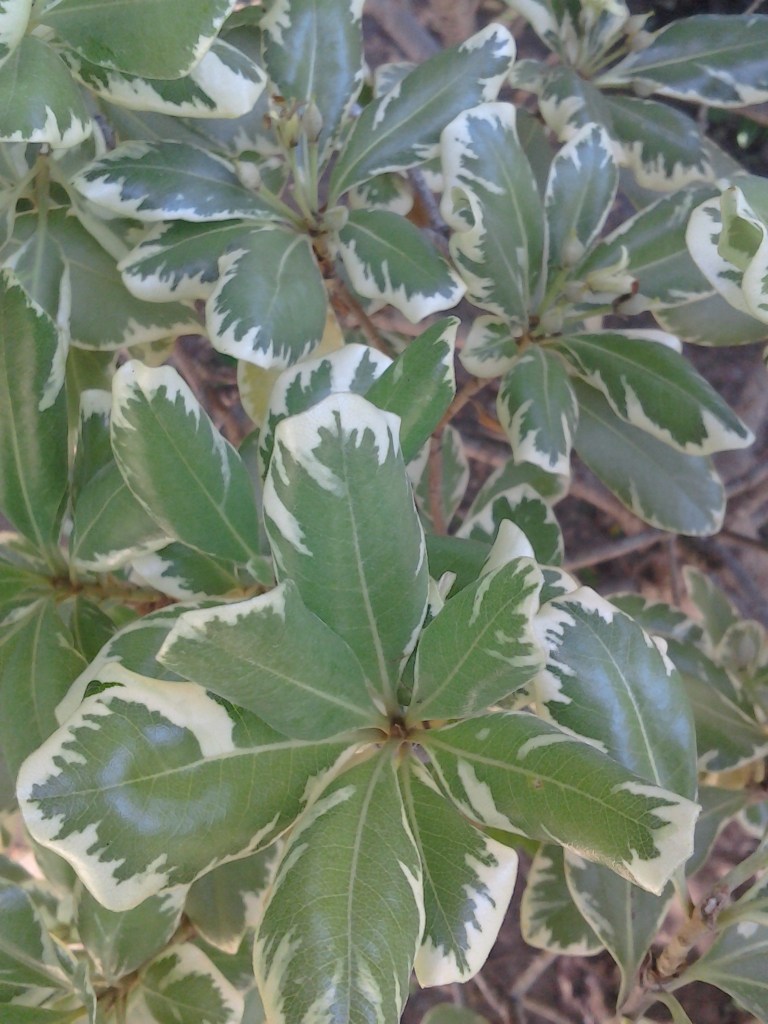
There are too many other plants known as ‘mock orange’ for Pittosporum tobira to still go by that name, which is why it is more commonly known by its Latin name, or simply as ‘tobira’. The pleasantly fragrant flowers do not smell too much like those of orange anyway. The glossy and dark green leaves are like those of some hollies, without the distinctive prickly points. ‘Variegata’ has lighter green foliage variegated with white, but does not bloom as much. Dwarf cultivars, both variegated and unvariegatd, bloom even less. ‘Variegata’ has a tendency to occasionally produce stems of green (unvariegated) foliage that grow more vigorously and can overwhelm the original variegated growth if not pruned out. Common green Pittosporum tobira can grow as a small tree in the partial shade of larger trees, but is more often maintained as dense shrubbery less than ten feet tall. It makes a nice dense hedge in full sun, but unfortunately does not bloom if shorn regularly. All cultivars are resilient to drought once established.
Too much of a good thing eventually gets old. That is how so many of the good junipers that were so popular half a century ago became so unpopular. They became too common, and many were planted into situations that they were not appropriate for. As they matured, many became overgrown or disfigured. Only recently have a few newly introduced modern cultivars restored the appeal of both new and traditional junipers to a generation that is less familiar with their former stigma.
Even though all junipers are evergreen and somewhat similar in regard to foliar texture and their lack of interesting bloom, they demonstrate considerable diversity. Some are low and sprawling ground covers. Others are dense low shrubbery. A few develop as small trees. Branch structure may be densely compact, gracefully arching, rigidly upright, or sculpturally irregular.
Some junipers have yellowish new growth that eventually turns to a more typical deep green. Others are bluish gray throughout. A few rare types are variegated. Almost all junipers have scale-like leaves (like those of cypress). A few have needle-like leaves.
‘Blue Arrow’ and more traditional ‘Skyrocket’ junipers are like short and plump Italian cypress with bluish or gray foliage. ‘Wichita Blue’ juniper is even shorter and plumper, with more sculptural branch structure. However, it is not nearly as irregular and sculptural as the old fashioned ‘Hollywood’ juniper. Modern ‘Gold Star’ and the older ‘Old Gold’ junipers are shrubby types that exhibit arching stems with gold tips.
‘Icee Blue’ is like an improved version of the classic ‘Blue Rug’ juniper, that matures as a shallow bluish ground cover. ‘Blueberry Delight’ juniper is one of the few junipers known for conspicuous fruit, with pretty powdery blue berries against grayish needle-like foliage on trailing stems. ‘Limeglow’ juniper gets a bit deeper, and exhibits chartreuse new growth that turns rich green.
Just because junipers can be shorn certainly does not mean that they should be! Shearing deprives junipers of their naturally appealing texture and form. Instead, junipers should be selectively pruned only where necessary to eliminate growth that is beginning to become obtrusive. Stems should be cut back deeply into the main stems from which they originate, in order to avoid leaving stubs or disfigured stems. Tree junipers like ‘Hollywood’ juniper, as well as overgrown shrubby junipers, can be pruned to expose bare trunks and stems. The gnarly stems and shredding bark can be as appealing as the foliage that obscures them.
Otherwise, once established, junipers do not need much attention or water, and are remarkably resilient. They only rarely get infested with spider mites or scale insects, or get damaged by disease. They only want good sun exposure.
So many really nifty small trees never get an opportunity to perform to their best potential. Many function so well as shrubbery that there is no need to prune them into tree form. Many just get shorn down because that is the most obvious option.
There certainly is no problem with maintaining large shrubbery as shrubbery if that is the intended function. Oleander, photinia, privet, bottlebrush and various pittosporums are all excellent shrubbery, and except for oleander, can be shorn into hedges. Yet, any of them can alternatively be grown into small trees.
‘Standards’ are shrubs that are trained onto single staked trunks. Small shrubs trained as standards, such as boxwood, azalea and euryops, are really only shrubbery on a stick. The larger shrubs though, are more often trained onto trunks about six feet tall so that they can develop as small trees with single trunks.
However, they do not necessarily need single straight trunks. Many have naturally sculptural trunks that are worthy of display. They can be planted as shrubbery, and simply trained up on a few of the trunks that they are naturally equipped with. They only need lower growth pruned away as they mature, instead of getting pruned down.
Overgrown shrubbery that has become so obtrusive that it might otherwise need to be removed can often be salvaged by getting pruned up as small trees. For example, if a New Zealand tea tree or myoporum has gotten so wide at the base that it is awkward to work around, the basal growth can be pruned away so that only upper grown that has adequate clearance remains suspended on exposed trunks. The gnarly trunks within are often more appealing than the abused foliage that obscured them.
Japanese maple, crape myrtle, water gum (Tristania laurina) and various podocarpus really are small trees, but often get shorn instead of pruned properly by ‘mow, blow and go’ gardeners who do not know any better. Olive, coast live oak and saucer magnolia are substantial trees that often get shorn into shrubbery before they can grow beyond the reach of abusive gardeners.
Hollywood juniper as well as some of the other larger junipers naturally develop into sculptural small trees that are just as appealing with or without their lower growth. The gnarly foliated stems are just as sculptural as the trunks and stems within. If space allows, they can be left to grow somewhat wildly with only occasional pruning of superfluous stems.
Good old fashioned boxwood hedges really look silly if just a single missing plant get replaced with a different cultivar (cultivated variety) or specie. Most of the older boxwood hedges are the traditional, but somewhat yellowish Japanese boxwood. Most middle aged hedges are a relatively newer cultivar that is a bit greener. Modern boxwood hedges are more likely a cultivar of English boxwood, Buxus sempervirens.
English boxwood resembles Japanese boxwood, but has slightly narrower leaves that produce a slightly more objectionable aroma when shorn or otherwise disturbed. These opposite (paired) glossy leaves are only about a quarter to half an inch wide and about twice as long. The color is slightly darker with a more ‘olive’ tone. Wild English boxwood in Europe can grow as small trees. Most garden varieties are fortunately much shorter and more compact, which is why they are so popularly shorn into small formal hedges. They also do well as topiary. ‘Aureo Variegata’ is variegated with nicely contrasting cream colored leaf margins.
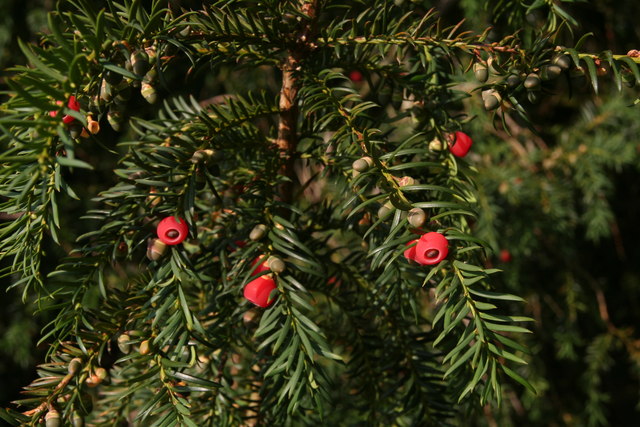
English yew has inhabited landscapes and gardens for centuries. (This is not my picture.)
It is difficult to know how big any of the various cultivars of English yew,Taxus baccata, will eventually get, and how long they will take to get that big. Most can get almost as tall as thirty feet. Some can get nearly twice as tall. However, they can take more than a century or several centuries to do so. Old specimens around Europe are significantly older than two thousand years. Slow growth is an advantage for formal hedges that get shorn only annually. English yew prefers regular watering. Partial shade is not a problem.
Irish yew is actually a cultivar of English yew with densely upright growth. The various golden yews have yellowish foliage. Otherwise, most English yews have finely textured dark green foliage on angular stems that resemble those of redwood. Individual leaves are very narrow, and only about half and inch to an inch long. The peeling dark brown bark resembles that of large junipers, but not quite as shaggy. English yew is toxic.
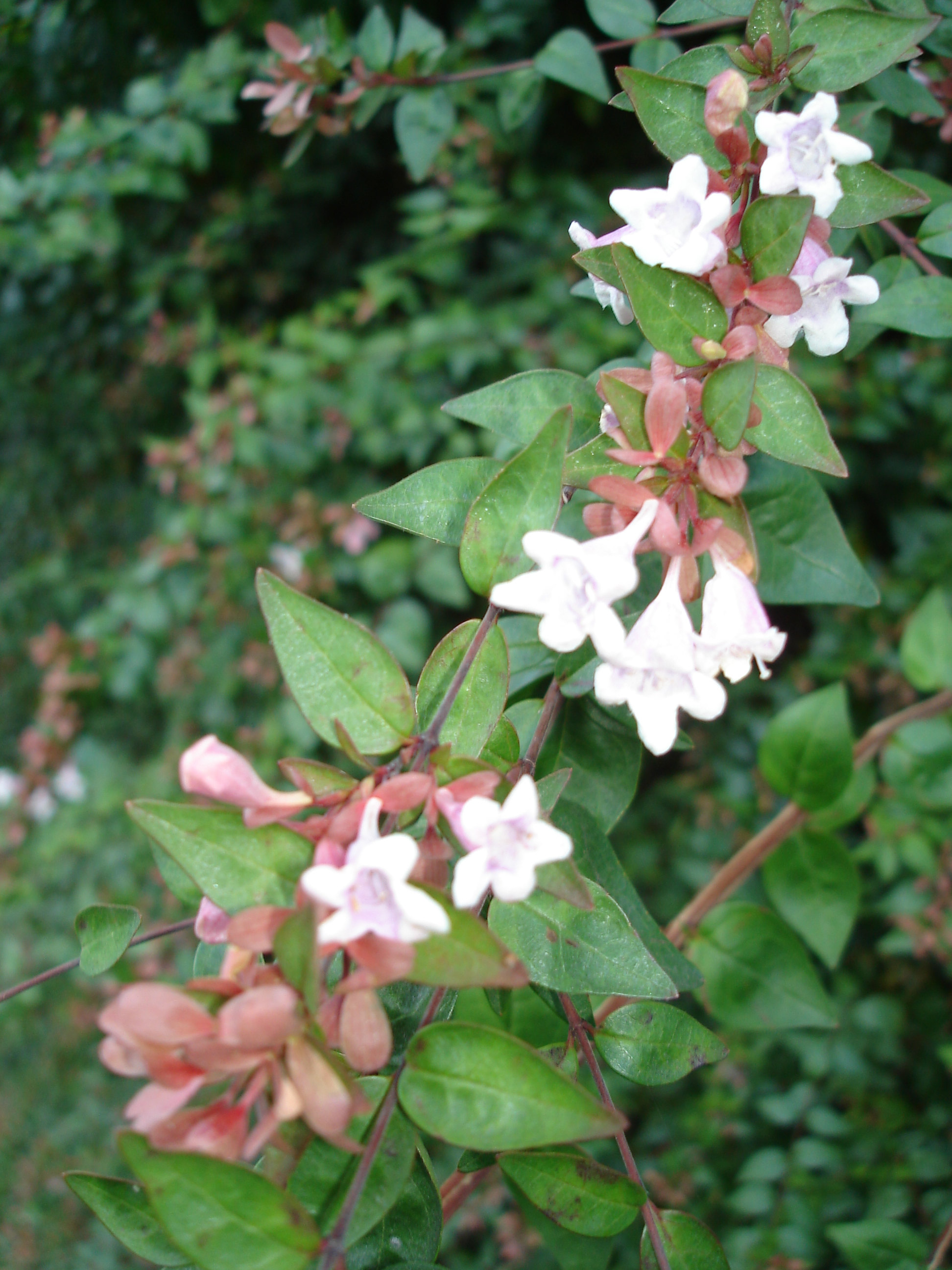
With indiscriminate pruning, glossy abelia, Abelia X grandiflora, will never develop its natural form, with elegantly long and thin stems that arch gracefully outward. Sadly, almost all get shorn into tight shrubbery or hedges that rarely bloom. If only old stems get selectively pruned out as they get replaced by fresh new stems, mature shrubs can get eight feet tall and twelve feet wide.
Against their bronzy green foliage, the tiny pale pink flowers that bloom all summer have a rustic appeal. In abundance, they can be slightly fragrant. The tiny leaves are not much more than an inch long. Vigorous young canes that shoot nearly straight out from the roots slowly bend from the weight of their bloom and foliage as they mature.
Partial shade is not a problem for glossy abelia, but will inhibit bloom somewhat. Young plants want to be watered regularly. Old plants are not nearly so demanding, and can survive with notably less water. If alternating canes is too much work to restore old and neglected plants, all stems can be cut back to the ground at the end of winter. New growth develops quickly.



 Tony Tomeo