By the end of the Victorian Period, dracaena palm, Cordyline australis, had become very popular, both as small trees and as foliar plants. The largest specimens were only about twenty feet tall and half as wide. Removal of trunks that grew too tall for short foliar plants induced fresh basal growth. The drab leaves grew three feet long and three inches wide.
Cultivars with bronzed foliage became more popular after the Victorian Period, although not as common as the original. They grew slower and stayed smaller. The many modern cultivars of the past few decades stay even smaller, with even more impressively colorful foliage. Most are purply bronze or variegated with creamy white, pale yellow, pink or tan.
Modern cultivars generally mature efficiently, but then attain height too slowly to function as small trees. Some do not develop substantial trunks. They are therefore more popular for their delightful foliar color and texture. Many generate appealingly pendulous foliage. However, a few eventually develop sculptural form with exposed corky trunks and limbs. Removal of unimpressive floral panicles prior to bloom removes floral frass before it gets messy.
The strikingly glaucous juvenile foliage of silver mountain gum, Eucalyptus pulverulenta, is likely more familiar within floral design than in home gardens. Actually, it is uncommon within home gardens, although quite popular as cut foliage among florists. Its paired and sessile leaves are oval or bluntly cordate (‘heart shaped’), and about an inch or two long.
Adult growth is rare, even among established trees. However, small white flowers bloom from the axils of juvenile leaves that are a year old. (Juvenile growth of most species can not bloom.) Bloom might continue from spring until autumn, as blooming stems sag from the weight of younger distal growth. The aromatic and evergreen leaves stiffen with age.
Low and shrubby specimens with a few trunks may not get much higher than fifteen feet. They have potential to get twice as tall though, particularly if pruned up onto bare trunks. Lignotubers expand below the trunks. Strips of old bark shed to reveal fresh matte brown bark. Incidentally, the Latin name of this species often transposes for Eucalyptus cinerea.
Pittosporum eugenioides leaves have distinctively wavy margins.
Large shorn hedges or informal screens are the more popular functions of Pittosporum eugenioides. It works like a modern and more relaxed option to privet. What few garden enthusiasts know is that it can alternatively be allowed grow into a small tree, either as a standard (on a single trunk) or with multiple trunks. It grows rather efficiently to more than twenty feet tall and about half as broad while young, and as it matures, can eventually get about thirty feet tall and broad.
The glossy leaves have appealingly wavy margins and distinctively pale midribs. The slightly fragrant flowers are only pale yellow, and are not abundant among young trees. Big old trees often bloom enough in autumn to be pleasantly fragrant. Stems and foliage are lemony fragrant when pruned or shorn. However, the common name of ‘lemonwood’ (or tarata) is not so common locally for Pittosporum eugenioides.
Johnny jump up and jumping cholla have no more than amusing names in common with hopbush, Dodonea viscosa. Neither a dangerous cactus nor a docile annual, hopbush is an elegantly upright and evergreen shrub. It is very popular for both informal and formally shorn hedging. With pruning, it can become a small tree with handsomely furrowed bark.
Hopbush has potential to get about as tall as a two story house, particularly with pruning for tree form. Conversely, with only occasional pruning for hedge form, it is just as happy to stay just six feet tall. Trees with single and straight trunks fit nicely into narrow spaces. Trees with a few irregular trunks that lean outwardly are more sculptural for larger areas.
The narrow evergreen leaves are about two or three inches long, with light bronzy color. ‘Purpurea’ has purplish bronze color, but does not grow as vigorously. Most hopbush are female, and generate interestingly papery seed. Bloom and seed production are variable though, and some specimens become male. Roots should be complaisant with concrete.
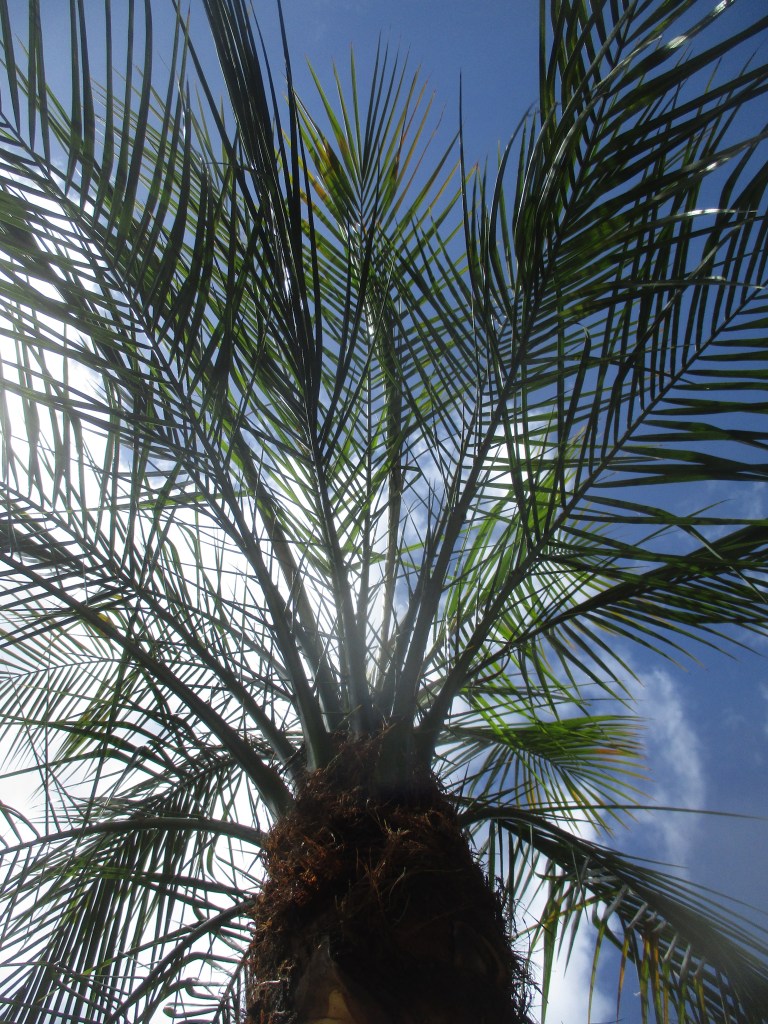
Canary Island date palm is the largest local palm. Pygmy date palm, Phoenix roebelenii, although a species of the same genus, is one of the more diminutive palms. It might take many years to grow ten feet tall, and may never get twice as tall. Its pinnately compound leaves are only about two to four feet long. Thin leaflets are about five to ten inches long.
Such compact stature is a distinct advantage for some situations. With sufficient sunlight, pygmy date palm is a delightful houseplant. It is also appealing within atriums and cozily compact gardens. For those who appreciate the aesthetics but not the large size of most palms, pygmy date palm is a practical option. It actually resembles a common date palm.
Like all date palms, a pygmy date palm surrounds its single terminal bud with nasty long spines, which are specialized proximal leaflets. These spines are painful to interact with while grooming and pruning deteriorated old leaves and floral trusses back to their trunk. Unlike most other palms, mature pygmy date palms are not very conducive to relocation.
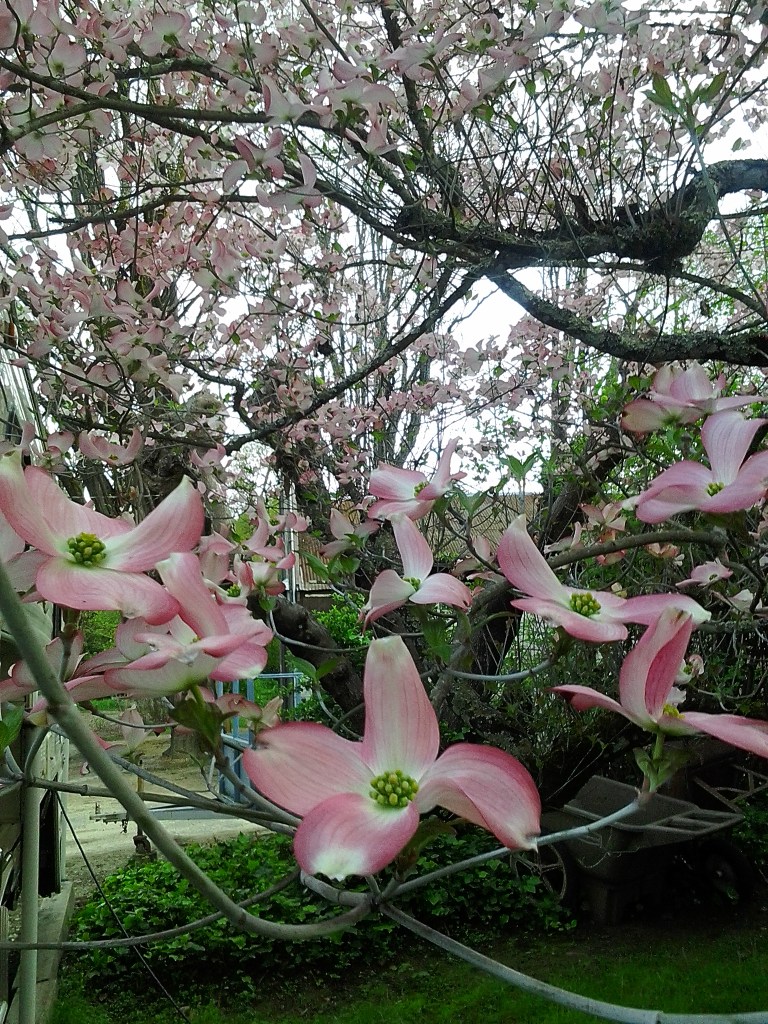
Before foliage develops, this American dogwood is a cloud of profuse pink bloom in a partly shaded and sheltered garden.
The state tree of Missouri produces the state flower of North Carolina, which are both the state tree and state flower of Virginia, but no so exploited by the state that it seems to be named for! The American dogwood, Cornus florida, is such a classic American tree that last year, young trees were given to Japan to commemorate the gift of Japanese flowering cherry trees from Japan a century earlier.
Profuse early spring bloom is not what it seems to be. Tight clusters of minute flowers would not be much to look at, but are surrounded by four big white bracts (modified leaves) that really put on an impressive show before green leaves develop. Many modern varieties have pink or nearly brick red bracts, and a few get variegated foliage as bloom dissipates. Foliage can get quite colorful just before it falls in autumn.
In the wild, American dogwoods are ‘understory’ trees that are happiest in forests of larger trees that shelter them from harsh sun exposure and drying wind. In relatively arid western climates, they want rich soil, regular watering and partial shade at least after noon. They are sensitive to reflected glare and wind, as well as alkalinity and salinity. (Too much fertilizer will roast the foliage.) Since American dogwood trees rarely get more than fifteen feet tall in cultivation, they are proportionate to sheltered atriums. Wild trees do not get much taller than thirty feet.
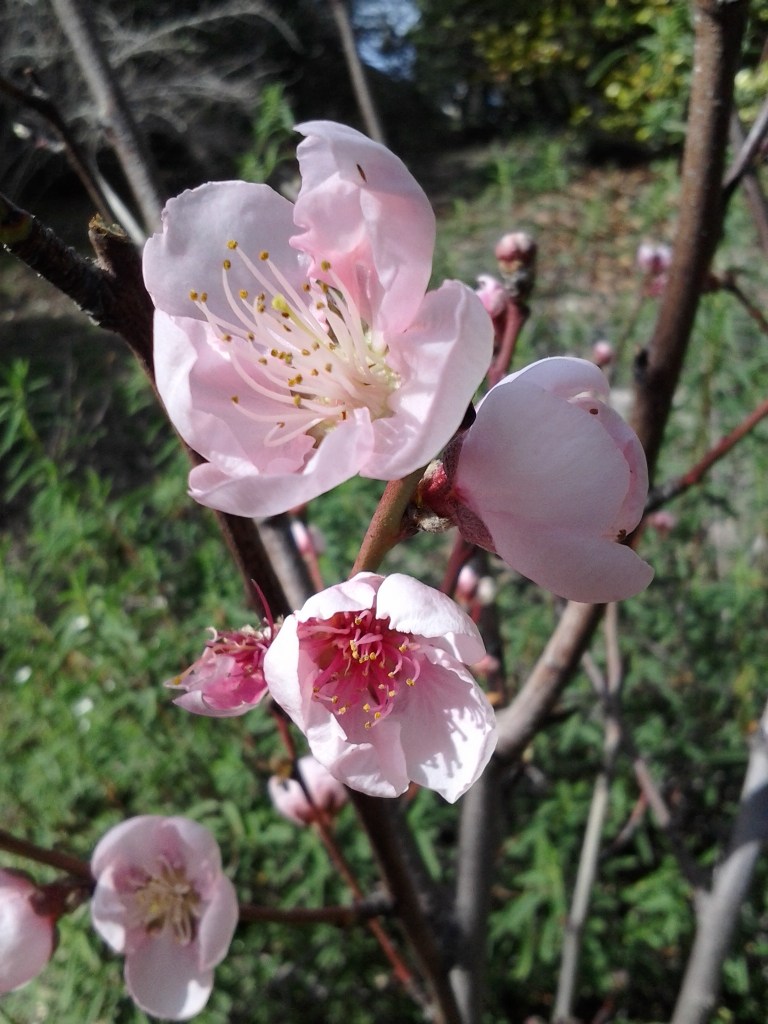
Even when weather is more typical for the local climate, many types of flowering apricot, Prunus mume, bloom during winter. Flowers seem to be a bit more resilient to wind, rain and frost than those of flowering cherry that bloom a month or so later. Nonetheless, they are delicate and share their white or pastel pink color with wintry landscapes only briefly.
Although many garden varieties of flowering apricot are fruitless, some, particularly feral trees, produce fruit. Some of such fruit is desirable to those who utilize it. However, most is unpalatable without specialized processing. Flowering apricot works as understock for a few related trees, so occasionally grows from the roots of such trees after their removal.
Flowering apricot is quite rare locally, which is why it seems to be so unseasonable as it blooms so early. Like flowering cherry and plum, it blooms on otherwise bare stems prior to generating new foliage for spring. Copious bloom of garden varieties is nicely fragrant. Flowers are nearly an inch wide. Mature trees are about ten to more than twenty feet tall, and almost as broad.
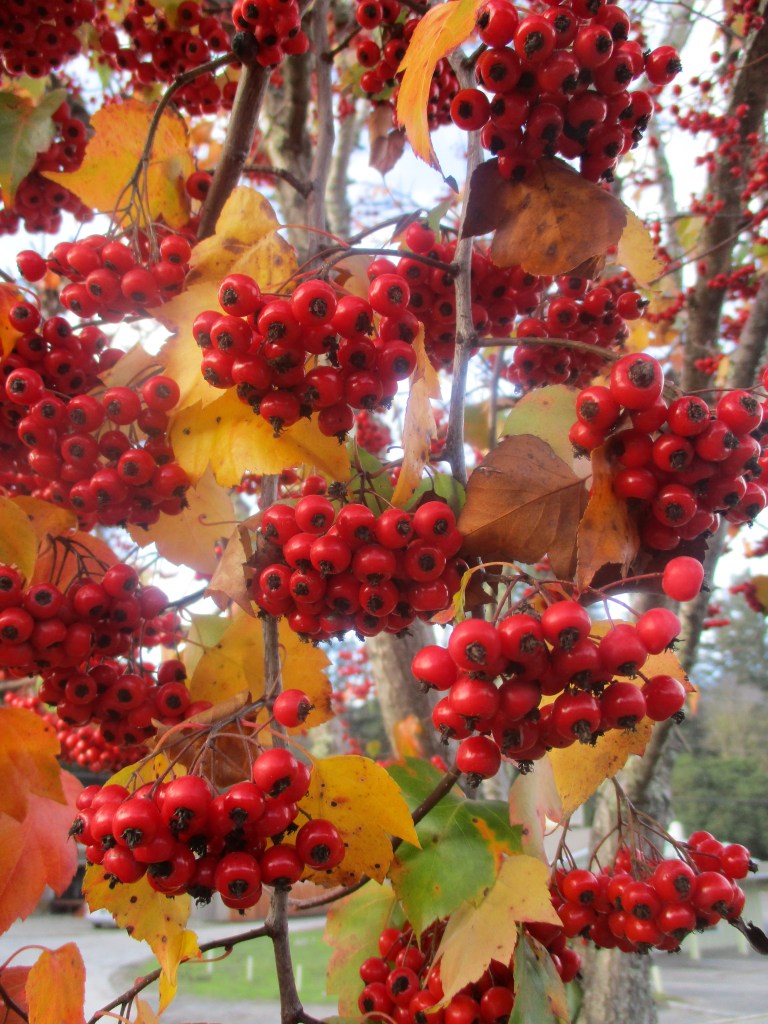
Most red berries that provide color and attract birds through late autumn and winter grow on shrubbery. Berries of English hawthorn, Crataegus laevigata, grow on trees. They are not big trees, but they are distinguished. Mature trees might get no taller than twenty feet, but their furrowed trunks with weathered bark resemble those of older and statelier trees.
Trusses of small white flowers that bloom in spring are comparable to those of pear. Like pear bloom, they emit a potentially objectionable musky fragrance. Modern cultivars that bloom with pink, double pink or double red flowers are less fragrant. English hawthorn is uncommon locally. The few cultivars that produce yellow or orange berries might be rare.
The deciduous leaves of English hawthorn are only about an inch or two long and wide. They are deeply lobed, with a handsomely coarse texture. Foliage can turn rusty orange or brownish yellow for autumn. Defoliation exposes any remaining berries, at least until the birds finish with them too. Thorns are unfortunately unavoidable.
Almost all photinia in local landscapes is Fraser’s photinia, Photinia X fraseri, which is a thornless and fruitless hybrid of two species that are now rare. Some of the old fashioned photinia are thorny. Some produce copious berries that can get messy, or feed birds who can get messy. More modern cultivars of Fraser’s photinia are becoming more available.
Fraser’s photinia is popular as a shorn evergreen hedge. New foliage that develops after shearing is richly reddish bronze, and fades to dark green. Bronze color is best in spring, after late winter shearing. Summer shearing stimulates a repeat performance, although it may not last as long before the foliage fades to green. Shearing enhances foliar density.
Unshorn photinia can develop into small trees as tall as fifteen feet, with new growth that is a bit less richly colored than that of shorn photinia. It also blooms, often profusely, with big and rounded trusses of tiny creamy white flowers. Bloom is not impressively colorful. Floral fragrance is objectionable to some. All photinia types are susceptible to fire blight.
All of the popular fruit trees produce flowers. Otherwise, they could not produce fruit. The stone fruits, such as almond, apricot, cherry, peach, plum and prune, bloom very impressively this time of year. (Stone fruits have single large seeds known as stones. Almonds are the large stones of small fruits that resemble peaches.) The pomme fruits, such as apple and pear, bloom about as prolifically shortly afterward, followed lastly by related but rare quince.
The difference between these trees and their counterparts known as ‘flowering’ trees is not so much the flowers, but the fruit. ‘Flowering’ is something of a euphemism for trees that might otherwise be known as ‘fruitless’, since they produce either uselessly small fruit, or no fruit at all.
This may seem silly to those who enjoy growing fresh fruit in the garden. However, fruit trees require so much pruning in winter, and can be so messy if the fruit does not get completely harvested. The flowering trees are happy to provide the profuse bloom without so much maintenance and potential mess. Because they were developed as ornamental trees, their flowers are more impressive, with many more shades of pink, as well as white. Many types bloom with big and fluffy double flowers.
Flowering cherry and plum are probably the most popular of the flowering stone fruit trees. Most flowering plums have purplish foliage, so are more commonly known as purple-leaf plum. Flowering almond, apricot, prune and peach are relatively somewhat rare. Most flowering stone fruit trees are completely fruitless, but some purple-leaf plum can produce messy and sour plums as they mature.
Flowering pear is probably not recognized as such because it is more often known as fruitless pear. Ironically, it can produce enough tiny pear fruit to be messier than other flowering fruit trees. Flowering pear blooms only white, and is not as florific as the other flowering trees, but grows large enough to be a mid-sized shade tree, and has the advantage of remarkable foliar color in autumn. Evergreen pear is an entirely different sort of tree that only blooms well if the weather is just so, and lacks fall color (because it is semi-evergreen).
Flowering apples are known as flowering crabapples. Unlike the other flowering trees, many flowering crabapples develop a sloppy branch structure if not pruned almost like trees that produce fruit. Yet, the weirdest of the flowering trees is the flowering quince, which is not even the same genus as fruiting quince. It develops into a thicket that blooms before everything else. Fruiting quince instead matures into a rampant tree, and blooms after the other fruit trees.




 Tony Tomeo