Almost all photinia in local landscapes is Fraser’s photinia, Photinia X fraseri, which is a thornless and fruitless hybrid of two species that are now rare. Some of the old fashioned photinia are thorny. Some produce copious berries that can get messy, or feed birds who can get messy. More modern cultivars of Fraser’s photinia are becoming more available.
Fraser’s photinia is popular as a shorn evergreen hedge. New foliage that develops after shearing is richly reddish bronze, and fades to dark green. Bronze color is best in spring, after late winter shearing. Summer shearing stimulates a repeat performance, although it may not last as long before the foliage fades to green. Shearing enhances foliar density.
Unshorn photinia can develop into small trees as tall as fifteen feet, with new growth that is a bit less richly colored than that of shorn photinia. It also blooms, often profusely, with big and rounded trusses of tiny creamy white flowers. Bloom is not impressively colorful. Floral fragrance is objectionable to some. All photinia types are susceptible to fire blight.
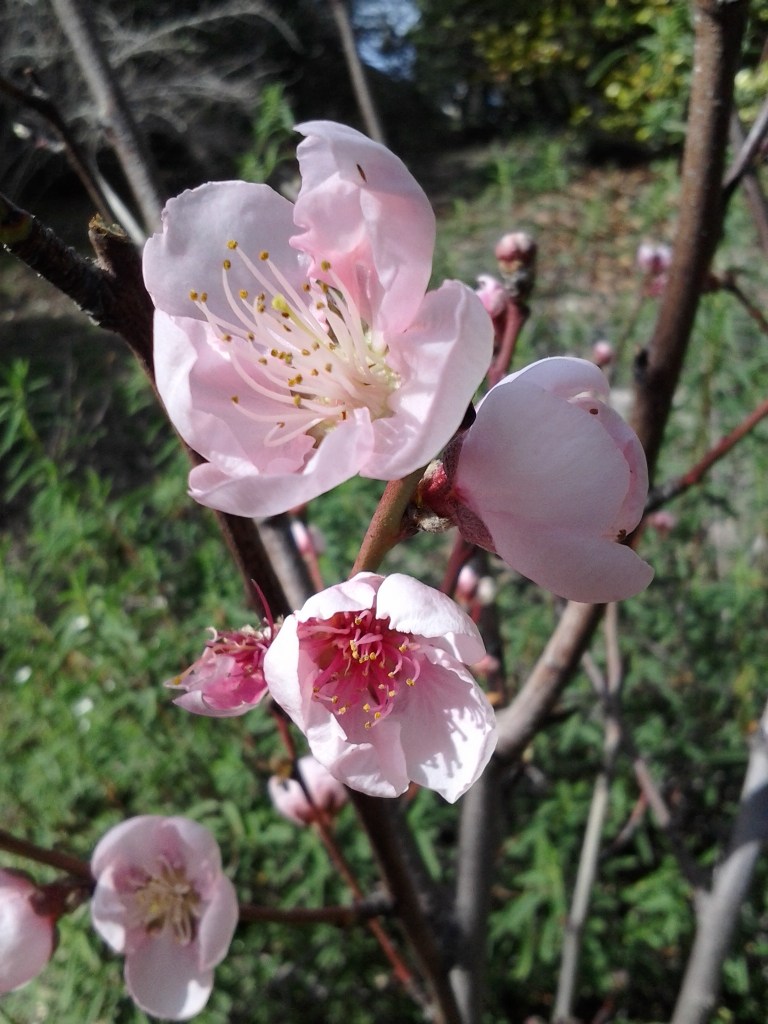
All of the popular fruit trees produce flowers. Otherwise, they could not produce fruit. The stone fruits, such as almond, apricot, cherry, peach, plum and prune, bloom very impressively this time of year. (Stone fruits have single large seeds known as stones. Almonds are the large stones of small fruits that resemble peaches.) The pomme fruits, such as apple and pear, bloom about as prolifically shortly afterward, followed lastly by related but rare quince.
The difference between these trees and their counterparts known as ‘flowering’ trees is not so much the flowers, but the fruit. ‘Flowering’ is something of a euphemism for trees that might otherwise be known as ‘fruitless’, since they produce either uselessly small fruit, or no fruit at all.
This may seem silly to those who enjoy growing fresh fruit in the garden. However, fruit trees require so much pruning in winter, and can be so messy if the fruit does not get completely harvested. The flowering trees are happy to provide the profuse bloom without so much maintenance and potential mess. Because they were developed as ornamental trees, their flowers are more impressive, with many more shades of pink, as well as white. Many types bloom with big and fluffy double flowers.
Flowering cherry and plum are probably the most popular of the flowering stone fruit trees. Most flowering plums have purplish foliage, so are more commonly known as purple-leaf plum. Flowering almond, apricot, prune and peach are relatively somewhat rare. Most flowering stone fruit trees are completely fruitless, but some purple-leaf plum can produce messy and sour plums as they mature.
Flowering pear is probably not recognized as such because it is more often known as fruitless pear. Ironically, it can produce enough tiny pear fruit to be messier than other flowering fruit trees. Flowering pear blooms only white, and is not as florific as the other flowering trees, but grows large enough to be a mid-sized shade tree, and has the advantage of remarkable foliar color in autumn. Evergreen pear is an entirely different sort of tree that only blooms well if the weather is just so, and lacks fall color (because it is semi-evergreen).
Flowering apples are known as flowering crabapples. Unlike the other flowering trees, many flowering crabapples develop a sloppy branch structure if not pruned almost like trees that produce fruit. Yet, the weirdest of the flowering trees is the flowering quince, which is not even the same genus as fruiting quince. It develops into a thicket that blooms before everything else. Fruiting quince instead matures into a rampant tree, and blooms after the other fruit trees.
All crabapple trees flower. Almost all subsequently produce fruit. Those designated as ‘flowering’ crabapples exhibit the most spectacular bloom, but generally produce inferior fruit. A few cultivars are nearly fruitless. Crabapples not designated as ‘flowering’ are not as bold in bloom, but generally produce larger fruit of better quality. Their fruit is useful for jelly and other culinary applications.
Almost all crabapple trees here are flowering crabapples. Fruiting crabapples are rare locally. Their fruit is not as popular as it is in other regions. However, flowering crabapples that produce big fruit are increasingly trendy. Their fruits can get as wide as an inch and a half, almost as big as fruits of fruiting crabapples. If not picked or eaten by birds, even typical berry sized fruits are messy.
White, pink or reddish pink bloom is impressively profuse, just prior to spring foliation. In fact, bloom is comparable to that of flowering cherries, and only a bit later. Most flowering crabapples get no taller than fifteen feet. Aggressive annual dormant pruning is not necessary as it is for trees that produce heavy apples. Instead, mature trees appreciate summer structure pruning and thinning.
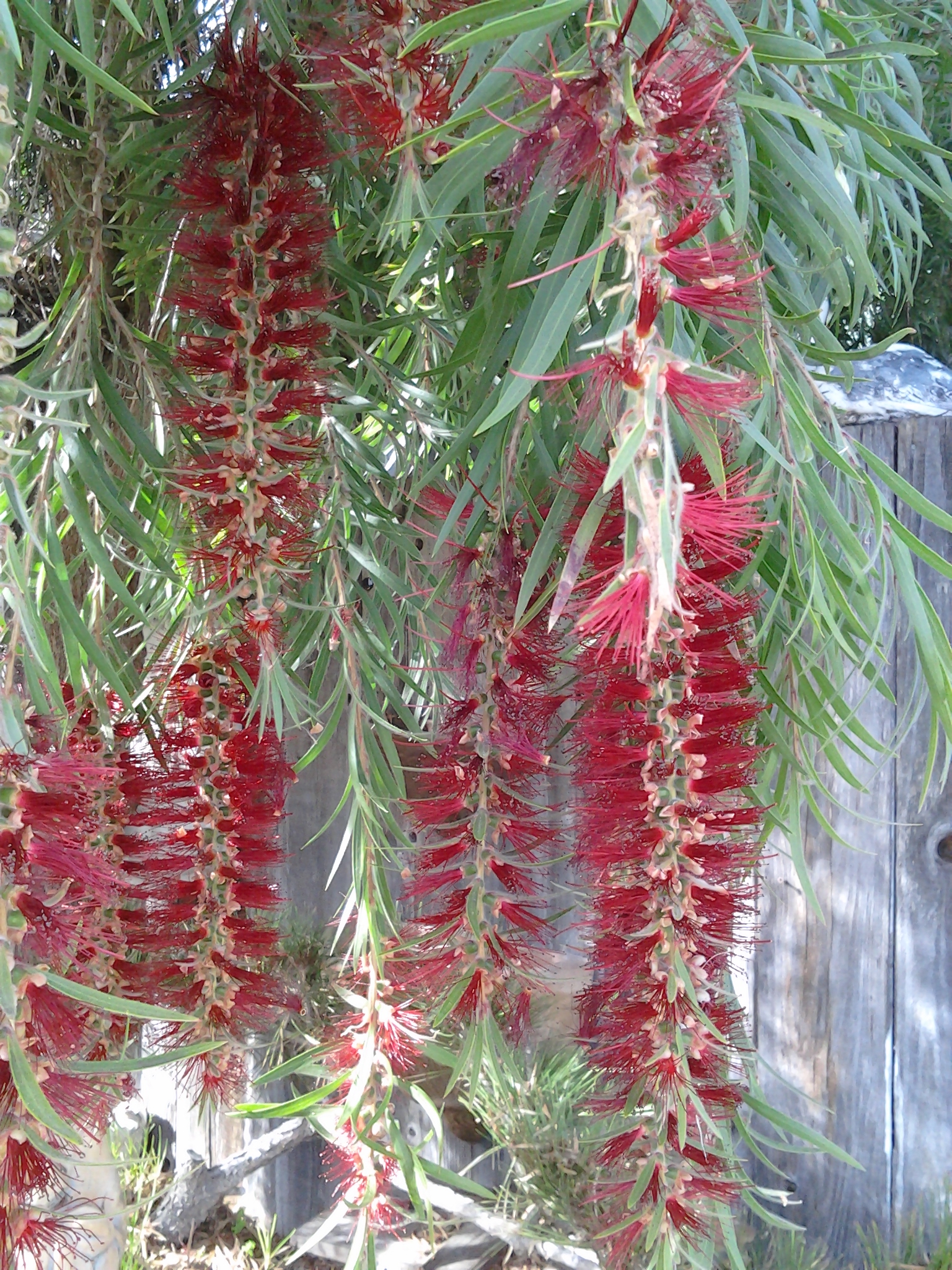
It is no wonder that it takes many years to get to fifteen feet tall, and may never get more than twenty feet tall. Weeping bottlebrush, Callistemon viminalis, may grow less than a foot a year, but seems to hang downward two feet. Because the stems are sculptural, and the bark has an appealingly rough texture, most weeping bottlebrush trees are grown with multiple trunks. The brick red bottlebrush flowers that bloom sporadically at any time of the year are more abundant early in summer. Established plants bloom more colorfully with a bit of water, but can probably survive quite a while without it. The evergreen leaves are narrow and mostly less than three inches long. Weeping bottlebrush needs good sun exposure.
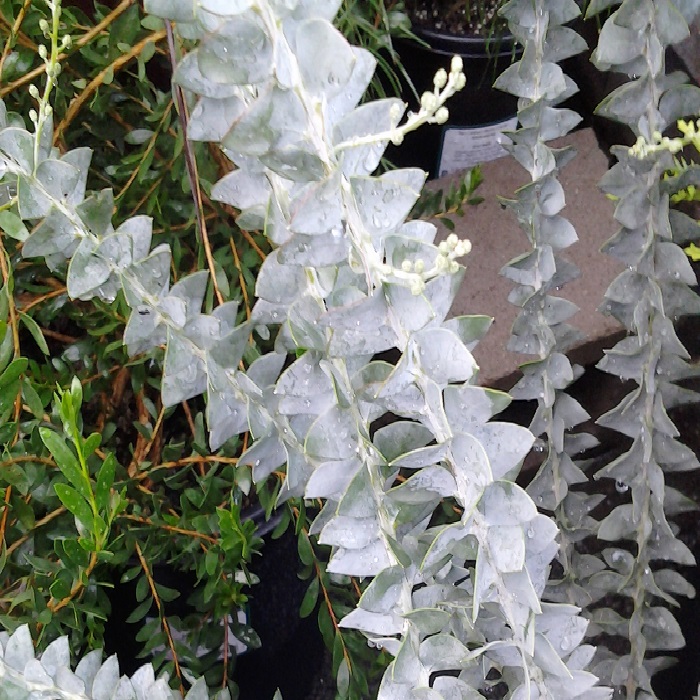
Even without the bright yellow staminate flowers (fuzzy with prominent stamens) that bloom in late summer or autumn, the grayish foliage of knife-leaf wattle, Acacia cultriformis, is still striking. It contrasts nicely with dark green foliage of pines, redwood and ivy. What seems to be small triangular leaves are actually ‘phyllodes’, which are modified petioles (leaf stalks) of vestigial leaves. They are about half an inch to an inch long, and neatly arranged on stiff stems.
Mature trees do not get much more than ten feet tall, and grow slowly enough to be kept even shorter. They can tolerate a bit of shade from larger trees. However, they bloom more profusely with better exposure. If the pollen is not a problem, the flowers are nice for cutting. So is the foliage, which is complimentary to many other cut flowers. Like almost all acacias, knife-leaf acacia does not require much water once established.
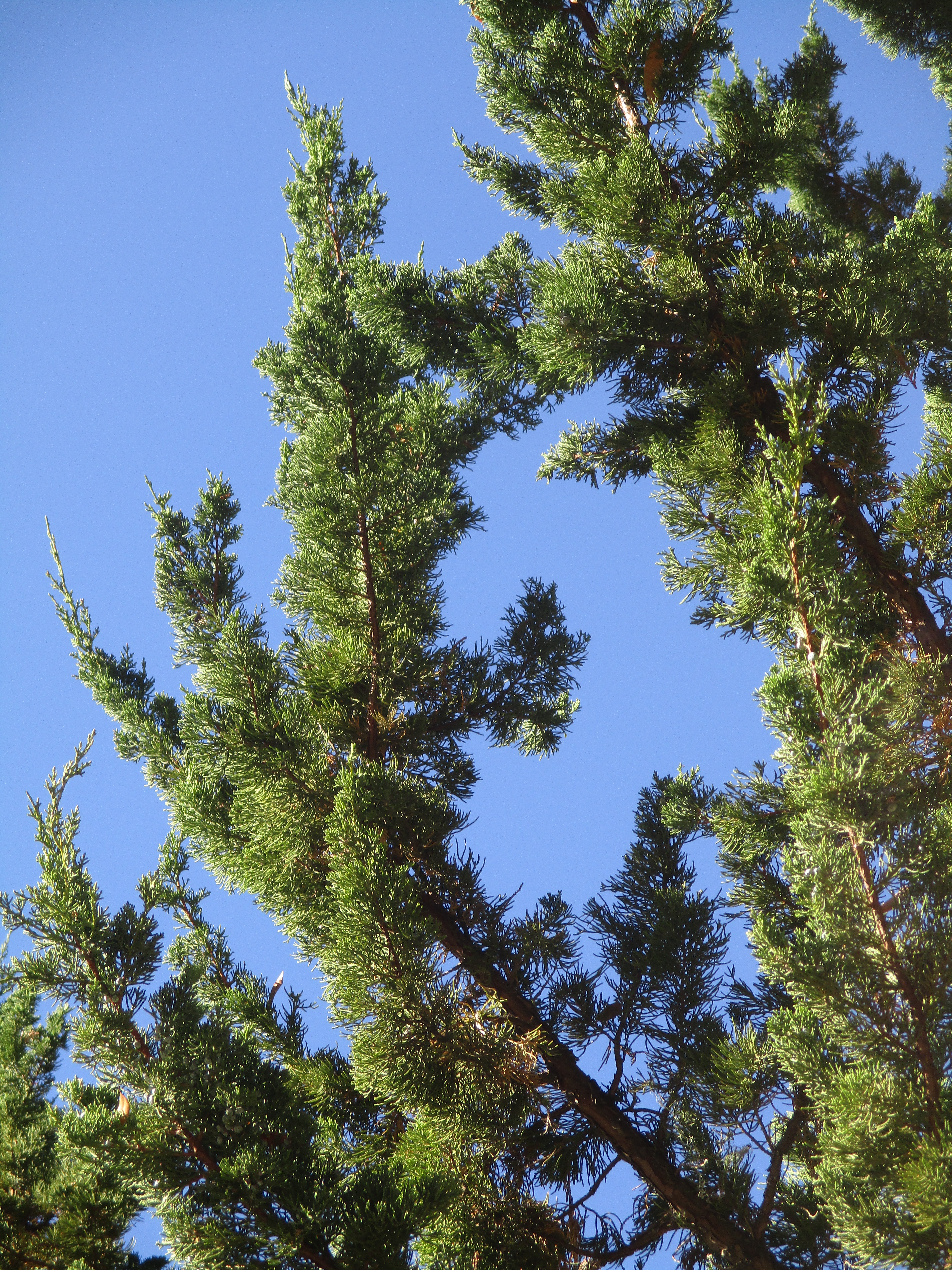
Ah, something vintage! Remember Hollywood juniper, Juniperus chinensis ‘Kaizuka’ (or ‘Torulosa’) flanking big two-car garage doors of mid century modern homes? Those that are still around after half a century are big and strikingly sculptural, like miniature Monterey cypress for home gardens. They get about fifteen feet tall and ten feet wide, but have potential to get significantly larger.
Hollywood juniper is an old classic that is still reasonably available in some nurseries. Their densely foliated stems twist and turn picturesquely upward, typically leaning one way or another toward sunlight or away from prevailing wind. Some say they look like frozen green flames. Their gnarly trunks and flaking bark can be exposed as they grow tall enough for low growth to be pruned away.
Because of their very irregular branch structure, Hollywood juniper is more adaptable to free-formed pruning than the presently trendy junipers with strictly upright or conical form. They must never be shorn, but do not mind if obtrusive limbs get pruned back to the main trunks. Therefore, they are actually more adaptable to smaller modern gardens than some modern cultivars of juniper are.
In California, it is hard to imagine that hinoki cypress, Chamaecyparis obtusa, gets big enough to be harvested for lumber in Japan. Almost all of the local garden varieties stay quite short. The largest rarely get up to second story eaves. The most compact types that are grown for bonsai, do not get much more than a few inches tall. Most are somewhere in between, to about ten feet tall.
The ruffled sprays of evergreen foliage are surprisingly dense relative to the soft texture and often irregularly loose branch structure. Mature trees often shed branches to reveal sculptural reddish trunks and limbs within, while maintaining the distinct density of their foliar tufts. The minute leaf scales have rounded tips. (Other specie have pointed leaves.) Tiny round cones are rarely seen.
Because of slow growth and irregular form, hinoki cypress is an excellent specimen ‘trophy’ tree, but not so useful as hedging shrubbery. It prefers a bit of shade, and will tolerate considerable shade. However, varieties with yellow new growth are more colorful with good (but not harsh) exposure. It does not take much pruning and grooming to enhance form and expose branch structure.
‘Shrubbery’ sounds so unflattering for a pine; but mugo pine, Pinus mugo, is not really much of a tree. The tallest trees do not reach eaves. Most old trees are only a few feet tall and about twice as broad, with strictly rounded form, and dense forest green foliage. The stout paired needles are only about one or two inches long. The plump cones, which are rarely seen, are not much longer.
Although very rare in other types of landscapes, and originally from the Austrian and Italian Alps, mugo pine is one of the most popular and traditional features in Japanese gardens. Even though it grows very slowly, it should have enough room to do so without competing with other more aggressive plants that might overwhelm it. It should neither be shorn nor pruned back too aggressively.
It does not grow fast, but by the time it gets old, mayten, Maytenus boaria, might be tall enough to reach upstairs eaves, and nearly as broad. The main trunk and limbs are nicely outfitted with uniformly checked grayish bark. Smaller stems are so very limber that it is a wonder that trees are able to gain any height at all. These stems arch gracefully, with their wiry tips hanging vertically.
Almost all modern maytens are of the cultivar ‘Green Showers’, which has slightly larger leaves. Yet, the evergreen leaves are so small that it is not easy to discern much difference from the slightly yellower leaves of older trees. Ironically, older trees seem to be more resilient. Newer trees seem to be more sensitive to rot if watered too frequently, particularly if soil does not drain adequately.
Pruning and grooming is not as simple as it might seem to be from the outside. If the very pendulous stems around the edges get cut like bangs, bunched stems accumulate and lose their softly pendulous texture. They need to be thinned too, so that they can hang more softly. Dead stems should be groomed from within. Main stems are not likely to regenerate if cut back too severely.
No, it is not an oxymoron. ‘Yellowwood’ is the common name for a few specie of Podocarpus. The evergreen (or ‘everblue’) foliage of ‘Icee Blue’ yellowwood, Podocarpus elongatus ‘Monmal’, really is as silvery grayish blue as the name implies. It can be as striking as some cultivars of Colorado blue spruce. It grows slowly in narrow columnar form to only about fifteen or twenty feet tall.
The finely textured evergreen foliage is ideal for both formal hedges and informal screens, although it takes a while to fill in, particularly for larger hedges and screens. Tip pruning of lanky growth of informal screens improves density. The narrow leaves are about two inches long. Fresh new foliage may be lighter and very slightly greener, which can contrast nicely with more mature foliage.
‘Icee Blue’ yellowwood will tolerate a bit of partial shade, but exhibits the best color in full sun. It prefers to be watered somewhat regularly while getting established. As it matures, it becomes less reliant on watering. Like many other Podocarpus, it is susceptible to infestation by scale insects and the ants that cultivate them. Scale produce sticky honeydew which blackens with sooty mold.


 Ah, something vintage! Remember Hollywood juniper, Juniperus chinensis ‘Kaizuka’ (or ‘Torulosa’) flanking big two-car garage doors of mid century modern homes? Those that are still around after half a century are big and strikingly sculptural, like miniature Monterey cypress for home gardens. They get about fifteen feet tall and ten feet wide, but have potential to get significantly larger.
 In California, it is hard to imagine that hinoki cypress, Chamaecyparis obtusa, gets big enough to be harvested for lumber in Japan. Almost all of the local garden varieties stay quite short. The largest rarely get up to second story eaves. The most compact types that are grown for bonsai, do not get much more than a few inches tall. Most are somewhere in between, to about ten feet tall.
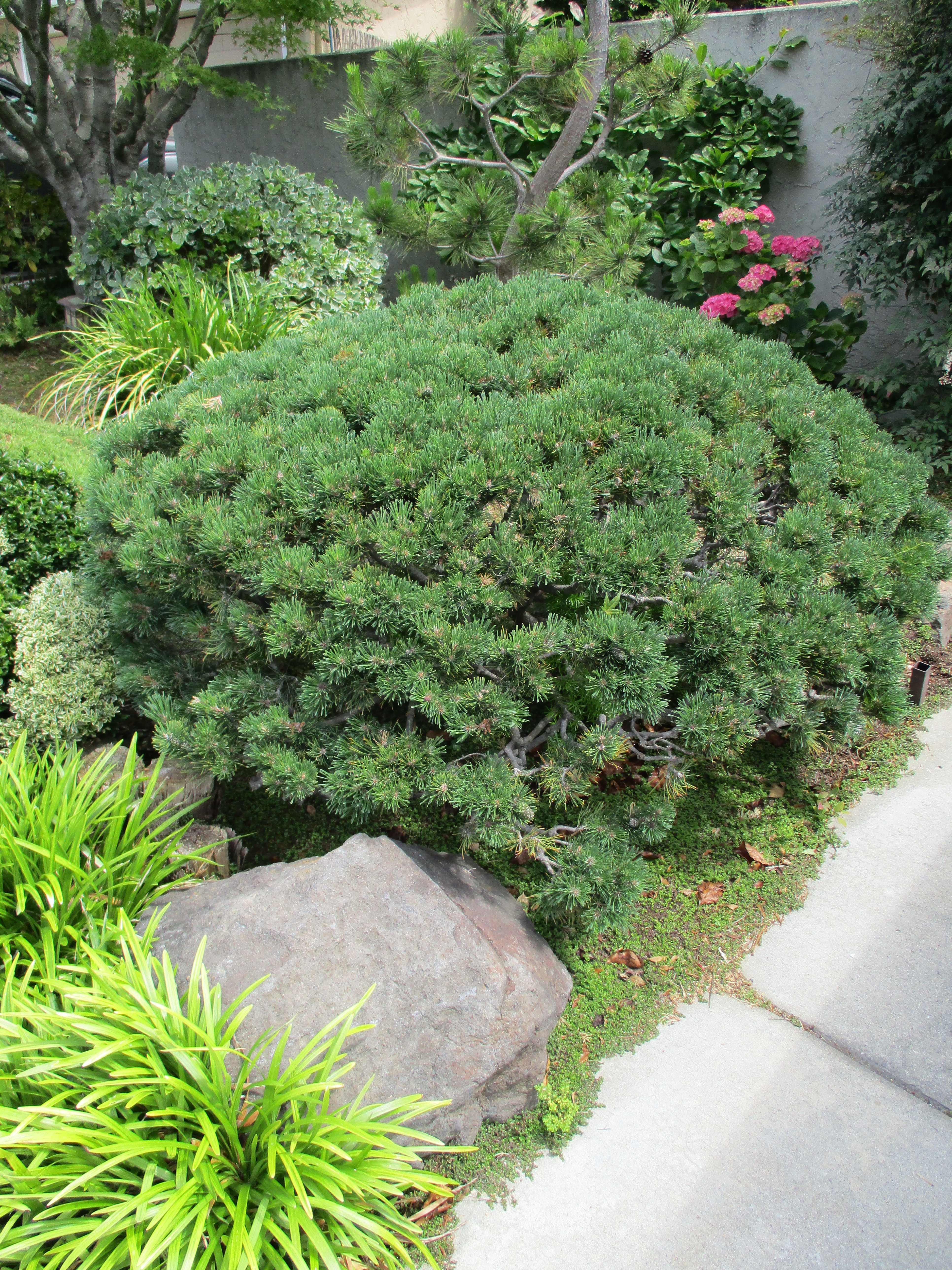 ‘Shrubbery’ sounds so unflattering for a pine; but mugo pine, Pinus mugo, is not really much of a tree. The tallest trees do not reach eaves. Most old trees are only a few feet tall and about twice as broad, with strictly rounded form, and dense forest green foliage. The stout paired needles are only about one or two inches long. The plump cones, which are rarely seen, are not much longer.
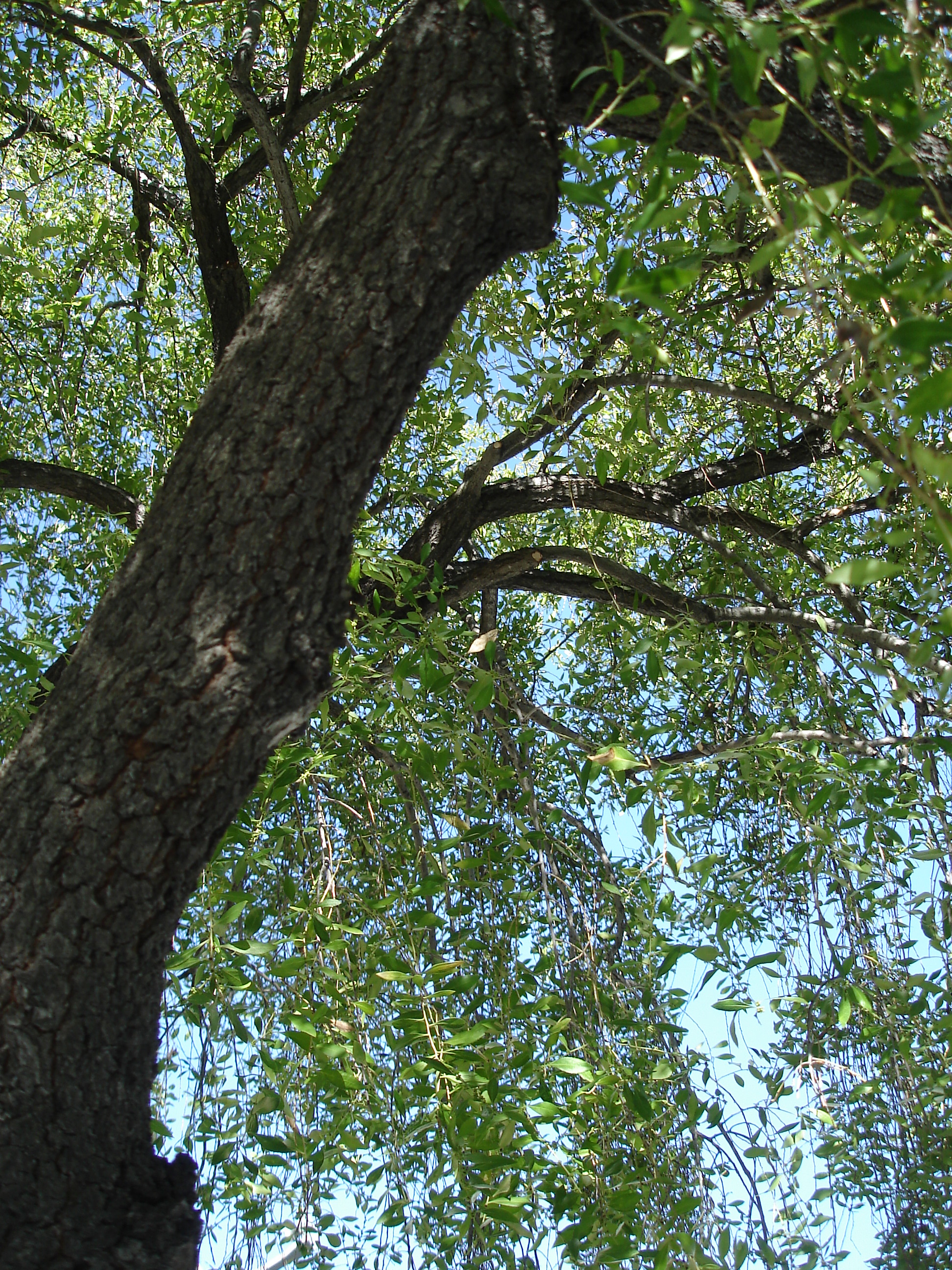 It does not grow fast, but by the time it gets old, mayten, Maytenus boaria, might be tall enough to reach upstairs eaves, and nearly as broad. The main trunk and limbs are nicely outfitted with uniformly checked grayish bark. Smaller stems are so very limber that it is a wonder that trees are able to gain any height at all. These stems arch gracefully, with their wiry tips hanging vertically.
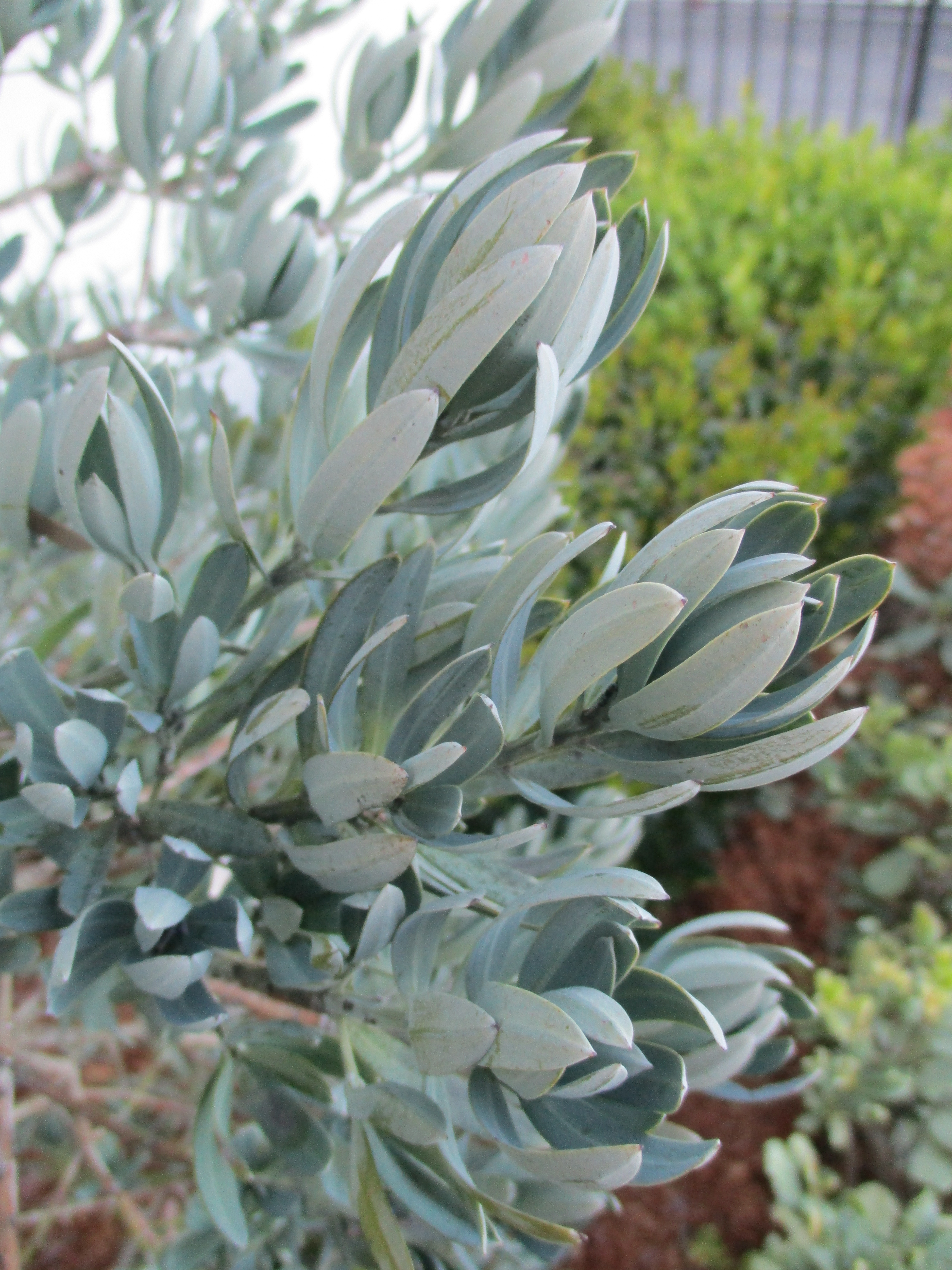 No, it is not an oxymoron. ‘Yellowwood’ is the common name for a few specie of Podocarpus. The evergreen (or ‘everblue’) foliage of ‘Icee Blue’ yellowwood, Podocarpus elongatus ‘Monmal’, really is as silvery grayish blue as the name implies. It can be as striking as some cultivars of Colorado blue spruce. It grows slowly in narrow columnar form to only about fifteen or twenty feet tall.
