 My weekly gardening column does not have much space for everything that should be said about the various topics and featured specie. I just try to fit the most basic of information into the space available, but usually would like to fit more in.
Sometimes, I would like to fit more pictures in too. It can be difficult to select just one camellia, or just one rhododendron. I typically select those that have the best contrast for black and white pictures, just in case some newspapers must deprive them of their color. That often means that I get to select my favorite white flowers rather than their more colorful counterparts. Regardless, there are so many good pictures that do not get seen. Then, there are also many qualities of the subjects that are difficult or impossible to show in pictures.
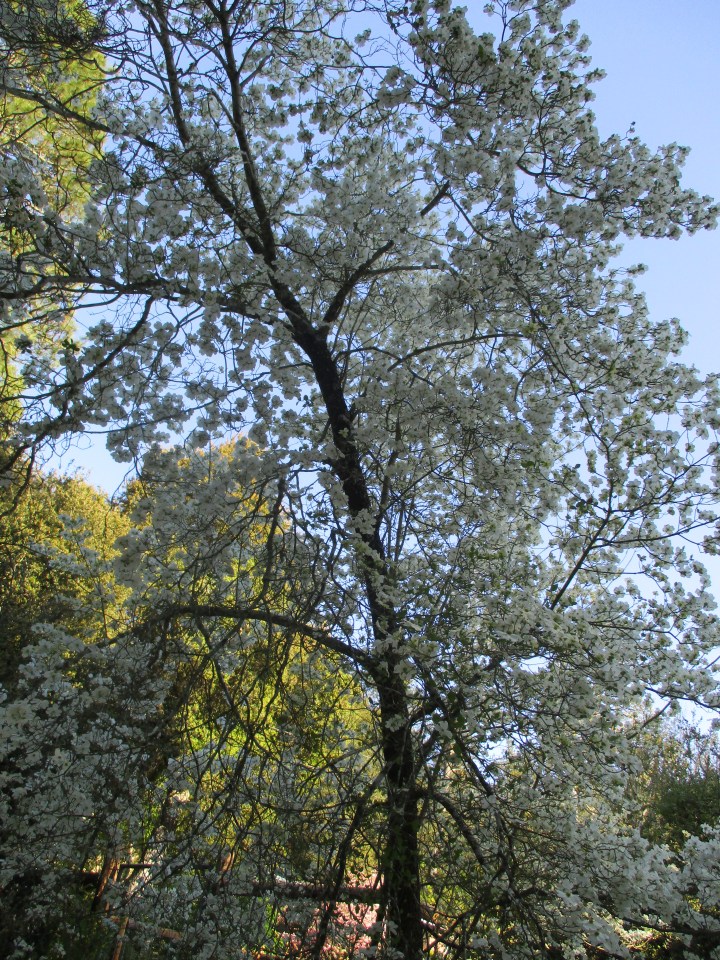
The dogwood picture that will get posted on Tuesday is pretty good, and happens to be white, but does not show how spectacular the tree that produced the bloom is. I selected a picture that was a close up of the same flowers in the picture below. Unfortunately, even if I had room for another picture, I could not get one that adequately represented the splendor of the tree. The best I could get is the picture above. I might try to get more pictures of pink and red dogwoods in the next few days, but pictures are nothing like the real thing. I had the same difficulty with the flowering cherries. The bloom was spectacular close up, but the trees looked like pink clouds on trunks from a distance.
If you can imagine, the tree in the picture is about twenty feet tall. It can be seen half a block away, through the adjacent deciduous trees. It looks just like a dogwood in Virginia should look, but happens to be right here on the West Coast, where you would not expect to see such an excellent specimen. Does that help?
I used to grow dogwood trees in the mid 1990s. They are not my favorite spring flowering tree because they do not do so well in the Santa Clara Valley. You would not know that by how well they do here on the coastal side of the Santa Cruz Mountains, just a few miles away. There are many specimens in the neighborhood that are comparable to this one. Some are pink. A few are almost brick red. The foliage probably does not color as well in autumn as it would in Virginia, but by our standards, it colors nicely.
Two very happy pink dogwoods are in front of an elegant home of early American architecture that is located just downhill from the white dogwood in the picture above. Even with redwoods and coast live oaks all around, the dogwood trees and home really look like they could be in the vicinity of Virginia. It is obvious why those from the East are so fond of dogwoods.
 The first half of the name sound appealing enough. The second half, not so much. Do the seeds grow into snails? Do they just look like snails? Not many have seen them. Tiny pale white flowers that are supposed to bloom in spring, as well as small black berries that develop after bloom, are rare. Laurel-leaf snailseed, Cocculus laurifolius, is grown just for its glossy evergreen foliage.
 Those of us with ‘maintenance gardeners’ are likely aware of how rare it is to find someone who knows how to maintain hedges properly. It seemed so simple years ago. Several identical plants could simply be planted in a row, and then somewhat regularly shorn for confinement to a prescribed space. They were not allowed to exceed a specific height or width for long between shearing.
 Fans of the Brady Bunch might recognized agonis, Agonis flexuosa, from the front yard of the Brady Residence. That particular tree was rather dark olive green, and might have grown two or three feet annually to reach the upstairs eaves. Most of the popular modern cultivars are darker bronze or burgundy, and probably stay a bit shorter, but attain the same elegant and slender form.
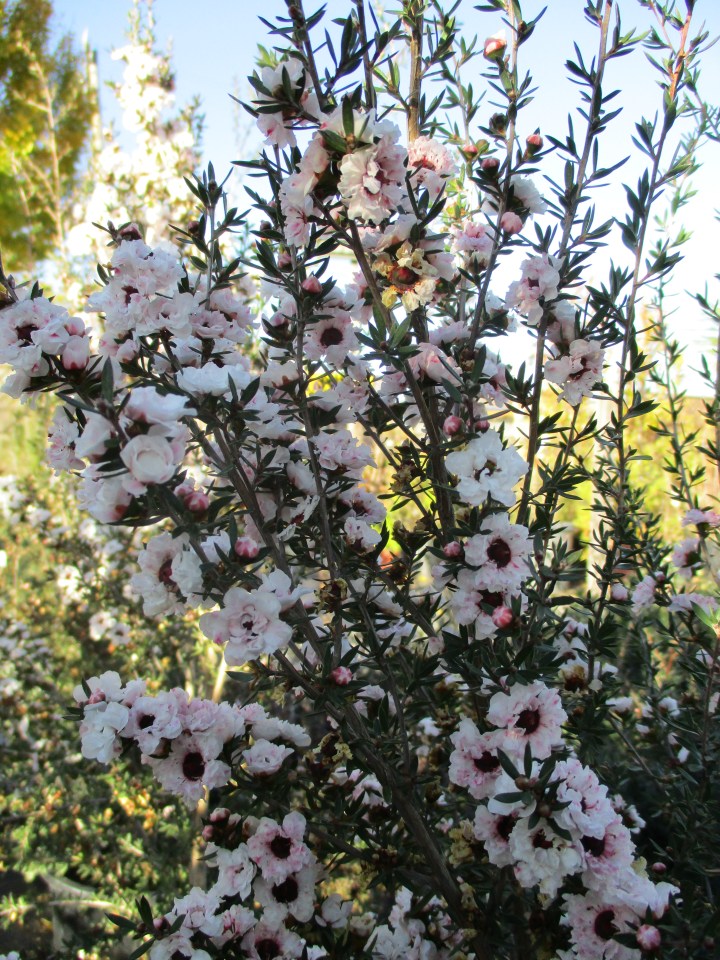 With such an odd variety of flowers blooming out of season, it should be no surprise that New Zealand tea tree, Leptospermum scoparium, decided to join the party. It starts blooming in phases in spring, and continues into autumn, so is not too terribly out of season. Besides, some varieties are known for spontaneous bloom phases at any time of year. Bloom can be pink, white or red.
