Five of these six succulents have weirdly silly common names. I did not notice until after I got all of their pictures.
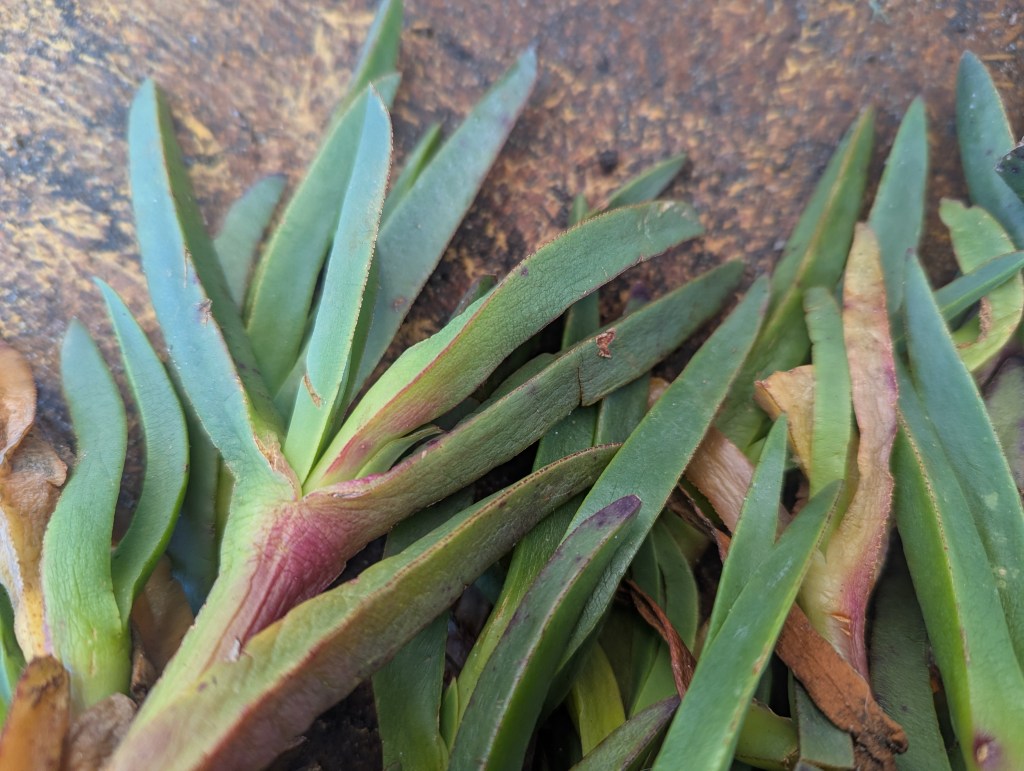
1. Carpobrotus edulis or Carpobrotus chilensis, pigface is a new acquisition that should help stabilize a sandy bank in one of our landscapes. It came from a beach in Santa Cruz.
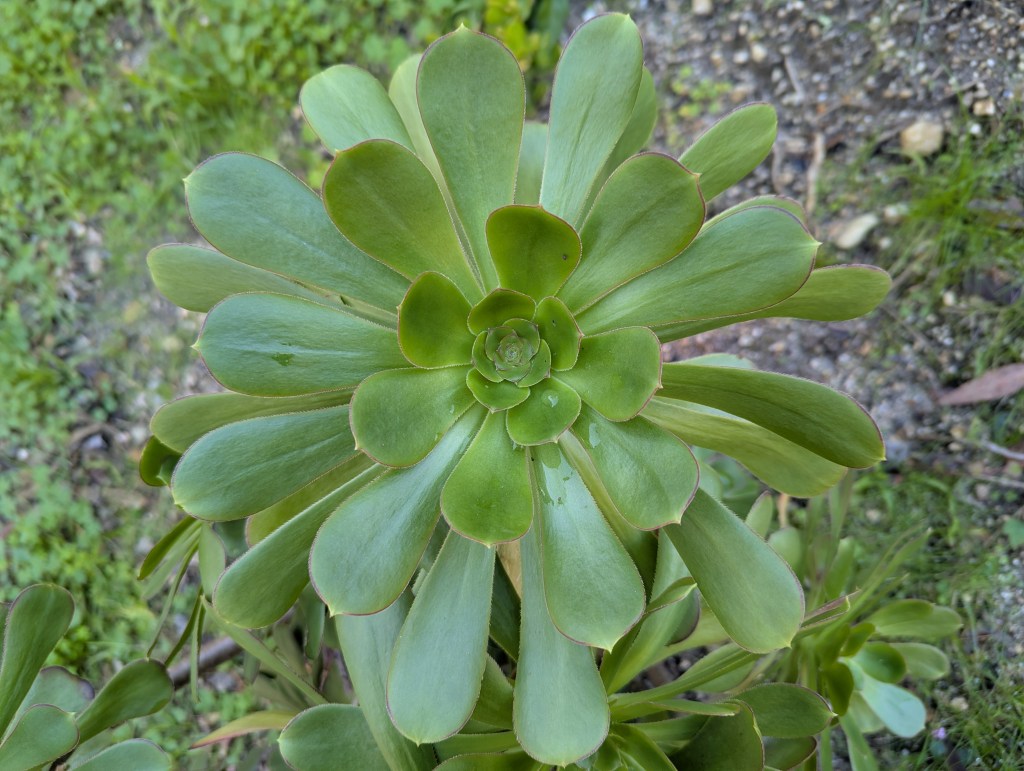
2. Aeonium arboreum, common houseleek not only has a silly name, but also has a silly form, with wide foliar rosettes suspended by lanky and otherwise awkwardly bare stems.
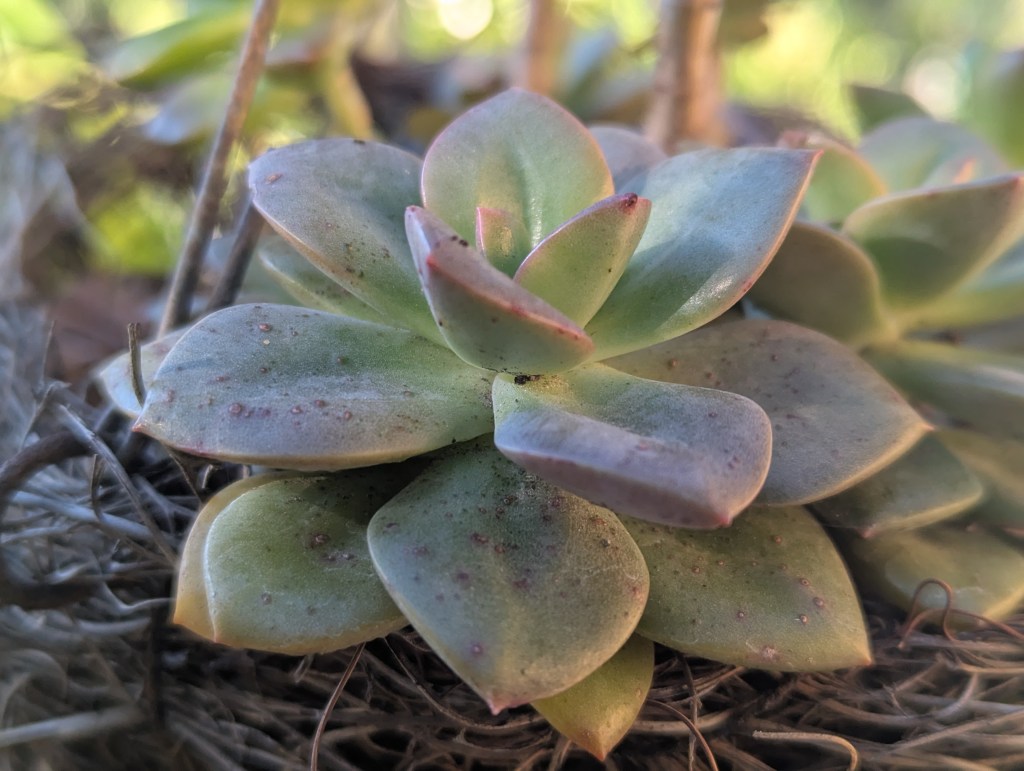
3. Graptopetalum pentandrum, bluebean is not actually within any of the landscapes. It is a diminutive specimen that remains potted in the nursery. I am unsure of its identity.
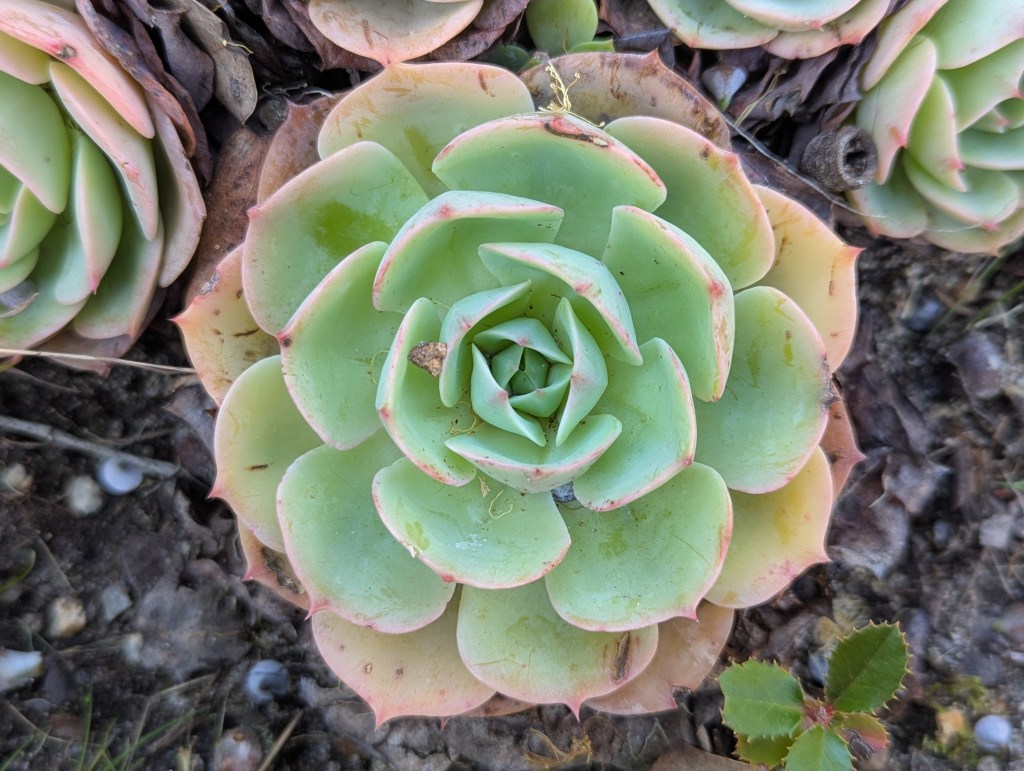
4. Echeveria elegans, Mexican snowball contrasts splendidly with the limey green of the common houseleek, which it grows at the base of. I would not mind more of these about.
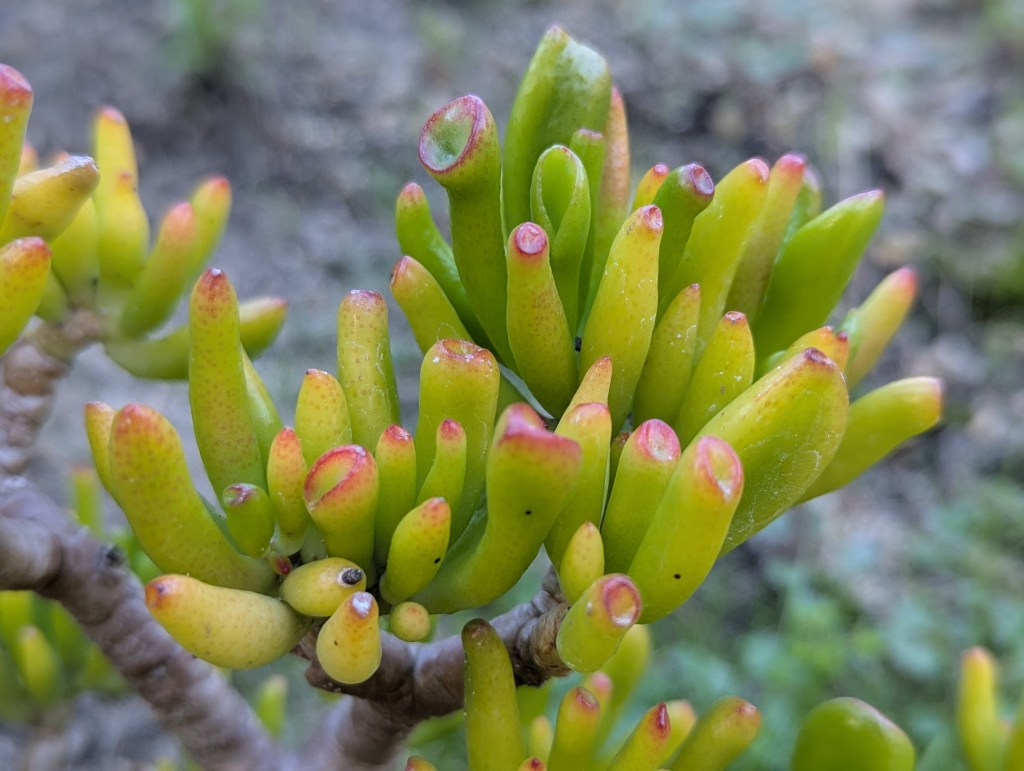
5. Crassula ovata ‘Hobbit’, Hobbit’s pipe, like common houseleek, is silly both in name, and in form, with these oddly tubular leaves. It is a lighter green than typical jade plant.
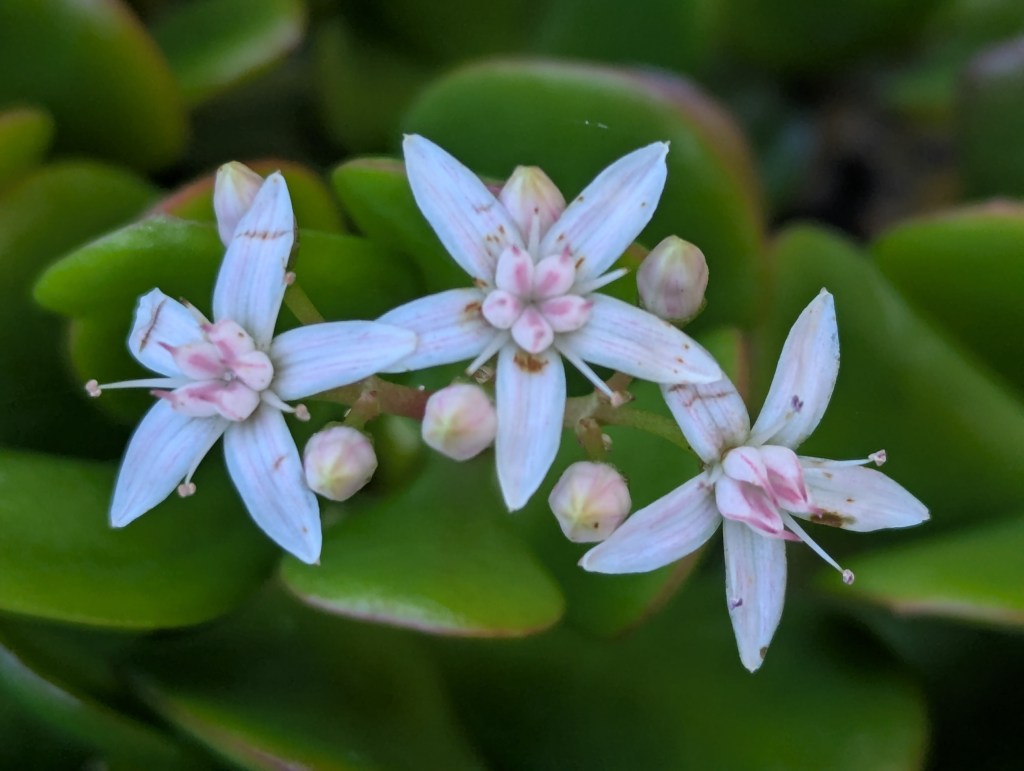
6. Crassula ovata, jade plant is the only one of these Six that lacks silliness. Its bloom is too cute in closeup view to omit, though. Besides, Six on Saturday is better with flowers.
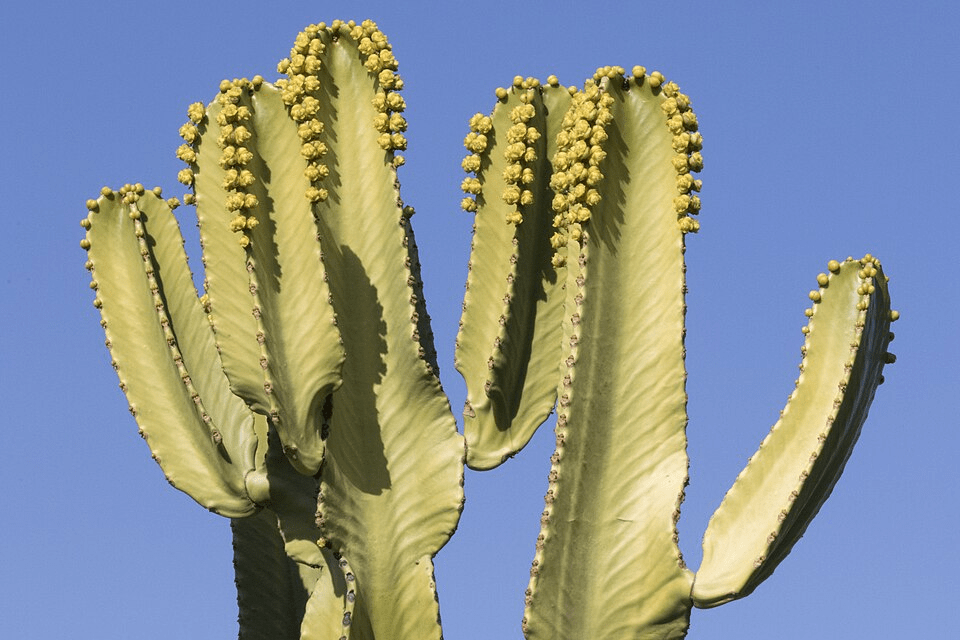
Candelabra tree resembles cacti, but is not related.
The weirdly sculptural succulent stems of candelabra tree, Euphorbia ingens, dark green but devoid of any real foliage, are striking in the right situation. These stems resemble those of unrelated cactus, with longitudinal ridges topped with spines. Although botanically interesting, the minute greenish yellow flowers that bloom in autumn and winter on the ridges of the upper portions of the upper segments are not much to look at. Deep red seed capsules that turn purple as they ripen sometimes develop in milder climates after the flowers are gone, but are almost never seen locally. Good exposure is preferred. Candelabra tree are better structured and more prominent standing alone away from other larger trees and shrubs. Cool winters and occasional frosts limit their height to not much more than fifteen feet; and unusually cold frost can actually kill big specimens back severely. However, in sheltered areas and milder climates, candelabra tree can get twice as tall. Soil should drain very well and get dry between watering. Regular watering can cause rot, particularly in dense or rich soil. The main problem with candelabra tree is the remarkably caustic latex sap, which can be dangerous to children, chewing dogs or even those who need to prune the stems. Fortunately, candelabra tree needs very little attention, and only needs to be pruned where the stems get in the way or start to lean against fences or roofs. The caustic sap prevents insect problems.
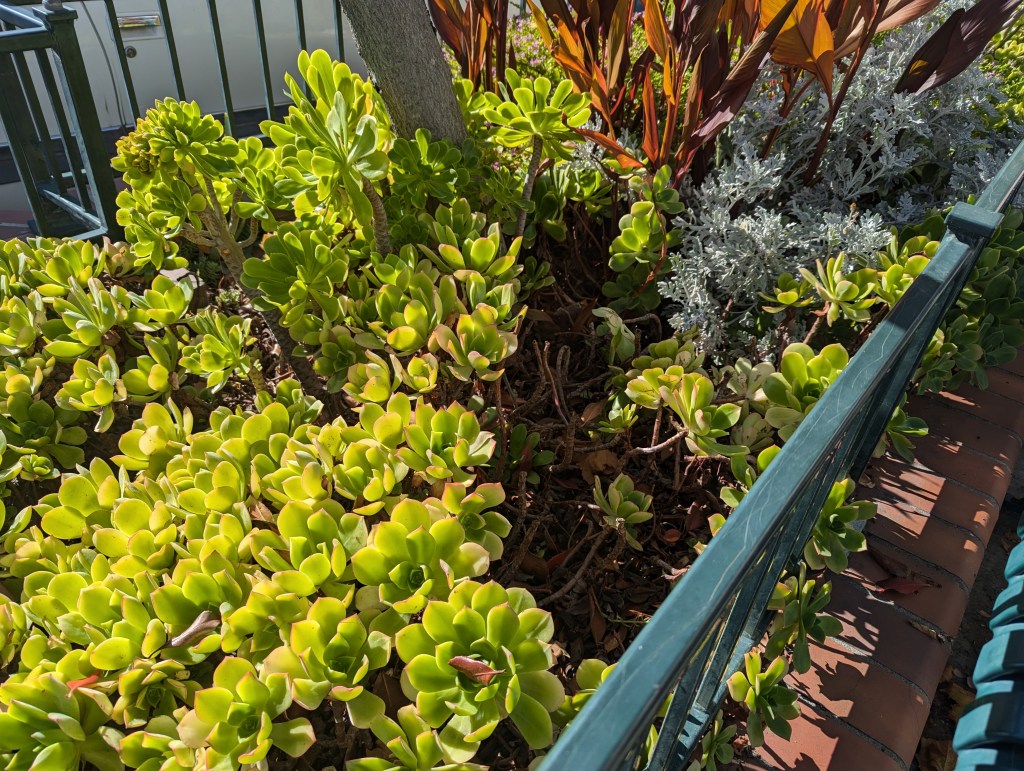
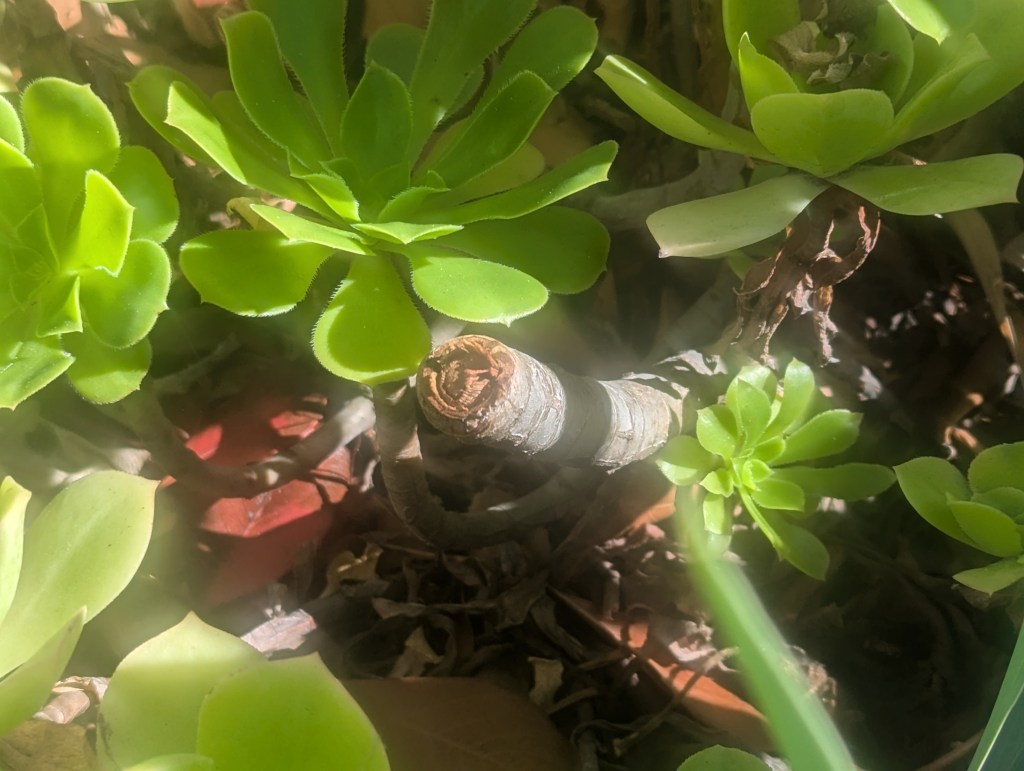
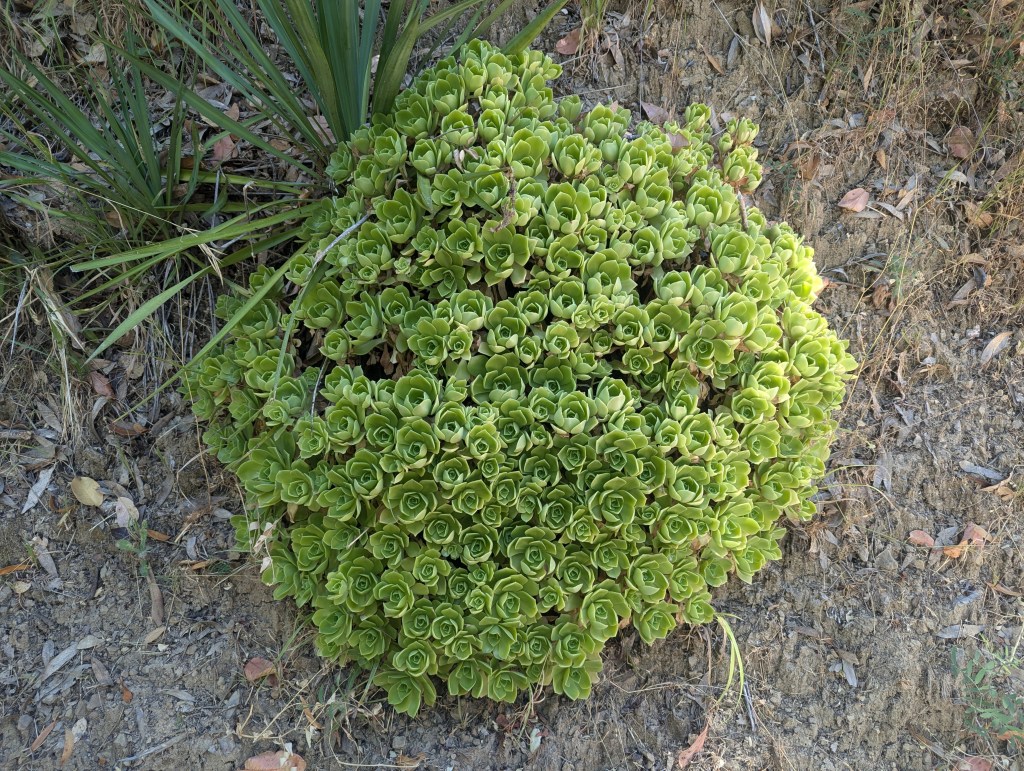
Nasturtiums were a good choice for my downtown planter box, or so I thought. I know that people pick flowers from such planter boxes. I figured that nasturtiums bloom so abundantly that no one could possibly pick all the flowers from them. Technically, I was correct. Technically, not all of the flowers were picked. However, there were times when only a few of the abundant flowers remained. I replaced them with some sort of compact aeonium like perennial that I can not identify. It forms dense mounds of yellowish green succulent foliage that I figured no one would bother. I do not mind when I notice a few pieces missing. There is enough to share. What I do mind is that someone clear cut harvested enough to leave this bald patch. The left half of the picture demonstrates what it should look like. What is worse is that there is so much of it extending outside of the railing that would not have been missed if it had been taken. Also, as the picture below shows, the more prominent common aeonium is not exempt from such pilferage. So, why do I bother? Well, I still enjoy my downtown planter box.
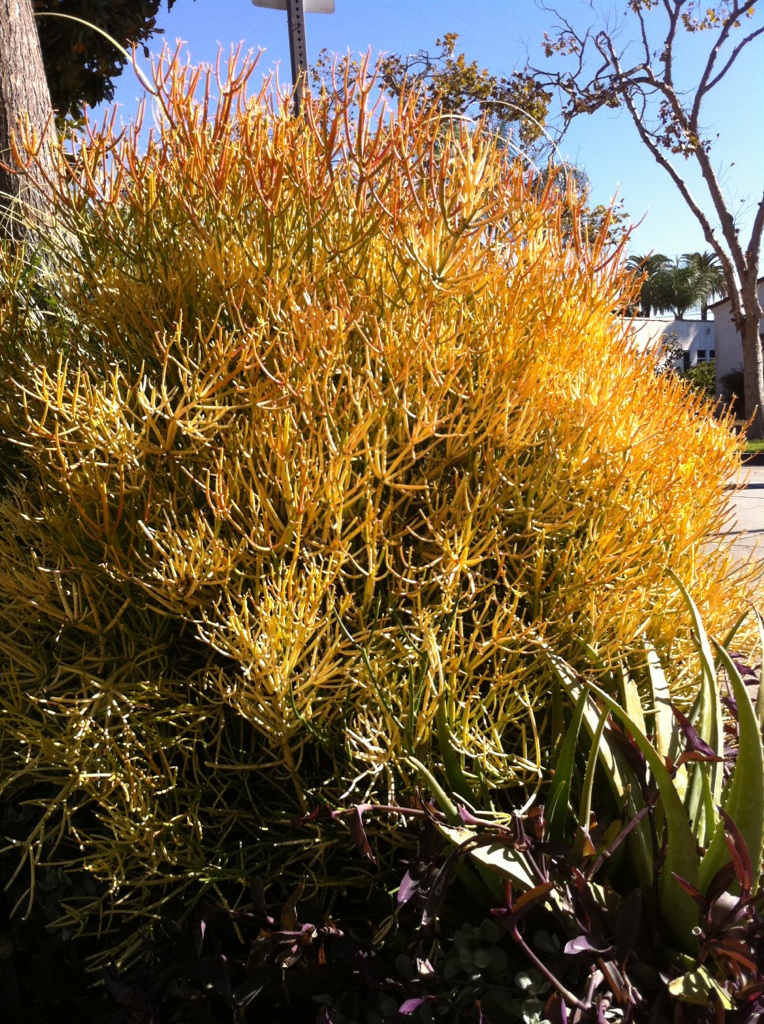
Sticks on fire is a more colorful and more compact version of pencil tree.
The old fashioned pencil tree, with leafless, succulent stems is a strikingly strange plant already. In mild climates of coastal Southern California, it can get quite large, nearly ten feet broad and twice as high. Sticks on Fire, Euphorbia tirucalli ‘Sticks on Fire’, stays less than half as large, but is even weirder because the stems are so oddly colored.
The inconspicuous leaves drop almost as soon as they develop, leaving distended fleshy stems that are either reddish or yellowish orange. Stems fade to softer yellow through summer, and then turn red in winter. Size and growth rate are limited by a lack of chlorophyll. Although related to poinsettia, the flowers of sticks on fire are not significant.
Sticks on fire prefers full sun exposure and warmth, but unfortunately needs protection from frost during winter. It can be happy under an eave on a south or west facing wall, or in a large tub that can be moved to shelter during winter. Plants in tubs are a bit more sensitive to rot if watered too frequently. The sap of sticks on fire is very caustic to skin and can be dangerous if it gets in the eyes.
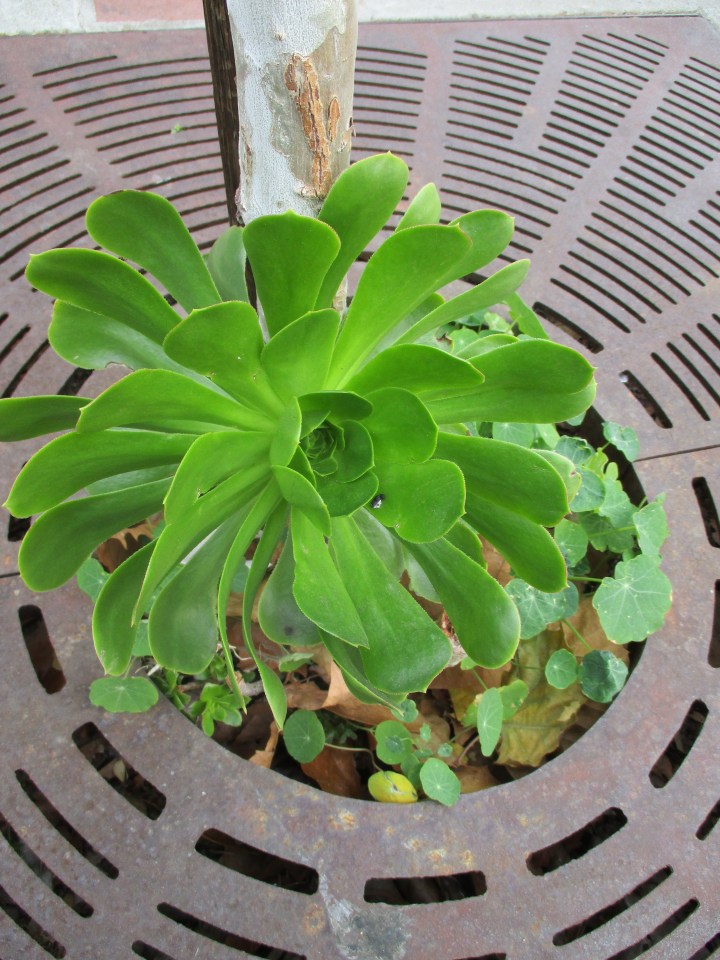
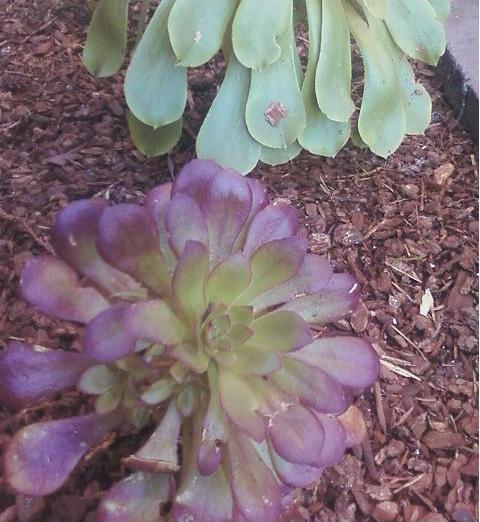
The once traditional Aeonium arboreum, with round, dense rosettes of slightly serrate, olive green leaves has become less popular than its more colorful varieties that have become more available over the years. ‘Atropurpureum’ has rich purplish brown foliage. ‘Zwartkop’ is even darker and stays more compact. Long and sometimes unkempt clusters of tiny yellow flowers that bloom in spring or summer are not much to look at against green foliage, but contrast nicely against dark foliage. Larger plants can get to three feet tall and wide, with foliar rosettes wider than six inches.
Like many succulents, Aeonium arboreum is so easy to propagate from cuttings, that small pieces that need to be pruned from established plants can be plugged into the garden wherever more of the same plants are desired. New cuttings like to be watered until they develop roots. Established plants are a bit happier with occasional watering, but can survive neglect just fine. After all, they are native to similar climates in the Mediterranean and northern Africa.
These are a few plants that survived where my former home was abandoned, and where the new home is to be built. Some of them had been here since 2006 nineteen years ago.
1. Cereus peruvianus, night blooming cereus is from Brent’s former Miracle Mile garden balcony. I do not know why it is so spiny now. Maybe it is angry about being abandoned. Aeonium arboreum, common houseleek is from another friend’s garden near Monterey.
2. Crassula arborescens spp. undulatifolia, ripple jade, as well as the pinwheel aeonium below, remain unidentified. These names that I present here are merely guesses of their identities. Anyway, I procured this from a jobsite that I worked at in Hayward years ago.
3. Aeonium haworthii, pinwheel aeonium came from the same garden that the common houseleek came from near Monterey. The slope that it is attached to is actually too steep to stand on. Yucca recurvifolia, curve leaf yucca is from an old jobsite in Boulder Creek.
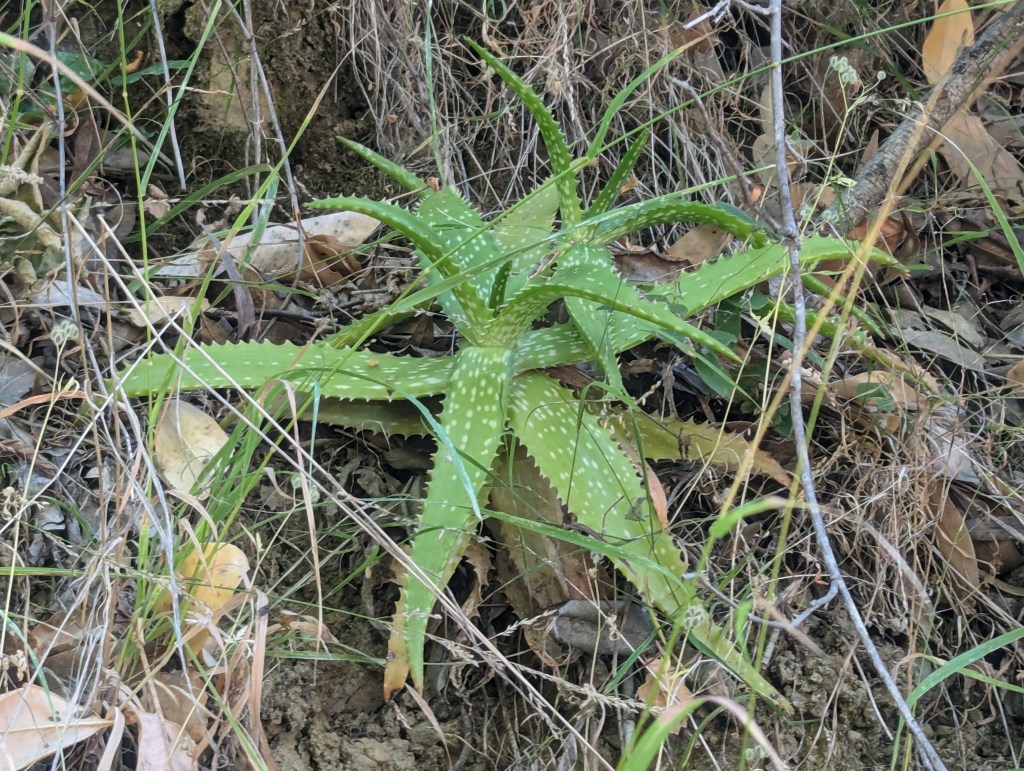
4. Aloe arborescens, candelabra aloe came from the home garden of an old friend in the East Hills of San Jose. It is higher on the same steep slope as the pinwheel aeonium and curve leaf yucca. It should grow better and produce pups for dividing with a bit of water.
5. Pelargonium graveolens, rose geranium impresses me most because it survived for so long, like the other perennials, but is supposedly not as resilient as they are. I found this in an old home garden in San Francisco, although I believe that it is common elsewhere.
6. Iris pallida, Dalmatian iris is important because it is from the garden of my maternal maternal great grandmother in Oklahoma. I acquired it when I was about four. Crassula ovata, jade plant was from my former home in town, where I lived after the earthquake.
The pinkish magenta of rock purslane bloom is almost obnoxiously bright.
In Santa Cruz and coastal areas down to Los Angeles and San Diego, rock purslane, Calandrinia spectabilis (grandiflora) has been popular for only a few years. It is still somewhat uncommon here in the Santa Clara Valley. Because of the ambiguity of its Latin species name, it is most commonly known simply by its genus name of Calandrinia.
Moderate watering is best. On the coast, rock purslane only needs water occasionally through the driest summer weather. It should recover readily from winter frost damage. Partial shade is not a problem, but may limit profusion of bloom. Harsh exposure or reflected glare can actually roast the tender succulent foliage.
From about now through autumn, limber, two foot tall stems suspend strikingly bright magenta flowers above the low, grayish evergreen foliage. The fragile leaves are neatly arranged in terminal rosettes. Foliage, stems, flower stalks and all parts are sensitive to traffic, and can even get broken by a cat sneaking through the garden. Broken bits and pieces of stem root very easily to make new plants, though.
If it appears to be related to burrow’s tail, it is because pork & beans is the same genus.
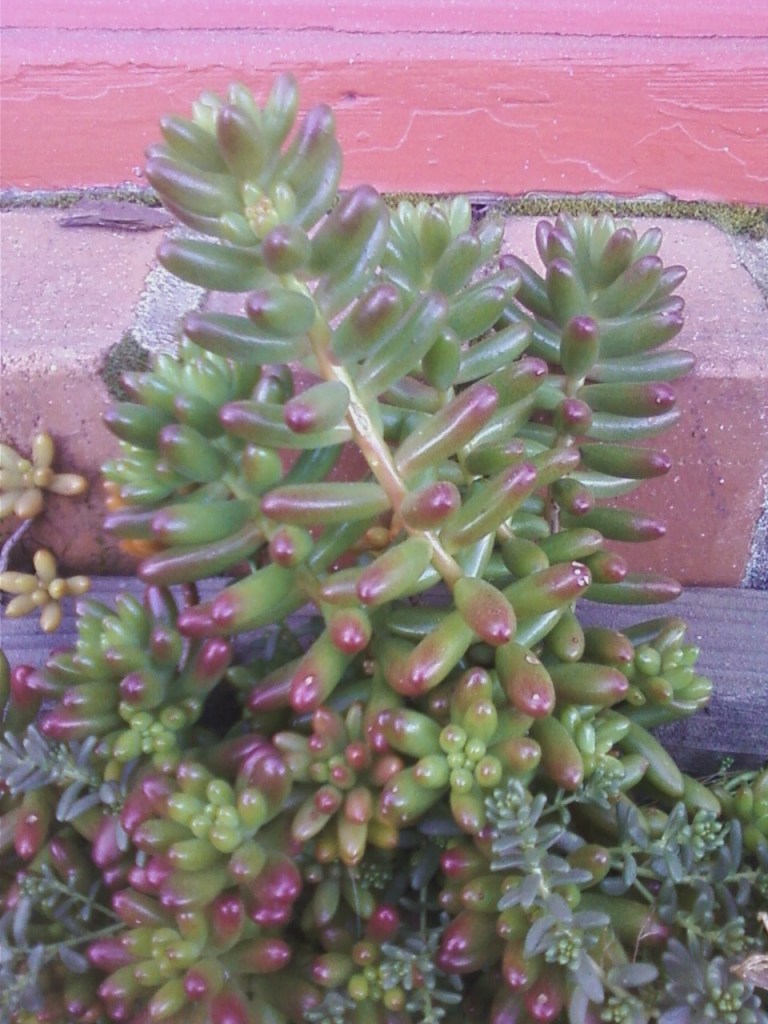
The tender succulent foliage of pork and beans, Sedum rubrotinctum, is as squishy as it appears to be, so is safest where it will not be disturbed. Although it sprawls around without getting much deeper than six inches, it does not fill in reliably enough to be a real ground cover over a large area anyway. It can instead add color and texture in small doses between larger plants or stones. It is a nice addition to urns of mixed perennials, rock gardens and dish gardens. It propagates very easily from stem cuttings or even leaves that break off, so can be tucked into gaps in stone walls.
The plump three quarter inch long leaves resemble jelly beans more than pork and beans, since they are green where shaded. More exposed foliage is more bronzy red or brown, especially at the tips. Small clusters of tiny yellowish flowers are held above the foliage on reddish brown stems in spring.
Succulents that would not survive in alpine gardens where rock gardens were originally popularized are quite popular for rock gardens here.
Rock gardens, as they are known now, evolved from more traditional alpine gardens that were designed to display specimens of small plants found in the mountains of Europe. These plants were mostly compact and slow growing to be adapted to the harsh climates and rocky soils of higher elevations, but do not compete well with more aggressive plants. They consequently need their own space, and are quite happy surrounded by rock or gravel to insulate the surface of the soil and control weeds. Slight slopes, as well as the abundance of rock, enhance drainage to replicate mountainous conditions.
Compact plants from all over the world now find homes in rock gardens. The compact nature of rock garden makes them practical for small spaces, particularly where slopes make other gardening difficult. Sculptural, colorful or lichen covered rocks, as well as garden sculpture, can be as ornamental as the plants that surround them. Larger stones can substitute for low retaining walls.
Plants for rock gardens do not need to be from mountainous areas, but should be compact. They must also be appropriate to the particular microclimate. For example, small succulents and cacti want to be as exposed in a rock garden as they would be in a real landscape. Lily-of-the-valley shrub conversely prefers sheltered cooler spots.
Trees for rock gardens are generally very small. Pendulous (weeping) and dwarf Japanese maples are more desirable than those that eventually grow into mid sized trees. Dwarf forms of spruce, eastern hemlock, cedar, fir and false cypress all work well. There are also several dwarf pines to choose from, including dwarf cultivars of Scots, Japanese red, tanyosho, mugho, white and pinon pines.
Dwarf forms of cotoneaster, hebe, holly, rockrose, germander and Japanese barberry have become as popular in rock gardens as the more traditional small heathers and heaths. There are several compact junipers as well. Some rock gardens plants grow into small shrubbery. Others sprawl about as mats or dense ground cover.
Thrift (sea pink), campanula, snow-in-summer, fleabane, coral bells, plantain lily, evergreen candytuft, carpet bugle (Ajuga spp.), and small herbs like thyme and oregano are some of the more popular perennials for rock gardens. Mat forming penstemon, columbine, cranesbill, saxifrage, rockcress and dwarf types of dianthus and primrose are more difficult to obtain, but worth trying. There are of course many small succulents like aeonium, echeveria, stonecrop (sedum) and ice-plant.
Crocus, grape hyacinth, snowdrop and wild freesia are the only common bulbs that are well suited to rock gardens. Uncommon dwarf cyclamen (not Cyclamen persicum), small types of narcissus and diminutive iris that can sometimes be found by mail order catalogues, online, or occasionally in nurseries that stock unusual plants are actually more proportionate to rock gardens than they are in more typical types of gardens.
While away from work and home, and tending to errands downtown, I got these pictures from my downtown planter, which inadvertently became something of a Memorial.
1. Cuphea hyssopifolia, Mexican heather is not my favorite component of the downtown planter, but remains because it was installed by someone who was here prior to my time. A uniquely confined colony of montrebia that I will discuss on Wednesday also remains.
2. Senecio cineraria, dusty miller and the stonecrop below are from the garden of a now deceased client so can only be removed if a bit of it gets established in my home garden. It and the Mexican heather above are the only two of these six which are not succulents.
3. Sedum reflexum ‘Blue Spruce’ stonecrop is being displaced by the unidentified species of Aeonium below, but is also already established in my home garden. I expected it to be displaced eventually when I put it here several years ago. It is gratifying to see remnants.
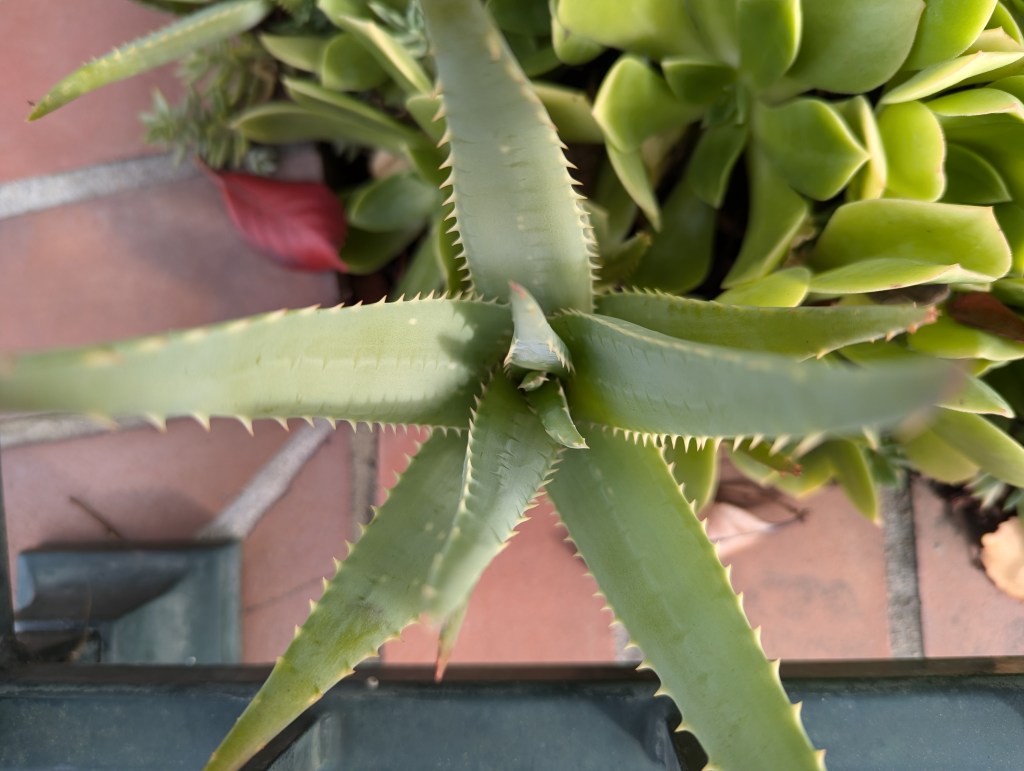
4. Aloe, as the Aeonium at the bottom of this list, is unidentified. It and both of the last six are from the garden of the deceased mother of a deceased friend who happened to be a direct descendant of Spanish explorers who were the first to arrive where Monterey is.
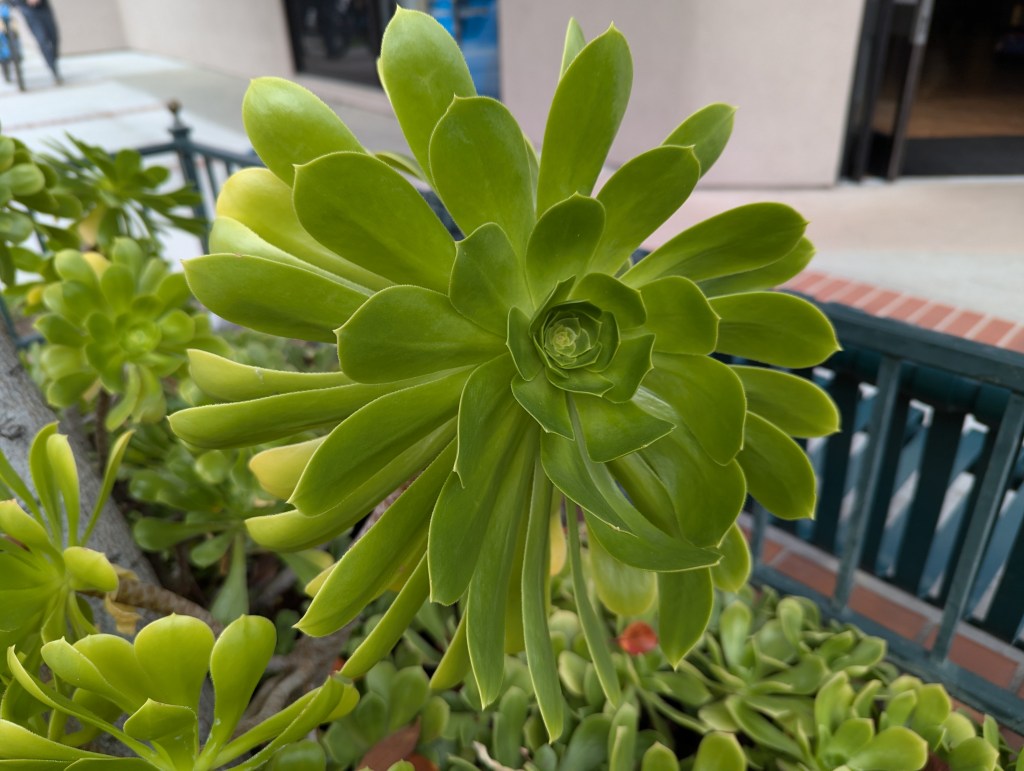
5. Aeonium arboreum, tree houseleek is the most striking vegetation within the planter, but is also occasionally disfigured by theft of its most sculptural stems. A darkly bronzed cultivar from the same special origin was taken piece by piece until none of it remained.
6. Aeonium is as unidentified as the Aloe above. It initially resembles the tree houseleek, also above, but remains low, dense and mounding. It is the most abundant vegetation of the planter, so was the primary culprit of the displacement of the stonecrop, also above.






 Tony Tomeo