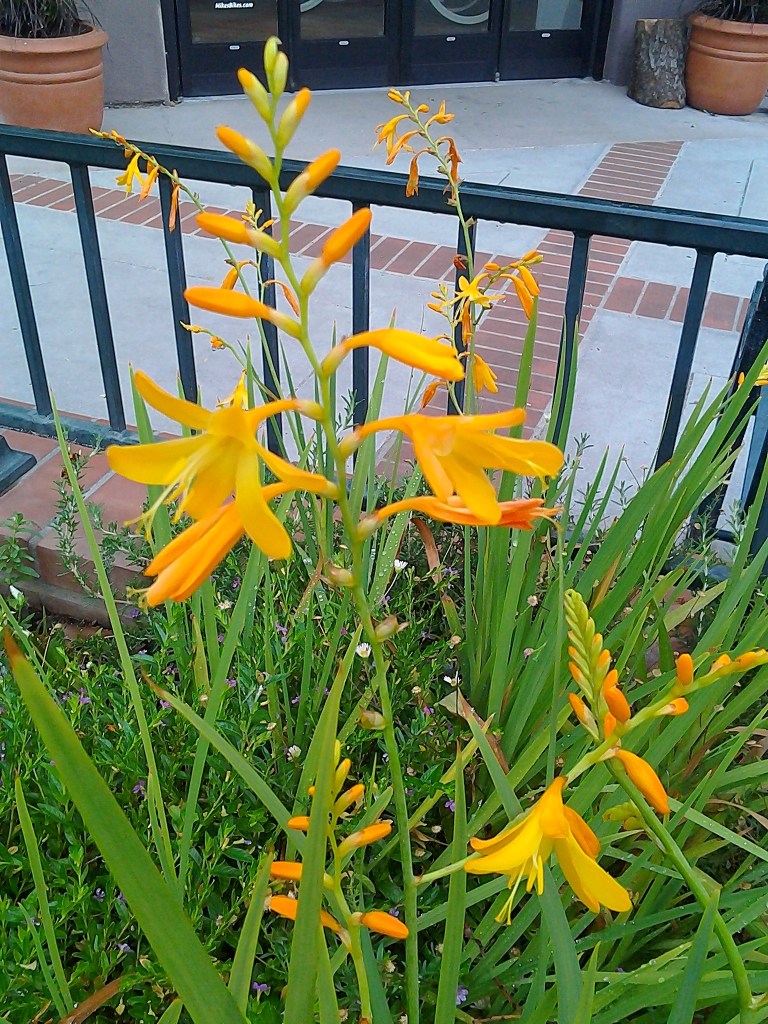
Bright orange montbretia is quite reliable and resilient, but can easily become a weed if not groomed of fading flowers.
Once they get into the garden, montbretia, Crocosmia X crocosmiiflora, may never leave. They sometimes survive the demolition of their original garden to emerge and bloom in the garden of a new home built on the same site. Bulbs (actually corms) multiply surprisingly efficiently to form large colonies that should eventually be divided if they get too crowded to bloom. Ungroomed plants sow seeds that may be invasive.
The one or two inch wide flowers are almost always bright orange, but can sometimes be reddish orange, yellow or pale yellow. The branched flower stems are two or three feet tall or a bit taller, and stand nicely above the grassy foliage. The narrow leaves are about half and inch to an inch wide.
Gladiolus hybrids are not reliably perennial locally. They might not be reliably perennial anywhere. I had believed that they could be so where they get more winter chill, but chill does not seem to help. I have been told that they are no more perennial in Pennsylvania, Oregon or Oklahoma. When I grew them many years ago, only about a third survived to bloom for a second season. Of that third, only about a third survived to bloom for a third season. This is one of many reasons why I am so ‘glad’ about perennial Gladiolus papilio , as well as Watsonia species, from Tangley Cottage Gardening. Although, strangely, a few hybrid Gladiolus survive.
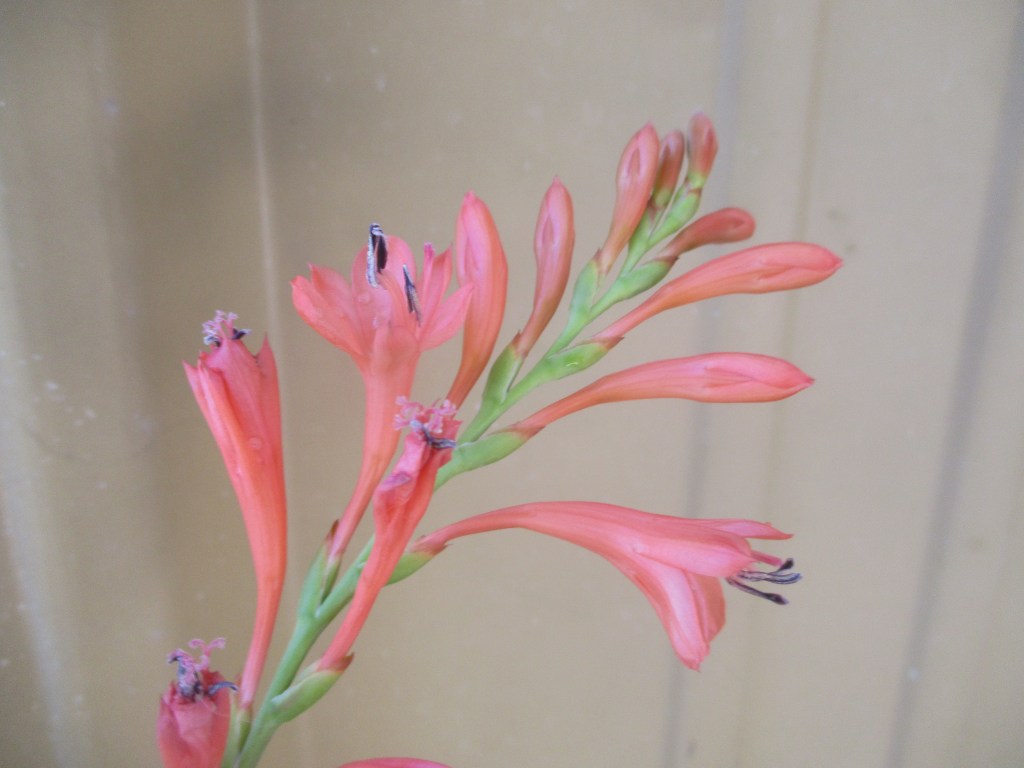
1. Watsonia X pillansii ‘Coral and Hardy’, just like the Gladiolus papilio, was a gift from Tangly Cottage Gardening of Ilwaco in Washington. I learned that it blooms in summer.
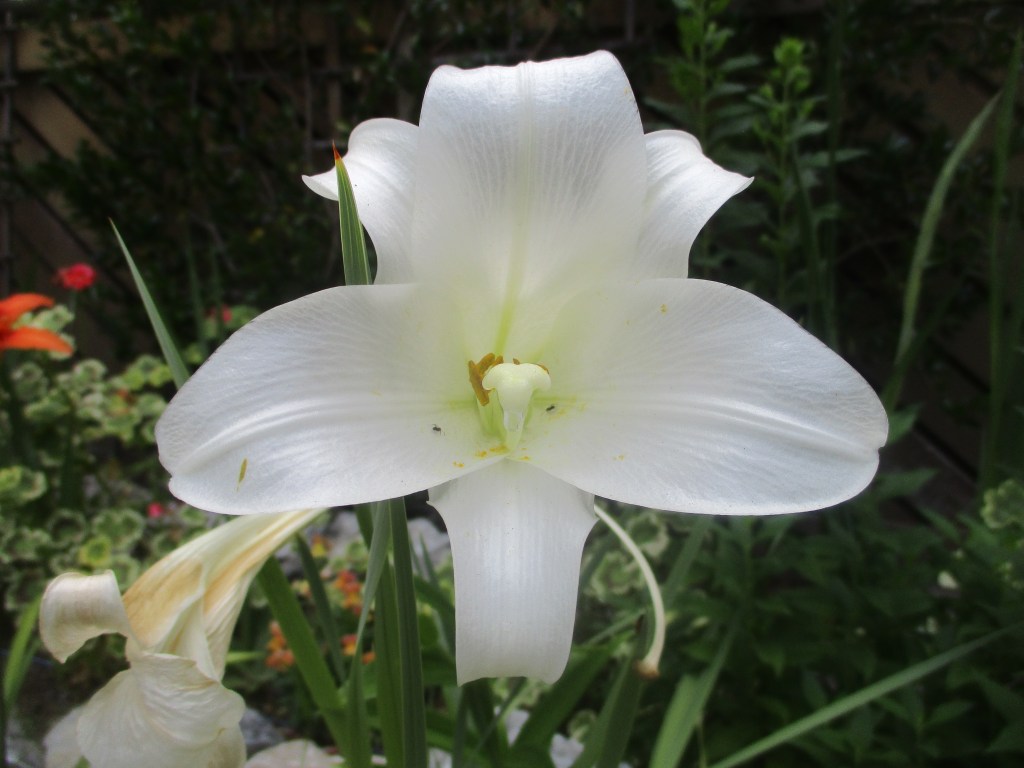
2. Lilium of an unidentified cultivar is finally finishing bloom. Obviously, it is irrelevant to Gladiolus. It just happened to be so pretty precisely as I was in need of a sixth picture.
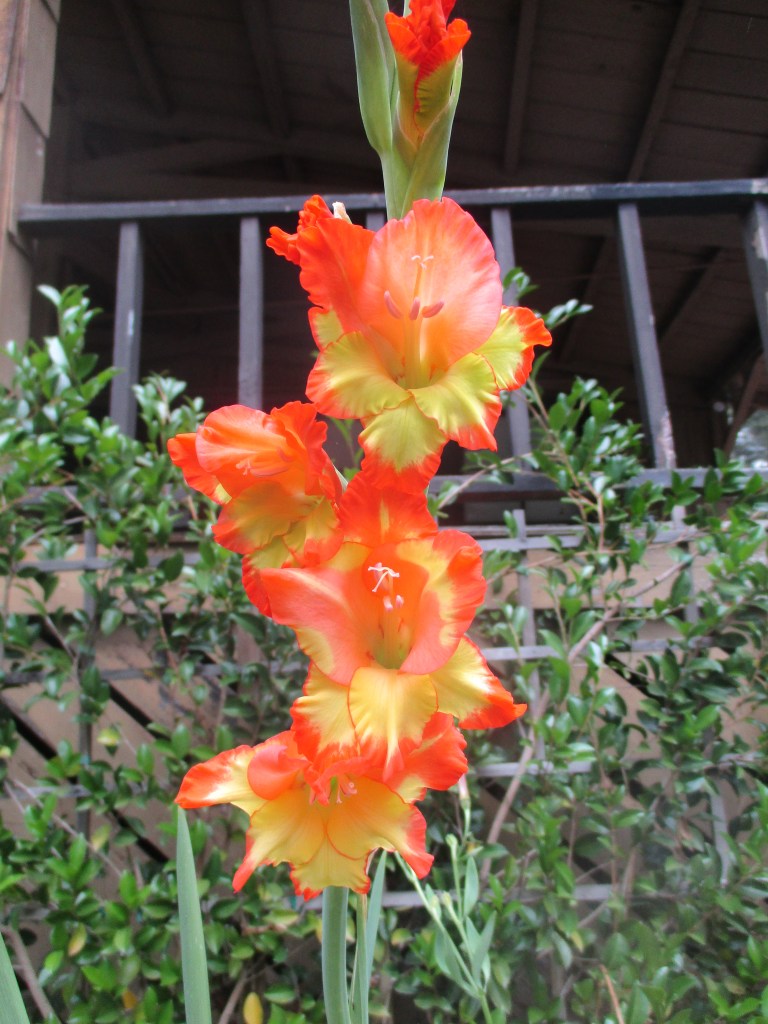
3. Gladiolus is mostly finishing bloom now. These few are blooming a bit late. These are merely the common hybrid sort that someone purchased from a retail nursery years ago.
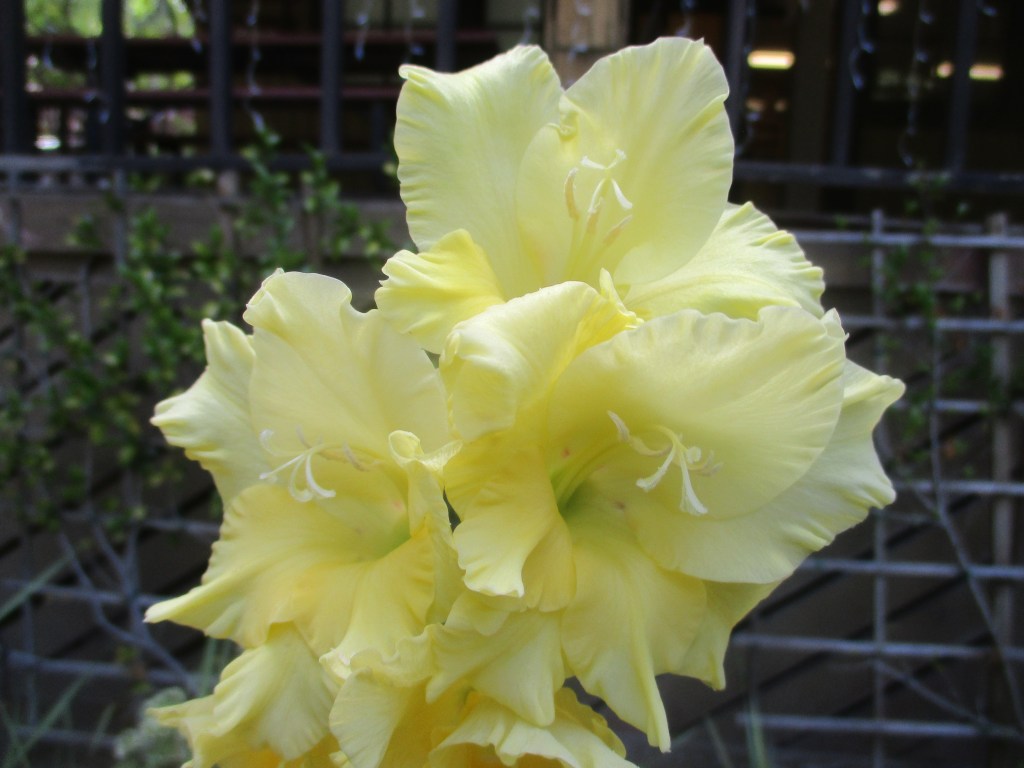
4. Not only have a few of the Gladiolus hybrids been surprisingly reliably perennial for a few years, but this pastel yellow cultivar has actually multiplied, from one bulb to a few.
5. This Gladiolus hybrid blooms annually also, but unlike the pastel yellow cultivar, does not multiply. This and one other just like it are the only two, with neither more nor less.
6. This purple Gladiolus hybrid does the same. It would be nice if it could generate a few copies. Since it is the only specimen here, and might be fragile, I will not tamper with it.
Although they will not bloom until summer or autumn, gladiolus are in season now. Their corms, which are like bulbs, are now available from nurseries, and are ready for planting. Unlike earlier spring bulbs, they need no chill, and should not generate new foliage until warmer spring weather. Corms prefer to be at least four inches deep, in sunny situations.
The most popular and common gladiolus, Gladiolus X hortulanus, are hybrids of several species. They bloom more impressively than their simpler parents, but are not as reliably perennial. Most corms bloom for only a single season, although some within each group may bloom for a second season or more. Blooms can get heavy enough to need staking.
Bloom can be bright or pastel hues of any color except true blue, perhaps combined with another related color. Individual florets are not large, but they share their floral stalks with several similar florets that bloom upward from the bottom. Long and pointed leaves stand upright, flaring only slightly to the left and right. The tallest gladiolus can get six feet high.
Spring bulbs are making a comeback from their unceremonious internments last autumn. Some of the earlier sorts are visibly extending foliage above the surface of the soil. A few narcissus, daffodil and crocus are already blooming! Now it is time to plant late bulbs, or summer bulbs, which start to grow through warm spring weather, and bloom for summer.
Spring bulbs are generally the same as hardy bulbs of climates with cold winter weather. They are hardy to frost while dormant. Since chill is relatively mild locally, their hardiness is irrelevant. Conversely, some prefer more chill than they experience locally. Inadequate chill can compromise performance. Autumn planting maximizes their brief chill exposure.
Late bulbs are completely different from spring bulbs. Not only do they not require chill to perform, but some dislike it. Many of the most popular late bulbs that can naturalize here succumb to frost elsewhere. Instead of early planting for chill, as spring bulbs prefer, late bulbs prefer late planting to avoid chill. Their foliage emerges after the last threat of frost.
However, although they do not need or even appreciate chill, most popular late bulbs are resilient to the minor chill of local climates. Once established, they simply die back to the ground in response to the first frost of autumn. They maintain dormancy through winter to regenerate for spring. Some repeat this process for years, since the soil does not freeze.
Not all late bulbs are actually bulbs. Most are corms, rhizomes, tubers, tuberous roots, or other bulb-like perennials. Some, such as dahlia and canna, bloom through an extensive season. Some, such as lily and gladiolus, bloom only once. Planting in phases for a few weeks prolongs their bloom. Of course, they will synchronize for any subsequent bloom.
Canna and common white calla are two of the most reliable late bulbs. Crocosmia is too reliable, and since it can be invasive, it is rarely available. Common gladioli and various lilies are spectacular in bloom, but not reliably perennial. Dahlia is a very rewarding and reasonably reliably perennial summer bulb. It is spectacularly variable in color, form and texture.
It grows from dormant rhizomes like a few of the popular early spring bulbs do. However, the many garden varieties of Canna are actually late or summer bulbs. They will become available after last frost, at about the time that early bulbs bloom. Also unlike early bulbs that mostly bloom prolifically once, Canna bloom sporadically from late spring until frost.
Canna foliage can be as appealing as the bloom. The big and lush leaves can be green, bronze, striped or irregularly variegated. ‘Australia’ has strikingly dark bronze foliage with red bloom. ‘Tropicana’ is striped green, yellow, bronze red and purplish pink, with orange bloom. ‘Stuttgart’ is irregularly variegated with white, with ribbony peachy orange bloom.
Of course, the bloom can be quite spectacular atop all that foliage too. Flowers might be pink, red, orange, yellow, creamy white, or a spotty combination of two such colors. Most popular cannas bloom with big and floppy flowers. Some have narrower and wispy floral parts. Bigger cannas can get taller than eight feet. All growth dies back after frost though. New growth regenerates fast in spring.
While so many flowers are finishing their bloom and leaving their drying foliage behind, naked lady, Amaryllis belladonna, is just beginning to bloom, naked of any foliage. Clusters of a few to several bright pink flowers stand on bare stems about two feet tall. Individual flowers are about two and a half to three and a half inches long, and resemble lily flowers. Foliage only appears after flowers deteriorate, and lasts only until weather gets warm late in spring. The strap shaped leaves are about a foot to a foot and a half long. Through summer, the two or three inch wide bulbs are dormant and bare, and seem to be dead with their tops visible at the soil surface, but retain fleshy roots below. They should therefore only be dug and divided if they get too crowded or need to be moved.
When there is not an app for that, there is probably a bearded iris that will work just fine. Really, there is just about every shade of yellow, blue, purple, orange, pink and almost-red imaginable, ranging from wildly bright to subdued pastel. There are actually several shades of white, and a few rare flavors of dark purplish black.
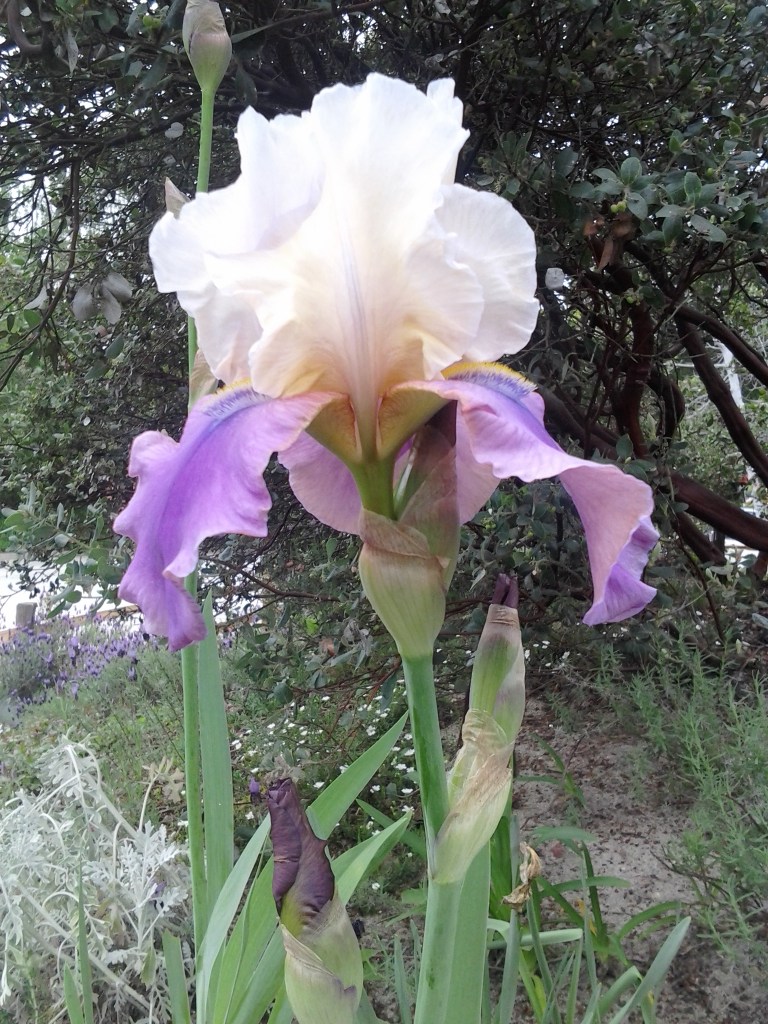
It seems that the most popular of the bearded iris bloom with two or more colors. The standards may be very different from the falls. Any part of the flower may be striped, spotted, blotched or bordered with another color. Flowers may be relatively simple or garishly ruffled. Many are fragrant.
Bearded Iris bloom between March and May. Some of the modern varieties bloom again in autumn. Flower stems can be as short as a few inches, or as tall as four feet, with only a few to several flowers. The rubbery and somewhat bluish leaves form flat fans that look neater if groomed of deteriorating older leaves. Each fan dies back after bloom, but is efficiently replaced by about two more new fans. Colonies of fans should be divided over summer every few years, or as they get too crowded to bloom well. Bearded iris likes well drained soil and at least six hours of direct sun exposure daily.
There is nothing simple about dahlia. Some are short bedding plants that behave as annuals. Tree dahlias develop big and lanky canes that can get as high as ground floor eaves, only to replace them during the next summer. The most popular dahlias are lushly foliated perennials with striking and extraordinarily colorful bloom. Most are taller than bedding dahlias, but less than six feet tall.
Dahlias can bloom just about any color except blue. However, most purple dahlias tend to be rather reddish or pinkish. Green dahlias are rare, and tend to be rather yellowish. Floral form is wildly variable! So is floral size. Some dahlia flowers get no wider than two inches. Larger sorts get about ten inches wide, so must be staked. Dahlias might be as variable as related chrysanthemums.
Dormant dahlia tubers can go into the garden as early as late autumn here. Most start in winter though, to be less susceptible to rot while waiting for spring. After blooming through summer, dahlia growth succumbs to frost late in autumn. Division of crowded dormant tubers every few years promotes healthier spring regeneration. There is no need to dig and store tubers through winter here.
It was easy to bury spring bulbs so discourteously in shallow graves last autumn. None of them got proper funerals. Perhaps cool season annuals obscured their interment sites. No one needed to know they were there. It seemed like a perfect crime, until now. They are back like the undead. After all, they were not dead when interred. They were merely dormant, and likely plump and healthy.
Crocus, snowdrop, narcissus and some of the other related daffodil might already be blooming. Otherwise, their foliage is emerging above the soil. They do not necessarily wait for the soil to get warmer later in winter. Hyacinth and tulip will bloom a bit later. Delayed planting delays bloom, but only for the first season. Established spring bulbs from previous seasons will bloom as they like.
Spring bulbs, including corms, rhizomes, tubers and tuberous roots, prefer early interment for a reason. They appreciate a good chill through winter. Although most get refrigerated artificially prior to sale, they certainly do not mind a bit more chill. Besides, they also appreciate early root dispersion, even while still dormant. They prefer to bloom early, but unfortunately, also finish bloom early.
Summer bulbs are very different. They go into the garden later because they do not require chill. Furthermore, many types are sensitive to minor frost if they begin to grow too early in winter. Since they start growth later than spring bulbs, summer bulbs generally bloom later. However, some bloom for extensive seasons. A few summer bulbs bloom from early summer until frost in late autumn.
Dahlia, canna and old fashioned white calla are the more reliable of summer bulbs to plant now. Old fashioned white calla may be rare in nurseries. Smaller, more colorful, but less vigorous callas are more popular. Such summer bulbs are more sustainable than spring bulbs, and can perform for many years. Gladiolus and various lily are spectacular summer bulbs, but bloom once annually.
Incidentally, unlike the spring bulbs, most summer bulbs are actually corms, rhizomes, tubers or tuberous roots.
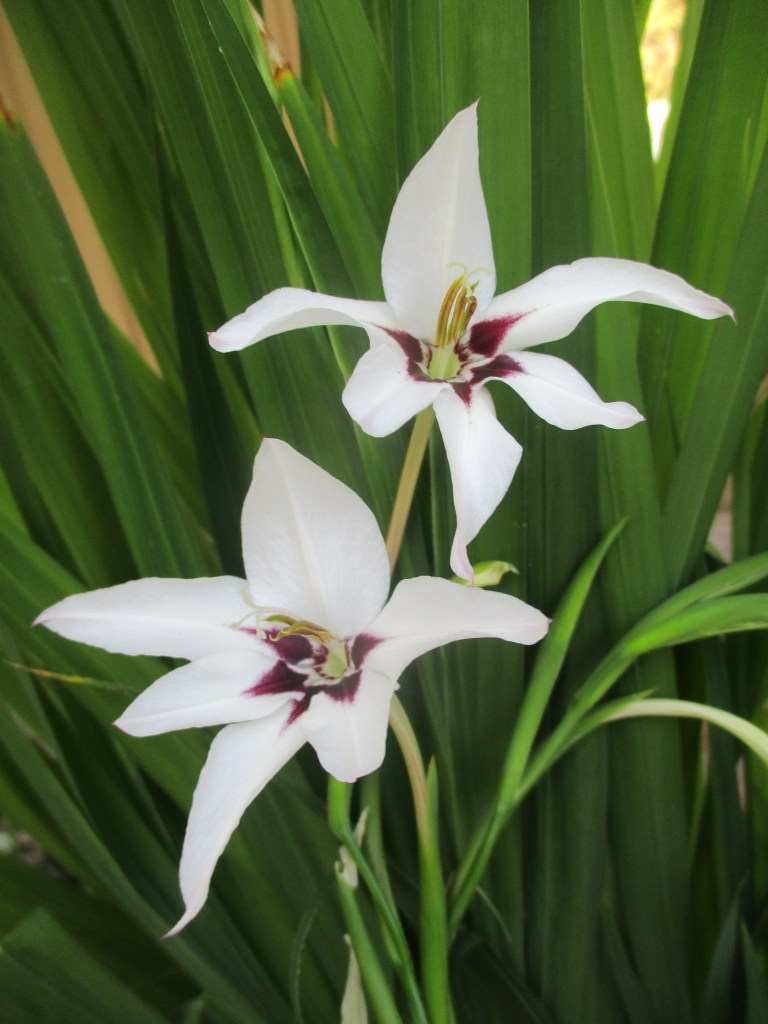
Summer bulbs and bulb like perennials bloom after spring bulbs. They therefore prefer later planting. Abyssinian gladiolus, Gladiolus murielae, is likely unavailable in nurseries while spring bulbs are seasonable. Their bulbs should be obtainable and ready for planting later, while other summer bulbs are in season. Abyssinian gladiolus blooms late in summer, or may still be blooming now.
Abyssinian gladiolus is more discreet than the more common hybrid gladiolus. It is also more reliably perennial. In favorable conditions, bulbs might multiply enough to be somewhat invasive. The narrow leaves stand more than two feet tall. Floral stems can be three feet tall, to loosely suspend a few white flowers with garnet red centers. Each mildly fragrant flower is about two inches wide.
The bulbs, which are technically corms, prefer organically rich soil that drains well. Digging and storing them through the locally mild winters is unnecessary. After many years, established colonies of bulbs might migrate upward and closer to the surface of the soil. Digging dormant bulbs that have gotten too shallow to stand upright while foliated, and burying them deeper, improves stability.






 Tony Tomeo