Bear’s breech can be a bit too sustainable, and difficult to get rid of.
Like some other Victorian perennials that are still happy after a century, bear’s breech, Acanthus mollis, can get to be too much of a good thing. It can become invasive where not contained. Once established, it is difficult to eradicate. The bold coarse foliage looks great while the weather is favorable, but then dies back after bloom when summer weather gets warm, leaving obvious voids where other plants were crowded out.
The good news is that bear’s breech does not require much attention at all. It is very easy to propagate by division or simply by digging a few thick roots while dormant or just as new foliage appears in autumn. Well watered plants can keep their foliage all year, so that they only need to be groomed of older foliage and spent flower stalks. Partial shade is not a problem; although snails can be.
Big arching leaves form bold mounds of glossy foliage about three feet wide. The distinctively lobed and toothed foliage has an appealing texture and deep green color. Elegant mostly white flower spikes stand nearly five feet tall late in spring into summer. Acanthus balcanicus (illustrated) is more compact, with more intricately textured foliage.
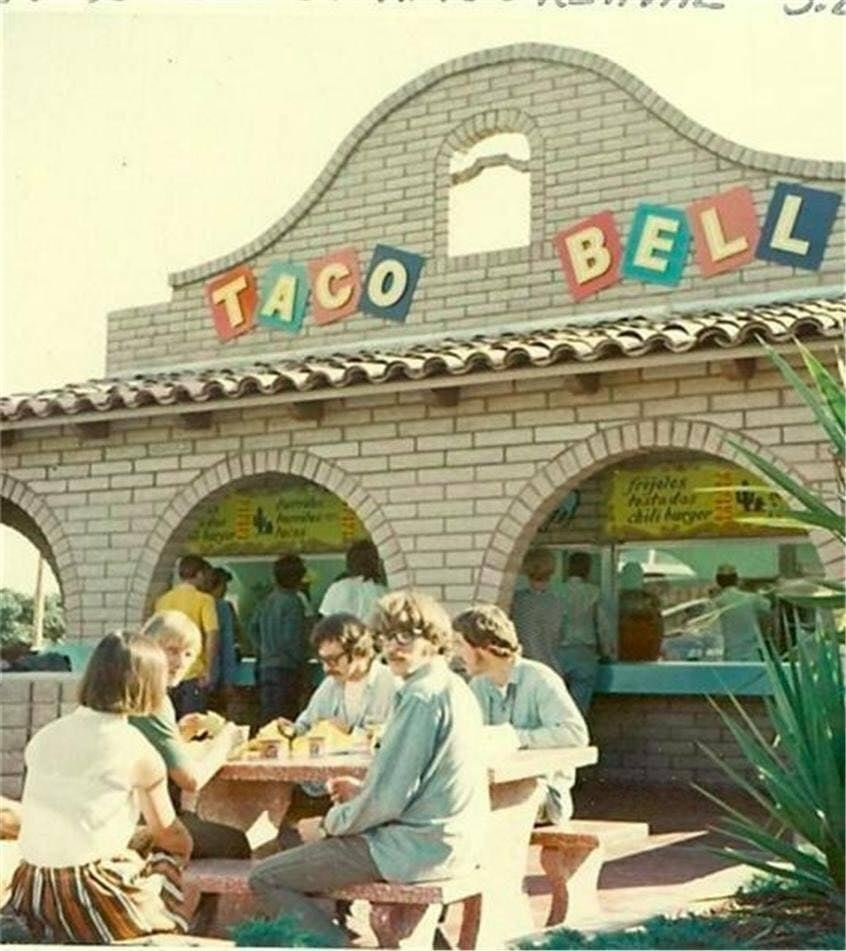
Yucca elephantipes at Taco Bell in San Luis Obispo in 1968.
Down on the corner, or at least next door to the western corner of Olive Street at Santa Rosa Street in San Luis Obispo, Creedence Clearwater Revival stopped at Taco Bell, supposedly about the second of August of 1968, on their way from Palo Alto to Santa Monica. They were famous for such horticultural songs as ‘Run Through The Jungle’, ‘Have You Ever Seen The Rain’, ‘Cotton Fields’ and ‘I Heard It Through The Grapevine’, which I incidentally remember playing on the radio as I drove over the Grapevine Highway on my second trip to Los Angeles sometime in about 1987. This particular Taco Bell is conveniently located for travellers, since its corner location is also the interchange of southbound Highway 101 and Highway 1. The two highways are concurrent to the south. The original Taco Bell building has been replaced with a larger modern building that also occupies the parcels to its left and right, so that it really is down on the corner now. A bit more than eighteen years after the picture above was taken, in autumn of 1986, Brent and I became very familiar with the original. It was the scene of one of his more notorious adventures, which is too naughty for me to describe here. Another tamer incident involved the relatively small giant yucca, Yucca elephantipes, to the lower right in the picture. It was larger by 1986, and prior to one of our visits to Taco Bell, it had suspiciously deposited a few small limbs onto the sidewalk. Upon closer inspection, we found bits of pulverized chrome plated plastic and an emblem from what was likely a relatively new Cavallier of the early 1980s. Of course, we could not just leave the yucca canes there on the sidewalk to eventually be disposed of. We loaded them into the trunk and took them back to our dormitory, where we shared them with neighbors. The smallest shoot grew in a can of soil in our dorm room until it matured enough to also be given away. Because I sort of enjoyed it while it was there, Brent gave me a larger and more impressive specimen with an even more scandalous history a few years later. I have grown hundreds of giant yucca specimens since then, but the original that Brent gave me before 1990 is still here. I wonder if any of the others survive.
Vegetation that survives within untended gardens is truly sustainable.
Sustainability is a good idea gone bad. It is so often used as a marketing gimmick by those who actually have the least to gain from it. Really, landscapers and gardeners would not have much business if landscapes really were sustainable and able to function without their help. The best landscapes probably compromise between being as sustainable as possible with a few more conventional but less sustainable features to make them functional.
For example, lawn happens to be among the least sustainable of landscape features. It needs ridiculous volumes of water and continual maintenance, typically with gasoline powered mowers. Many lawns are gluttons of fertilizer. Yet, almost all landscapes have lawn of some sort. Lawns are certainly justifiable for children and dogs.
The trick is to use lawn like rugs for the landscape instead of like wall to wall carpeting. If possible, it should not be an all purpose ground cover for whatever area is not landscaped with something else. It should cover only areas that will get used as lawn.
Bedding annuals are likewise far from sustainable. They need too much water and work, and get replaced seasonally. Even those that sometimes naturalize where a bit of water is available, like sweet alyssum, godetia and nasturtium, really do not perform quite like more pampered bedding plants do.
The best way to see sustainability in action is not in the pretty pictures in the brochures of landscape companies with something to sell, but in the worst of landscapes. Plants that survive in abandoned landscapes where lawns and bedding plants have died off are obviously more sustainable.
Bottlebrush, oleander and various junipers and yuccas may be stigmatized as ‘gas station’ plants, but earned that stigma by being so resilient and sustainable. The many types of cotoneaster, manzanita, wild lilac and rockrose are also worth investigating, (although wild lilac and rockrose do not live as long as the other shrubbery does.) Redwood, California laurel, strawberry tree, incense cedar and many types of eucalyptus, oak , cypress and acacia are among the more sustainable of trees.
Like my Six on Saturday from last week, these Six are described in reverse chronology of their approximate acquisition. My first two were acquired only within the last two years, so do not yet have much history with me. The last was actually acquired prior to the first of last week, and in conjunction with the second of last week, so is not exactly compliant with chronology. The fourth and sixth would have been more interesting in bloom. They all represent memories for me regardless, like almost all of the inhabitants of my simple garden. I notice them more at this time of year, while I work with them more.
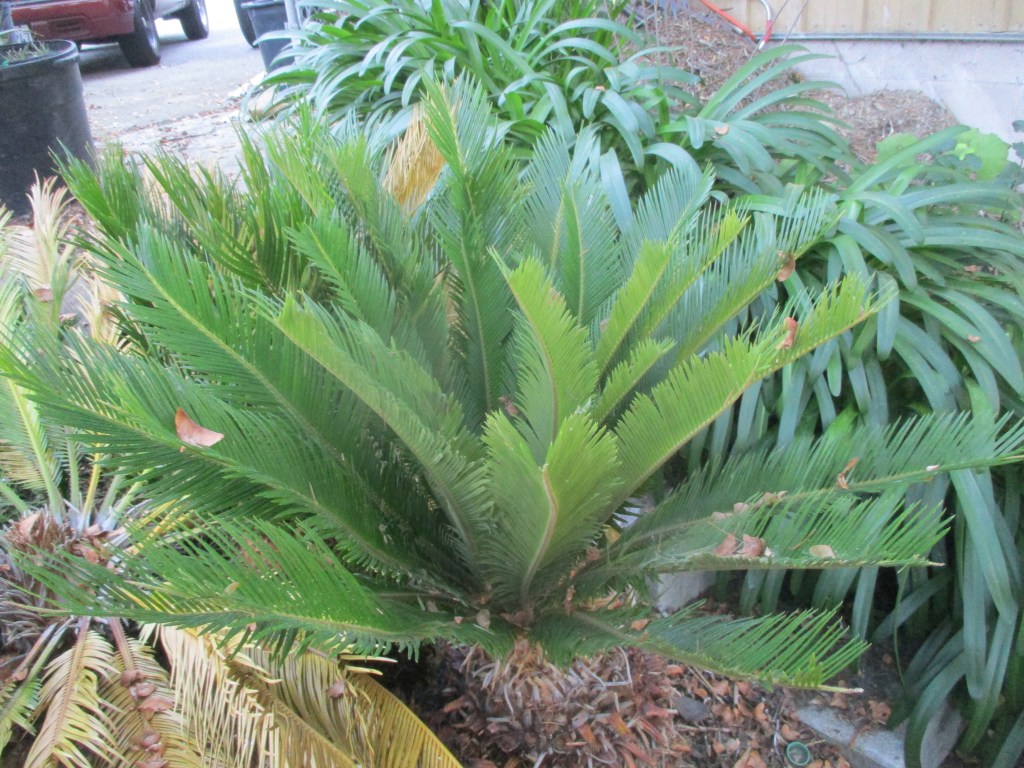
1. 2021 Cycas revoluta, sago palm is another of several excellent items that I got for free on Craigslist. It got cut into too many pieces for relocation. All but a few are now rooted.
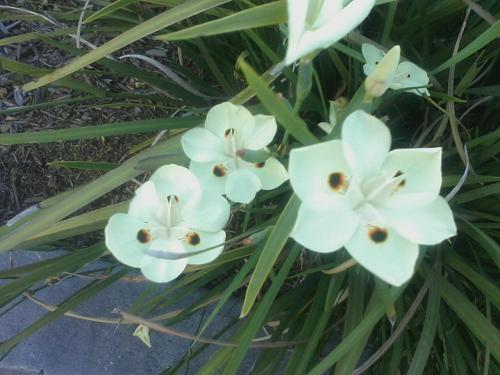
2. 2020 Gladiolus murielae, Abyssinian gladiolus is native to Abyssinia, not an abyss. It came here from the garden of a neighbor though. I had wanted to grow it for a few years.
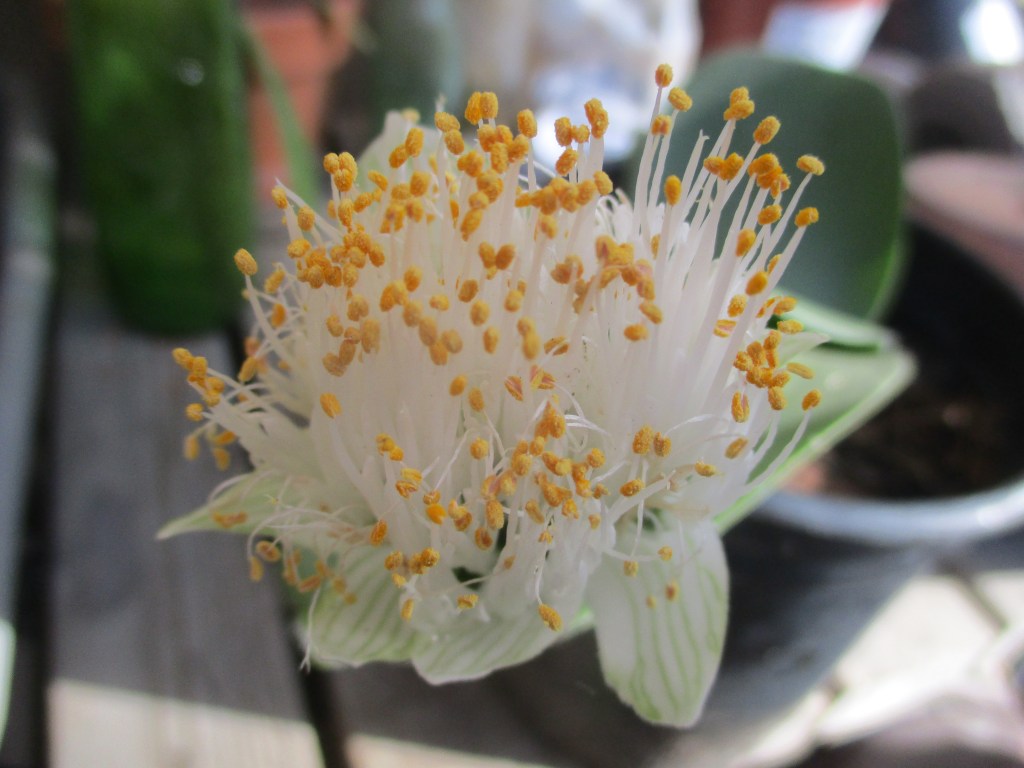
3. 2015 Haemanthus albiflos, white blood lily came from a garden of an elderly client in Santa Clara who was quite fond of it. That is why I am so fond of it, even if unimpressed.
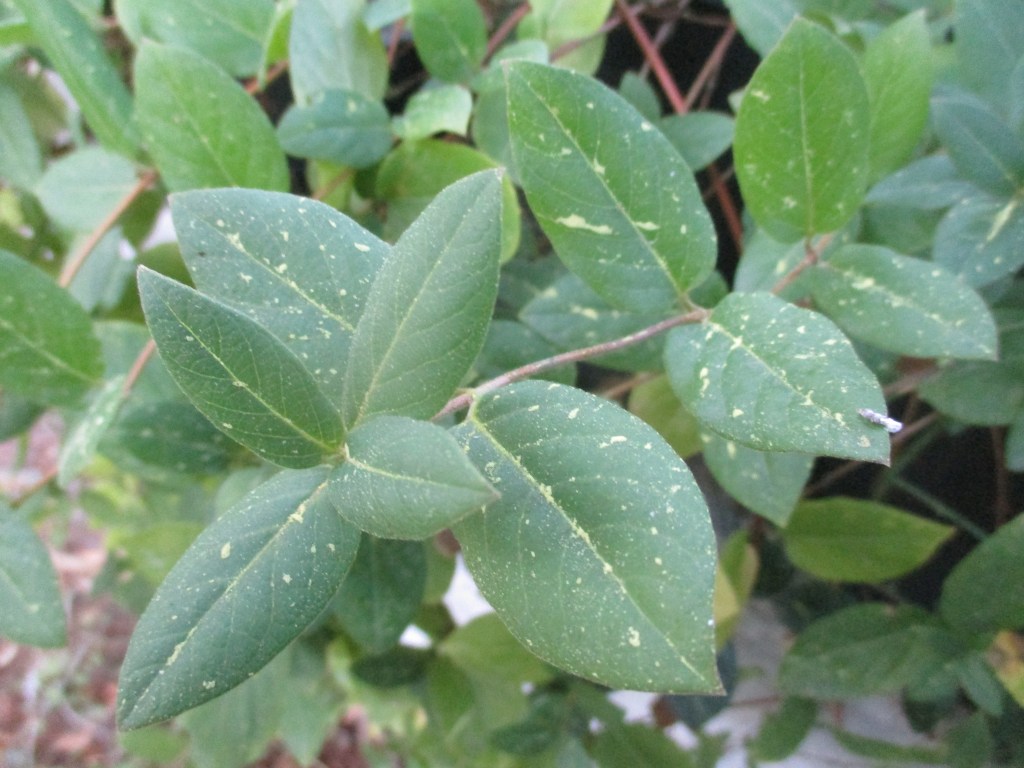
4. 2012 Lonicera albiflora, white honeysuckle is one of many souvenirs from Oklahoma. Most were seed. This and only a few others were live plants. It has grown very well here.
5. 1990 Chamaedorea seifrizii, bamboo palm was one of the first houseplants that I took from Brent when I moved into my apartment in town after the Loma Prieta Earthquake.
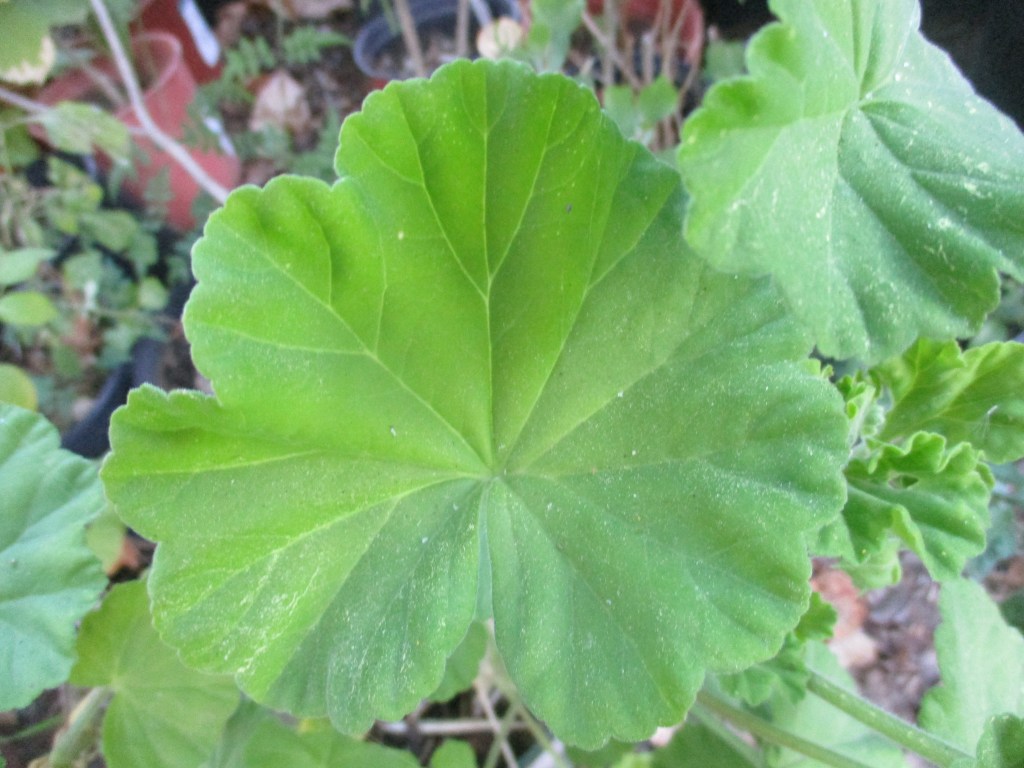
6. 1982 Pelargonium hortorum, zonal geranium without a zone gets big and weedy with hideously bright pink bloom. It grew wild with the crocosmia #2 of the Six for last week.
Truly sustainable plants are less lucrative to the nursery industries.
My rhubarb really has been around a while! My father’s father’s father and mother grew it quite some time ago, and shared some shoots of it with my father. He then shared it with my maternal grandmother, who shared it with her mother, another of my great grandmothers, who thought it was something really exotic. Along the way, it was undoubtedly shared with friends and neighbors all over the place.
My great grandparents with the original rhubarb also grew old varieties of grapes, oranges, lemons, walnuts and all sorts of vegetables. Their two (‘Carpathian’ English from Persia) walnut trees were remnants from an orchard that was already old before their home was new in 1940. The few ‘ornamental’ features of their garden included such old fashioned but resilient plants as junipers, callas, pelargoniums (geraniums), dahlias and roses. Yes, the stereotypical Italian American garden. My great grandfather even gave me my first nasturtium seeds.
My maternal grandfather likewise grew all sorts of traditional vegetables, as well as cherries, peaches, avocados, blackberries and raspberries. My grandmother competed for limited garden space to tend to her many roses, as well as lilacs and bearded iris that she got from her mother. My mother still grows a large herd of the original iris, several lilacs and a copy of the peach tree.
My very first experiences with gardening were in the old fashioned but remarkably sustainable gardens of my parents, grandparents and great grandparents. Such gardening with so many old fashioned plants would seem primitive by modern standards, but really demonstrates how sustainable proper horticulture is.
Of course, as a horticulturist, I work with all sorts of exotic plants and modern varieties. Although some are fun to work with, the best and most sustainable plants are the old classics and simpler ‘unimproved’ plants, especially those that can be propagated from seed, division or cuttings from established plants.
Many modern varieties of plants are more beneficial to the retail nursery industry than to home gardens, since they do not last too long. They are generally either not well suited to local climates, or are genetically weak from extensive breeding or mutation. (Many of the mutant characteristics that some varieties are selected for, such as variegated foliage or compact growth, compromise vigor.) As they come and go, more new plants are needed from nurseries to replace them. This is actually contrary to the sustainability fad that so many nurseries claim to promote.
Perhaps our parents know more about gardening and sustainability than we give them credit for.
The original Dodge Dart, with the slant-six engine, was not much to look at, but was built to last. While cars were expected to last ten years or a hundred thousand miles, Darts easily lasted twice as long or twice as far. A few are still going now! Such resiliency really made a reputation for Dodge. The problem was that those who bought Darts had no need to buy another car for a long time.
That is a problem with sustainable plants too. Those that last too long, or are too easy to propagate, eliminate the need to buy new plants from nurseries. Many of the most traditional plants that have been popular for a long time probably earned their popularity by being so reliable and sustainable. These are the plants that the nursery industry would prefer to replace with newer varieties.
Good old fashioned lily of the Nile is about as tough and reliable as a perennial can be. If it gets crowded after a few years, it can be dug, divided and replanted over a much larger area, and even shared with friends. Kangaroo paw has been a fad for a few years because it is purported to be tough and drought tolerant too, but like a 1982 Oldsmobile Omega, it dies out in only a few years.
Kangaroo paw is certainly worth growing for striking blooms, even if it is enjoyed for only a few years. It is not too demanding, and can be sustained longer with a bit of specialized grooming and plugging (replanting shoots slightly deeper than they naturally grow). It is just important to realize that kangaroo paw sustains the nursery industry more than it should be expected to sustain itself.
Many of the trendiest modern varieties of old fashioned plants are not so justifiable. Perennials are the most notorious, especially if they are labeled as annuals. Sensational labeling with buzzwords like ‘sustainable’, ‘eco-freindly’ or ‘riot of color’ (seriously!?) can sometimes be a clue. Plants that seem to be ‘doped up’ (blooming with ridiculous profusion) might look their best when first planted, only to decline afterward, instead of growing into their garden space.




 The original Dodge Dart, with the slant-six engine, was not much to look at, but was built to last. While cars were expected to last ten years or a hundred thousand miles, Darts easily lasted twice as long or twice as far. A few are still going now! Such resiliency really made a reputation for Dodge. The problem was that those who bought Darts had no need to buy another car for a long time.
 Tony Tomeo