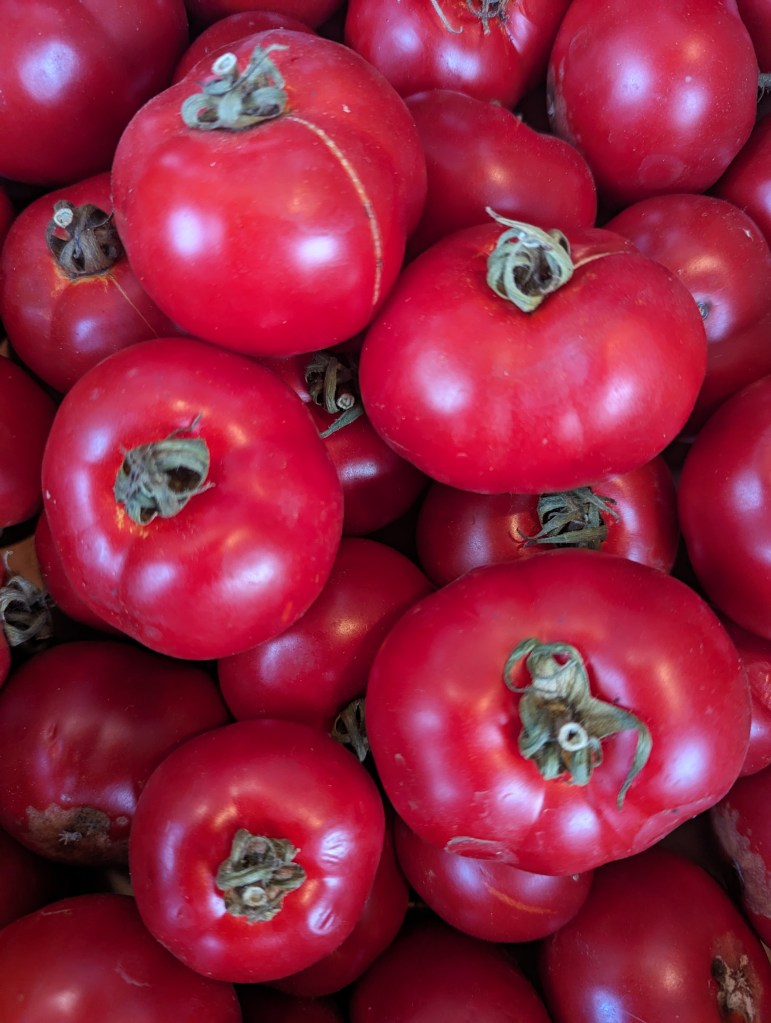
Like most warm season vegetables, tomatoes, Solanum lycopersicum, are actually fruits. They contain seed, whereas actual vegetables are vegetative plant parts that lack seed. Although mostly red, some are orange, yellow, green, pink, brown, purple or pallid white. Some are smaller than small grapes, while ‘Beefsteak’ may grow wider than five inches.
For home gardens, the most popular varieties of tomato are indeterminate. They produce their fruit sporadically throughout their season, on lanky irregular stems. They are neater with the support of tomato cages or stakes. Determinate varieties are shrubbier and more productive, but only for a brief season. They are quite conducive to succession planting.
It is still a bit too early for small tomato plants to go into their gardens. However, seed can start inside or in a greenhouse now. It is possible to sow seed directly into a garden later, but they are vulnerable to mollusks. Nurseries can stock several varieties of tomatoes as small plants. Countless more varieties are available from mail order or online purchases. Many heirloom varieties truly are strange and unique.
(This article is from 2010, so contains irrelevantly outdated information.)
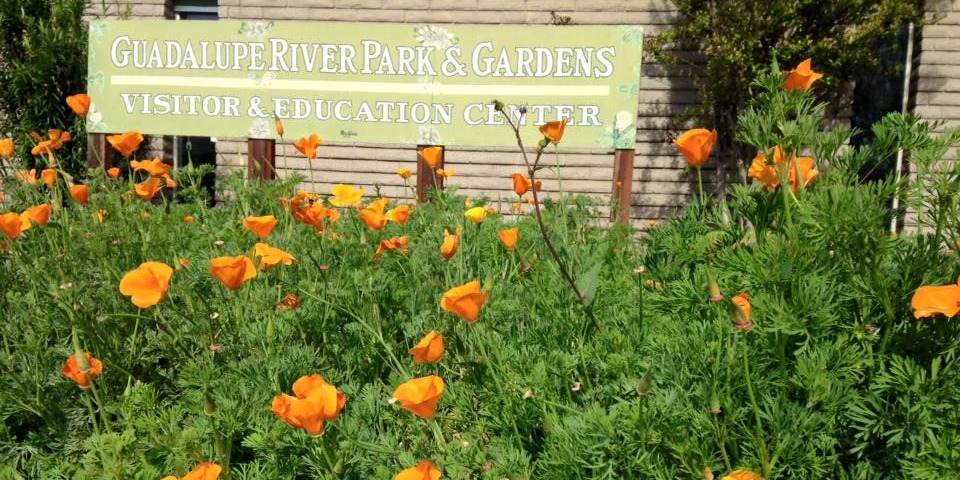
Now that the world renowned San Francisco Flower and Garden Show is over, it is time for an even more important horticultural event; Spring in Guadalupe Gardens, on April 24, between 10:00 a.m. and 3:00 p.m.. This celebration of Guadalupe Gardens, Earth Day and the Great Outdoors may not be as big and as fancy as some of those ‘other’ shows, but it is so much more important because it is local, centered around the Guadalupe Gardens Visitor and Education Center, which is located at 438 Coleman Avenue in San Jose.
My favorite part of Spring in Guadalupe Gardens is all the vendors of unusual plants. In past years, I found several fuchsias, aloes, cacti and weird tomato plants at Spring in Guadalupe Gardens. I never know what to expect until I get there. I hope to find unusual fig trees this year.
Spring in Guadalupe Gardens is also a great opportunity to meet with representatives of all sorts of gardening clubs. Gardening questions can be brought by the Master Gardeners of Santa Clara County’s Gardening Advice booth, where I will be working throughout the day. There will be workshops and lectures, music and entertainment, as well as fun activities for children.
Spring in Guadalupe Gardens happens to be at the same time as the peak of bloom in the Heritage Rose Garden, which is the largest public garden in the United States of America dedicated to the preservation of old roses. There will be tours in other gardens and trail walks too. If I did not need to work at the Gardening Advice booth, I would want to tour the Historic Orchard, which is literally a tree museum of the many fruit trees that once filled the vast orchards of the Santa Clara Valley.
Earth Care Recycling will host a free electronic waste drop off at the Visitor and Education Center to collect all sorts of computers, keyboards, monitors, televisions, stereos, radios, printers, fax machines, telephones, cell phones, DVD players and VCRs. (I thought mine was the last of the VCRs!) Proceeds benefit the Guadalupe River Park Conservancy.
Admission and parking are free. Just follow the signs from Coleman Avenue or West Taylor Street. More information about Spring in Guadalupe Gardens can be found at www.grpg.org or by telephoning 298 7657.
The unfortunate news about the Wildflower Show organized by the Santa Clara Valley Chapter of the California Native Plant Society and the Mission College Biological Sciences Department is that it will be at the same time (with another hour until 4:00 p.m.). The fortunate news is that it will continue the following day on April 25, so we all can attend both events! The Wildflower Show will be at Mission College in Santa Clara. Parking in lot C and admission are free.
More than four hundred specie of wildflowers and native plants will be displayed and accurately labeled. There will be free classes for native plant identification and wildflower gardening, and nature activities for children. Books, posters, seeds and note cards will be available for purchase. More information can be found at www.cnps-scv.org, or by telephoning 650 – 260 3450.
Like most warm season vegetables, tomatoes, Solanum lycopersicum, are actually seed bearing fruit. They are both the most diverse and the most popular home grown produce. Grape tomatoes are smaller than little grapes. ‘Beefsteak’ can get wider than five inches. Although mostly red, some are yellow, orange, pink, green, brown, purple or pallid white.
The most popular varieties of tomato for home gardens are indeterminate. They produce fruit sporadically throughout the season, on irregularly sprawling stems. Tomato cages or stakes support their growth. Shrubbier determinate varieties seem to be more productive only because all of their fruit develops within a brief season. They work well for canning.
Small tomato plants in cell packs and four inch pots, which are available from nurseries, should grow efficiently in the garden as the weather warms through spring. Varieties that are unavailable as small plants can grow from seed in cold frames through late winter, to be ready for the garden after last frost. Directly sown seed can be vulnerable to mollusks.
If there are any cool season vegetables left in the garden, they should probably be harvested pretty soon. If left too much longer, they will be ruined by warming weather. Cabbage will bolt (start to bloom) once it realizes that it is spring. Cauliflower and broccoli, which are juvenile flowers, will become bitter as the flowers mature and try to bloom. Besides, they all need to get out of the way.
Warm season vegetables need the space. Tomato, pepper, eggplant, zucchini and other squash plants are ready to disperse their roots and get to growing. They are usually planted as seedlings because only a few of each are needed. A few seedlings of each type are more reliable, but not much more expensive than a packet of seeds; and they do not need to take the time to germinate.
However, because they are so easy to grow, seed for zucchini and other squash, as well as melon, are popularly sown directly where plants are desired. There was no need to sow them indoors earlier to plant in the garden as seedlings now. Onions can be grown from seed for late harvest, or they can be grown from juvenile onions known as ‘sets’ for earlier harvest or for green onions.
There are two main reasons why cucumbers, beans and corn should be grown from seed, although cucumber seedlings can be practical if only a few are desired. Otherwise, so many individual plants are needed that it would be relatively expensive to purchase enough seedlings. The main reason for sowing seed directly is that their seedlings are sensitive to the stress of transplanting.
Tomato, zucchini and beans are likely the most popular of warm season vegetables because they are so productive and reliable, even in limited space. Pole beans can be grown on trellises against fences or walls in very tight spots. Corn is less popular because it needs so much space, and needs to be watered so regularly. Too few plants may not be adequate for cross pollination. Pepper and eggplant, as well as okra, are not too demanding, but appreciate rich soil, regular watering and warm exposure.

 If there are any cool season vegetables left in the garden, they should probably be harvested pretty soon. If left too much longer, they will be ruined by warming weather. Cabbage will bolt (start to bloom) once it realizes that it is spring. Cauliflower and broccoli, which are juvenile flowers, will become bitter as the flowers mature and try to bloom. Besides, they all need to get out of the way.
 Tony Tomeo