 The delightfully clear sky blue flowers of blue plumbago, Plumbago auriculata, seem like they belong with colorful annuals or in a tailored border of colorfully blooming perennials. However, the rampant canes of mature plants are really best in the background where they have room to grow wild. The canes do not climb like vines, but can flop over other shrubbery as high as fifteen feet.
Rounded trusses of small blue flowers begin to bloom sporadically by the end of spring, and continue to bloom in phases until late summer. Supposedly, each subsequent phase should be a bit more profuse than the previous; but not all plants are aware of this. They might bloom best in mid summer, and less profusely later. ‘Alba’ blooms white. Pale foliage indicates a need for fertilizer.
Blue plumbago is not as easy to work with as it seems to be. Once established, it can grow like a weed, and really seems to take care of itself, and it is probably better to allow it to do so. It does not like to be shorn into hedges or geometric shapes as it so often is. Shearing ruins the natural form, eliminates most of the outer canes that provide bloom, and exposes sparse interior growth.
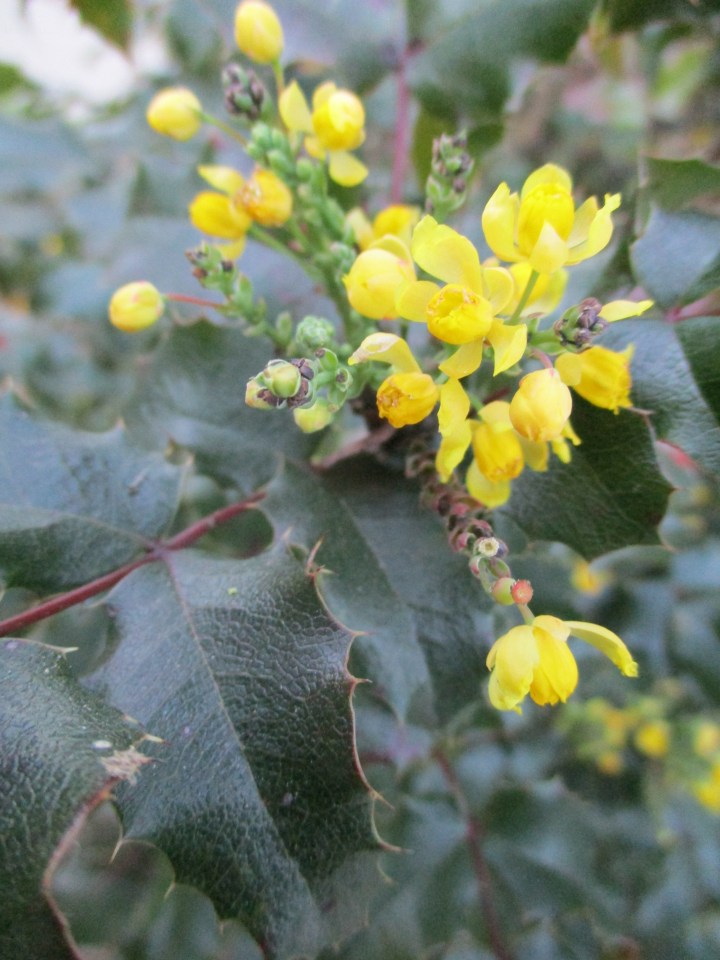 Oregon has good taste. Douglas fir, one of the most useful of timber trees in America, was selected as the state tree. Oregon grape, Mahonia aquifolium, was designated as the state flower. Although the tight clusters of tiny bright yellow flowers that bloom about now may not be as flashy as other state flowers, they contrast handsomely against the glossy and deep dark green foliage.
 Pictures are probably prettier than the real thing. Australian fuchsia, Correa pulchella, really does bloom with pendulous soft pink flowers through winter when not much else is blooming. However, the flowers are quite small, and the color is rather hazy. The real appeal of Australian fuchsia is that it is so undemanding, and once established, only needs watering a few times through summer.
 Okay, so this is not really the time of year that they should be blooming. Torch lily, Kniphofia uvaria, should bloom in the middle of summer. However, without watering, naturalized plants bloom when the weather prompts them to. Some wait out the warm and dry summer weather to bloom as soon as they get dampened by the first rains. Others bloom in spring, before things get too dry.
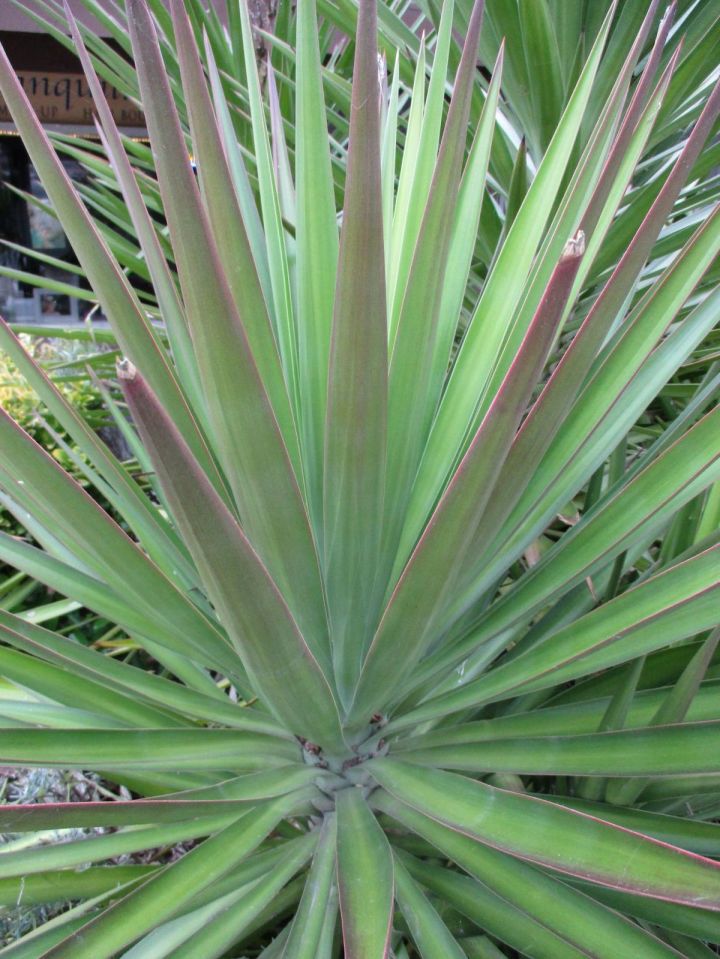 From a simple picture, Spanish bayonet, Yucca aloifolia, is indistinguishable from the common giant yucca. The narrow leaves are about two feet long, and flare upward and outward from terminal buds. Plump conical trusses of waxy white flowers with purplish highlights stand vertically just above the foliage. The main difference is that the leaves are more rigid than they appear to be, with nastily sharp terminal spines.
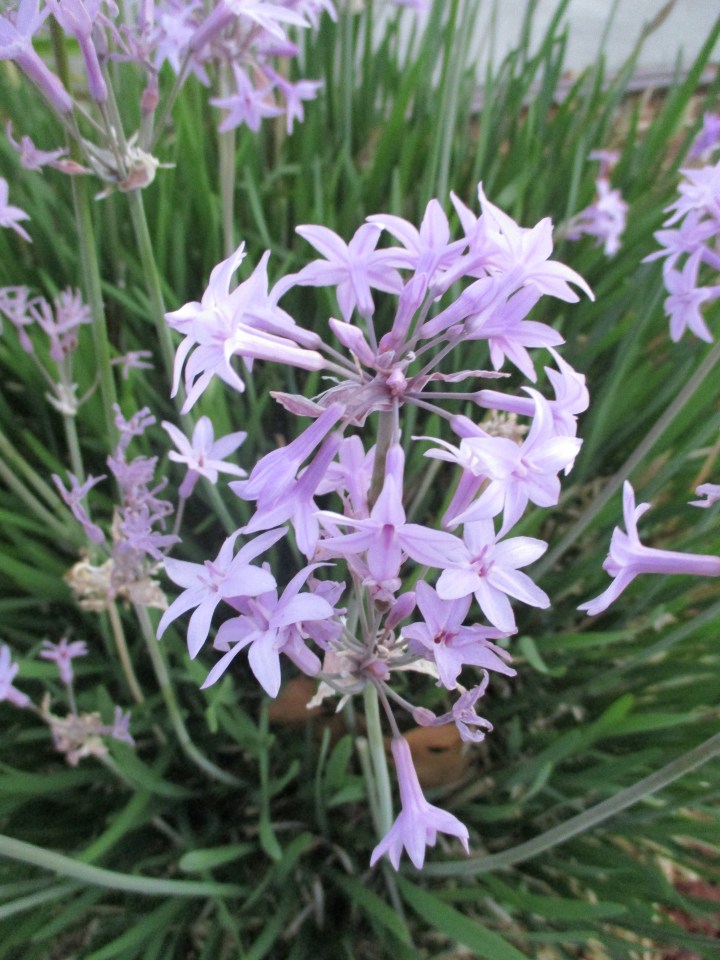 Some flowers are better left in the garden rather than cut and brought in. Society garlic, Tulbaghia violacea, looks like it would be an ideal cut flower, with nice bare stems. The aroma suggests otherwise. It smells something like a strongly aromatic combination of onion and garlic. Even in the garden, it might be a good idea to keep it at a distance. Deer and rabbits do not mess with it.
 Tony Tomeo