Flowering cherries are a complicated group of many distinct hybrids, of several species. Japanese cherry, Prunus serrulata, is the most common ancestor of almost all of them. It is a relatively small deciduous tree that does not get much more than twenty five feet tall. The wild species produces unpalatable fruit, but its many hybrids are generally fruitless.
Most flowering cherries exhibit splendid autumn foliar color, with yellow, orange and red. Weeping cultivars develop strikingly pendulous form. Birch bark cherry exhibits distinctly smooth and chestnut brown bark, with broad lenticels. Weeping cultivars are sometimes grafted onto birch bark cherry trunks. This combines pendulous form with smooth trunks.
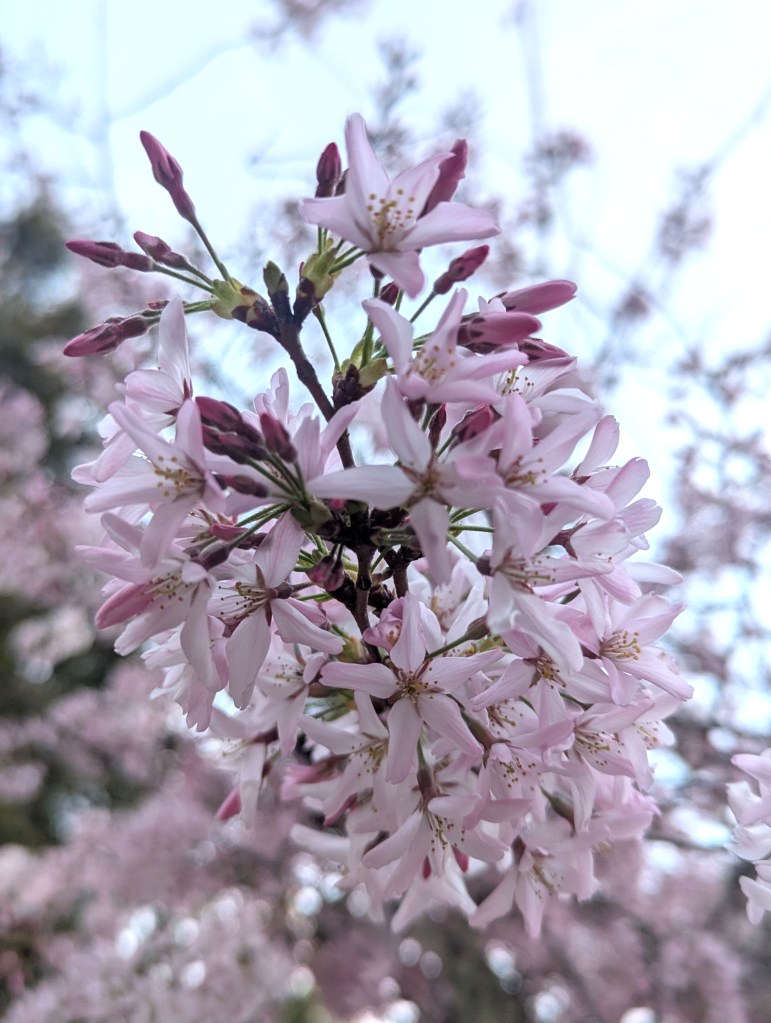
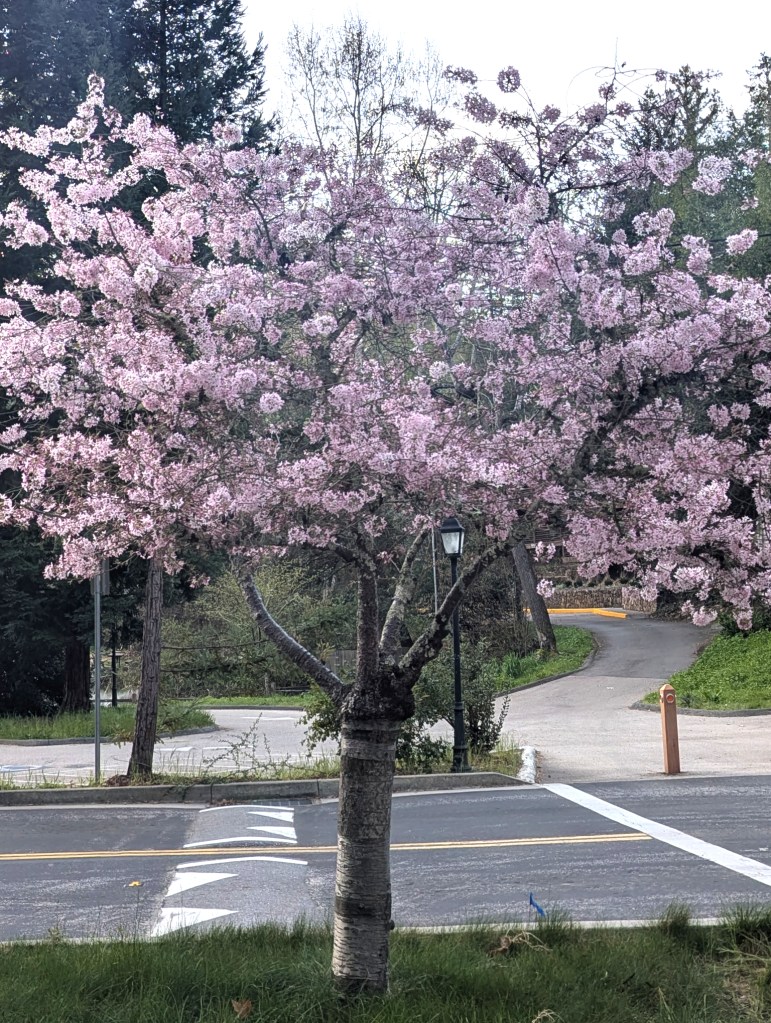
The primary allure of flowering cherries, though, is their profusions of early spring bloom. Floral color ranges from bright white to rosy pink, although most cultivars are pastel pink. Flowers can be delicately single or billowy double. Some cultivars bloom slightly earlier or later than others, but all bloom quite early. Their blooming stems are pretty cut flowers.
Fruit trees such as apricot, cherry, peach and plum, bloom about now. Some are already finished, while a few are just beginning. Apple and pear trees will bloom somewhat later. More colorfully, flowering or fruitless counterparts of such trees are on similar schedules. Flowering apricot has already finished bloom. Flowering crabapple will likely bloom last.
The difference between fruit trees and their flowering counterparts is not their bloom. It is their fruit or lack thereof. “Flowering” has become a euphemism for “fruitless”. Trees with such designation produce either no fruit or fruit of relatively inferior quality. Wildlife might enjoy some of any inferior fruit. Although, even inferior crabapples might make good jelly.
Purple leaf plums are probably the most popular of this type of flowering or fruitless tree. Flowering cherry is less common. Flowering peach is somewhat rare. Fruitless pear is a popular street tree, but may not bloom as profusely as the others. Also, it does not bloom quite as early. Flowering quince grows as shrubbery rather than trees with upright trunks.
While very closely related, fruiting trees and their fruitless counterparts are very different. Fruiting trees should obviously produce fruit. That is their primary purpose. Their fruitless counterparts are merely ornamental. The truly fruitless types grow and bloom where fruit would be a messy nuisance. For example, some perform well as small scale street trees.
Because they are fruitless, such trees do not require specialized dormant pruning. There is no need to prune to concentrate resources into developing fruit. Nor is there any need to prune to accommodate the weight of fruit. Fruitless trees can assume their natural form and scale instead. Although none are large trees, they can grow taller than fruiting trees.
Also because they are fruitless, their bloom is their priority. They bloom more abundantly than fruiting trees, and some bloom with double flowers. Floral color is more diverse too, ranging from bright white to rich rosy pink. Some flowering crabapple trees bloom nearly red. Since dormant pruning is unnecessary, blooming stems are splendid as cut flowers.
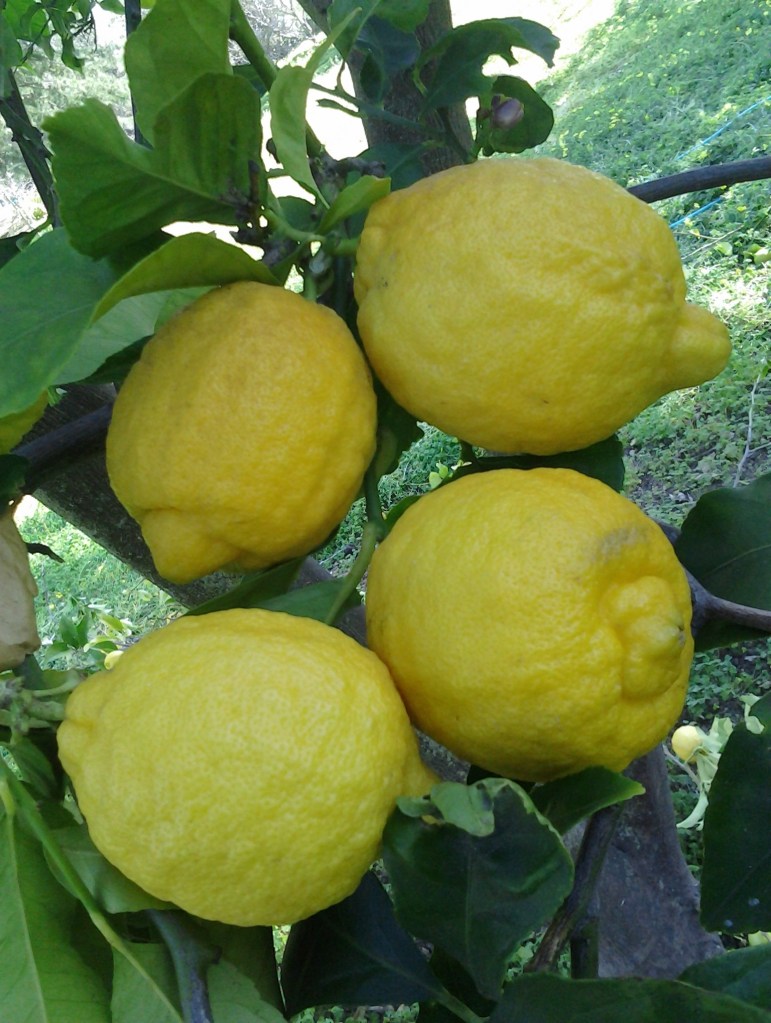
Planting and pruning of deciduous fruit trees are priorities for winter. Evergreen fruit trees are not as much of a concern. For them, planting and pruning should happen after winter. However, most citrus trees are most productive with their summerish fruit through winter. Oranges, lemons, limes, Mandarin oranges, grapefruit and more are ripening about now.
With the exception of Mandarin oranges, most citrus fruits are impressively durable. Most can last for months on their trees, which is likely why they seem so summerish. Mandarin oranges have loose skin, which causes them to oxidize faster than the others. ‘Valencia’ oranges, though, can linger for a year after ripening. They actually sweeten as they age.
Also, some cultivars of citrus extend their production with sporadic fruiting. While ‘Lisbon’ lemon fruits only for winter, ‘Eureka’ lemon fruits more sporadically. ‘Eureka’ is actually a cultivar or cultivated variety of ‘Lisbon’. Although a bit less productive in season, ‘Eureka’ produces several fruits out of season. It rarely disappoints by failing to provide a few fruit.
Oranges and lemons are the most familiar of citrus. They are surprisingly diverse though. ‘Meyer’ lemon is almost as acidic as other lemons, but with a richer flavor like an orange. Most oranges are dessert oranges for eating out of hand, but ‘Valencia’ is for juice. Blood oranges are for juicing, but ‘Moro’ is a dessert orange. Sour oranges are for marmalades.
Mandarin oranges that developed in the Americas formerly classified as tangerines. Now they seem to qualify as Mandarin oranges, like more traditional Mandarin oranges. They collectively might be the most diverse class of popular citrus. More cultivars of Mandarin orange are available than the others. ‘Rangpur’ lime is actually a sour Mandarin orange.
There is so much variety among citrus. Besides oranges, lemons and Mandarin oranges, there are too many to list. Grapefruit, limes kumquats, pomelos, calamondins and citrons are a few examples. Limequats are hybrids of limes and kumquats. Tangelos are hybrids of grapefruit and Mandarin oranges. Orangequats are hybrids of oranges and kumquats.
Cut Christmas trees are the epitome of cut foliage. They grow on farms until harvest, like most other cut foliage. They then beautify homes and other interior spaces for Christmas. Ultimately, they become compost or green waste. Live Christmas trees are very different. They also grow on farms, and beautify interior spaces, but are living, evergreen conifers.
They are supposed to be the more sustainable option. Ideally, some live Christmas trees function as such for multiple years. A few are actually appropriate to home gardens when they grow too big to bring in. Realistically though, most live Christmas trees grow too fast and too large. Some actually become more of an environmental detriment than an asset.
Furthermore, live Christmas trees are actually less sustainable than cut Christmas trees. Cut Christmas trees grow on plantations where they need merely irrigation and fertilizer. Live Christmas trees require plastic pots, synthetic growing medium and more fertilizers. They only become sustainable after several years of reliable service as Christmas trees.
Among live Christmas trees, the more expensive sorts are typically the most sustainable. Various spruces grow slowly enough to remain potted and symmetrical for several years. They are more expensive because they take so long to grow to marketable size. As they outgrow their pots, most are proportionate to home gardens. Few grow as big shrubbery.
A few compact cultivars of fir and even pine are about as sustainable as spruces. Lemon cypress, Eastern red cedar and arborvitae are more conducive to shearing. Even as they grow faster, they can remain confined to pots for quite a few years. Afterwards, they might fit well into a garden. If not, they can be given to neighbors who can accommodate them.
Cheap, overly common and pre-decorated live Christmas trees are the least sustainable. Almost all are Italian stone pine or Canary Island pine. A few might be Aleppo pine. They may be pretty while new, but do not perform well for long as potted plants. However, they grow much too large for compact home gardens. Their long term options are very limited. Big trees require big landscapes.
Although it classifies as a tree, mugo pine, Pinus mugo, is more like shrubbery. Old trees may be only a few feet tall, and maybe twice as wide. Not many are more than eight feet tall. Their form is densely rounded. Foliage is deep forest green. Stiff paired needles are only about one to two inches long. Plump cones are not much longer, and are quite rare.
Mugo pine, although native to the Alps, is a traditional feature of Japanese gardens. Yet, it is rare within other types of gardens. It does not grow fast or big enough to be practical for much more than aesthetic appeal. It does excel at that, though, by developing such a distinctly rounded form. It can work well as foundation planting or a short informal hedge.
Mugo pine is not particularly discriminating about local soils or climates. It merely craves sunny and warm exposure. Mature specimens do not need much water, but are healthier with occasional irrigation. Mugo pine appreciates room for unrestricted growth. Shearing deprives it of its natural form and texture. If necessary, selective pruning may be tedious.
Norfolk Island pine seems to have been built rather than grown.
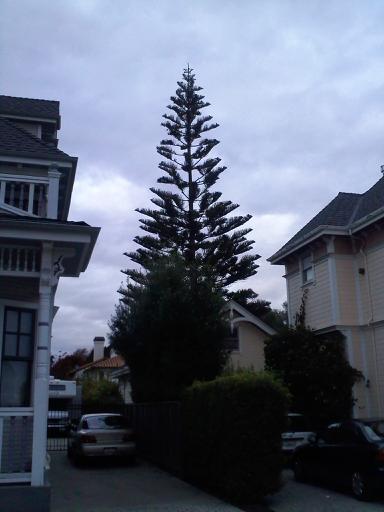
In coastal areas of Southern California, the Norfolk Island pines, Araucaria heterophylla, are among the most distinctive large trees. Perhaps they are better described as ‘unusual’ . . . , or even ‘strange’. They are so symmetrical that they seem to have been assembled from prefabricated kits than to have grown as natural trees. Their strictly organized conical branch structures and remarkably straight central trunks are always visible through their uniformly open canopies. In such mild climates, they can get nearly a hundred feet tall and half as wide, so are not easy to hide. In Hawaii, their symmetry has actually made them popular as Christmas trees. Their finely textured juvenile foliage is comprised of narrow, half inch long pine-needle like leaves, which are wider among adult growth.
Locally though, Norfolk Island pines are primarily enjoyed as houseplants, particularly since they can grow slowly and live in pots for many years. The climate is just a bit too cool in winter for them to be very happy in the garden. However, as they eventually get too large for their homes, many end up in the garden anyway. They stay much smaller and are not nearly as symmetrical as they are in milder climates, and may be damaged by the more severe frosts every few years, but they have a certain appeal and distinction regardless. Those that get planted in the garden while young seem to be more symmetrical than those that get disfigured by living as houseplants longer. For some reason, trees that develop weak or curved trunks as houseplants tend to continue to grow with interestingly irregular trunks and branch structure.
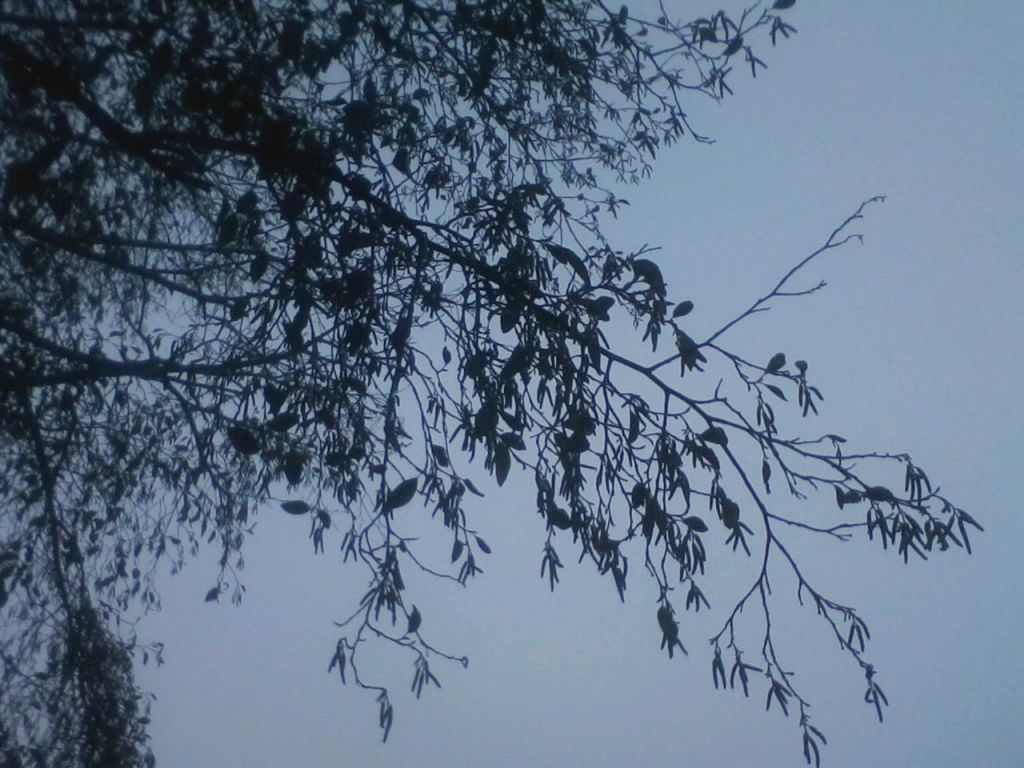
During the summer, the native white alder, Alnus rhombifolia, is a nice shade tree that looks bigger than it really is. By late winter, the bare deciduous canopy has an appealingly picturesque silhouette. This time of year is actually when white alder is typically less appealing, with dead foliage that provides no interesting fall color, but lingers until knocked down by rain or late frost. Yet, even now, it sometimes surprises with these funny looking floral structures that are interesting both in the early winter landscape, and with cut flowers.
In past decades, white alder was an ´expendable’ tree that was put into landscapes for quick gratification while slower but more desirable trees matured. By the time the desirable trees matured, the alders were removed to make more space for the desirables. This technique was practical because, like many fast growing trees, alders do not live very long, so start to deteriorate after about twenty five years anyway. However, alders often live longer than expected.
Mature alders are usually less than fifty feet tall where they are well exposed. They can get at least twice as tall where shaded by other trees or big buildings. Their plump trunks with mostly smooth silvery gray bark make them seem larger than they really are though. Too much water promotes buttressed roots which can displace pavement.
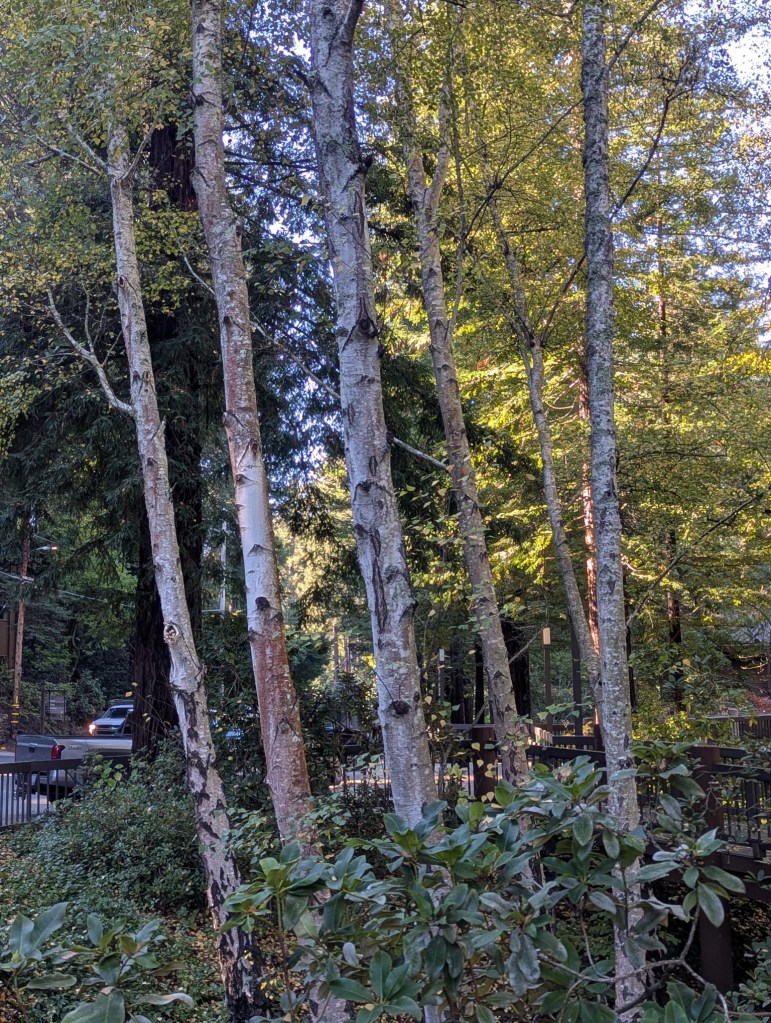
European white birch, Betula pendula, is a team player. It usually inhabits landscapes in groups rather than singly. Some trees have two, three or more trunks. After all, its primary allure is its strikingly white trunks. Because its foliar canopies are not overly broad, a few can fit into limited space. It is an informal and relaxed tree with nicely pendulous growth.
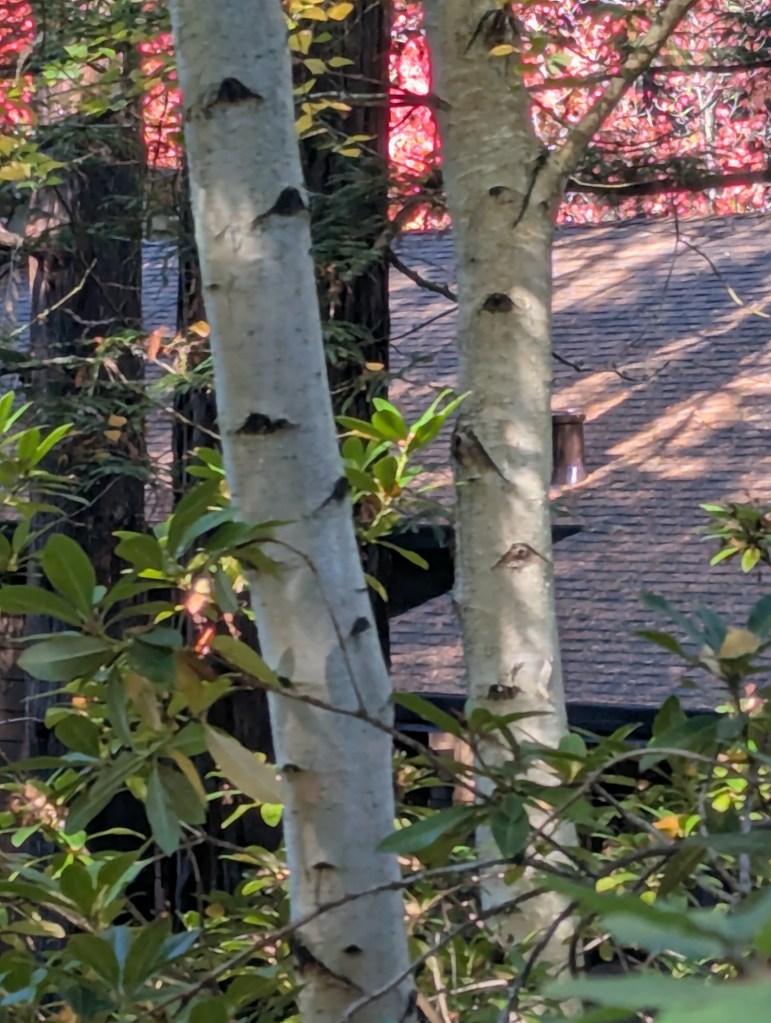
Mature European white birches are not much more than fifty feet tall here. They can grow taller where winters are cooler. Their slender trunks are mostly less than a foot and a half wide. They generally lean with prevailing winds and away from shade. Their smooth and white bark develops rough and black furrows with age. Their little leaves are deciduous.
European white birch appreciates regular irrigation, so should perform well within lawns. It produces only moderate shade. ‘Laciniata’ has intricately lobed foliage and a narrower form. ‘Youngii’ is so pendulous that it needs staking to stand upright. It can not grow very tall. ‘Purpurea’ has bronzed foliage and somewhat tan trunks, but has become very rare. European white birch might self sow.
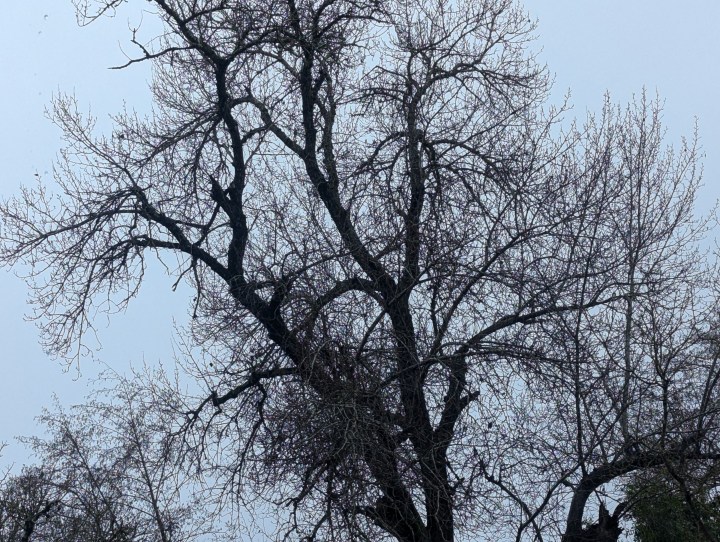
Autumn foliar color does not seem to last long enough. As it dissipates, though, it reveals silhouettes of bare deciduous trees. Some are delightfully sculptural, with strikingly pale bark on their trunks and stems. Others develop distinctively reddish twigs. Some display interesting bark textures or patterns. Color, texture and patterns are remarkably variable.
Of course, for most species, bark does not change much throughout the year. It becomes more prominent now merely because defoliation increases its exposure. In fact, some of the most distinctive bark belongs to evergreen species. Some belongs to flowering trees, fruiting trees or arboriform shrubbery. The sources are as variable as the characteristics.
European white birch is likely the most familiar tree with white bark. Jacquemontii birch is even whiter. California sycamore is a massive tree with mottled light gray and tan bark. Crape myrtle, which is more proportionate to home gardens, is more mottled. Some elms exhibit elegant tan trunks and limbs. European beech trunks develop metallic gray color.
Melaleucas are evergreen trees with distinctively shaggy trunks. Eucalyptus are likewise evergreen, but generally with pale and smooth trunks. Lemon gum is particularly tall and elegant. However, red ironbark eucalyptus has dark and notably rough trunks and limbs. ‘Marina’ madrone develops smooth trunks and limbs with brown and cinnamon red color.
Coral bark Japanese maple and osier dogwood display colorful bark differently. Theirs is on small twigs rather than trunks and main limbs. Color actually develops in response to autumn chill and defoliation. Coral bark Japanese maple develops, pinkish orange color. Osier dogwood is more brownish red, although some cultivars are orangish or yellowish.
Trees that exhibit distinctive bark are subject to the same constraints as all other trees. In other words, they must be appropriate to their particular landscapes. California sycamore for example, is much too large for compact urban gardens. Osier dogwood can grow as a thicket without intensive maintenance. Any new tree or shrubbery should be sustainable.
Pasadena sustained the worst of the damage caused by the strongest Santa Ana Winds in three decades. Huge piles of debris from broken trees are much more than can be removed any time soon. Falling debris and trees damaged many roofs, cars and anything else that happened to get in the way.
Other towns and neighborhoods throughout the area, particularly those at the base of mountains, also sustained major damage. At the same time, severe winds ravaged the San Francisco and Monterey Bay Areas as well, particularly in the Santa Cruz Mountains and the hills of the East Bay.
Some of the damage caused by wind in urban areas might have been less disastrous if trees had gotten the respect and attention that they deserve. Some trees develop structural deficiencies that need to be corrected by pruning, either to eliminate the problems, or at least to decrease the strain exerted onto the structurally deficient parts. A few trees that become unstable as they mature may likewise need to be pruned or even removed.
It is not always possible to prune trees to remove all structural deficiencies without damaging the affected trees more, or causing more structural problems to develop. For example, major pruning to remove all parts that may get blown down by wind, such as pollarding or ‘topping’, may seem to be effective for the short term, but actually stimulates the development of vigorous secondary growth or watersprouts that are disproportionately heavy and even more likely to tear off from the older limbs.
Structural pruning more often involves thorough reduction of weight and wind resistance. Weight of foliage and stems directly applies leverage against unions where smaller stems are attached to the larger stems from which they originate. Wind resistance adds more leverage as foliage gets blown about by wind. Thinning obviously removes significant weight, and also decreases wind resistance to allow wind to blow though the affected canopies.
Besides helping to compensate for structural deficiency, structural pruning is also beneficial to potentially unstable trees for the same reasons. However, unstable trees typically need even more reduction of weight and wind resistance. Some of the most unstable trees and those that are deteriorating need to be removed because their instability cannot be accommodated.
During winter, while deciduous trees are bare, evergreen trees are more susceptible to wind damage, obviously because they retain their weight and wind resistance through winter while the weather is the most severe. Unstable trees become even more destabilized as rain softens the soil. Regardless of the potential for susceptibility to wind damage, this would be a good time of year to get any needed tree maintenance done, prior to any more windy and rainy winter weather.
Arborists certified by the International Society of Arboriculture are the most qualified to identify potential structural problems or instability, and to prescribe corrective procedures. A list of certified arborists can be found at the website of the International Society of Arboriculture at http://www.isaarbor.com.


 Tony Tomeo