Palms Are Very Distinctive Among Trees

Palms provide distinctively lush foliar texture.

Palms seem to exemplify the culture of California. However, only the California fan palm, which is also the desert fan palm, is native. All others are exotic. With its dwarf palmetto, Oklahoma has as many native palms as California. Furthermore, the California fan palm is only endemic within remote riparian ecosystems of the Colorado and Mojave Deserts.

Common date palms were likely the first of the many exotic palms in California. Spanish Missionaries imported them for date production during the Eighteenth Century. Although initially utilitarian rather than decorative, recycled trees from displaced orchards became popular for larger landscapes. Potentially messy fruit is minimal without male pollinators. 

Long before urbanization displaced date orchards, many other palms came to California merely because of their visual appeal. Some are large enough to be shade trees. Others can provide shade in groups. Many develop elegant trunks or sculptural form. Some stay relatively low or shrubby. All innately provide famously and luxuriantly evergreen foliage.  

Palms are most certainly appealing within appropriate situations. They are very different from other trees though. Like arborescent yuccas and cordylines, palms are ‘herbaceous trees’. Unlike yuccas and cordylines, and with very few exceptions, palms do not branch. Nor do their trunks continue to expand in width as they continue to grow in height above.  

Palms consequently spend their first few years widening their bases at ground level. Big palms, such as Canary Island date palm, likely require many years. Once their bases are adequate, developing palms ‘launch’ into vertical growth. Although palms do not branch, a few, such as Mediterranean fan palm, develop multiple trunks from their primary bases. 

Once palms launch, they grow only upward. They lean only to avoid shade, or if pushed by wind. It is impossible to direct their bulky but singular terminal buds around obstacles, such as utility cables. It is also impossible to contain their shade as they get high enough to shade adjacent areas instead. Many palms are spiny, so are difficult to prune properly, even while young and within reach.
The Stakes Could Be High

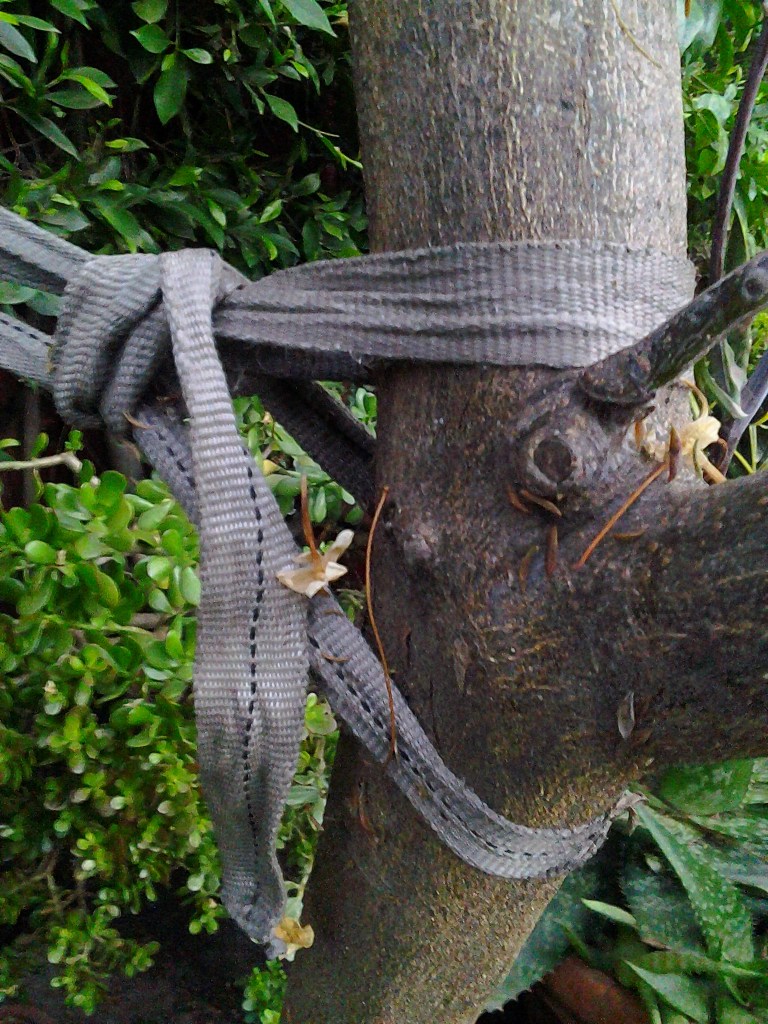
Some unfortunate trees become so reliant on staking and straps that they are never able to support their own weight.

The irony of landscaping and gardening to bring nature closer to the home is that it is so very unnatural. Plant specie are imported from all over the world, grown in synthetic environments, and then expected to perform in unfamiliar climates and soils far from home. Most plants have been bred for optimal retail appeal at the expense of their natural adaptations.

Trees grown in nurseries need to be staked tightly to develop the sort of straight trunks that branch at just the right height to be marketable. In the landscape, trees need to be staked because they have become so dependent on the stakes that they grew up with. Eventually though, trees need to learn how to carry their own weight.

When new trees get planted and staked loosely with heftier stakes that stand up to wind, old tightly bound nursery stakes should be removed since the tight binding interferes with trunk development. By the time trees gets planted, the nursery stakes are probably nearly rotten through at the ground anyway. The new heftier stakes should not hold trees tightly in place, but simply be there to keep them from getting blown over.

Straps should likewise not be tightly bound, but instead allow for a bit of motion with the breeze. Straps should cross over in a ‘figure eight’ pattern between trees and their stakes, so that trunks do not rub so abrasively against the stakes. Most trees need only two straps each, or two pairs of straps if two stakes are used, with support up high, and lower support to prevent outward bowing. If there are no branches to hold straps in place, straps must be nailed or otherwise attached to the stakes.

Some sturdy trees, like well developed redwood trees and small magnolias, may not need stakes. Palms and yucca certainly do not. However, limber trees like the various eucalyptus may need more support than just two straps. The problem is that many trees become dependent on their stakes and will not develop strong trunks if they do not need to.

It is better to prune maturing staked trees to limit weight and wind resistance (that might cause them to blow over) than to provide more support with heftier stakes. If a maturing young tree is relying on stakes and straps for support, it needs to be pruned. A young unstaked tree that begins to lean from the weight of its canopy should likewise be pruned until it regains its posture without getting staked and bound. Trees should never be tied to other trees, buildings or anything else that can be damaged by the tension.

American Dogwood

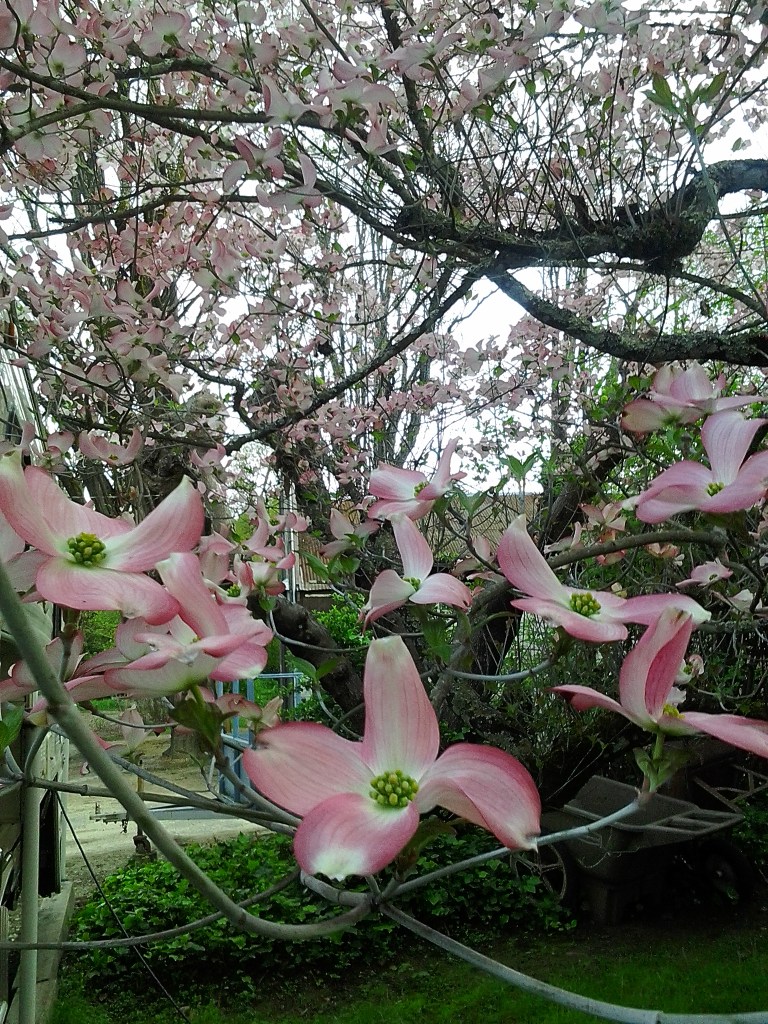
Before foliage develops, this American dogwood is a cloud of profuse pink bloom in a partly shaded and sheltered garden.

The state tree of Missouri produces the state flower of North Carolina, which are both the state tree and state flower of Virginia, but no so exploited by the state that it seems to be named for! The American dogwood, Cornus florida, is such a classic American tree that last year, young trees were given to Japan to commemorate the gift of Japanese flowering cherry trees from Japan a century earlier.

Profuse early spring bloom is not what it seems to be. Tight clusters of minute flowers would not be much to look at, but are surrounded by four big white bracts (modified leaves) that really put on an impressive show before green leaves develop. Many modern varieties have pink or nearly brick red bracts, and a few get variegated foliage as bloom dissipates. Foliage can get quite colorful just before it falls in autumn.

In the wild, American dogwoods are ‘understory’ trees that are happiest in forests of larger trees that shelter them from harsh sun exposure and drying wind. In relatively arid western climates, they want rich soil, regular watering and partial shade at least after noon. They are sensitive to reflected glare and wind, as well as alkalinity and salinity. (Too much fertilizer will roast the foliage.) Since American dogwood trees rarely get more than fifteen feet tall in cultivation, they are proportionate to sheltered atriums. Wild trees do not get much taller than thirty feet.

Queen Palm

The elegant queen palm has a slender trunk and a billowy canopy. Grouped trees lean gracefully away from each other.

While Mexican fan palms and Canary Island date palms dominated the palm fad in California during the Victorian period, the queen palm, Syagrus romanzoffiana, was still relatively uncommon. Since then, selective breeding has improved their foliar color and density. They are now the most popular of palms.

Modern queen palms grow a bit faster than their Victorian ancestors to about thirty feet tall, and then grow somewhat slower for another ten to even twenty feet. Their long and arching feather (pinnately compound) leaves are quite billowy. The elegant trunks are generally slender, but often develop constrictions or bulges from fluctuations of irrigation or nutrient availability. The abundant fruit can be messy.

Palms Need Proper Planning Too

Every species of palm has a distinct personality. All have attributes; but many also have the potential for considerable problems.

California has no more native palms than Oklahoma has with the diminutive dwarf palmetto. The stately California fan palm, which is also known as the desert fan palm, inhabits warm desert regions in southern California. It is what put the ‘Palm’ in ‘Palm Springs’. However, because it likes heat and minimal humidity, it is not so happy away from deserts. The very tall and lean Mexican fan palm is closely related to the comparably stout California fan palm, but is so happy in local climates that it naturalizes and can be invasive.

The queen palm has a leaner trunk, and a broader and more billowy canopy. It rarely self sows, but is so overly popular that it very often gets planted in bad situation where it does not have room to grow. Unlike fan palms that have rounded palmate leaves that radiate outward from the ends of bare petioles (leaf stalks), the queen palm is a ‘feather’ palm, with pinnately compound leaves comprised of narrow leaflets arranged along stiff midribs.

The massive Canary Island date palm is another feather palm, with a broad canopy and bulky trunk. Like Mexican fan palm, it often self sows, so gets into some weird situations. The foliage is so thick that is commonly becomes infested with rats and pigeons. Female trees produce messy fruit that keeps rats and pigeons well fed.

Whether they get planted intentionally or simply appear in the landscape, the main problem with all these and other large palms, is the expense of maintenance, since they can only be maintained by professional arborists who know how to climb such large branchless trees. Without regular grooming, fan palms that are so often allowed to retain long beards of old leaves become fire hazards, and have the potential to drop dangerously heavy sections of their beards without warning. Removal of old deteriorating leaves from the huge canopies of Canary Island date palms is quite an chore!

There are few small palms, like windmill palm and Mediterranean fan palm, that are more proportionate to compact gardens. Windmill palm has a strikingly shaggy trunk and a compact canopy that is easy to groom before it grows beyond reach. Mediterranean fan palm has multiple trunks that grow so slowly that it takes many decades for them to grow beyond reach. Nasty sharp thorns on their petioles make pruning difficult but not impossible.

Selection of a palm that is appropriate to a particular situation is just as important to limiting serious long term problems as the selection of any other tree is.

Blue Gum

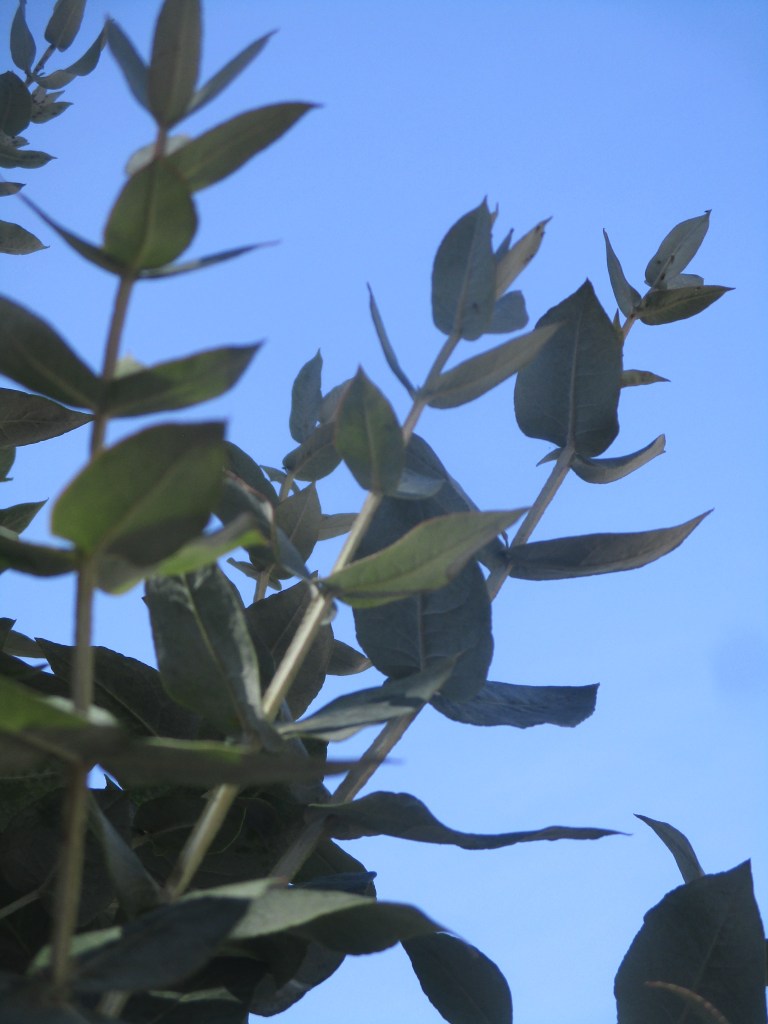
Juvenile blue gum foliage is very aromatic.

This is the primary eucalyptus that earned a bad reputation for all other eucalyptus. Blue gum, Eucalyptus globulus, arrived in California in the 1850s, and grew on plantations for timber. As its timber proved to be of inferior quality, and demand for wood pulp dwindled, the plantations succumbed to abandonment. Feral trees naturalized into adjacent areas.

Although once a common timber and wood pulp commodity, and effective as windbreaks for agricultural purposes, blue gum was never popular for landscapes. Those that inhabit urban or suburban situations were generally there prior to urban expansion around them. They are far too massive, messy and combustible, and inhibit the growth of other plants.

Mature blue gum trees can be significantly taller than a hundred feet, with elegantly high branched form. Limbs that fall freely from such heights are very dangerous. The aromatic foliage is evergreen. Adult leaves are stereotypically lanceolate and curved. Silvery blue juvenile leaves are blunt, sessile (lacking petioles) and more aromatic than adult foliage. Strips of smooth tan bark shed to reveal paler bark.

UTILITY CABLES NEED SPACE

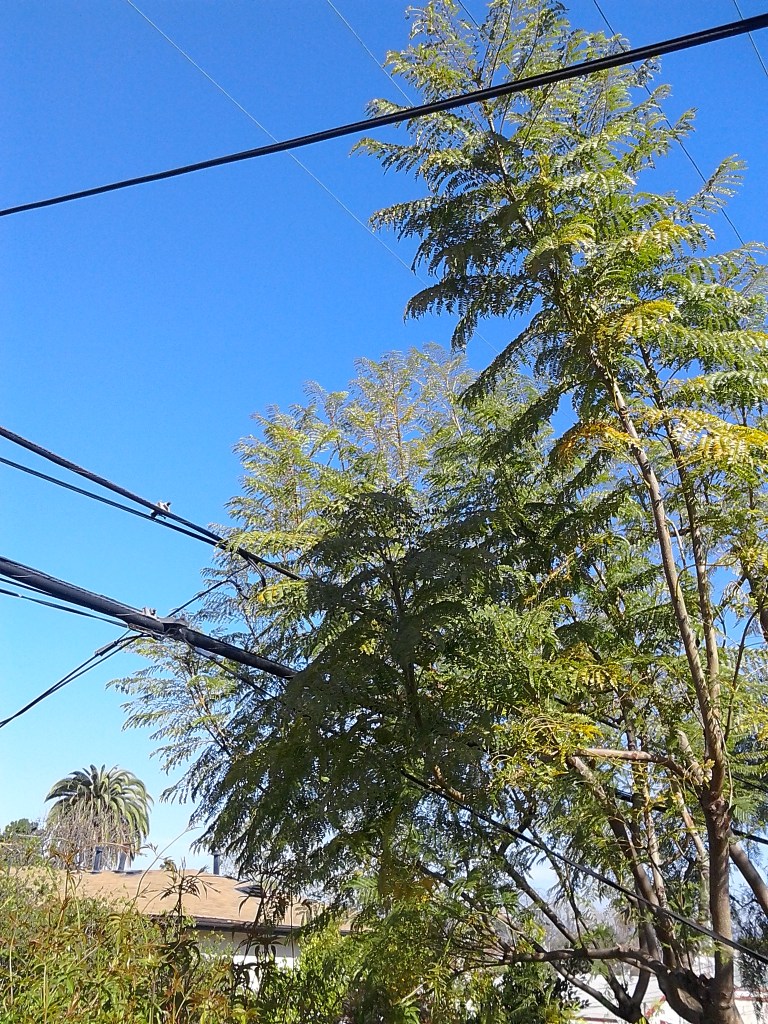
With all the cables coming and going, this unfortunate tree does not have much room to grow without causing trouble.

Since I did not make the drive up or down the coast very often, the rare silvery-gray Bismarck palm that I could see slowly climbing into the skyline near the edge of Highway 101 through Santa Barbara seemed to be slightly taller every time I saw it. It grew slowly, but enough to notice since I only saw it less than annually. Then, when I drove by about a month ago, it was gone.

This exemplary specimen had been quite healthy and happy (even though Bismarck palms are not supposed to be happy on the coast). There was only one problem. It was under high voltage utility cables. As it grew, it got too close to the cables, so needed to be removed in order to maintain the minimal clearance required for high voltage.

Unlike other trees, palms have only single terminal buds that grow upward. They can not develop branches to grow around cables, so only die if the single bud needs to be pruned away. Complete removal is therefore the only option when palms begin to grow into high voltage cables.

Sadly, palms often get planted under utility cables. Many Mexican fan palms grow under cables because birds that eat their fruit drop the seed there. Queen palms are popularly planted around the perimeters of back yards, and along the back fence lines that are very often directly below and parallel to high voltage cables.

Trees that are not palms can get disfigured by pruning for clearance around high voltage cables, but generally survive. Trees with central leaders (single trunks) and strict form, such as spruces and redwoods, can get be so disfigured that removal may be more practical than pruning. Trees with more irregular form, like sycamores and elms, are somewhat easier to salvage. Unfortunately, crews hired to maintain clearance are unable to prioritize the health and structure of trees that get too close to high voltage cables.

Lower cables for telephone, television and house-drops (lower voltage cables that extend from utility poles to homes and other buildings) do not often justify pruning for clearance like upper high voltage cables do. However, these lower priority cables can still be damaged if too many limbs sag onto them or become abrasive as they blow in the wind. Really, it is best to avoid problems with utility cables by selecting and planting trees that are not likely to become too obtrusive. Palms, large trees and trees that are likely to be severely disfigured by pruning to maintain clearance should be kept at safe distances.

Olive

Olive trees are compact but gnarly.

For millennia, olive, Olea europaea, dutifully produced oil and edible fruit for civilizations of the Mediterranean region. During the last several centuries, it migrated to do the same in other regions of similar climate throughout the World. At least two centuries ago, it got to California, and became a major agricultural commodity. Now, it lives in home gardens. 

The abundant and oily fruit that justified cultivation of olive trees for thousands of years is ironically a potential nuisance for home gardens. Few people harvest and process them. Olive fruit can stain pavement and attract rodents. Fruitless or mostly fruitless cultivars of olive, and dwarf cultivars, have been increasingly popular for only the past few decades.

Olive trees are not big, but slowly develop grandly sculptural trunks. Some might be little more than twenty feet tall when mature. Few get more than forty feet tall. Most have a few leaning trunks, which become furrowed and distended with age. The narrow and grayish evergreen leaves are about two or three inches long. Olive fruits are about an inch wide.

Red Ironbark Eucalyptus

The pendulous foliage of red ironbark eucalyptus moves softly in the breeze. The tall, curvy trunks are elegant and sculptural.

The many varied eucalypti never seem to outgrow the bad reputation of the blue gum and red gum eucalypti that get too big, messy and dangerous for urban gardens. Fortunately though, most others do not get nearly as large, and many stay proportionate to urban gardens. Their smaller canopies are neither as messy, nor as structurally unsound. Their adaptability to so many California climates and tolerance of aridity are serious advantages.

Red ironbark eucalyptus, Eucalyptus sideroxylon, is one of the mid-sized eucalypti that can eventually get quite tall, so is probably best where it has room to grow. Pruning for containment in compact gardens is actually quite a bit of work. Their coffee colored and deeply furrowed bark on elegantly sculptural trunks and limbs contrast nicely behind the mint frosting colored and softly pendulous foliage. The lanceolate leaves are about five inches long and three quarters of an inch wide. Flowers are almost always pinkish red, but can be pink or white.

Only Arborists Specialize In Trees.

Big trees need real arborists. Even the best of gardeners should not be expected to perform major specialized arboricultural techniqes.

Just as most problems in landscapes are caused by maintenance gardeners hired to maintain the landscapes, many of the problems with trees are caused by those hired to fix such problems. Arboriculture, which is the horticulture of trees, really should be performed, or at least directed, by professional arborists. It is too specialized to expect it to be done properly by those lacking education and experience.

Even the few proficient gardeners who can perform most aspects of gardening well are not likely as proficient with proper arboriculture as arborists are, not only because it is so different from other gardening, but also because of the techniques and tools involved. Gardeners compare to arborists something like those who clean windows on skyscrapers. Custodians who clean windows on the highest floors from the inside probably would not want to clean the same windows from the outside like window washers do. There are just too many differences in the two related but vastly different types of work.

Arborists who are certified by the International Society of Arboriculture, or ISA certified arborists, are the most qualified to assess the health, stability and structural integrity of trees, and to then prescribe any necessary arboricultural procedures. These arborists have passed an examination of their arboricultural expertise, and maintain their certification by continued involvement with ISA educational seminars, workshops and classes.

Arborists and the tree service businesses that they are affiliated with are easy to find at the website of the ISA at www.isaarbor.com. They can be found directly by name, or regionally by city or ZIP code. The website is also an excellent resource for those wanting to learn more about trees and the importance of proper arboriculture.

Trees are the most substantial features of landscapes, and are really worthy of more respect than they commonly get. Structural problems or instability can be serious problems, not only to the affected trees, but also to anything around them that might be damaged or destroyed by falling limbs or even entire trees. Proper arboriculture helps to keep trees healthy and reasonably safe for many decades or centuries.