The strikingly glaucous juvenile foliage of silver mountain gum, Eucalyptus pulverulenta, is likely more familiar within floral design than in home gardens. Actually, it is uncommon within home gardens, although quite popular as cut foliage among florists. Its paired and sessile leaves are oval or bluntly cordate (‘heart shaped’), and about an inch or two long.
Adult growth is rare, even among established trees. However, small white flowers bloom from the axils of juvenile leaves that are a year old. (Juvenile growth of most species can not bloom.) Bloom might continue from spring until autumn, as blooming stems sag from the weight of younger distal growth. The aromatic and evergreen leaves stiffen with age.
Low and shrubby specimens with a few trunks may not get much higher than fifteen feet. They have potential to get twice as tall though, particularly if pruned up onto bare trunks. Lignotubers expand below the trunks. Strips of old bark shed to reveal fresh matte brown bark. Incidentally, the Latin name of this species often transposes for Eucalyptus cinerea.
Foliage is often employed to obscure views. Evergreen shrubbery or trees can provide privacy in the garden or for windows. It can just as easily hide unappealing buildings in the distance, or driveways where cars get parked. Unfortunately, too much foliage often obscures desirable views or interferes with lighting.
There are all sorts of reasons to control greenery that might otherwise get overgrown. Overgrown shrubbery and trees not only hides the architectural appeal of a home, but can also be a security risk by concealing windows and doors that burglars might break into, and by obscuring security lighting and street lights. Too much shade prevents lower plants from getting the sunlight they need.
The best way to limit overgrowth is by selecting plants that stay proportionate to their intended functions. For example, shrubbery below windows should naturally stay lower than the lower windowsills. Shade trees for areas where views should stay open should have high branch structure and relatively bare trunks. Well, most of know that this does not always happen.
The options are limited for greenery that wants to get larger than it should. Obviously, it can be pruned regularly; but this may be more work than it is worth, and can cause disfigurement Some plants can be pruned less frequently if pruned more severely, but will be bare and potentially unsightly for quite a bit of time. Overgrown plants can alternatively be removed and replaced with plants that are more proportionate to intended functions.
An option that is not often considered is an ‘updo’. Trees and large shrubbery that are obtrusive to views or lighting can be pruned up and over what they are being obtrusive to. For example, lower growth of large pittosporums that is covering low windows can be pruned away to expose bare inner trunks supporting higher growth. The lower trunks can be appealingly sculptural without being too concealing. This works nicely for large shrubbery like viburnum, bottlebrush, oleander, photinia and pineapple guava.
Street trees that interfere with street lights (or marquis on storefronts) may need to be updo pruned a few times for adequate clearance, but these procedures are much less work, are less disfiguring to the affected trees, and produce more appealing results than keeping trees down.
Of the few native species that share the same designation of ‘red willow’, Salix lasiandra, is likely the most common locally. However, it has a few other common names, including shining willow and Pacific willow. For those acquainted with it, recognition is easier than nomenclature. It is not a problem though, since red willow is rarely an intentional choice.
Red willows, including less common species, grow wild in local riparian situations. They sometimes sneak into home gardens, particularly if irrigation is generous. Their rampant growth is susceptible to spontaneous limb failure. Pruning can compensate for structural deficiency of young trees. However, trunks typically succumb to decay within thirty years.
Mature trees are mostly less than thirty feet tall, typically with low branches, and possibly with a few elegant trunks. The gray or light brown bark is finely furrowed. The deciduous foliage has a slight sheen, and then turns brownish yellow prior to autumn defoliation. Its narrow leaves are about three inches long. Twigs are yellowish or green rather than red, as it implies.
Shade has become less of a priority for modern urban gardens than it still is for older and more spacious suburban gardens. Significantly less sunlight reaches the ground of such confined gardens among taller and shadier homes and fences. Even where shade might be desirable, space for shade trees might be minimal. Streets are the primary exception.
Streets, and associated curbs and sidewalks, are generally the sunniest situations within modern urban neighborhoods. They collect and radiate ambient heat that warms nearby homes and gardens, even if the weather is already unpleasantly warm. Cars that park on pavement without shade are vulnerable to the most heat, which accelerates weathering.
It is an unfortunate waste. Sunshine that is useless and undesirable on streets would be useful within gardens. Although sunlight is not transferable from one situation to another, it might be partially abatable with shade. Streets are certainly no place for gardening; but the space above them may have potential to accommodate the canopies of shade trees.
Street trees are simply trees that flank streets and other roadways. Most are shady. A few are merely visually appealing. They may inhabit parkstrips, treewells or gardens that are adjacent to sidewalks. Many municipalities prescribe street trees for most of their streets. Conforming street trees are standard accessories for streets within new residential tracts.
Of course, street trees must be appropriate to their particular applications. They must get tall enough for clearance above the largest of vehicles that use the roadways below. For commercial districts, some must also stay above storefront signs. Contrarily, a few street trees must stay below aerial utilities. Street lamps, high or low, require clearance as well.
Size and form are not the only considerations. Roots of street trees must be complaisant with infrastructure. Mess should be as minimal as practical. The most complaisant street trees might stay too small to attain adequate clearance or provide much shade. The most visually appealing might be too messy. Selection of appropriate street trees necessitates significant research regarding every potential option.
Its plump and inch-long acorns are misleading. Tanoak, Notholithocarpus densiflorus, is not actually an oak. Otherwise, it would be a species of Quercus. Regardless, its wood is potentially as practical for furniture and flooring as wood of other oaks. It also works very well as firewood. Historically, tanoak bark was useful for tanning leather, hence its name.
Although native and somewhat common in some coastal forests, tanoak is almost never a choice for intentional planting. Those that inhabit home gardens likely either grew from acorns, or were there prior to development of the landscapes. Young trees can grow fast to more than forty feet tall, typically with conical form. Mature trees might get twice as tall.
Tall trunks of tanoak are elegantly upright, and eventually develop lofty branch structure. Their gray or brownish bark is handsomely furrowed. The somewhat leathery evergreen foliage produces potentially objectionable tomentum. The dentate leaves are two to four inches long. Sadly, tanoak is very susceptible to Sudden Oak Death Syndrome (SODS).
Such silvery foliage provides a bold display on such a substantial tree. Most comparably silvery foliage is of smaller perennials or shrubbery, such as agaves or artemisias. Agyle apple, Eucalyptus cinerea, grows intimidatingly fast to nearly thirty feet tall and almost as wide. Although shorter than most other eucalypti, it can get a hundred feet tall in the wild.
Paired juvenile leaves of young trees are circular and sessile (clinging directly to stems, without petioles). Unpaired adult leaves are lanceolate and as silvery as juvenile leaves. Coppicing or pollarding force juvenile growth and temporarily eliminate adult growth, but also ruin structural integrity. Trees subsequently rely on repetition of the same technique.
Trunks and limbs can be disproportionately bulky, and create an illusion of a bigger tree. Irregular branch structure can be sculptural. Fibrous brown bark is handsomely furrowed. Juvenile foliage is a popular accessory to cut flowers. Adult foliage is likewise delightful. Incidentally, the Latin name of this species often transposes for Eucalyptus pulverulenta.
Windy weather sometimes breaks limbs from trees, or blows entire trees over. Evergreen trees are innately more susceptible to such damage than deciduous trees are. Wind can blow more easily through deciduous trees while they are bare through winter, when most wind occurs. However, deciduous trees are now more susceptible to sudden limb failure.
Sudden limb failure, or spontaneous limb failure, is a result of gravity rather than of wind. It is actually more likely without wind, during mild or warm weather, particularly with high humidity. It consequently has potential to be more hazardous than limbs that blow down. More people go outside among trees during mild weather, and fewer expect falling limbs.
Sudden limb failure occurs if limbs become unable to support their own increasing foliar weight. Warmth accelerates vascular activity, which sustains foliar growth. High humidity and a lack of wind inhibit evapotranspiration (evaporation from foliage), which otherwise helps to alleviate excessive weight. Developing fruit can also cause sudden limb failure.
In the wild, willows, poplars, sycamores, and perhaps a few other riparian trees regularly and naturally exhibit partial sudden limb failure. Limbs that fracture and sag onto soil, but remain partially attached to their original tree, can generate roots and grow as new trees. Although their strategy is practical for them, it is unacceptable within refined landscapes.
Several native and exotic trees of chaparral climate are quite susceptible to sudden limb failure within or adjacent to irrigated landscapes. Since they are not accustomed to such abundant moisture, they overindulge. Mature wild trees are more likely to exhibit sudden limb failure after an unusually rainy and warm winter, or if rain continued late into spring.
All native oaks, particularly valley oak and coast live oak, are susceptible to sudden limb failure. So are Monterey pine and Monterey cypress. Carob, sweetgum, various elm and various eucalypti are exotic species that are notorious for such behavior. Evergreens are more unpredictable, since their new growth is less obvious among their lingering foliage.
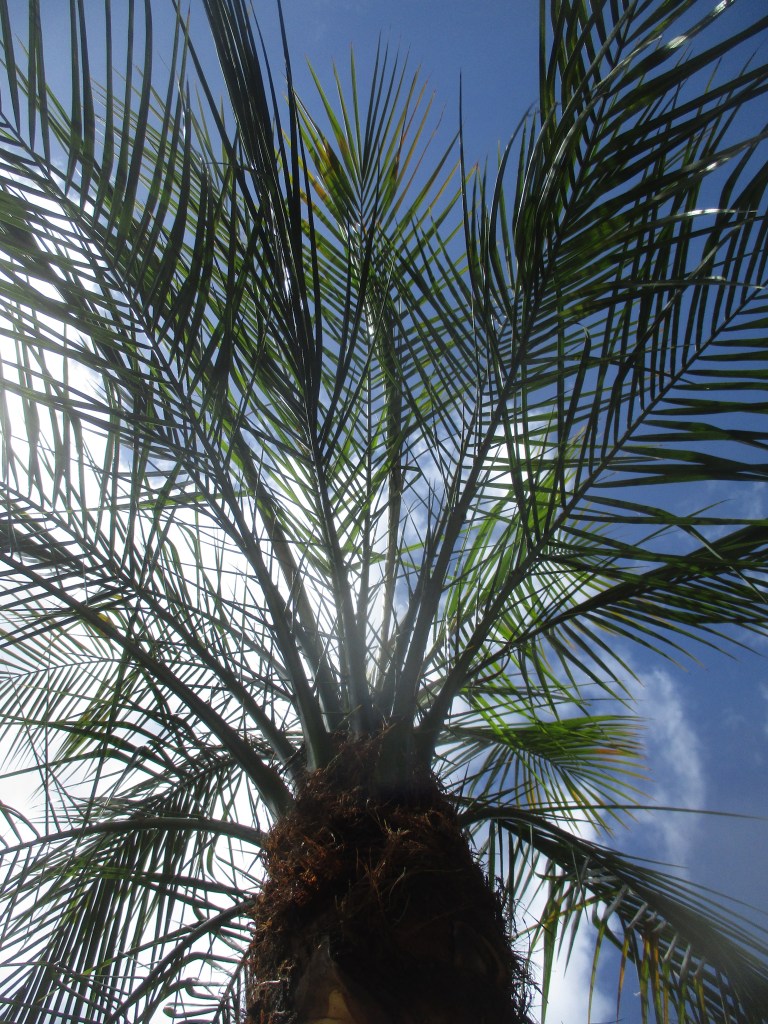
Canary Island date palm is the largest local palm. Pygmy date palm, Phoenix roebelenii, although a species of the same genus, is one of the more diminutive palms. It might take many years to grow ten feet tall, and may never get twice as tall. Its pinnately compound leaves are only about two to four feet long. Thin leaflets are about five to ten inches long.
Such compact stature is a distinct advantage for some situations. With sufficient sunlight, pygmy date palm is a delightful houseplant. It is also appealing within atriums and cozily compact gardens. For those who appreciate the aesthetics but not the large size of most palms, pygmy date palm is a practical option. It actually resembles a common date palm.
Like all date palms, a pygmy date palm surrounds its single terminal bud with nasty long spines, which are specialized proximal leaflets. These spines are painful to interact with while grooming and pruning deteriorated old leaves and floral trusses back to their trunk. Unlike most other palms, mature pygmy date palms are not very conducive to relocation.
Palms seem to exemplify the culture of California. However, only the California fan palm, which is also the desert fan palm, is native. All others are exotic. With its dwarf palmetto, Oklahoma has as many native palms as California. Furthermore, the California fan palm is only endemic within remote riparian ecosystems of the Colorado and Mojave Deserts.
Common date palms were likely the first of the many exotic palms in California. Spanish Missionaries imported them for date production during the Eighteenth Century. Although initially utilitarian rather than decorative, recycled trees from displaced orchards became popular for larger landscapes. Potentially messy fruit is minimal without male pollinators.
Long before urbanization displaced date orchards, many other palms came to California merely because of their visual appeal. Some are large enough to be shade trees. Others can provide shade in groups. Many develop elegant trunks or sculptural form. Some stay relatively low or shrubby. All innately provide famously and luxuriantly evergreen foliage.
Palms are most certainly appealing within appropriate situations. They are very different from other trees though. Like arborescent yuccas and cordylines, palms are ‘herbaceous trees’. Unlike yuccas and cordylines, and with very few exceptions, palms do not branch. Nor do their trunks continue to expand in width as they continue to grow in height above.
Palms consequently spend their first few years widening their bases at ground level. Big palms, such as Canary Island date palm, likely require many years. Once their bases are adequate, developing palms ‘launch’ into vertical growth. Although palms do not branch, a few, such as Mediterranean fan palm, develop multiple trunks from their primary bases.
Once palms launch, they grow only upward. They lean only to avoid shade, or if pushed by wind. It is impossible to direct their bulky but singular terminal buds around obstacles, such as utility cables. It is also impossible to contain their shade as they get high enough to shade adjacent areas instead. Many palms are spiny, so are difficult to prune properly, even while young and within reach.
Some unfortunate trees become so reliant on staking and straps that they are never able to support their own weight.
The irony of landscaping and gardening to bring nature closer to the home is that it is so very unnatural. Plant specie are imported from all over the world, grown in synthetic environments, and then expected to perform in unfamiliar climates and soils far from home. Most plants have been bred for optimal retail appeal at the expense of their natural adaptations.
Trees grown in nurseries need to be staked tightly to develop the sort of straight trunks that branch at just the right height to be marketable. In the landscape, trees need to be staked because they have become so dependent on the stakes that they grew up with. Eventually though, trees need to learn how to carry their own weight.
When new trees get planted and staked loosely with heftier stakes that stand up to wind, old tightly bound nursery stakes should be removed since the tight binding interferes with trunk development. By the time trees gets planted, the nursery stakes are probably nearly rotten through at the ground anyway. The new heftier stakes should not hold trees tightly in place, but simply be there to keep them from getting blown over.
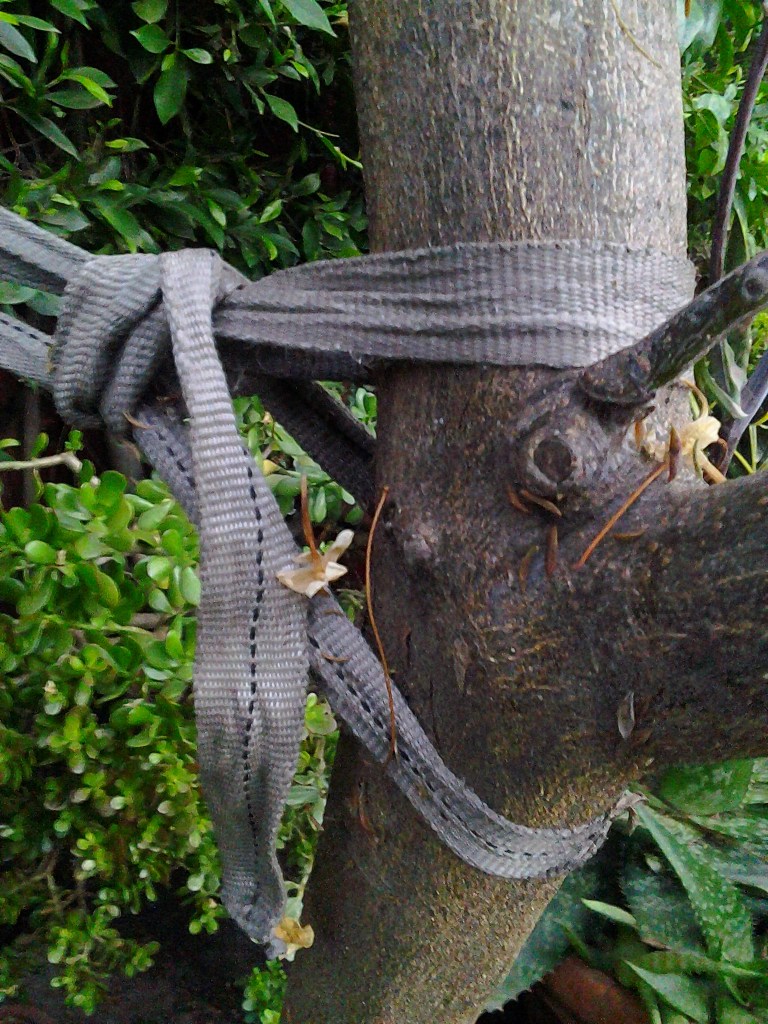
Straps should likewise not be tightly bound, but instead allow for a bit of motion with the breeze. Straps should cross over in a ‘figure eight’ pattern between trees and their stakes, so that trunks do not rub so abrasively against the stakes. Most trees need only two straps each, or two pairs of straps if two stakes are used, with support up high, and lower support to prevent outward bowing. If there are no branches to hold straps in place, straps must be nailed or otherwise attached to the stakes.
Some sturdy trees, like well developed redwood trees and small magnolias, may not need stakes. Palms and yucca certainly do not. However, limber trees like the various eucalyptus may need more support than just two straps. The problem is that many trees become dependent on their stakes and will not develop strong trunks if they do not need to.
It is better to prune maturing staked trees to limit weight and wind resistance (that might cause them to blow over) than to provide more support with heftier stakes. If a maturing young tree is relying on stakes and straps for support, it needs to be pruned. A young unstaked tree that begins to lean from the weight of its canopy should likewise be pruned until it regains its posture without getting staked and bound. Trees should never be tied to other trees, buildings or anything else that can be damaged by the tension.