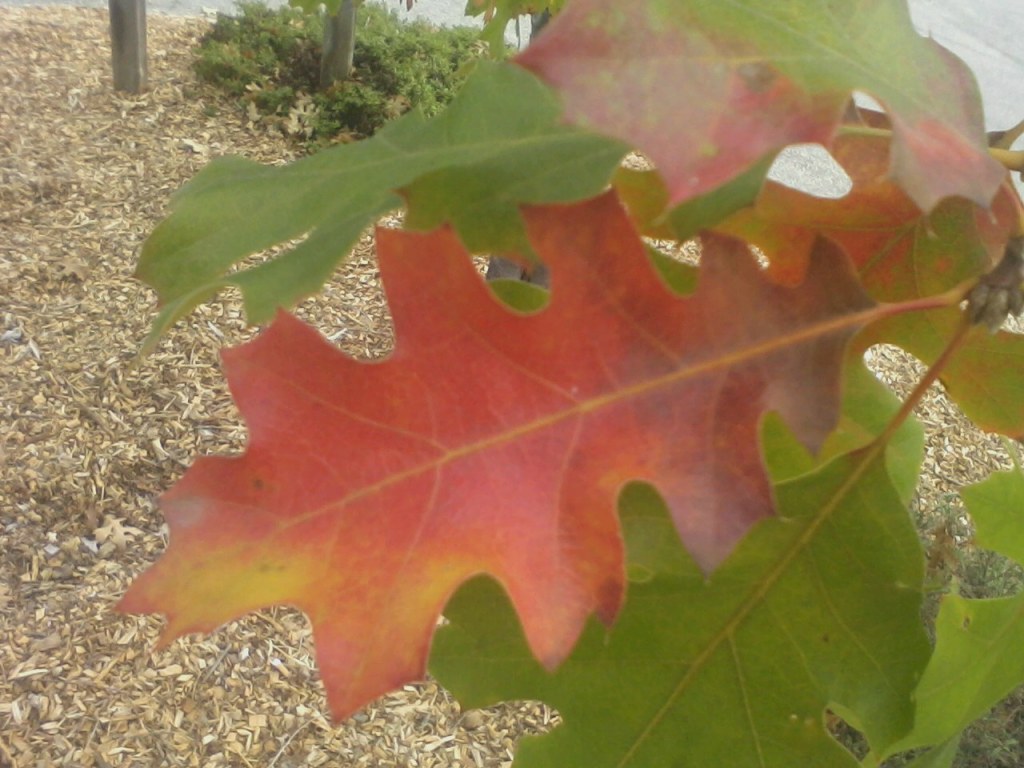
Not many native deciduous trees turn orange or brownish red in autumn like California black oak can.
Though native mostly to the Sierra Nevada and Coast Ranges between San Francisco and Oregon, California black oak, Quercus kelloggii, also inhabits isolated colonies in lower mountains as far north as the southern half of the Oregon Coast, and as far south as San Diego County. It actually occupies more area than any other hardwood tree in California. Wild trees competing in forests can get more than a hundred feet tall and live for five centuries. Well exposed urban trees may take their first century to eventually get about half as tall with trunks as wide as four feet.
Even while young, California black oak is a distinguished tree, with a broadly rounded canopy and elegantly arching limbs. The smooth silvery bark of young trees eventually becomes dark and uniformly checked with maturity. The distinctive deeply lobed leaves are about five inches long, and turn gold, soft orange or even brownish red before falling in autumn.
The parents of this unintentional hybrid are supposedly American sycamore and Oriental sycamore. No one really knows. London plane, Platanus X acerifolia, appeared within a private collection in London at the middle of the Seventeenth Century. It became popular there two centuries later, through the Victorian Era, because of its resilience to pollution.
Mature London plane trees might be taller than a hundred feet. Few here are old enough to be much taller than sixty feet though. Regardless, defoliation of such grand deciduous trees might be overwhelming through autumn. Foliar tomentum (fuzz) can be surprisingly irritating while raking too much foliage. Autumn color is unimpressively brownish yellow. The specific epithet ‘acerifolia’ translates to ‘maple foliage’, because the foliage resembles that of Norway maple.
London plane remains among the most common of street trees. It really is commendably adaptable to inhospitable urban situations. However, it is not perfect. Its roots eventually displace pavement. The foliar canopies can eventually grow disproportionately broad for compact urban parkstrips. For some people, the foliar tomentum can be a major allergen.
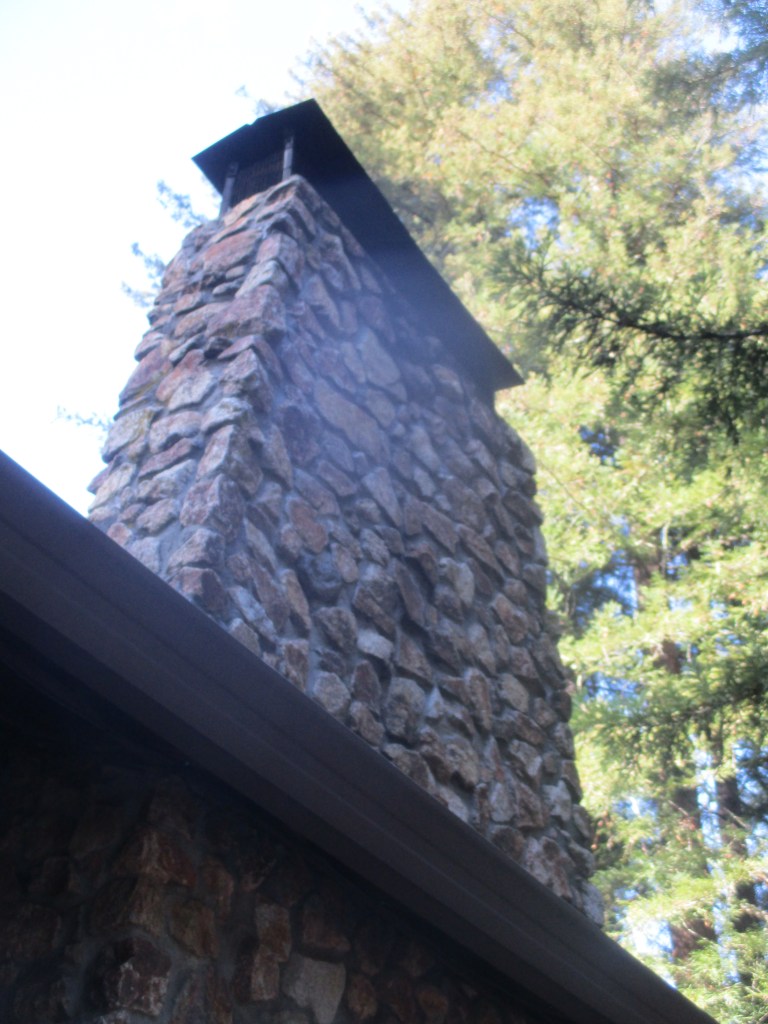
Chimneys are easy to neglect. Some are external to the homes they serve. They occupy visible but minor garden space. Others are internal. Only portions that extend above their respective roofs are visible. Besides the use of accompanying fireplaces or woodstoves, they do not change with the seasons. Nonetheless, chimney clearance is very important.
Trees and vines often extend growth over the tops of chimneys. They grow most actively while chimneys are least active through spring and summer. Such growth is hazardously combustible within the exhaust of chimneys below. Essential chimney clearance pruning eliminates hazardous vegetation prior to the use of associated fireplaces or woodstoves.
Various eucalyptus, cypress, pine, cedar, juniper, fir, spruce, oak and bearded fan palms are very combustible. Deciduous oaks become less combustible as they defoliate during cooling weather though. Other deciduous vegetation is likewise less combustible by the time chimneys are most in use. Vines can accumulate debris directly on top of chimneys.
Vegetation within ten feet of a chimney should generally be two feet below the top of the chimney or fifteen feet above it. More combustible vegetation justifies more clearance or more vigorous grooming. Accumulated dry detritus is more hazardous than fresh foliage. Burning vegetation drops burning debris onto other combustible vegetation and material.
Of course, fireplaces, woodstoves and their associated chimneys are not as common as they were in the past. Most municipalities banned them from new construction during the past many years. Removal of chimneys that incur damage from earthquakes is generally more practical than repair. Chimney clearance becomes unnecessary without chimneys.
Furthermore, few surviving chimneys experience as much use as they did decades ago. Modern heating systems are much more practical and efficient. They generate no smoke to offend neighbors. They are unregulated by ‘no-burn’ alerts. Now that urbanization has replaced orchards and woodlands, firewood might be expensive from local tree services.
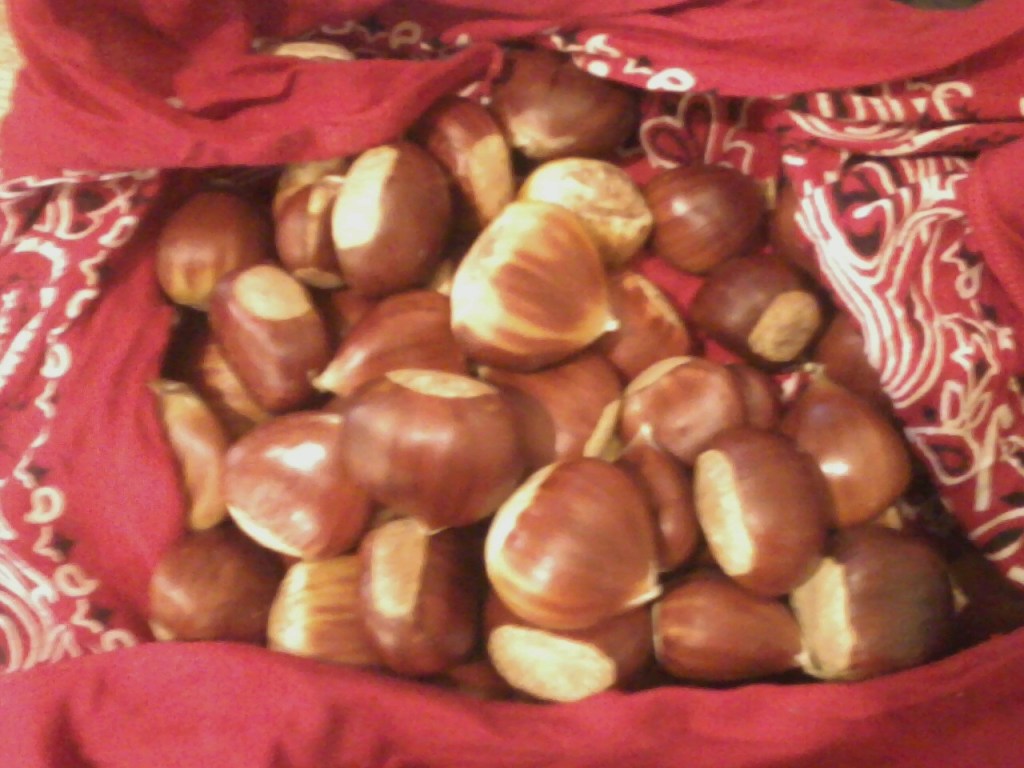
These chestnuts that may later be ‘roasting on an open fire’ are now falling from the trees that produced them over summer.
Of all the nut trees that are actually quite easy to grow, the chestnut, Castanea (various specie and hybrids), has somehow become the most obscure. It probably lost popularity while native forests in eastern North America were being annihilated by rampant disease (which never became such a threat in the west), but may be unpopular simply because it can get so big. Mature trees are regularly more than seventy feet tall and nearly as broad.
Chestnut trees are productive for those who like the nuts, but simply very messy for those who do not. The smooth meaty nuts are contained within offensively spiny husks known as ‘burrs’. A few varieties of chestnuts fall freely from the burrs. Most need to be separated from their burrs even after they fall to the ground. The evenly serrate leaves will soon be turning amber gold or brown for autumn.
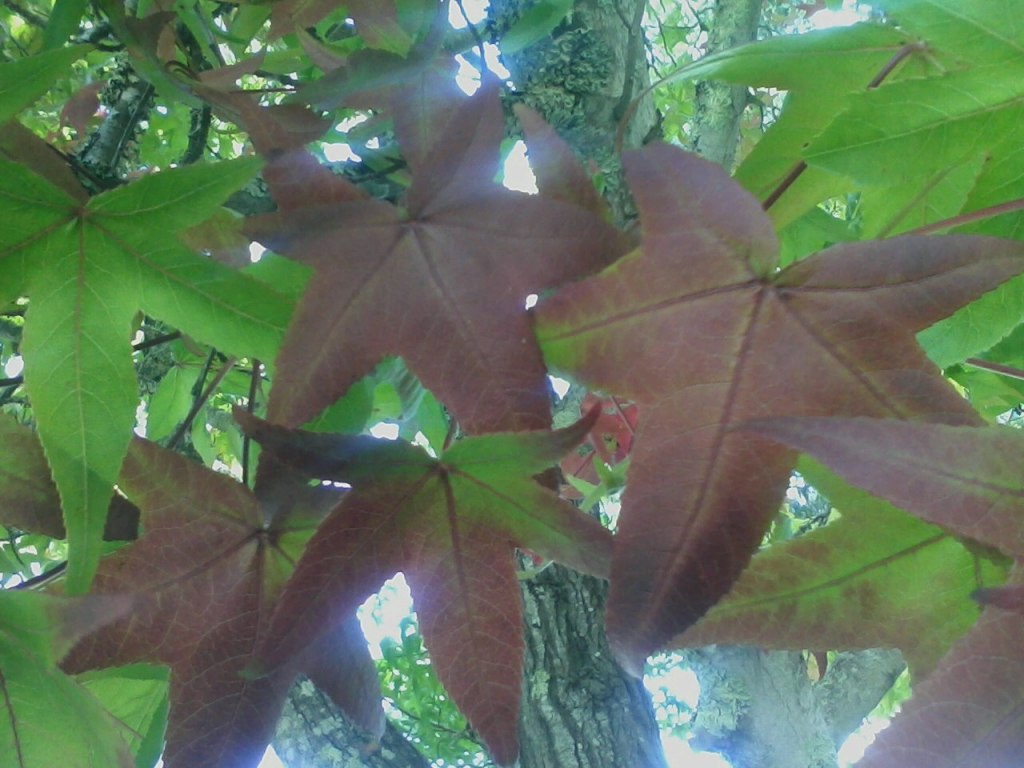
This might be the most spectacular and most reliable of autumn foliage available locally. Sweetgum, Liquidambar styraciflua, begins to develop a brilliant blend of yellow, orange and red in response to the earliest mild chill of autumn. It defoliates slowly to retain much of its colorful foliage through the earliest rain and wind of winter, and perhaps even later.
Sweetgum leaves are palmate, and about four inches wide, with five pointed lobes. One very rare cultivar has hierarchically lobed leaves, with lobes on lobes. Another has blunt lobes. Some cultivars as well as individual trees favor particular foliar colors for autumn. ‘Burgundy’ exhibits more dark red color than typical, and retains foliage later than typical.
Mature trees can grow fifty feet tall, but are not very broad. They can get taller and lankier to compete with other tall trees. Their upright form conforms to grove arrangement within large landscapes and parks. Unfortunately, their aggressive roots can displace concrete. Their branches can be structurally deficient. Their spiky and hard fruit can be obnoxious.
It may not seem like it is so now, but evergreen trees really are messier than most deciduous trees. They probably do not produce any more debris, but they drop their debris over much longer periods of time, or at various times, or simply ALL the time. Yet, at this time of year, it seems like the deciduous trees that mostly have dropped nothing or very little since last year, are making most of the mess in the garden as they defoliate for winter.
Defoliation is only beginning, and will continue for a while. Ironically, the most impressively colorful deciduous trees happen to be those that hold their foliage for a long time, making their defoliation process linger over a few months. Even the most efficiently neat trees that defoliate in a few days tend to do so during windy or rainy weather, when we are not so motivated to go out into the garden to clean up their mess.
As the rainy season begins in a few weeks or so, the gutters on the eaves should be cleaned of debris that has accumulated since last year. This can sometimes be delayed until all deciduous trees that contribute to the accumulation of debris are completely defoliated. Generally though, homes with many or big trees (or many big trees) may need their gutters cleaned more than once as they continue to collect debris through autumn and perhaps into winter.
Any debris that collects behind chimneys, in valleys (where roof slope changes direction) or anywhere else on the roof, should also be removed. Even without gutters to collect debris, flat roofs collect whatever debris that does not get blown off by wind. Only parapet roofs that are common on so many homes of Spanish architecture collect more debris, since they are sheltered from wind.
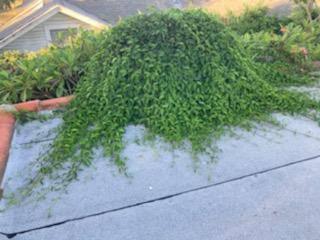
Trees and vines should never be allowed to lean onto roofs. Vines and some densely foliated trees tend to accumulate all sorts of debris that rots and then damages the roof below. Trees that touch roofing material are abrasive as they move in any breeze.
Obtrusive trees and vines are also a serious problem for chimneys. Cypress, cedar, pine and the beards (accumulations of dead foliage) of fan palms are particularly combustible. Even after they get soaked by rain, they can quickly dry if heated by the exhaust from a chimney. Maple, ash and other trees with open canopies may not be as combustible, especially while defoliated, but can get roasted by chimney exhaust, and can interfere with ventilation.
The excellent and remarkably brilliant shades of yellow, orange, red and burgundy of the foliage in autumn suggest that sweetgum, Liquidambar styraciflua, is from New England. However, it is native between New Jersey, Florida and the eastern edge of Texas, as well as isolated forests of Central America. It actually prefers mild climates to where winters are too cold. Mature trees are generally columnar (relatively narrow) and less than fifty feet tall where well exposed, but can get more than twice as tall to compete in forests.
Unfortunately, mature sweetgum trees can be somewhat problematic in urban gardens. Limbs are often weak enough to break in wind, or if they get too heavy from the weight of their own foliage. Also, the abundant round seed pods are outfitted with nasty spikes, like little maces almost two inches wide. They are painful to step on, and can actually be quite hazardous.
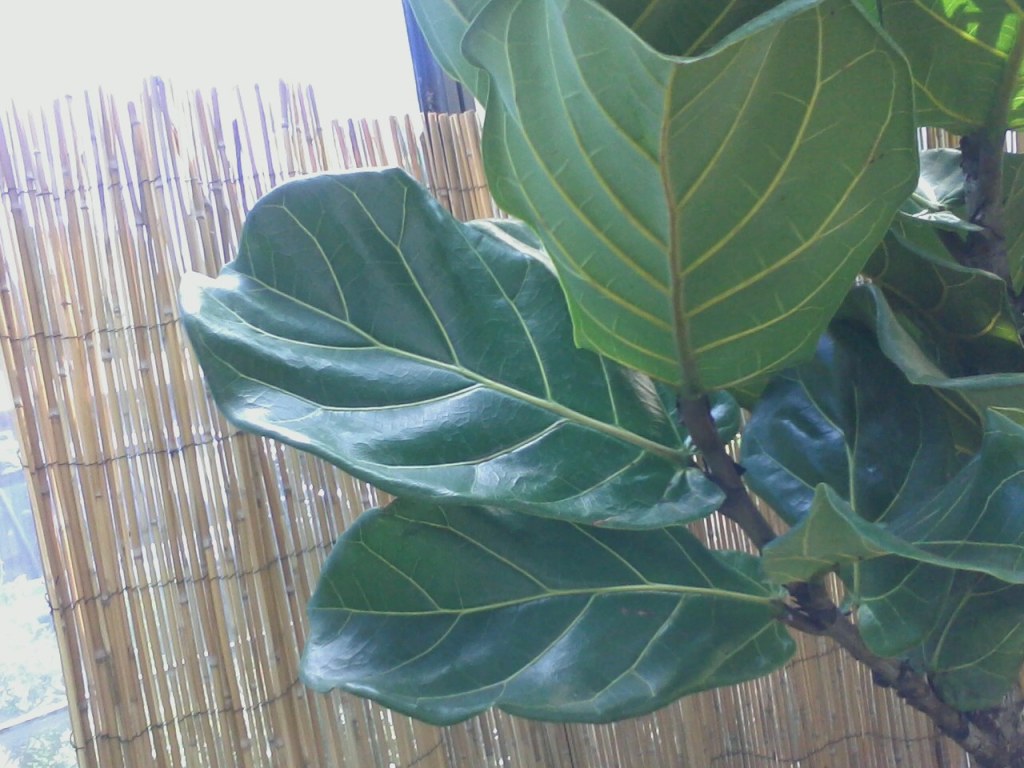
What a weird tree! Fiddle leaf fig, Ficus lyrata, is an uncommon but familiar large scale houseplant that we might not welcome into our homes if we knew how it behaves where it grows wild in the lower rainforests of Western Africa. Although it can grow upward from the ground like almost all other trees do, it often germinates and begins to grow as an epiphyte, within organic debris that accumulates in the branch unions of other trees. While suspended, it extends roots downward. Once these roots reach the forest floor, they develop into multiple trunks that overwhelm and crush the host tree as they grow.
The bold foliage is typically dark drab green, like the shades of green that were so popular for Buicks in 1970, with prominent pale green veins. Individual leaves are about a foot long and potentially nearly as broad at the distal (outward) ends, often with randomly wavy margins. Like fiddles, they are narrower in the middles, or actually more often narrower at the proximal (inward) ends. When pruning becomes necessary, the caustic sap should be soaked from fresh cuts with paper towels so that it does not drip and stain.
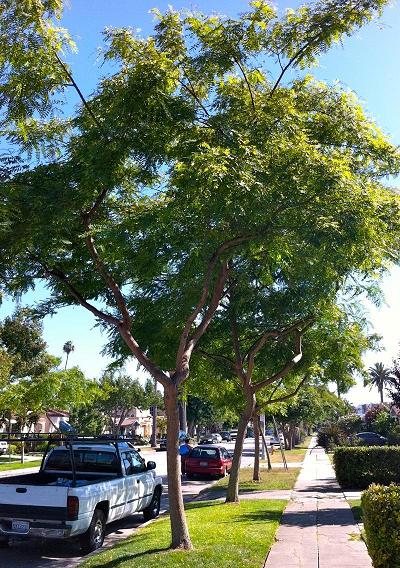
It may not get too tall, but with appropriate pruning, the tipu tree, Tipuana tipu, spreads a broad canopy high enough to be a good street tree. A mature tree is not much more than thirty feet tall and at least as broad. Roots are not too aggressive. A slight bit of mess is rarely but actually more likely to be a problem. The pale yellowish flowers that fall early in summer are followed by a few seeds. Not too long after the seeds stop falling, the deciduous foliage starts to fall. The soft green leaves are pinnately compound, with eleven to seventeen leaflets that are about an inch and a half long. Tipu tree is still uncommon, but really should be more popular than it is.
No matter how unique the individual gardens are, conforming street trees really unify a neighborhood. Streets of tract homes are typically planted with a common street tree that is complimentary to the architectural styles of the homes, and is complaisant to the difficulties of life at the curb. Neighborhoods of mixed architectural styles sometimes have difficulty finding a tree that suits every home, so often select two or more options. Older neighborhoods are not quite as selective about conforming street trees because so many various trees get mixed in over the years.
Before selecting a street tree, it is best to inquire with the particular municipality about designated street trees. Home owners associations generally install their own trees where needed, with little or no regard for the preferences of individual residents. Some urban neighborhoods (that are not home owner associations) are nearly as selective, requiring individual home owners to maintain a specific street tree or trees. Others do not require street trees, but limit selection for those who desire them. Selection is very often limited to only a single species.
There are of course many rural and unincorporated neighborhoods without limitations for street trees, and neighborhoods where limitations simply are not enforced. However, selection should still be limited to trees that are appropriate for curbside planting. Such trees should have high branch structure so that they can be pruned for clearance above the largest of trucks that can use the roadway. They should be reasonably clean, and not produce anything that could be messy on cars parked below. Roots should be complaisant with concrete curbs and sidewalks, particularly where space is limited. Foliage and bark must be resilient to harsh exposure and enhanced glare (from surrounding pavement).
London plane (sycamore) and crape myrtle trees are the two most common street trees planted by landscapers, and are the most commonly pre-designated street trees, but are actually not the best of choices. London plane is popular among landscapers because it can survive the neglect that landscapers are notorious for, but has aggressive roots that eventually damage concrete, especially since landscapers waste so much water and keep the soil saturated. Crape myrtle is remarkably colorful both in bloom and with fall color, and has remarkably complaisant roots, but does not get tall enough for adequate clearance, and often gets infested with insects that drop sticky honeydew on parked cars.