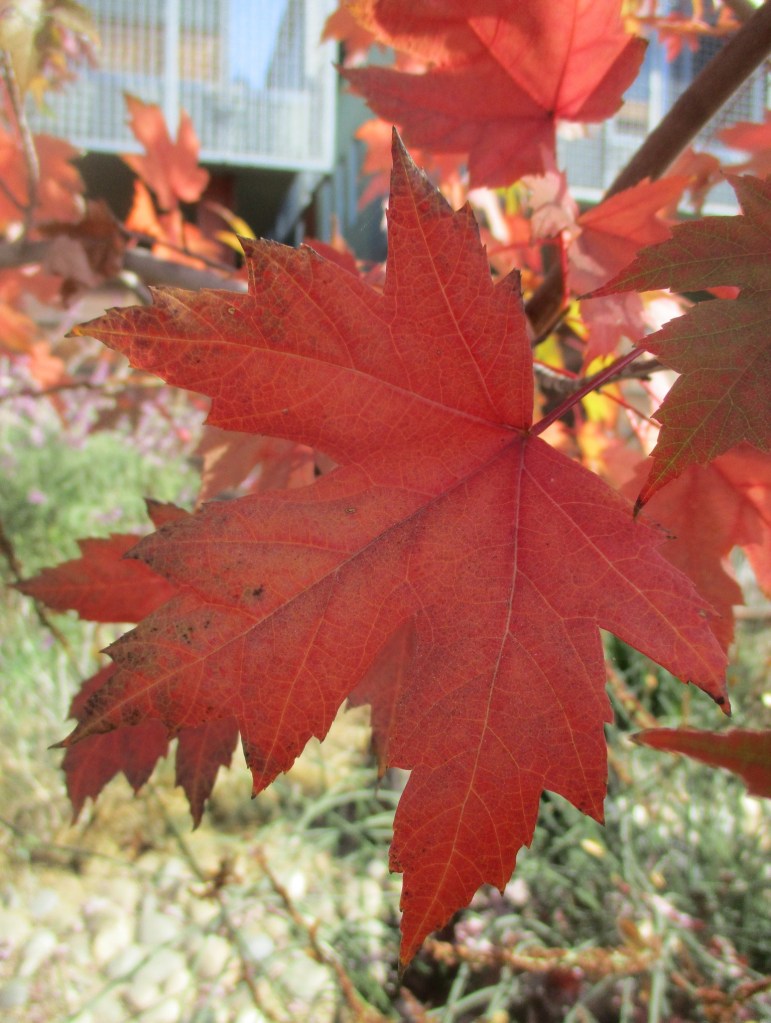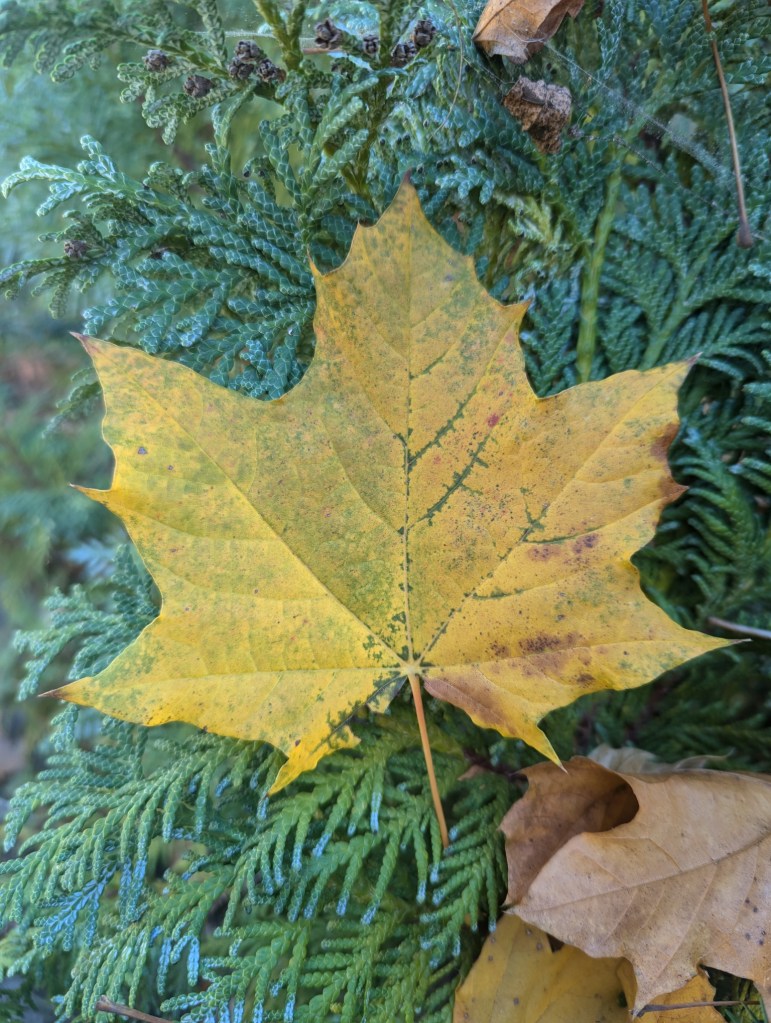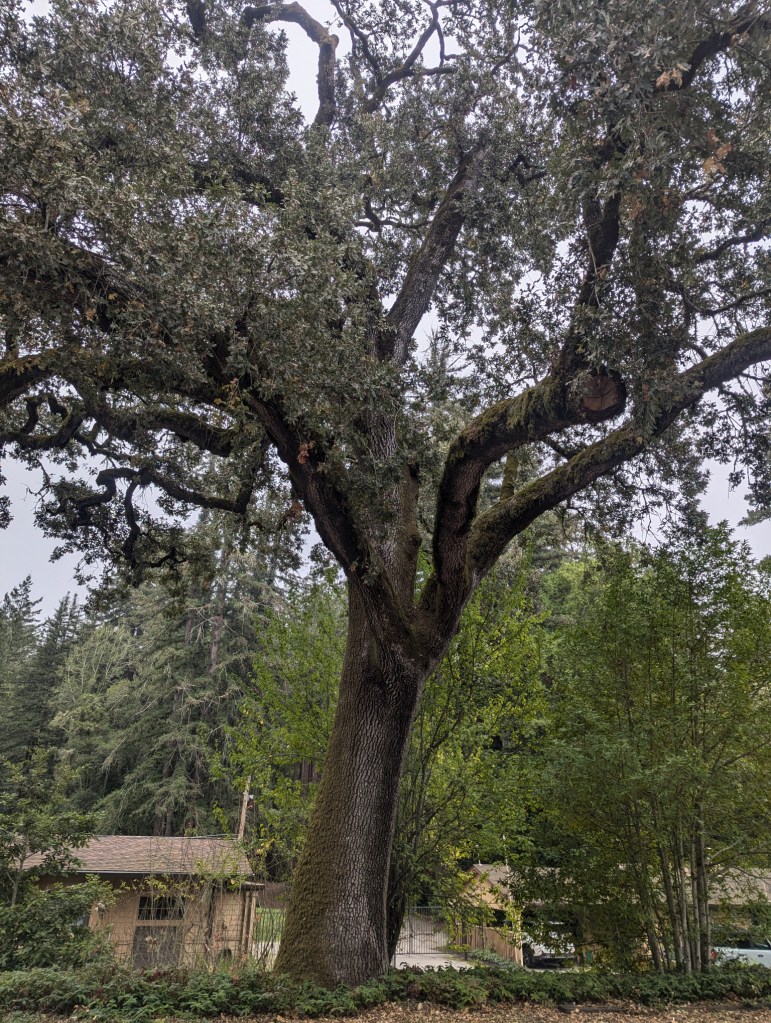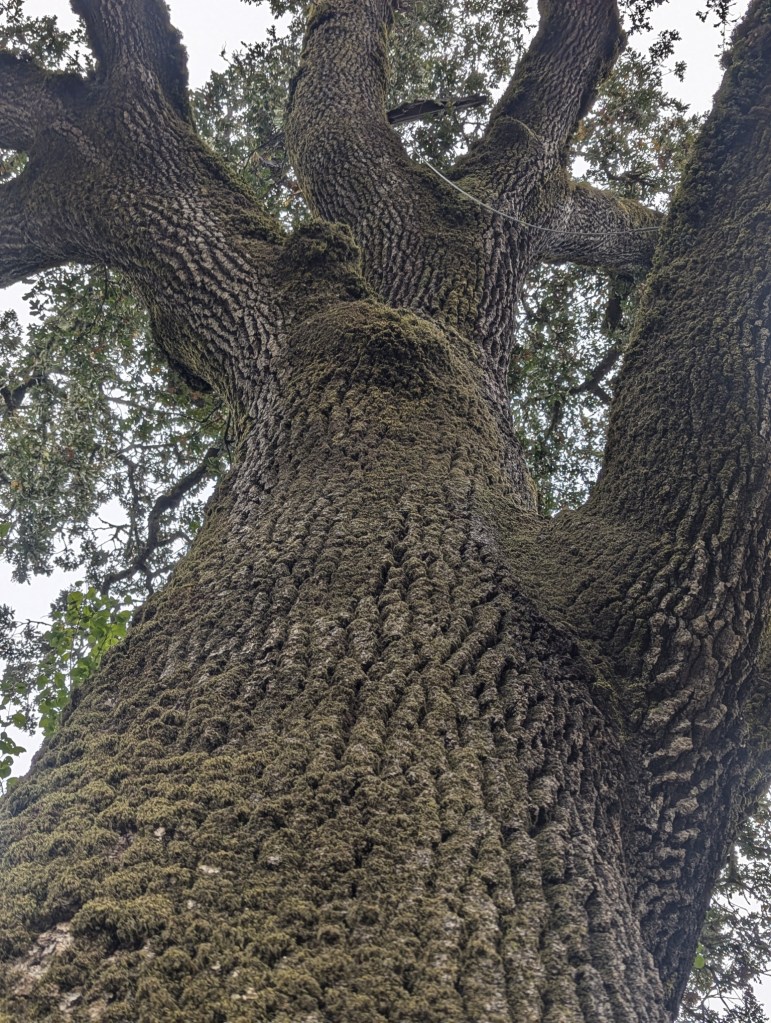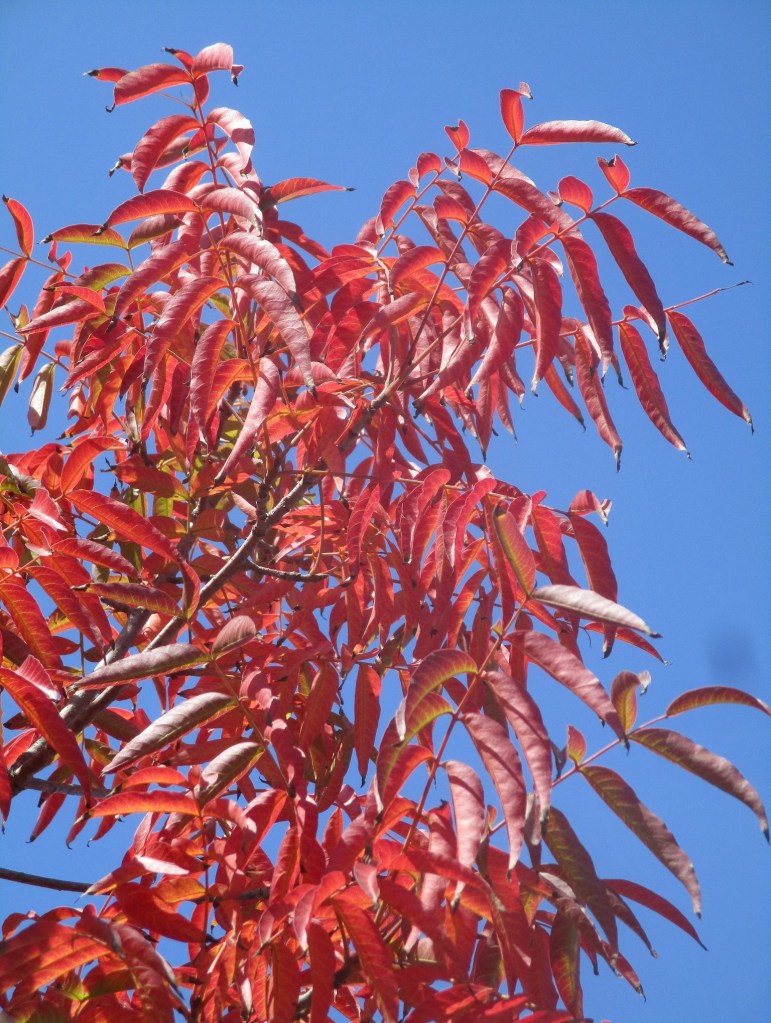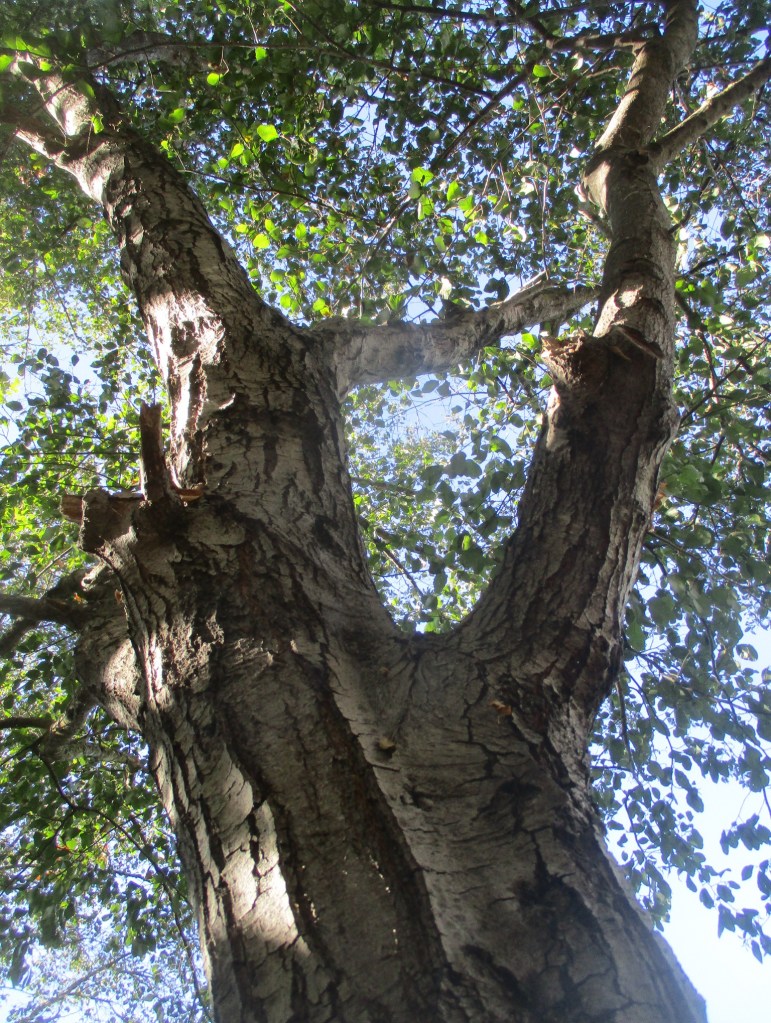
Chinese pistache, Pistacia chinensis, does not need too much chill to begin to turn color. In some climates, it is already yellowing. With cooler weather, it will develop fiery orange and red foliar color. Not only does it color reliably with mild weather, but it actually retains its color better. It could defoliate more efficiently within frostier, windier or rainier weather.
Chinese pistache grows about thirty feet tall and broad. Old trees can eventually grow to about forty feet tall. Some old trees are female, so can produce annoyingly abundant red berries. Modern trees should be fruitless male cultivars. Pinnately compound leaves are about nine inches long, with a dozen or so leaflets. Leaflets are two or three inches long.
Because of its resiliency, Chinese pistache is among the more popular shade trees here. Established trees do not need much irrigation and can likely survive with none. Frequent irrigation can promote shallow root dispersion, which can damage pavement. Otherwise, Chinese pistache is a good street tree. It merely needs pruning for clearance over roads, sidewalks and driveways.
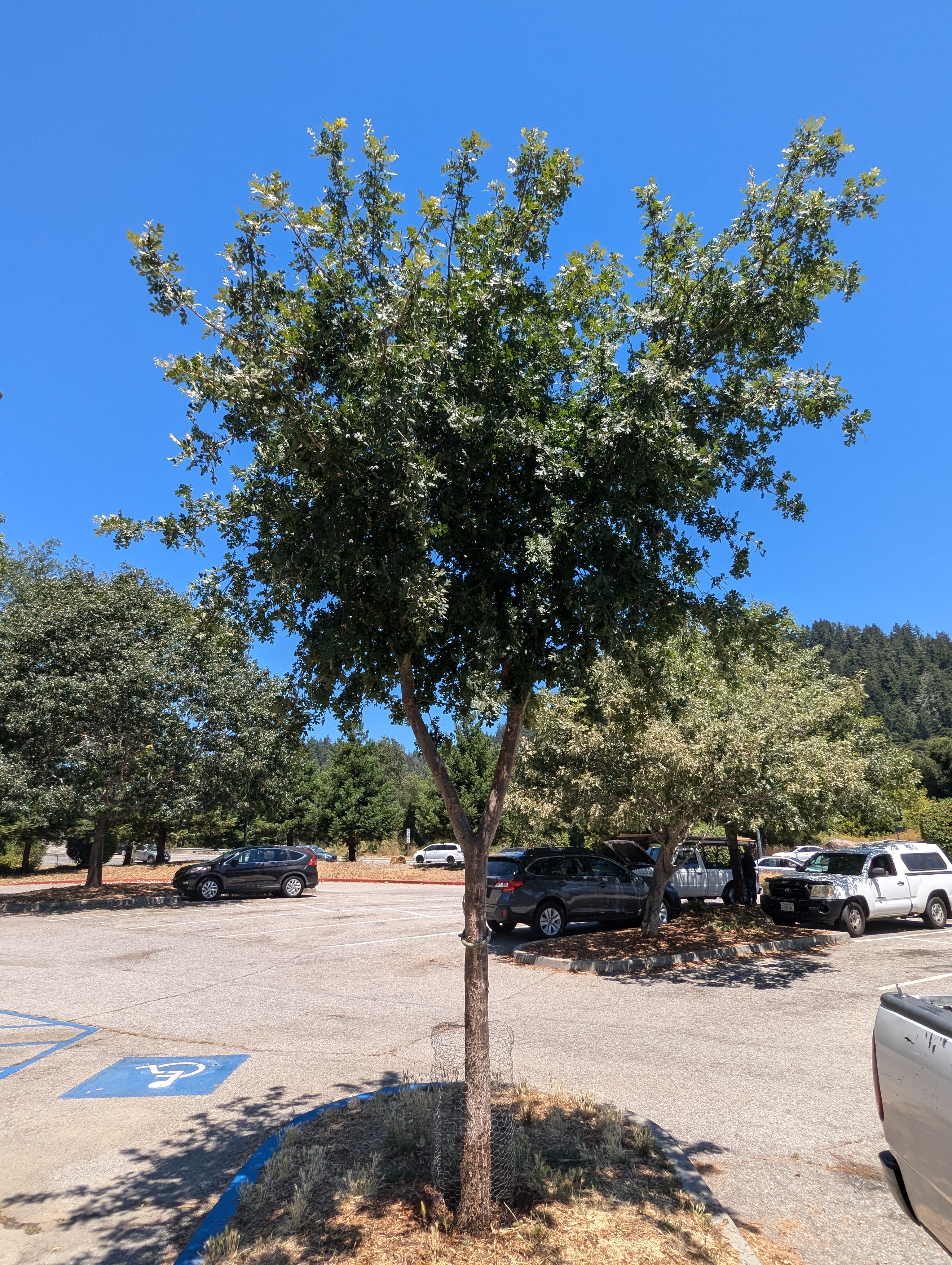
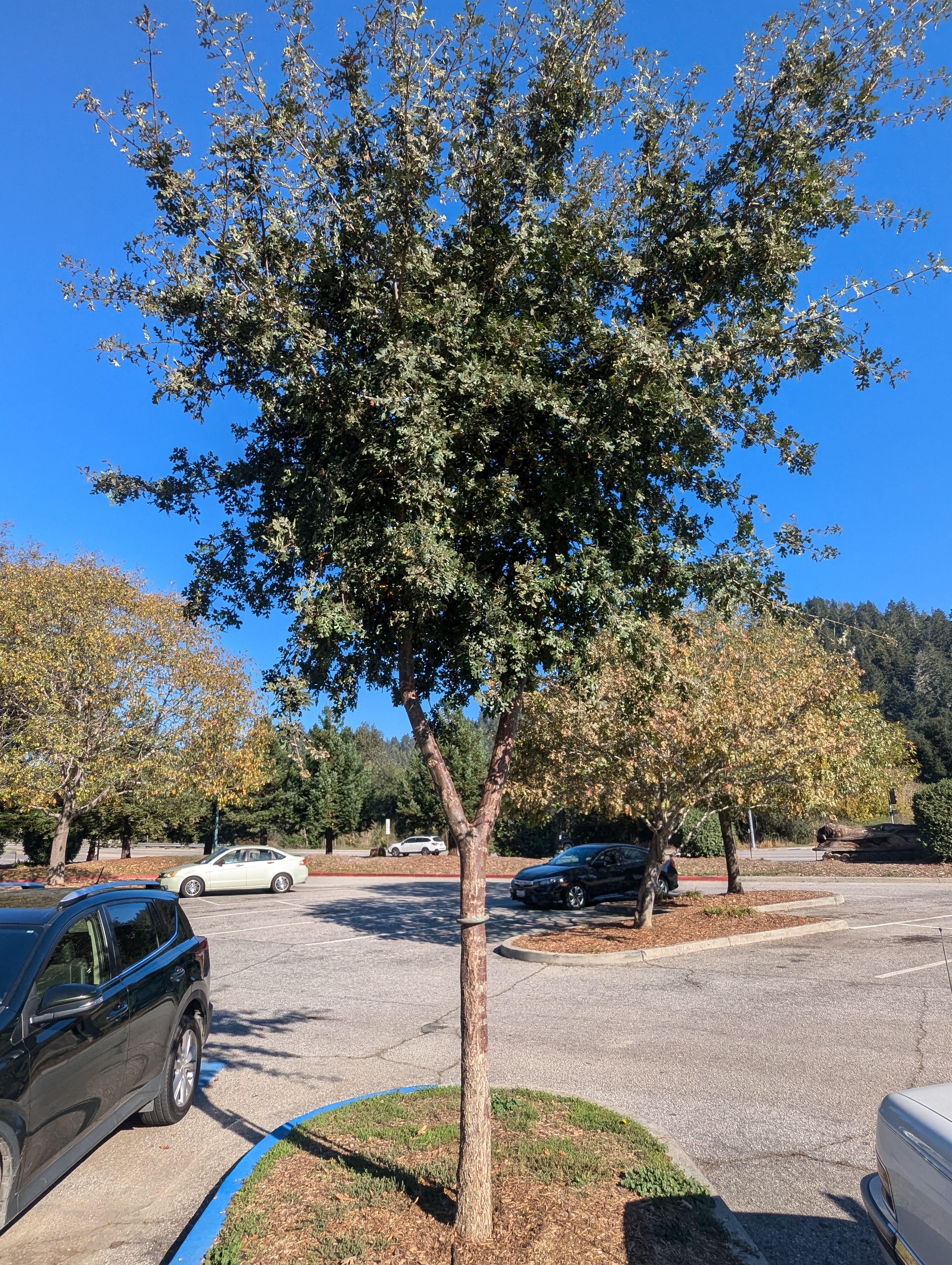
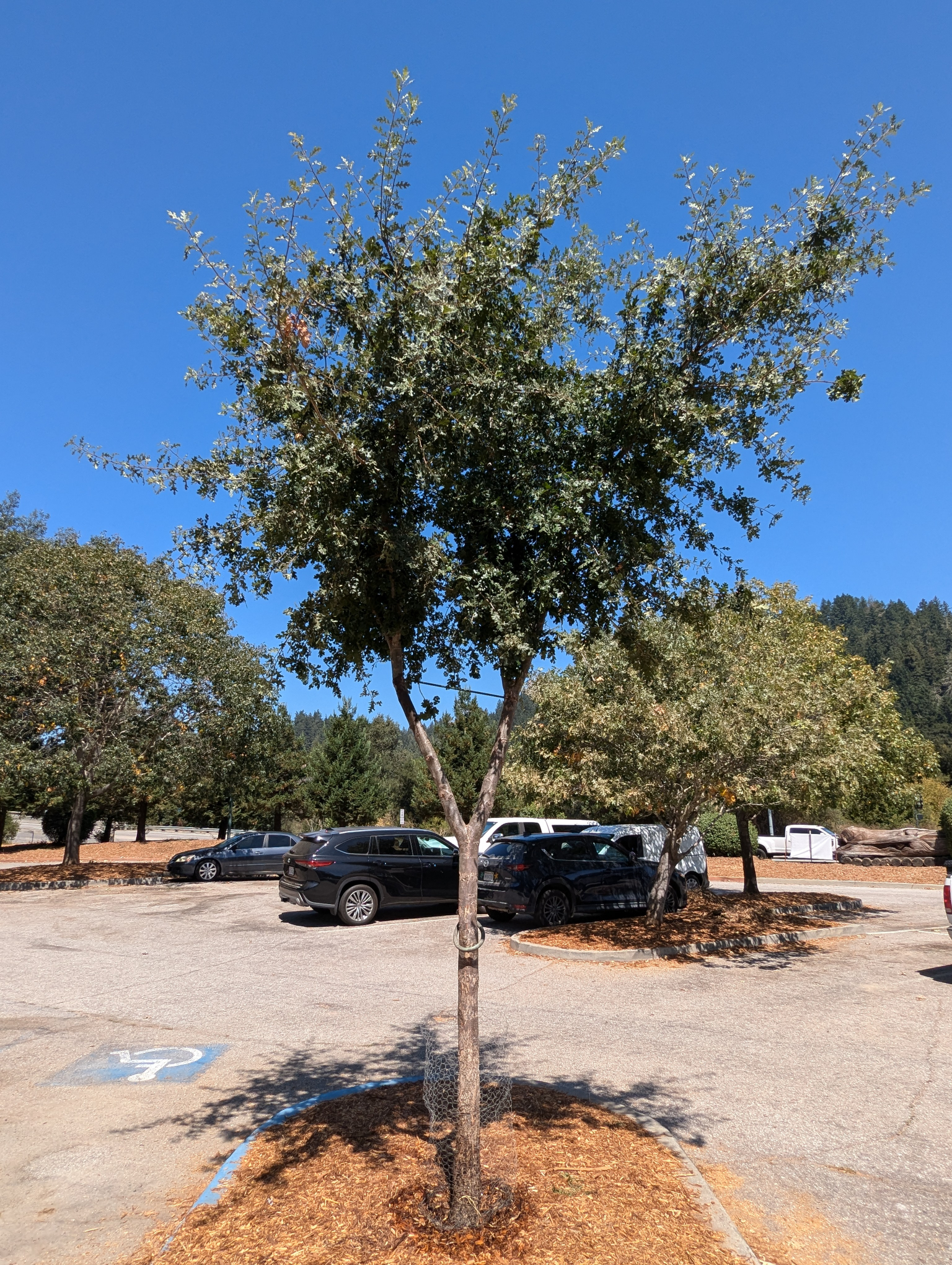
As mentioned in September of last year, comparisons of the growth of the Memorial Tree of Felton Covered Bridge Park are probably more accurate about now, at the end of its growing season, rather than in the middle of July, as I have been conducting them. So, like last year, I did comparisons at both times this year. A minor difference this year from last year is that this secondary comparison is fourteen weeks after the primary comparison instead of seven weeks, and more completely after the Tree has finished noticeable growth for the year. The first pair of comparison pictures compares the Memorial Tree now to July 12. The second pair of comparison pictures compares the Memorial Tree now to August 30 of last year. While the second pair demonstrates approximately how much the Tree has grown during the past year, the first pair demonstrates how much the Tree has grown since July 12. Strangely, most of the growth seems to have occurred after July 12. This is a good indication that the Tree has extended roots below the nearby lawn, so is exploiting irrigation there. (This species typically exhibits most of its growth during spring and early summer while the endemic soil remains moist from winter rain, but then decelerates its growth as the soil dries through summer.)
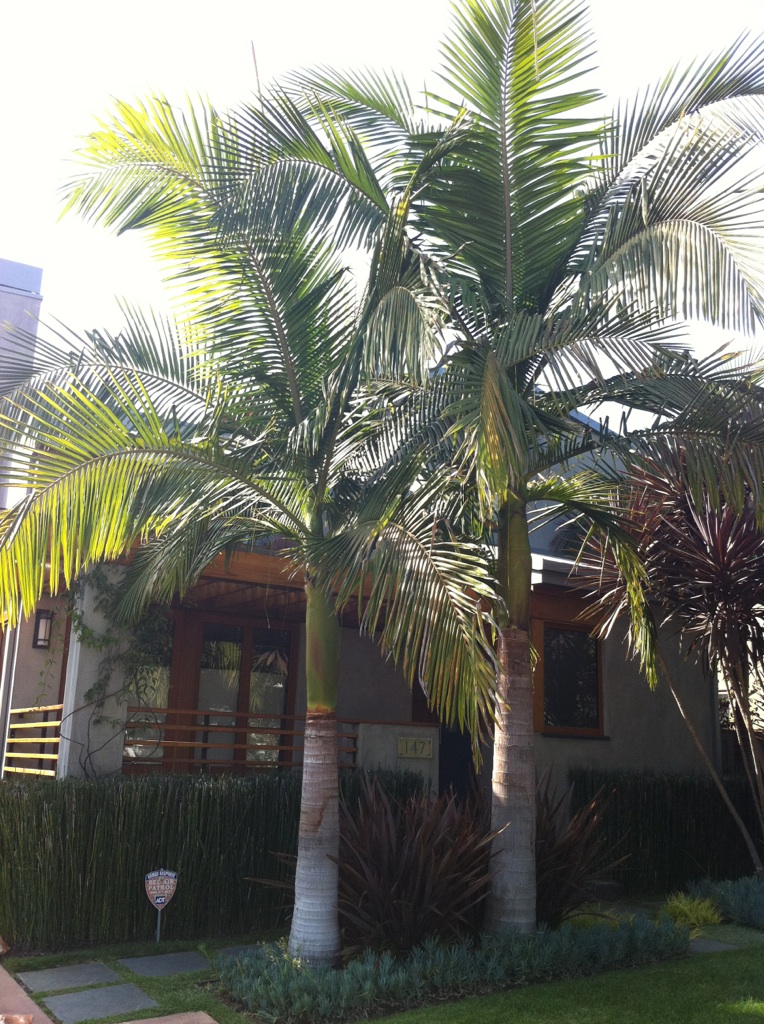
Piccabeen palm or bangalow palms is known more commonly here as king palm.
Where it grows wild in rain forests of eastern Australia, the piccabeen or bangalow palm, Archontophoenix cunninghamiana, is a strikingly elegant tree that gets to about fifty feet tall on a clean, slender trunk. The six to ten foot long feather fronds (pinnate leaves) form a light but distinctive canopy about ten to fifteen feet broad. Smooth green petioles (leaf stalks) encase the upper few feet of crownshaft, eventually peeling away cleanly to reveal the smooth trunk as it grows below. A juvenile king palm does not bloom, but eventually flaunts adulthood with softly pendulous ‘graduation’ tassels of profuse but tiny purple tinged white flowers. Locally, this palm is known more commonly as the king palm, and does best as a large houseplant or where it is protected from frost. Outdoors, it seem to be happiest close to the San Francisco Bay where it is somewhat insulated by all the water, but can unfortunately get smacked about by the wind there. A mature tree is somewhat more tolerant to frost than a young tree is, but can be damaged or even killed if it gets cold enough. King palm fortunately does well in the partial shade of larger adjacent trees or buildings that might shelter it from frost. However, it can not be pruned down for clearance from higher trees, ceilings or any other overhead obstruction (including utility cables), so should be planted where it has plenty of room to grow vertically, or where no one will mind it getting removed when it gets too tall after many years. Unlike most other palms, king palm does not transplant easily when mature. It has no problem getting planted from a pot to a larger tub or planter, or into the ground. Once in the ground though, it is there to stay.
Canary Island date palm is the biggest and boldest.
The biggest and boldest of the common palms is the Canary Island date palm, Phoenix canariensis, which can get more than sixty feet tall and nearly forty feet wide, with a full canopy of gracefully arching deep green fronds. A young tree actually spends the first many years as a shrubby plant while the base of the trunk develops. Fronds get longer and spread broader every year until the trunk gets big enough to elongate. Vertical growth then accelerates somewhat, but the canopy gets no broader.
Most trees are female, eventually producing ornately orange but messy clusters of inedible dates. Male trees eventually get a bit taller, but are not quite as graceful and bloom with unimpressive dusty tan flowers.
Old deteriorating fronds need to be pruned away close to the trunk. Petiole bases of the most recently removed fronds are often carved into ‘pineapples’ to leave a bit of support directly below the canopy. Removed fronds leave a distinctive pattern on the trunk.
Only a few of the many different palms that can be grown locally are actually common. The Canary island date palm and the Mexican fan palm, which had historically been the most common palms, have unfortunately given palms a bad reputation. Both get too large for small gardens, and need costly maintenance when they grow out of reach.
Since the late 1980s, the formerly uncommon queen palm has become the most common palm. Although it too eventually grows beyond reach, it is still more proportionate to home gardens while young. It has a relatively narrow trunk that is partially ‘self-cleaning’ (which means that old fronds, or leaves, often fall off or can be easily peeled off).
The windmill palm and the Mediterranean fan palm, although no more common now than a century ago, are two of the better palms for home gardens, since they do not get too large, and are somewhat easy to maintain. The Mediterranean fan palm has several sculptural trunks that curve out randomly from the base. Sharp teeth on their petioles make pruning a challenge, but not impossible.
The windmill palm has a straight solitary trunk that is distinctively hairy where old fronds get pruned away. It eventually grows out of reach, but takes many years to do so. By that time, many people allow beards of old fronds to accumulate on the trunks overhead instead of bothering to keep them pruned.
The desert fan palm, which is the only palm that is native to California, is very similar to the Mexican fan palm, but is about twice as stout and half as tall, with a fluffier canopy. Because it grows slower and stays smaller, it would be a better palm for urban gardens, except that it does not like to be watered regularly when mature. It really prefers warmer and drier climates.
Pindo palm and Mexican blue palm would also be great palms for urban gardens, but grow rather slowly before getting big enough to get noticed. In some climates, pindo palm produces strange and messy, but sweet and tasty fruit. Mexican blue palm is one of the most resilient palms, and blooms with really cool long floral tassels that a can drag on the ground from short trees.
‘Feather’ palms, like Canary Island date palm, queen palm and pindo palm, have pinnate (and generally compound) leaves, with small leaflets arranged on solitary midribs. Their fronds must be removed as they deteriorate.
‘Fan’ palms, like Mexican fan palm, Desert fan palm and windmill palm, have palmate leaves, centered around the distal termini of solitary petioles. These are most often pruned away, leaving distinctive patterns of petiole bases, but can alternatively be left to accumulate into thick beards of thatch.
Mexican fan palms are sometimes ‘shaven’ of their petiole bases to expose elegant lean trunks, although the procedure is intensive and expensive. Desert fan palms and some Mexican fan palms drop their own beards naturally.
There are a few reasons to not grow avocado trees from seed. Such trees take a few years to produce fruit. Then, their fruit may be very different from the fruit that provided the seed. It is therefore better to purchase a grafted tree, or at least to graft a seedling. However, some of the best and most productive avocado trees have grown from seed. I have been acquainted with many such trees, and have never met even one that produced inferior fruit. (The primary problem that I notice with seed grown avocado trees is that they grow so tall while young that most of their fruit is out of reach, but that is another topic for later.) Anyway, this is my justification for growing mango trees from seed. I am told that they are much more likely than seed grown avocado trees to produce inferior fruit. I suppose that I will find out now. I am willing to try grafting them if their fruit is not good. They can at least become good understock. Yet, I am also wondering why I get into these situations. I should have known better than to grow something that I know nothing about.
Texas selected a distinctive state tree; the pecan, Carya illinoensis. It is happy in the south and middle mid-west, where naturally grows about seventy feet tall. It can get almost as large here, so is best in big spaces. Summers are a bit too mild for reliable nut production in autumn, but single trees can sometimes make plenty. Two different trees (to pollinate each other) can actually be quite productive, although not quite as well flavored as in warmer climates. The pinnately compound leaves have about eleven individual leaflets that are about five or six inches long. Shade is not too dark.
Despite the pleasant warm weather, it will be autumn soon. This is the time to get ready for cooler weather through autumn and winter. The plants in the garden do that on their own without our help. They somehow seem to know what time it is. We only need to clean up the mess and empty the gutters when deciduous trees start to drop their leaves later. Most of our work involves features that are not plants.
Winters are so mild here that some of our work often gets delayed until it becomes necessary. If needed, we can paint, stain and seal decks, fences, patios and anything else outside anytime the weather allows right through winter. Many of us leave patio furniture outside all year both because the weather is not too harsh on it, and because patios are usable spaces even through winter.
Firewood is also commonly neglected or not even needed, but for different reasons. Many fireplaces were damaged or destroyed by the Loma Prieta Earthquake decades ago, and never repaired or replaced. Modern building codes outlawed the construction of new fireplaces even prior to that; so newer fireplaces are instead pellet stoves. Those of us who still use old fireplaces and stoves have more difficulty obtaining wood now that the orchards are gone and the outskirts of town are so much farther from home.
The advantage of pellet stoves is that fuel (which looks like stove food) is always available so does not need to be accumulated, stored and seasoned. The fuel also burns cleaner. Synthetic logs (made from compressed wood byproducts and fuel) are an expensive alternative for conventional fireplaces and stoves, but also burn cleaner than wood, and are always available. They are lightweight and clean, so can be picked up at the store and brought home in the trunk of a small car whenever a fire is wanted in the fireplace.
Good old fashioned firewood is both more work and stigmatized because of pollution. Those of us who do not have firewood available within our own gardens can purchase it from some tree service companies. It is most commonly obtained already split and seasoned directly from the wood yard where the tree service company stores it. It can be delivered for a price. Some people even like to pay a bit extra to get it stacked.
Firewood obtained in this manner is typically a mix of random woods from trees found in local landscapes. There is often a preponderance of a particular type of wood. No one ever knows what to expect. The specific type of wood is designated only when a large tree or group of trees needs to be removed, and can be isolated from mixed wood. Palms and yuccas, known as ‘herbaceous trees’, do not produce effective firewood! A few pieces in a load of firewood should not hurt anything, but palm or yucca ‘wood’ should not be purchased. Mixed wood often contains some resinous wood and eucalyptus, which burns just fine, but produces a bit more soot that needs to be cleaned from chimneys.
Firewood should be obtained annually in quantities that are likely to be used each winter. It is perishable, and can rot if stored several years outside. Even if it does not rot, it can become infested with rodents if it stays idle too long. Besides, excessive firewood simply takes up space that could be used for something else.
Mexican fan palm is also known as the skyduster palm.
It does not take long for Mexican fan palm, Washingtonia robusta, to get too big for most of the spaces it so often self sows its abundant seed into. The attractive lush foliage looks innocent enough, although the long petioles (leaf stalks) have nasty teeth. As trees get tall enough to get out of the way, they also get too big to manage, eventually reaching a hundred feet tall on elegantly curving trunks. No matter how tall they get though, their canopies always stay about eight feet wide. The problem is that the maintenance of such tall and aggressive trees can be costly.
Beards of old leaves can be allowed to accumulate on the trunks, but are combustible and can get infested with rats. Old leaves are more often pruned off, leaving a distinctive pattern of petiole bases. Old leaves can alternatively be ‘shaven’ to expose elegant bare trunks.
Redgum eucalyptus is famously adaptable and resilient.
Although not quite as aggressive, sloppy, big or structurally deficient as the notorious blue-gum eucalyptus, the red-gum eucalyptus, Eucalyptus camadulensis, is one of the ‘other’ eucalyptus that give eucalyptus a bad reputation. It is realistically too big and messy for refined urban gardens, and can be combustible if overgrown or too abundant. It is consequently probably not available in nurseries, despite being one of the most common species of eucalyptus (second only to blue-gum) in California. Red-gum eucalyptus has the advantage of being one of the most resilient large scale trees for unrefined or semi-wild landscapes, and works well where it has space to grow in many of the local county parks.