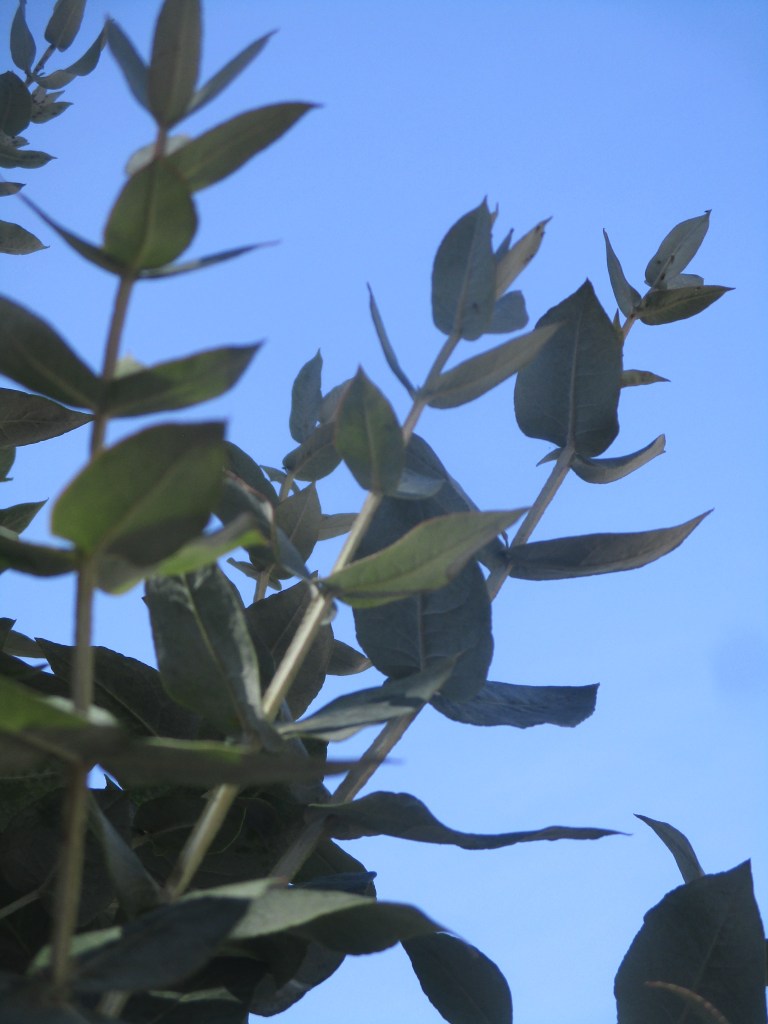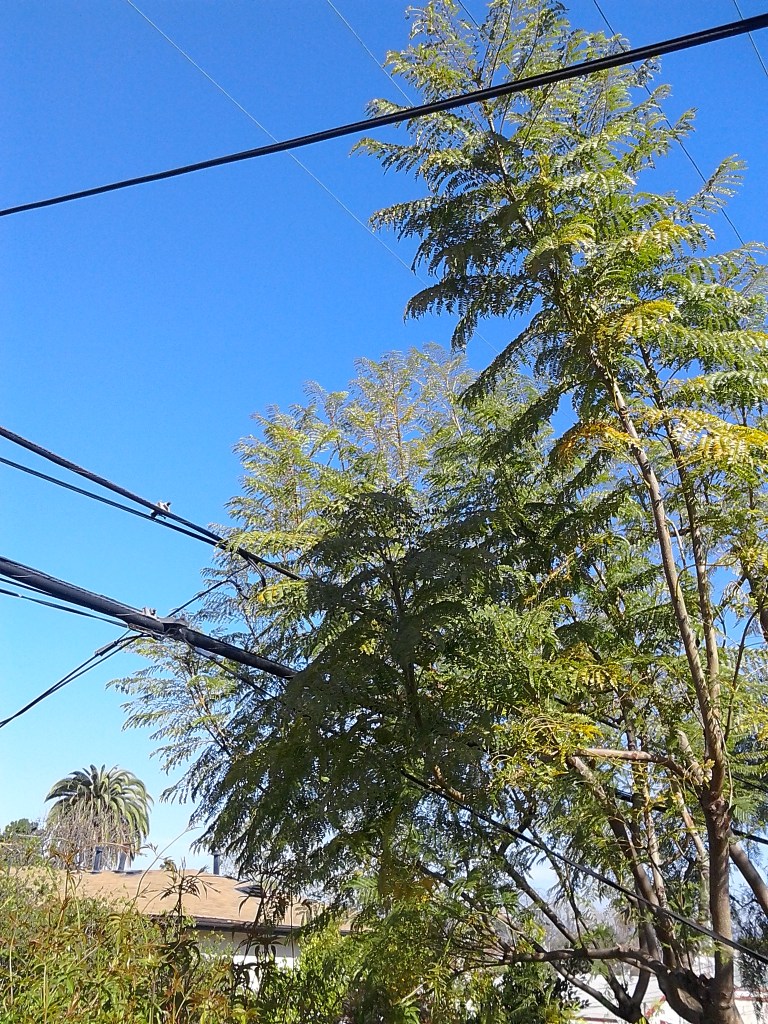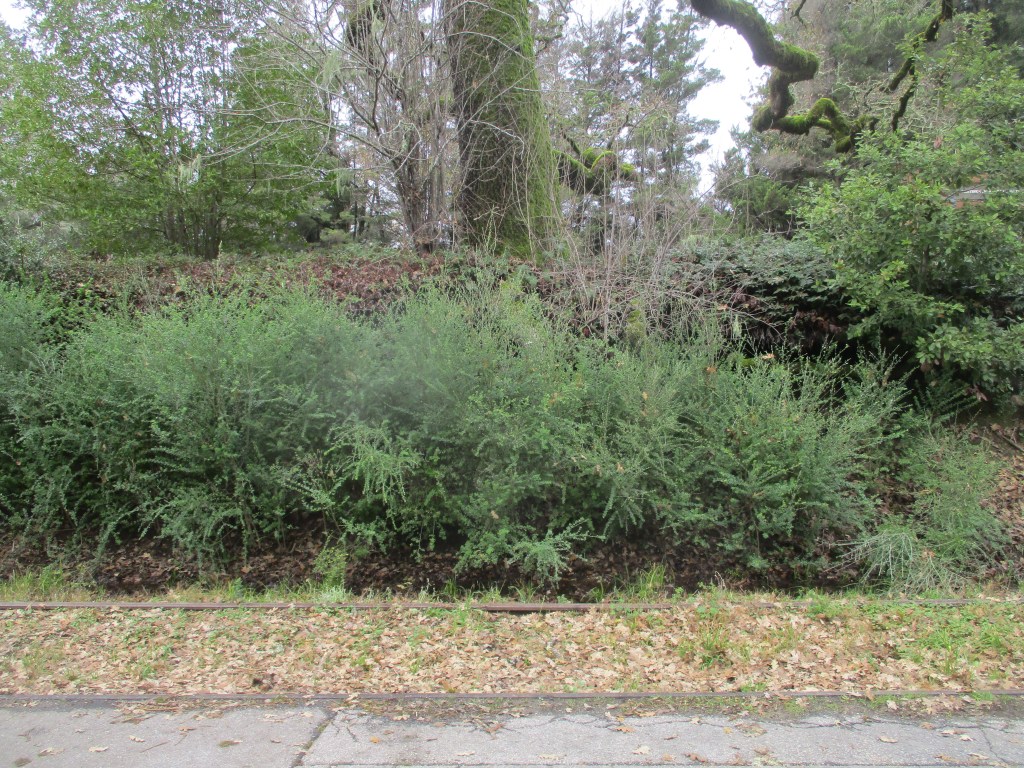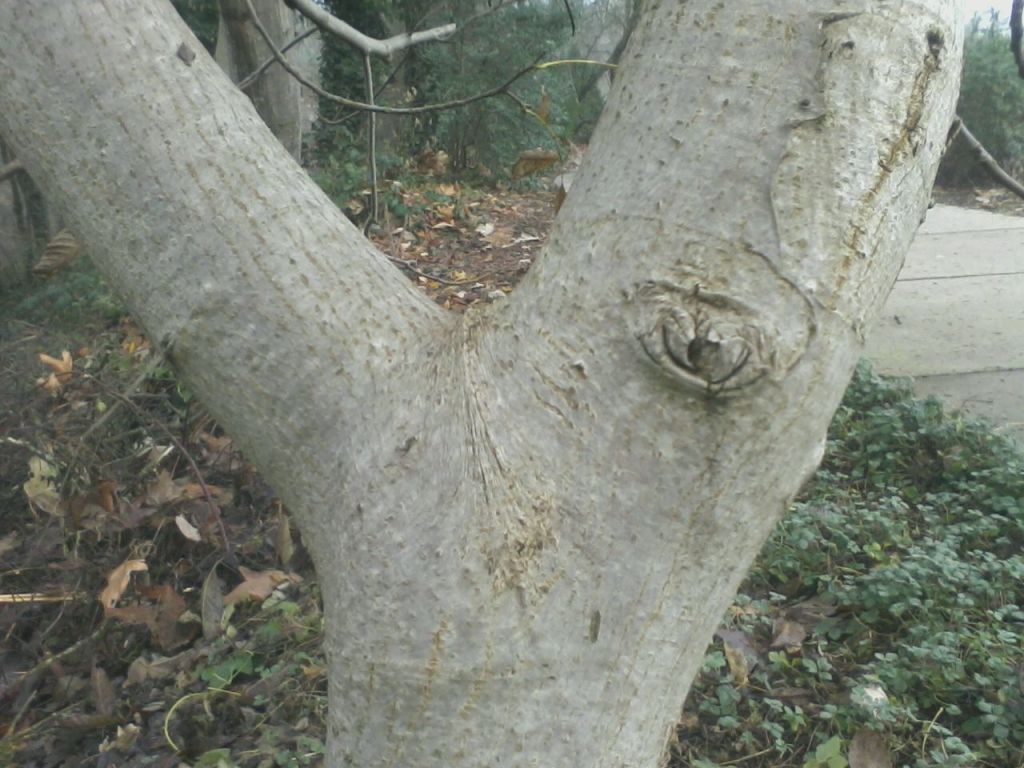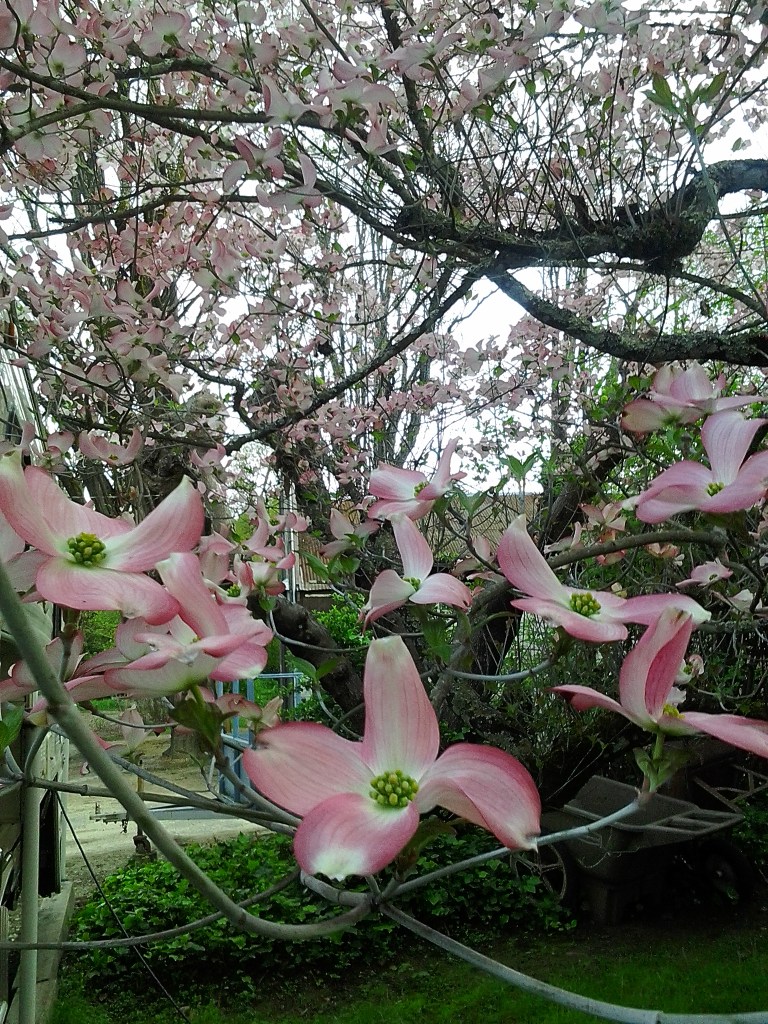
Even bare trees have style.

This big perennial ‘sticks of fire’ produces a thicket of bright yellowish orange stems that changes shades through the seasons.

Everyone knows that flowers provide color in the garden, particularly through spring and summer. As blooms become less abundant in autumn, fall color of deciduous plants and trees becomes more prominent. After most plants are finished blooming, and most of the fall color is gone, the garden may seem relatively bleak for winter. Only evergreen foliage remains. This is when plants that exhibit colorful bark or bare twigs really get noticed.

Various types of birch trees exhibit striking white bark all year. While the trees are bare in winter, the bark becomes even more prominent, particularly against a backdrop of evergreen trees. English walnut trees are not as striking, but are more sculptural. Fig trees (fruiting types) are more gray than white, so are more reliant on a backdrop of rich evergreen foliage or a darkly painted wall for contrast; but they grow fast enough to become interesting sculptural specimens within a few years. 

Bright white or light gray bark are certainly no substitute for the colors of flowers or foliage, but are striking nonetheless. They exploit the starkness of winter, and the sculptural nature of bare trunks and limbs.

Even without the sculptural structure of birch, walnut or fig trees, the more colorful twiggy growth of coral bark Japanese maple and osier dogwood trees can be quite an advantage in a stark winter landscape. As the name implies, coral bark Japanese maple has pinkish orange twigs. Osier dogwood can be ruddy brown, brownish orange or pale yellow. Frost improves color.

Unlike other Japanese maples that get pruned only lightly to enhance their form, coral bark Japanese maple can get pruned rather harshly just prior to spring growth in order to promote an abundance of the twiggy growth that is so colorful in winter. Osier dogwoods can get pruned down almost to the ground at the end of winter to eliminate tired older stems and promote colorful new stems for the following winter. They lack the colorful bloom that flowering dogwoods provide; so it is no bother that such harsh pruning prevents them from blooming.

Like trees with white or gray stems, coral bark Japanese maples and osier dogwoods are more striking against a backdrop of rich green foliage. Because winters are so mild here, they should be located where they will be most exposed to chill.

Six on Saturday: HAPPY NEW YEAR!

HAPPY NEW YEAR!

Happy January too! Happy Saturday! Really though, what is all the fuss about? There is nothing new about this. New years have been arriving annually for as long as anyone can remember. New days arrive daily. New hours arrive hourly. In fact, a new one just began within the last sixty minutes or so. Perhaps that justifies trying to be happy whenever we want to. I digress. My Six for this Saturday are irrelevant to this New Year, and actually, are not exactly happy. All six pictures involve just two trees, a valley oak, Quercus lobata and a coast live oak, Quercus agrifolia.

1. Thunderstorms are rare here. A real doozy arrived on Christmas morning though. The wind could have landed Rhody in Oz. This distinguished valley oak lost two major limbs. 

2. The worst of the damage is just above and slightly left of the center of this picture. The large limb that fell from there clobbered another large limb that was closer to the center.

3. Can you identify what this picture shows? The pair of short yellow lines near the lower center of the picture is a clue. That is the dirty tip of my left boot in the lower left corner. 

4. Tilting the camera from vertical reveals why I could not return to work after what was supposed to be a quick errand. This large coast live oak fell and totally blocked the road.

5. But wait, there’s more! This was more than we could move efficiently with the tractor. Two crews, working at both ends, took all day to clear it all. Another trunk fell to the left. 

6. The trunks had been deteriorating for decades. The moisture of the adjacent drainage ditch accelerated rot. All that evergreen foliage finally got too heavy when wet from rain. 

This is the link for Six on Saturday, for anyone else who would like to participate

Japanese Black Pine

Japanese black pines develops delightful cones.

It is unfortunate that most live Christmas trees grow too large for compact home gardens. Japanese black pine, Pinus thunbergii, which is very rarely available as a live Christmas tree, does not get much taller than twenty feet locally. Although it can slowly get about as broad, its sculpturesque branch structure adapts to pruning for containment if necessary.

Japanese black pine is a notably versatile pine. Most pines are excurrent (with a primary central trunk) or develop another similarly uncompromising form. Few are as cooperative with such casual form and relatively contained size as the Japanese black pine is. In the wild, it grows taller than a hundred feet. Yet, it is also very popular for bonsai and niwaki.

The evergreen foliage is richly deep green. The paired needles are about four and a half inches long, and perhaps stiffer than they appear to be. The cones are about two or three inches long, and nicely symmetrical. Fresh foliage and fresh or dried cones are useful for home decor. Even young trees have handsomely flaky bark, which darkens with rain.

Blue Spruce

Most blue spruce are garden varieties.

Sitka and Brewer spruce both live at low elevations and near the coast within their native ranges. Yet, neither perform as well here as blue spruce, Picea pungens, which is native to much higher inland regions of the Rocky Mountains. It grows neither as big nor as fast here as in the wild, so few old local trees are taller than thirty feet, or broader than twenty. 

Although compact, blue spruce should get sufficient space to develop its densely conical form without pruning for confinement or clearance. Such pruning is disfiguring. Since the evergreen canopy is so dense, it should retain low branches to the ground for as long as possible. Blue spruce works more like big and formal shrubbery than like compact trees.

Some cultivars of blue spruce are very stout and rounded. Most have remarkably blue or silvery color. Seed grown trees (which are not cultivars) are sometimes available online. They have potential to exhibit notable variation. Some might develop slightly more open canopies, with elegantly upwardly curved limbs. Spruce needles are about an inch long with quite a prickly texture.

Curly Willow

Curly willow is also corkscrew willow.

They start out simply enough, as weirdly twisted bare stems in fancy floral arrangements. By the time the last flowers fade, the submerged parts of these bare stems develop roots and perhaps leaves. These now rooted cuttings then graduate into pots or gardens. Most curly willow, Salix matsudana ‘Tortuosa’, is therefore unplanned. It is rare from nurseries.

Mature trees should not get much taller than fifteen feet, with awkwardly irregular branch structure. Regular pruning and grooming eliminates congested and structurally deficient growth. Alternatively, pollarding or coppicing during winter dormancy promotes vigorous growth. Healthy trees can drop overburdened limbs, and might live for only twenty years. 

Curly willow, which is also corkscrew willow, is popular more for distinctively curly stems than as a small deciduous shade tree. Specimens that provide such stems for cutting do not need to be very big. If cut and dried while dormant during winter, stems can not grow roots in water. Nor will they require plucking to remove their leaves, which are also curly.

ISA Certified Arborists Know Trees

Arborists work with the big trees.

Arborists are horticulturists. They just happen to be more specialized than most. Many or most other horticulturists work with flora that they engage from the ground. Arborists work exclusively with trees. Some must leave the ground to do so. The most experienced and educated arborists are those certified by the International Society of Arboriculture or ISA. 

ISA certification requires an arborist to pass an examination of arboricultural proficiency. Continued participation with ISA endorsed classes, workshops or seminars is necessary to maintain certification afterward. Arboricultural industries are demanding, with stringent professional standards. Certification with such industries is correspondingly demanding.

General information about the International Society of Arboriculture is available online at isa-arbor.com. This site, although designed for arboricultural professionals, is informative also for those who must procure the services of an arborist. The directory of ISA certified arborists can identify local arborists, as well as the tree services with which they affiliate.

Although arboriculture is pertinent throughout the year, it seems to become more so with the first storms of autumn. Some trees prefer dormant pruning during winter. Others might perform best after summer pruning. Various trees have various preferences. Regardless, the need for arboriculture becomes apparent as weather breaks limbs and uproots trees.

Trees are innately the most substantial and relatively permanent plants in home gardens and landscapes. Unlike annuals and some perennials, trees are not disposable, or easy to remove if they become too problematic. Many eventually get too big for those who are not experienced arborists to engage. That is why too many trees need professional help. 

Many municipalities require permits for the removal of significant trees. Inspection by ISA certified arborists, and associated reports, are generally prerequisites for the issuance of these removal permits. Some municipalities are more protective of trees than others. ISA certified arborists try to be familiar with the ordinances of the various municipalities in which they work.

Valley Oak

Valley oak is the grandest of oaks.

From the north end of the Sacramento Valley to the San Fernando Valley, the valley oak, Quercus lobata, is among the most familiar and distinctive of native oaks. It is the largest oak of North America, reaching more than a hundred feet tall with trunks as wide as ten feet, which is why it is rare in urban gardens. The hundred fifty foot tall ‘Henley Oak’ of Covelo is the tallest hardwood tree in North America. The oldest trees are about six centuries old.

The two or three inch long leaves have deep and round lobes. The foliage turns only dingy yellow and then brown in autumn, and can be messy as it continues to fall through early winter, particularly since the trees have such big canopies. The gnarly limbs are strikingly sculptural while bare through the rest of winter. The gray bark is evenly furrowed.

Incidentally, Oakland, Thousand Oaks, Paso Robles and various other communities within their range are named for valley oaks. (‘Roble’ is the Spanish name.)

White Alder

White alder is a sporadic native.

After a forest fire, white alder, Alnus rhombifolia, might be the first trees to regenerate into freshly deforested riparian situations. It grows quickly to exploit such an opportunity, and temporarily dominate a recovering ecosystem. Individual trees do not live for much more than half a century though. Then, they relinquish area to slower but more enduring trees.

Years ago, white alders did the same in new landscapes that needed shade. They grew fast to provide shade while preferable trees matured slowly. They subordinated and then vacated their landscapes as the preferred trees grew. Unfortunately, this technique is not so practical within municipalities that require but rarely grant permits for removal of trees. 

Although native, white alder is not prominent everywhere within its natural range. It might seem to be rare in Southern California, with only a few sporadic trees to provide seed for regeneration after a fire. Farther north, large and sustained colonies resist encroachment of other trees. Mature white alders can get forty to eighty feet tall, or taller where crowded by taller trees.

Six on Saturday: Eucalyptus

Blue gum earned a bad reputation for all species of the genus decades ago. It really is as massive, messy, combustible, unstable and structurally deficient as reputed. Some find its foliar aroma to be objectionable. Fortunately, it is not as invasive as formerly alleged. It is common only because it was planted so extensively a long time ago, and is somewhat naturalized in some regions.

Other eucalypti are more appropriate to landscape situations than blue gum, which is #6 below. #3 and many others are now classified as Corymbia, rather than Eucalyptus. Genus is omitted for these Six.

1. pulverulenta or cinerea is the only eucalyptus that was here when I arrived. I learned this species as ‘cinerea’. However, the correct designation seems to be ‘pulverulenta’. #2 should match.

2. cinerea or pulverulenta, as mentioned above, was supposed to match #1. It was labeled as cinerea. I thought that #1 is cinerea. I still do not know which is cinerea and which is pulverulenta.

3. sideroxylon is the first tree I planted in 2021. For such a dinky tree, it already has quite a history. I gave it to my colleague who appreciates the distinctively dark and coarsely textured bark.

4. citriodora is as goofy as it looks. It is about fifteen feet tall, with just a few leaves at the very top. Its smooth white bark contrasts with that of #3, which it will be planted close to this winter.

5. globulus ‘Compacta’ gets coppiced to produce aromatic juvenile foliage, but is less aromatic than the straight species, #6. It might be my least favorite eucalyptus, although I am fond of #6.

6. globulus gets pollarded to produce aromatic juvenile foliage, like #5, but on a trunk. It is the eucalyptus that gives all other eucalyptus a bad reputation. Nonetheless, I like its grand stature.

This is the link for Six on Saturday, for anyone else who would like to participate:

https://thepropagatorblog.wordpress.com/2017/09/18/six-on-saturday-a-participant-guide/

Fern Pine

Narrow leaves resemble pine needles.

It is neither a fern nor a pine. Fern pine, Podocarpus gracilior, can be a tree taller than fifty feet, and half as broad, but is often a shorn shrub or hedge that can be kept less than eight feet tall. Stems are limber enough while  young to be espaliered. The finely textured evergreen foliage is somewhat yellowish out in full sun, and darker green in partial shade. Individual leaves are as long as two and a half inches, and less than a quarter inch wide, and hang almost like fat pine needles. Some but not all mature trees can drop a bit of messy fruit with hard pits that are a bit larger than those of cherries. Bark gets distinctively blotched as it ages. The deep roots can be remarkably complaisant with concrete. Outer growth can get damaged by the harshest frosts every few winters or so, or roasted by hot dry heat every few summers.