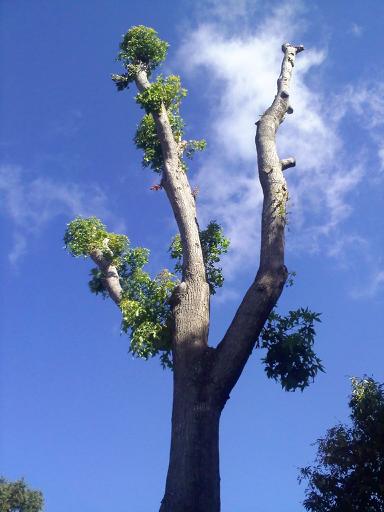
I use the term loosely. Okay, so maybe I use it mockingly in this context. This sort of thing really should have no connection to the works of Calder, Rodin or Brancusi. It might be worthy of a few fancy adjectives, such as ‘severe’, ‘unusual’, ‘dramatic’ and ‘bold’. Horticulturally though, we might be thinking more like ‘disgraceful’, ‘abhorrent’, ‘ridiculous’ or ‘just plain sad’.
There is nothing wrong with pollarding, that severe sort of pruning that almost all other arborists will tell you is wrong. It involves pruning trees back to the same distended terminal knuckles every winter. Only a few trees are adaptable to the technique, and technically, sweetgum happens to be one of those few trees.
The stipulation is that once pollarded, they MUST be cut back to the same knuckles EVERY winter. A small stub or maybe two can be left on knuckles to allow them to elongate…
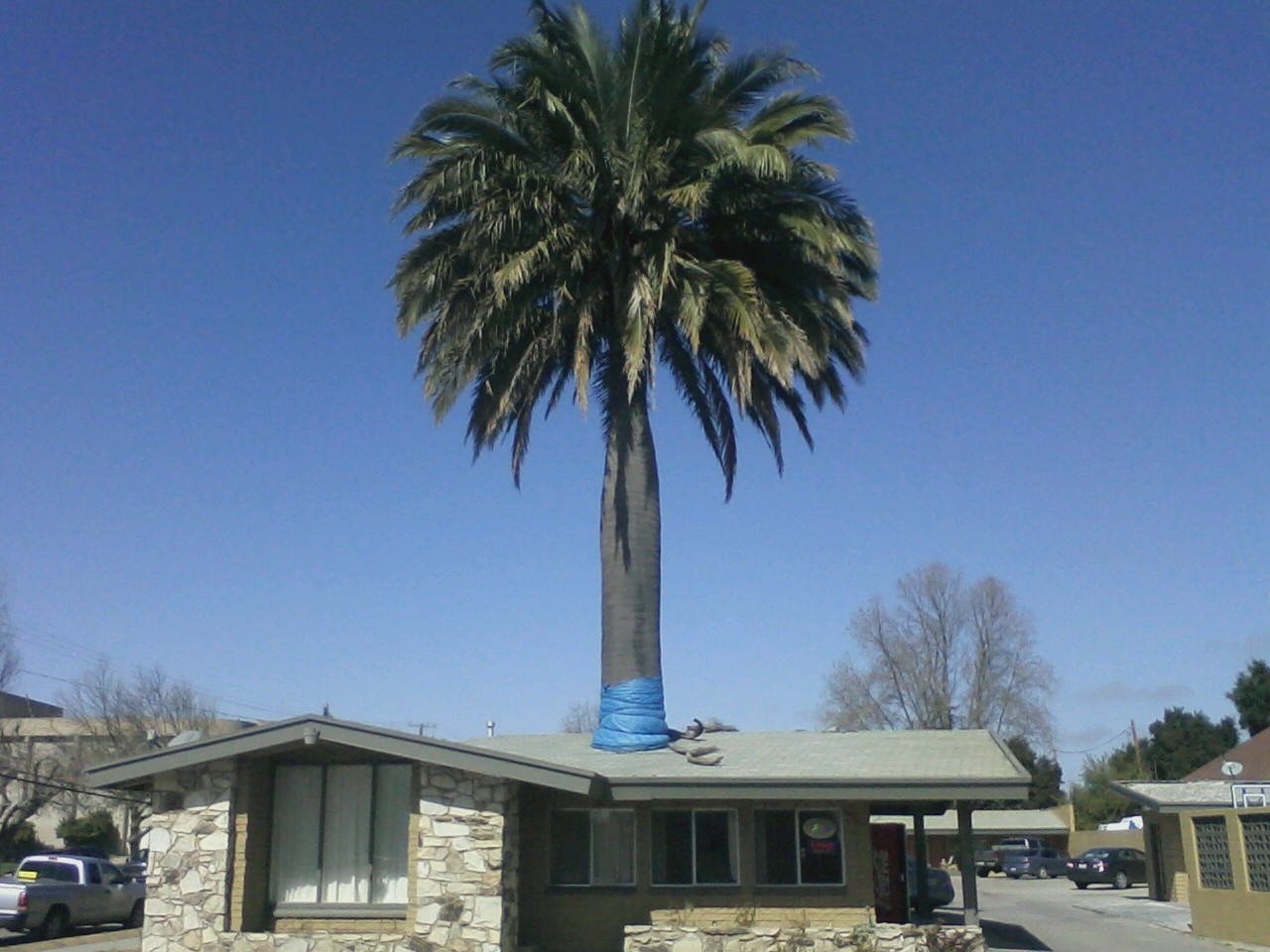
None of the above. It is just weird architecture, designed to preserve a rare Chilean wine palm. The tree was probably planted in the front garden of a Victorian home that was on this site before the site was redeveloped. Chilean wine palms were more popular back then; and this one seems to be about that age. Although it seems to be healthy now, the constriction in the trunk indicates that it had been stressed by the redevelopment, which undoubtedly covered much of the established root system. The time it took for the length of trunk above the constriction to grow coincides with the estimated age of the building below. The tree very likely had better access to rainwater before.
It is a hybrid. It is naturally occurring. Yet, most cultivars (garden varieties) resulted from intentional hybridization and selection. It is not as strange as it seems. Freeman maple, Acer X freemanii, is a naturally occurring hybrid of silver maple and red maple. It grows wild where the natural ranges of the parents overlap. From their example, breeders learned to selectively breed the cultivars.
These cultivars combine the fast growth rate of silver maple with the structural integrity of red maple. None get to be as imposing as the silver maple. Some get to be about forty feet tall and wide, which is a bit bigger than red maple gets in local climates. Foliage is lacy like that of silver maple, but more substantial, like that of red maple. It develops brilliant orange and red color for autumn.
Freeman maple, although locally uncommon, is one of the more practical maples here. Like silver maple, it does not require much chill in winter. Like red maple, it develops a symmetrical canopy with reasonably high branches. Roots should be complaisant with concrete. Because it is a hybrid, it is mostly sterile. It does not produce enough seed to be invasive in more conducive climates.
Arborists are very specialized horticulturists. They prefer to work with trees. Of course that is not as simple as it sounds. Some are nurserymen who grow trees. Some select appropriate trees for landscape design. Even some of the orchardists who work with many trees of a similar type have earned this prestigious designation. Decades ago, we still knew many of them as tree surgeons.
Arboriculture, which is the specialized horticulture of trees, has certainly evolved through the decades. Tree surgeons no longer graft fruit trees directly in home gardens. Nurserymen graft trees in production nurseries, to make them available from retail nurseries. However, modern tree surgeons now work with much more diversity of many species that were unknown to their predecessors.
As storms become more frequent through autumn and winter, the need for arboriculture becomes more apparent. More unstable trees fall. More structural deficient limbs break. Many trees prefer to be pruned while dormant through winter. In actuality though, arboriculture is important throughout the year. Some procedures, for some sorts of trees, should happen significantly earlier or later.
Trees are the most substantial features of home gardens. Once they grow beyond reach, they need to be maintained by qualified tree surgeons. Regardless of what most say, very few gardeners are qualified to perform major arboricultural procedures. Many tree surgeons will attest to finding that most damage that trees endure is caused by gardeners with minimal regard for arboriculture.
Tree surgeons who are Certified Arborists of the International Society of Arboriculture, or ‘ISA’, have demonstrated their proficiency with arboriculture. After passing their certification examination, Certified Arborists maintain their credentials by continued involvement with educational seminars, classes and workshops of the ISA. Not many other horticultural professionals are so dedicated.
More information about procuring the services of an ISA certified arborist can be found at www.isa-arbor.com.
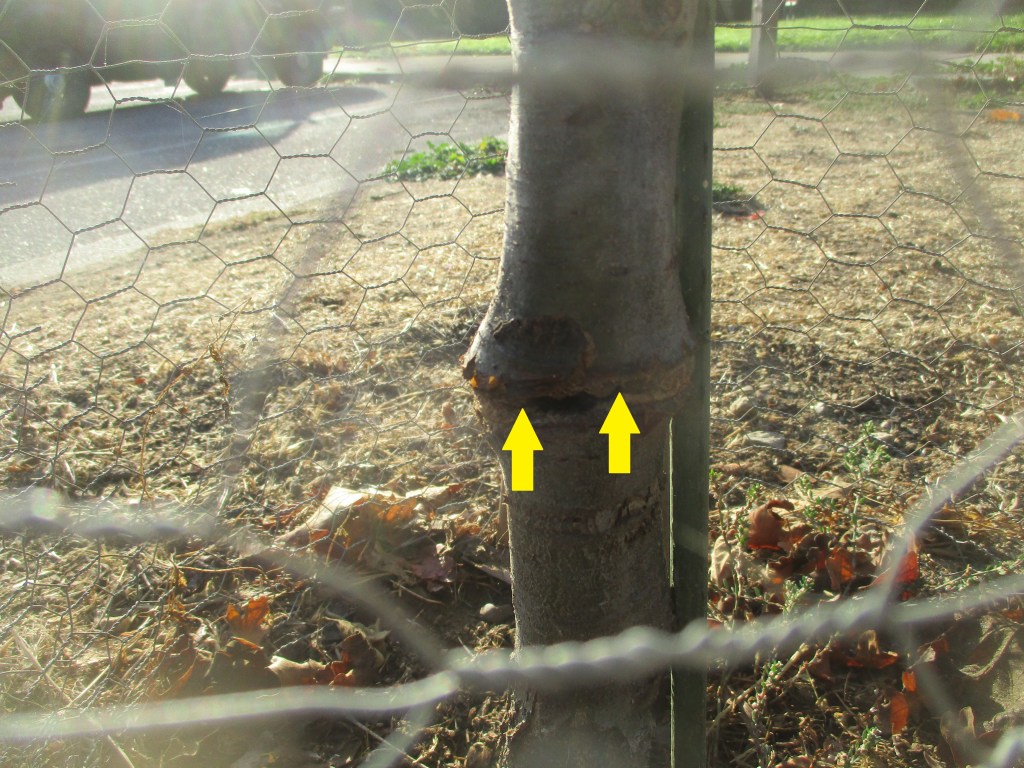
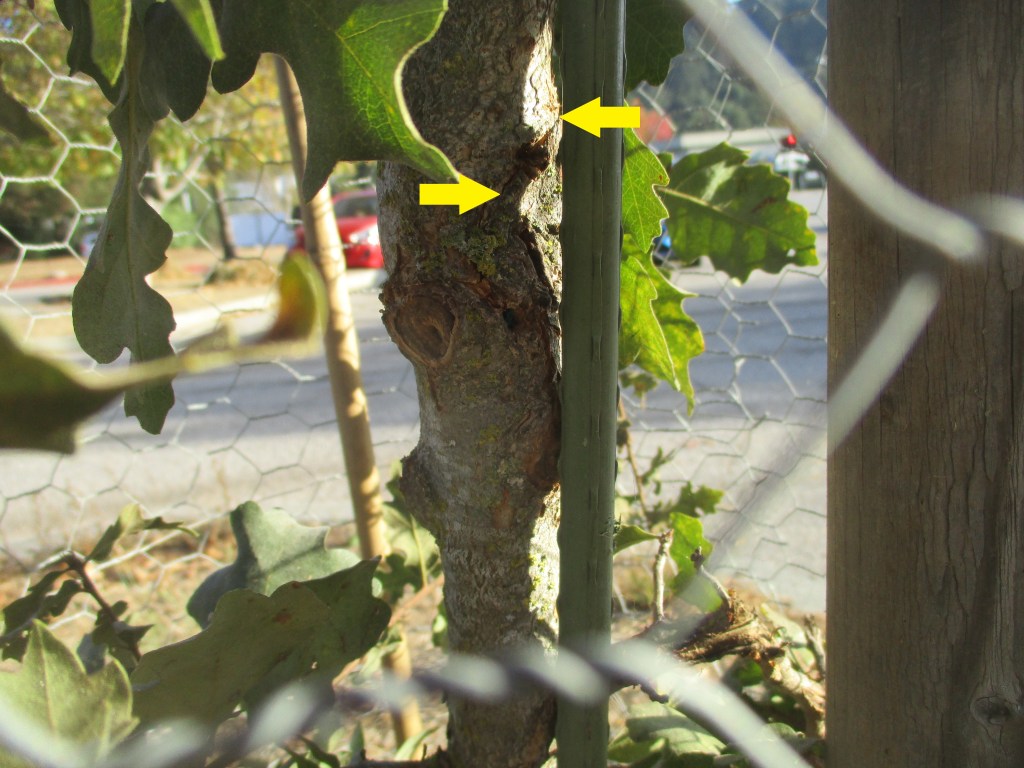
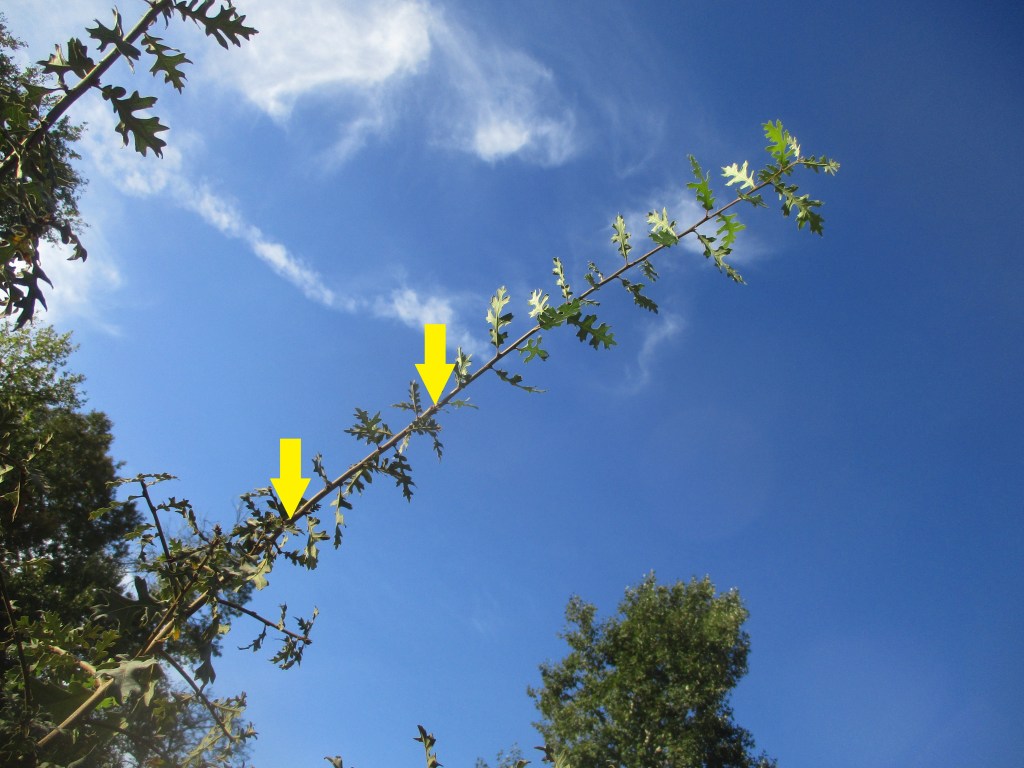
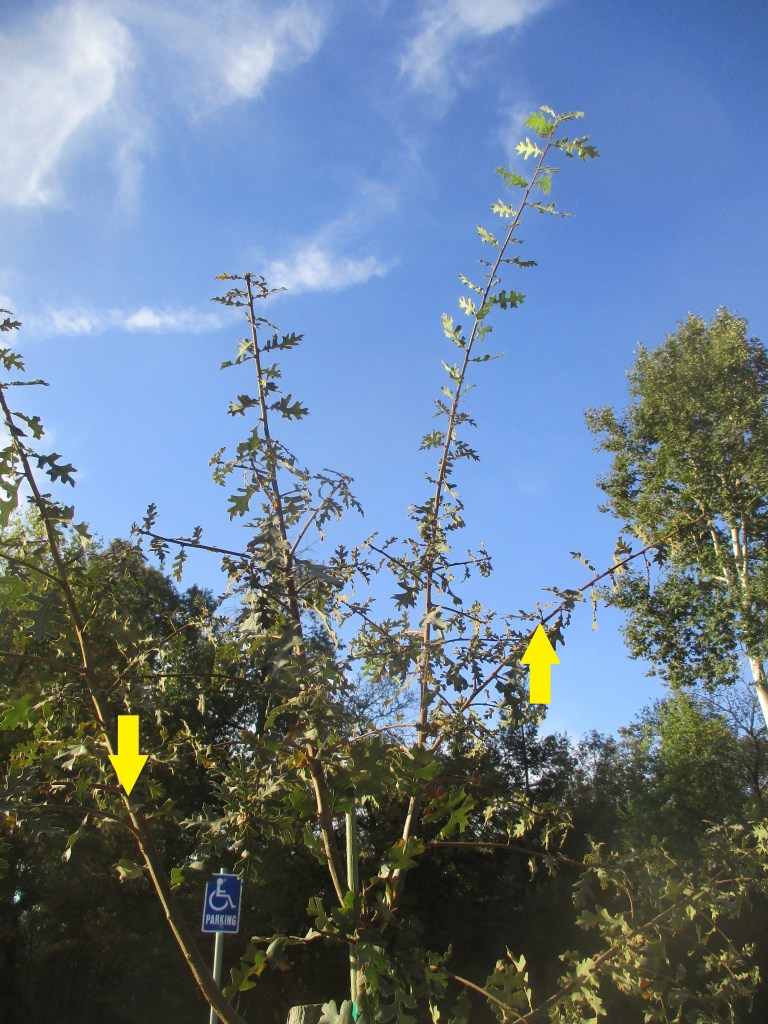
These pictures are from a similar article with the same name at Felton League, which was linked to here last Wednesday. They demonstrate how efficiently the Memorial Tree is recovering from vandalism four months ago. Pointer . . . ‘thingies’ were added to more precisely identify what some of the pictures illustrate. The other two linked-to articles provide more information.
1. A gardener at Felton Covered Bridge Park installed this chicken wire cage around the Memorial Tree after it was vandalized. The protection is minimal, but the gesture is very thoughtful.
2. This now minimal damage is all that remains of of the formerly major vandalism. The worst of the damage to the left and right was very efficiently compartmentalized in just four months.
3. This scar is all that remains of formerly major damage. It is now completely compartmentalized. Growth above not only continued, but was unusually accelerated for so late in the season.
4. This damage was compartmentalized so efficiently that the scar is barely visible. Actually, I am not even certain if this is a scar. I remember only that the trunk was sliced in three places.
5. Growth for the season was adequate prior to the vandalism. The marker to the lower left shows where growth started early last spring. The marker to the upper right, near the center of the picture, shows where growth was decelerating and expected to blind out by the middle of summer. However, growth accelerated vigorously past that, as if stimulated by the vandalism.
6. Growth was unusually vigorous, especially for late summer. During winter, the stem designated by the marker to the left should be removed so that it does not develop into another major trunk. The stem designated by the marker to the right should probably be pruned back so that it does not compete with the two upper stems that are developing into the main lower limbs.
This is the link for Six on Saturday, for anyone else who would like to participate:
Incense cedar produces delightfully aromatic wood.
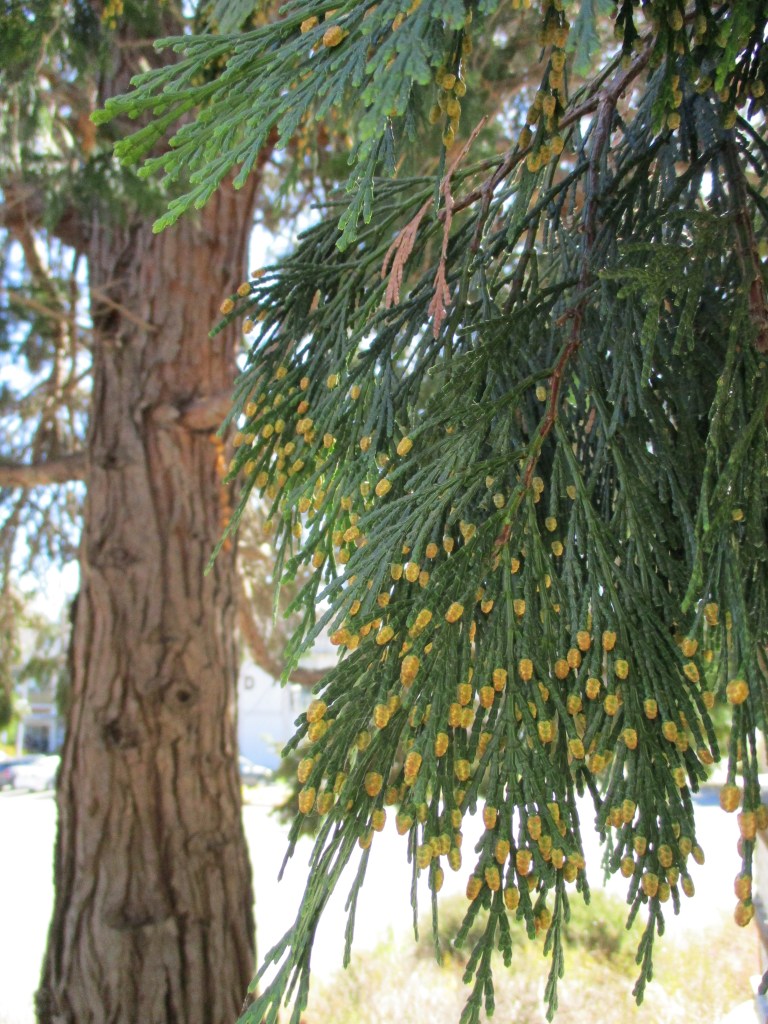
Nowadays, the delightfully aromatic foliage is familiar primarily in garlands at Christmas time. Most of the foliage of old trees is too high up for direct contact. Young trees with low foliage are rare. Incense cedar, Calocedrus decurrens, is unfortunately not as popular as it was a century ago. At that time, it was as utilitarian as it was appealing for spacious but minimally irrigated landscapes.
Incense cedar wood made good shingles and laminate for closets and cedar chests. The wood is aromatic enough to repel moths from woolens and furs, which were still popular then. It was less expensive to import than Eastern red cedar. It grows wild relatively nearby, in the Sierra Nevada and Cascade Mountains. Incense cedar fence posts might resist decay as well as redwood posts.
If the wild, where they compete with other trees for sunlight, old trees can get almost two hundred feet tall. However, well exposed old trees in Victorian gardens are less than half as tall after more than a century. Their canopies are generally conical. Large limbs can curve upward like extra trunks. Flat foliar sprays resemble those of arborvitae. The deeply furrowed bark is cinnamon brown.
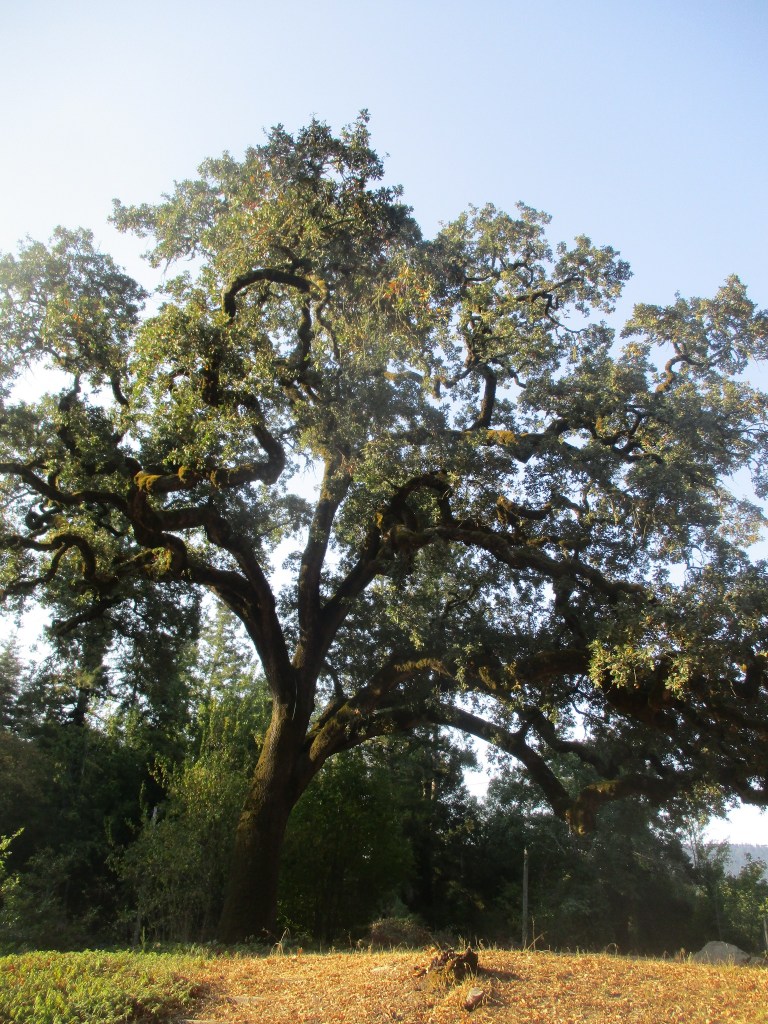
From the north end of the Sacramento Valley to the San Fernando Valley, the valley oak, Quercus lobata, is among the most familiar and distinctive of native oaks. It is the largest oak of North America, reaching more than a hundred feet tall with trunks as wide as ten feet, which is why it is rare in urban gardens. The hundred fifty foot tall ‘Henley Oak’ of Covelo is the tallest hardwood tree in North America. The oldest trees are about six centuries old.
The two or three inch long leaves have deep and round lobes. The foliage turns only dingy yellow and then brown in autumn, and can be messy as it continues to fall through early winter, particularly since the trees have such big canopies. The gnarly limbs are strikingly sculptural while bare through the rest of winter. The gray bark is evenly furrowed.
Incidentally, Oakland, Thousand Oaks, Paso Robles and various other communities within their range are named for valley oaks. (‘Roble’ is the Spanish name.)
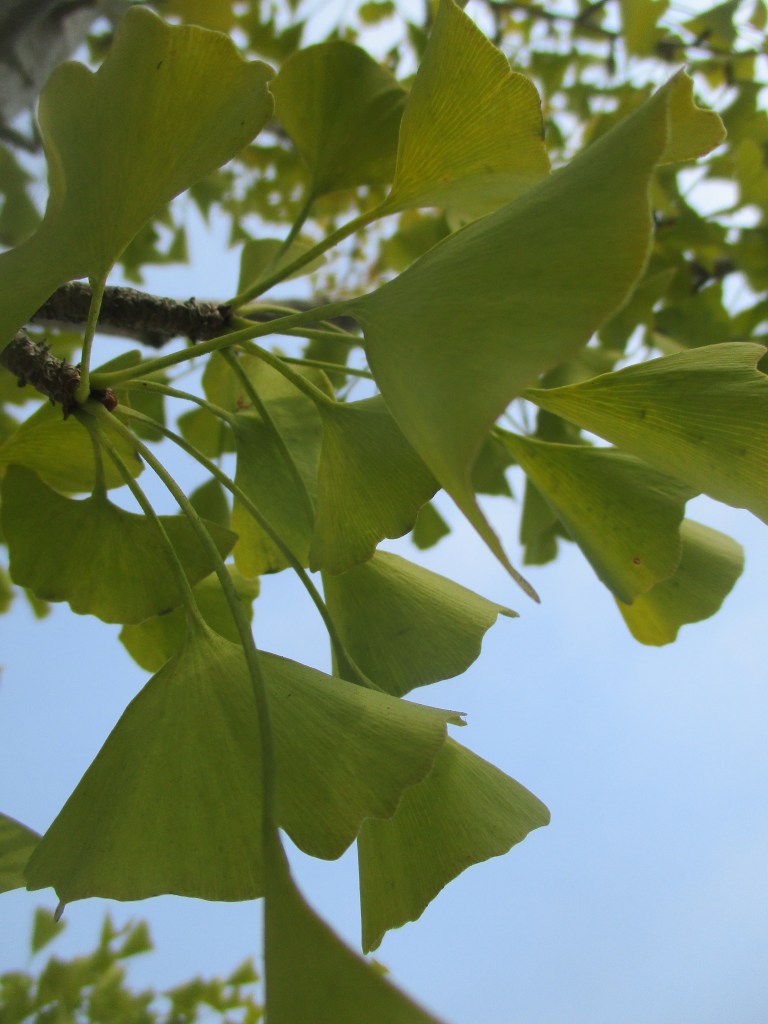
Where autumn chill is minimal, the best and brightest yellow autumn color is that of the ginkgo, Ginkgo biloba. Some know it at the maidenhair tree. Except for older trees that produce messy and stinky fruit, it is a notably clean tree. Perhaps it is too clean. It drops nothing all year, but can defoliate too soon once it develops it striking autumn color. Minimal chill actually prolongs the process.
Ginkgo is dioecious, with separate genders. Modern cultivars for landscapes are male, so produce no obnoxious fruit. Female cultivars that produce nuts and fruits are not commonly available in nurseries locally. (As objectionable as their aroma is, the nuts and fruits are edible.) Some people may be allergic to the pollen of mature male trees. Many mature trees predate modern cultivars.
Trees are somewhat slender and perhaps sparse while young. They develop a broader canopy as they age. Trees can get more than fifty feet tall, with sculpturally irregular branch structure. Foliar venation radiates outward from the petioles. Leaves, which are about two or three inches long, therefore have the shape of fishtails. Leaves on current season stems are cloven into paired lobes.
From the northern end of the Sacramento Valley to Santa Catalina Island, valley oak, Quercus lobata, is as Californian as Valley Girl. It inhabits mixed riparian forests and low hillsides up to about 2,000 feet, but prefers alluvial valley meadows in between. Although unpopular for landscaping, it sometimes self sows into home gardens. New landscapes sometimes develop around old trees.
Valley oak is one of the biggest of oaks, and the tallest oak of North America. Mature trees can be more than a hundred feet tall, and several centuries old. Trunks may be more than ten feet wide. Such big trees make big messes of acorns and deciduous foliage, which shed for weeks. Unfortunately, old valley oaks within new landscapes are susceptible to spontaneous limb failure and rot.
Where space is sufficient, new valley oaks are for future generations. They develop their distinctively sculptural branch structure slowly through several decades. If irrigation is not excessive, roots are remarkably complaisant. The evenly furrowed gray bark is rustically distinguished. The elegantly lobed leaves are about three inches long and half as wide. Yellowish autumn color is subdued.
‘A Tree Grows In Brooklyn’ documents the resiliency and invasiveness of the common but typically undesirable tree of Heaven, Ailanthus altissima. Once a single female tree get established, the extremely prolific seeds get everywhere, including cracks in concrete. The resulting seedlings conquer wherever they are not dug out. If cut down, they just resprout from the roots.
Male trees smell horrible while blooming for about a month in spring or summer. They are pollinated by flies, so naturally smell like what flies like. The tiny yellowish or tan flowers hang on panicles that can be a foot and a half long. Female blooms are not as big, prolific or objectionably fragrant. However, stems, leaves and all other parts of both genders smell rotten when handled.
Tree of Heaven, which has earned the alternative names of ‘tree of Hell’, ‘stink tree’, ‘ghetto elm’ and ‘ghetto palm’, is no longer a tree that gets planted by choice. It is typically a tree that plants itself, and on rare occasion, happens to grow into a good situation. They should not be allowed to overwhelm more desirable trees, or get too close to concrete or other damageable features.
Young trees grow very fast to about forty feet tall. Older and slower trees do not get much taller, although sheltered trees can get twice as tall, with elegant gray bark. They do not live much more than fifty years. The big pinnately compound leaves are surprisingly pretty. On vigorous shoots, individual leaves can get as long as two and a half feet, with leaflets as long as six inches.

 Is this a bad idea for a green roof?



 Tony Tomeo