Intricately blotched bark distinguishes Chinese elm.
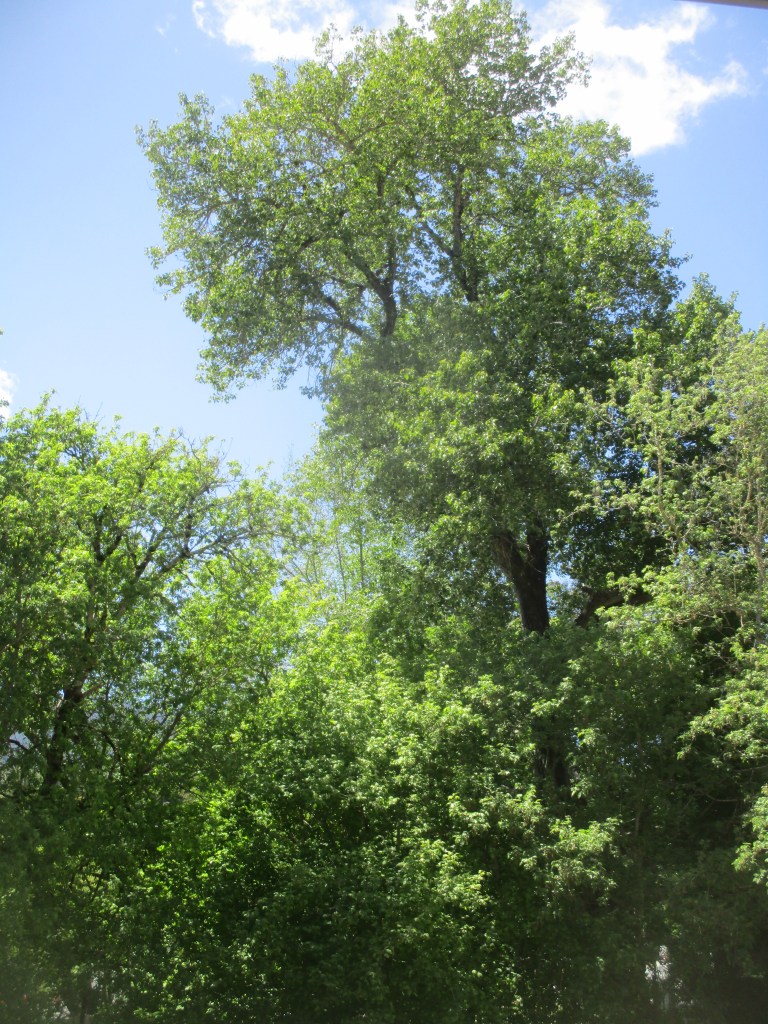
Since the Dutch Elm Disease (DED) epidemic that killed so many old and stately American elm trees so many years ago, the old fashioned Chinese elm, Ulmus parvifolia, has been unavailable in nurseries. That is why there are only old and middle aged trees, and maybe a few feral seed grown trees. Chinese elm is not bothered much by the disease, but is a vector. ‘Drake’ is a modern DED resistant cultivar, but it has a very different personality, with a more upright and symmetrical structure.
The elegantly lanky trunk and main limbs can be quite curvacious, with distinctively blotched gray and tan bark. The deciduous foliage can be messy in autumn as it falls slowly and may linger through December. The neatly serrate leaves are only about an inch or two long, and half as wide. Mature trees can be more than fifty feet tall.
California buckeye resembles related horse chestnut.
Chaparral climates are not easy without irrigation. The long summers are warm and arid. California buckeye, Aesculus californica, knows what to do if it can not stay hydrated out in the wild. It simply defoliates. Yes, it goes bare right in the middle of summer. If it does it early enough, it refoliates after rain resumes in autumn, only to defoliate again for winter.
This ‘twice deciduous’ characteristic is likely why California buckeye is not more popular for unirrigated landscapes of other natives. Shade is an asset through warm summers. In coastal, riparian or irrigated landscapes, the original spring foliage lasts through summer to defoliate in autumn, like that of most other deciduous plants. It may get shabby though.
Nonetheless, California buckeye is a delightful small tree, typically with a broad and low canopy suspended by a sculptural branch structure. Not many get more than twenty feet tall, although some get twice as tall. Bark is strikingly pallid gray. The elegant leaves are palmately compound. Six inch long trusses of tiny white flowers are sweetly fragrant in spring.
Shade trees are no longer appreciated like they had been. Only half a century ago, they were important components of suburban landscapes. Big deciduous trees shaded broad lawns and sprawling roofs during the warmth of summer. They defoliated to let warming sunlight through during winter. Now, modern architecture would not accommodate them.
Sunlight has not changed. Human interaction with it has. Modern homes are significantly taller, so create bigger shadows. They are closer together, with less garden space that is not within their bigger shadows, or shadows of adjacent homes. Higher fences intended to compensate for the minimal proximity of adjacent homes contribute even more shade.
Gardening can be difficult within the limited space and abundant shade of modern home gardens. Small evergreen trees or big shrubs that obscure unwanted scenery above the fences can also obscure much of the sunlight that manages to get past the infrastructure. Substantial vegetation in neighboring gardens can get close enough to be influential too.
The primary part of modern homes that is not excessively shaded is the roof, which is not used for gardening. Trees that are proportionate to modern home gardens are not much taller than associated modern roofs. Modern attics are fortunately insulated so efficiently that shade is not important. Besides, many modern homes are outfitted with solar panels.
Walls and windows of modern homes are efficiently insulated as well. Warming sunlight during winter is therefore not as much of an advantage as it is for older homes, although it is appealing within sunnier homes. Ironically, the utility cables of many modern homes are subterranean, so will not interfere with trees that get too big for their confined spaces.
Regardless of their functions within their landscapes, even small trees can develop roots that are sufficiently aggressive to displace pavement and deck suspensions, particularly since they are likely to be close to them where space is limited. Turf grass that is thin and wimpy because of insufficient sunlight is more susceptible to lumpiness of surface roots. Because of proximity, neighboring gardens must be considered too.
No other maple is native to so much of North America as the common box elder, Acer negundo. Yet, because of innate structural deficiency and a general lack of pizazz, it is also one of the least popular. The smaller and more adaptable garden varieties are more often grown for their interestingly colorful foliage. ‘Flamingo’ starts out with pink, white and pale green foliage that turns richer green and white by summer. ‘Violaceum’ has smokey purplish new foliage that fades to rich green. ‘Auratum’ has yellowish foliage that fades to chartreuse green. Any stems that try to revert to a more natural shade of green should be removed before they dominate. Unlike other maples that have distinctively palmate leaves, box elder has compound leaves with three or more leaflets each.
The natural ranges of black locust, Robinia pseudoacacia, likely included only the Ozark Mountains, the Ouachita Mountains, and the Appalachian Mountains south of New York. Early American colonists planted it elsewhere before botanists documented its origins. It was notably used for firewood, durable lumber, erosion mitigation, and soil conditioning.
Modern cultivars are less useful for such applications, but are more appropriate for home gardens. Regardless of elegantly lofty form, delightfully finely textured foliage, and richly fragrant white bloom, the species is aggressively invasive and wickedly thorny. Cultivars can bloom pink or rosy pink, lack thorns, and develop more compact and shapely forms.
Bloom resembles that of wisteria, with many small flowers hanging in pendulous trusses. Deciduous foliage, which was absent through winter, appears in conjunction with bloom, but does not obscure it. Individual leaves are pinnately compound, with small leaflets on central rachises (stalks). Most modern cultivars will not get much more than forty feet tall, to make moderate shade.
Riparian trees notoriously shed limbs spontaneously.
Winter storms sometimes break limbs or topple trees. Such damage is no surprise during winter because that is when almost all windy weather happens here. Early storms during autumn might be more damaging because deciduous trees are less aerodynamic prior to defoliation. Nonetheless, falling trees and limb failure are typically associated with wind.
That is why spontaneous limb failure is such a surprise when it happens, typically during pleasantly mild or warm weather of spring or early summer. It is more likely without wind than with it. Humidity, although atypical here, is a contributing factor. Healthy trees within riparian situations or lawns are more susceptible than distressed trees in drier situations.
Particular types of trees are more susceptible to spontaneous limb failure as well. Valley oak, coast live oak, sweetgum, carob, some pines and various eucalypti may shed limbs after an unusually rainy winter or an increase of irrigation. Riparian trees, such as willow, cottonwood, box elder and sycamore are notorious for shedding big limbs unexpectedly.
Spontaneous limb failure occurs if limbs are unable to support their own increasing foliar weight. Bloom can add significant weight too. Warmth promotes the vascular activity that increases foliar weight. Humidity and insufficient air circulation inhibit evapotranspiration (evaporation of foliar moisture), which typically compensates for increasing foliar weight.
As the terminology implies, spontaneous limb failure occurs suddenly, and often without warning. It is therefore potentially very dangerous. It is common among limbs that exhibit no prior structural deficiency. Even experienced and educated arborists who are familiar with vulnerable tree species can not identify and mitigate all potentially hazardous limbs.
Arborists often suggest pruning to limit the weight of trees that are innately susceptible to spontaneous limb failure. However, limbs that are already sagging from their own weight are risky to engage. Most damage occurs in spring and early summer. Fruit trees that are too productive can succumb to the weight of fruit as it ripens through summer or autumn.
Too much of a good thing eventually gets old. That is how so many of the good junipers that were so popular half a century ago became so unpopular. They became too common, and many were planted into situations that they were not appropriate for. As they matured, many became overgrown or disfigured. Only recently have a few newly introduced modern cultivars restored the appeal of both new and traditional junipers to a generation that is less familiar with their former stigma.
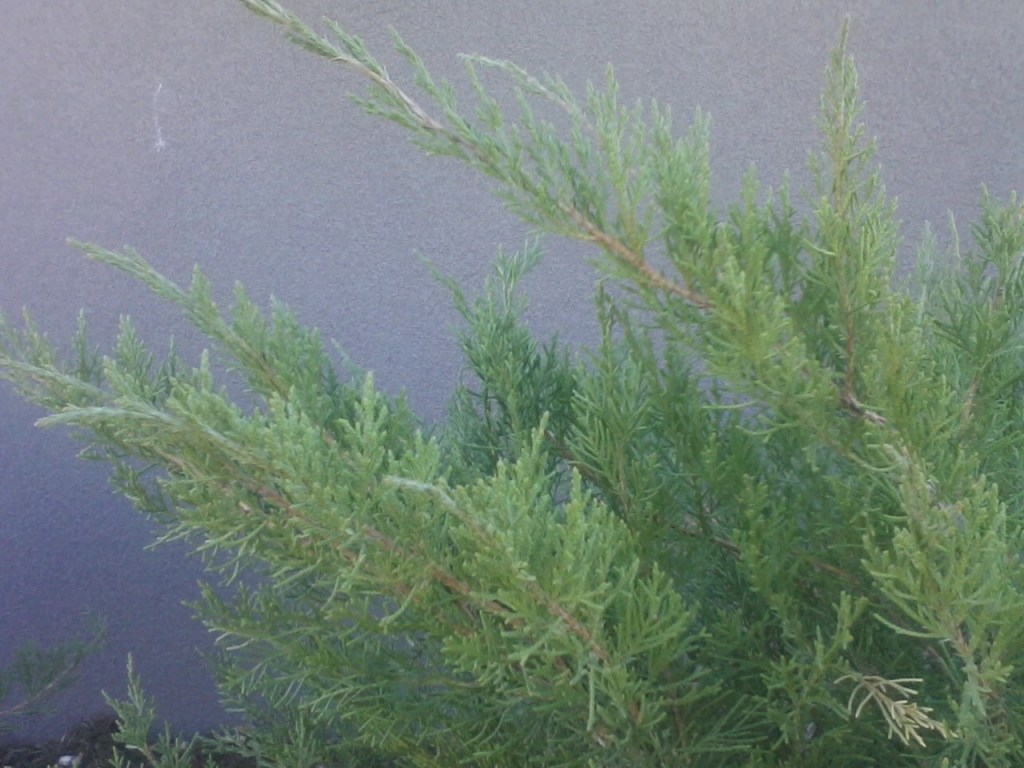
Even though all junipers are evergreen and somewhat similar in regard to foliar texture and their lack of interesting bloom, they demonstrate considerable diversity. Some are low and sprawling ground covers. Others are dense low shrubbery. A few develop as small trees. Branch structure may be densely compact, gracefully arching, rigidly upright, or sculpturally irregular.
Some junipers have yellowish new growth that eventually turns to a more typical deep green. Others are bluish gray throughout. A few rare types are variegated. Almost all junipers have scale-like leaves (like those of cypress). A few have needle-like leaves.
‘Blue Arrow’ and more traditional ‘Skyrocket’ junipers are like short and plump Italian cypress with bluish or gray foliage. ‘Wichita Blue’ juniper is even shorter and plumper, with more sculptural branch structure. However, it is not nearly as irregular and sculptural as the old fashioned ‘Hollywood’ juniper. Modern ‘Gold Star’ and the older ‘Old Gold’ junipers are shrubby types that exhibit arching stems with gold tips.
‘Icee Blue’ is like an improved version of the classic ‘Blue Rug’ juniper, that matures as a shallow bluish ground cover. ‘Blueberry Delight’ juniper is one of the few junipers known for conspicuous fruit, with pretty powdery blue berries against grayish needle-like foliage on trailing stems. ‘Limeglow’ juniper gets a bit deeper, and exhibits chartreuse new growth that turns rich green.
Just because junipers can be shorn certainly does not mean that they should be! Shearing deprives junipers of their naturally appealing texture and form. Instead, junipers should be selectively pruned only where necessary to eliminate growth that is beginning to become obtrusive. Stems should be cut back deeply into the main stems from which they originate, in order to avoid leaving stubs or disfigured stems. Tree junipers like ‘Hollywood’ juniper, as well as overgrown shrubby junipers, can be pruned to expose bare trunks and stems. The gnarly stems and shredding bark can be as appealing as the foliage that obscures them.
Otherwise, once established, junipers do not need much attention or water, and are remarkably resilient. They only rarely get infested with spider mites or scale insects, or get damaged by disease. They only want good sun exposure.
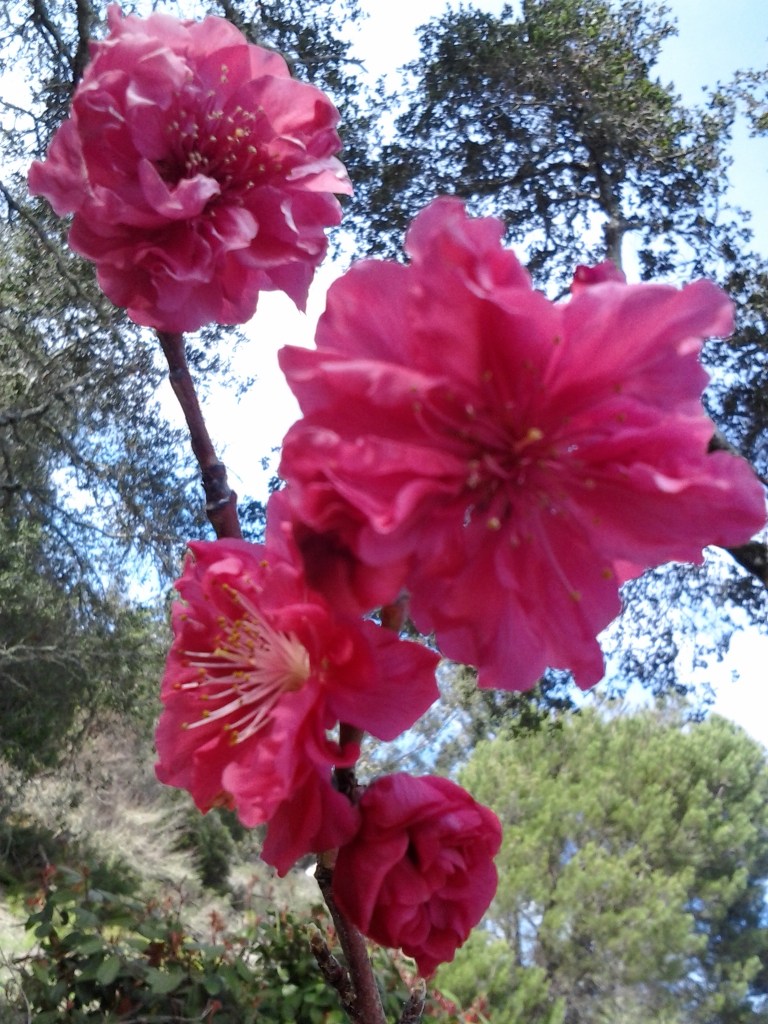
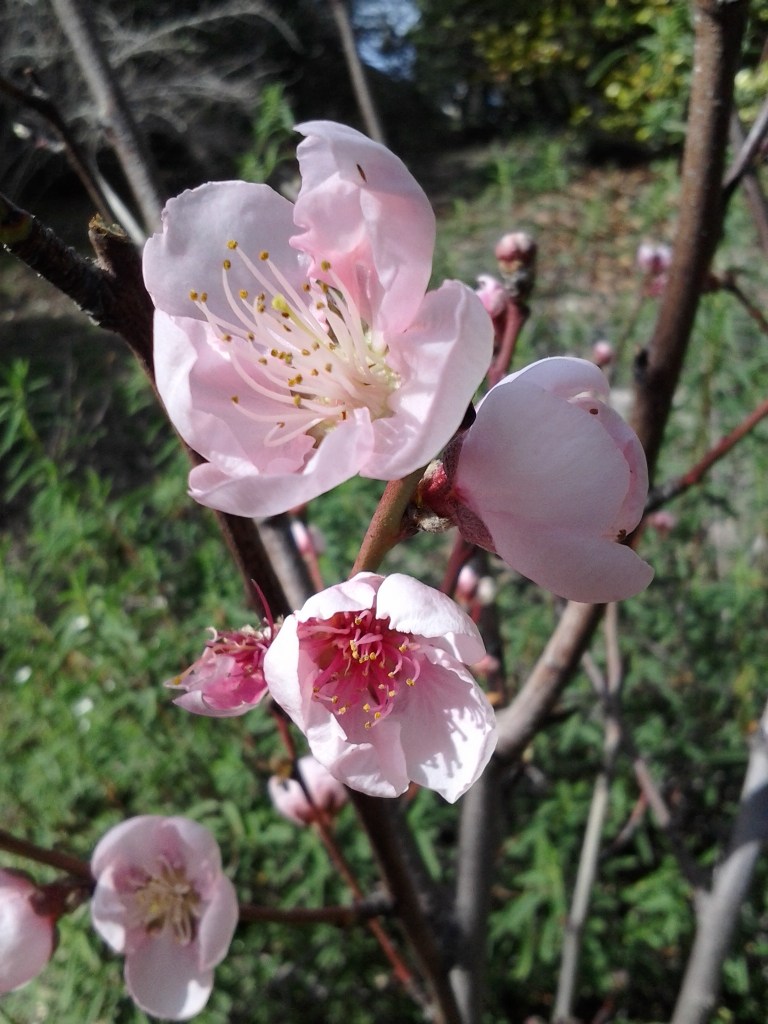
Since it does not produce an abundance of cumbersome fruit, flowering peach, Prunus persica, does not need the aggressive pruning while dormant through winter that fruiting peach requires, and can get significantly larger. However, tip pruning after bloom instead promotes shrubbier growth that blooms more prolifically the following spring. The fluffy double flowers are clear white, bright pink or rich pinkish red. ‘Peppermint’ flowering peach has red and white flowers, with a few flowers that are only white, and sometimes a few that are only red.
All of the popular fruit trees produce flowers. Otherwise, they could not produce fruit. The stone fruits, such as almond, apricot, cherry, peach, plum and prune, bloom very impressively this time of year. (Stone fruits have single large seeds known as stones. Almonds are the large stones of small fruits that resemble peaches.) The pomme fruits, such as apple and pear, bloom about as prolifically shortly afterward, followed lastly by related but rare quince.
The difference between these trees and their counterparts known as ‘flowering’ trees is not so much the flowers, but the fruit. ‘Flowering’ is something of a euphemism for trees that might otherwise be known as ‘fruitless’, since they produce either uselessly small fruit, or no fruit at all.
This may seem silly to those who enjoy growing fresh fruit in the garden. However, fruit trees require so much pruning in winter, and can be so messy if the fruit does not get completely harvested. The flowering trees are happy to provide the profuse bloom without so much maintenance and potential mess. Because they were developed as ornamental trees, their flowers are more impressive, with many more shades of pink, as well as white. Many types bloom with big and fluffy double flowers.
Flowering cherry and plum are probably the most popular of the flowering stone fruit trees. Most flowering plums have purplish foliage, so are more commonly known as purple-leaf plum. Flowering almond, apricot, prune and peach are relatively somewhat rare. Most flowering stone fruit trees are completely fruitless, but some purple-leaf plum can produce messy and sour plums as they mature.
Flowering pear is probably not recognized as such because it is more often known as fruitless pear. Ironically, it can produce enough tiny pear fruit to be messier than other flowering fruit trees. Flowering pear blooms only white, and is not as florific as the other flowering trees, but grows large enough to be a mid-sized shade tree, and has the advantage of remarkable foliar color in autumn. Evergreen pear is an entirely different sort of tree that only blooms well if the weather is just so, and lacks fall color (because it is semi-evergreen).
Flowering apples are known as flowering crabapples. Unlike the other flowering trees, many flowering crabapples develop a sloppy branch structure if not pruned almost like trees that produce fruit. Yet, the weirdest of the flowering trees is the flowering quince, which is not even the same genus as fruiting quince. It develops into a thicket that blooms before everything else. Fruiting quince instead matures into a rampant tree, and blooms after the other fruit trees.
Young trees are so impressionable. Too much water can damage their roots, or cause them to disperse too shallowly. Improper pruning can disfigure their branch structure, and ultimately compromise structural integrity. Improper staking to keep them stable can actually interfere with development of stabilizing roots, and interfere with trunk development.
Newly planted trees will of course want to be watered from spring to autumn for at least the first year, and more likely for a few years. Those that will eventually be less reliant on watering as they mature are actually the most demanding while young, because their confined roots are not yet adequately dispersed for self sufficiency. The problem is that too much water can keep lower soil too saturated for new roots to disperse into. This causes roots to instead disperse closer to the surface of the soil, which is not only unhealthy for the trees, but puts the roots closer to pavement, other plants and any other features that they can eventually damage as they grow.
Many young trees should be pruned as they grow to eliminate structural problems, and to instead promote good branch structure. The problem is that improper pruning can actually cause structural problems that will be with the victimized trees for the rest of their lives. Pruning should leave no stubs that will take longer to compartmentalize (heal), or that might produce vigorous but weakly attached new stems.
Stakes are unfortunately necessary to stabilize new trees. The problem is that the trees can become so reliant on stakes for support that they do not develop enough trunk strength to support their canopy without stakes. That is why trees should be tied loosely enough to their stakes to be able to move at least a little in a breeze. Nursery stakes (that trees are bound to for a straight trunk in the nursery) should be removed when sturdier stakes are added.
New trees are naturally a bit more distressed than mature trees that have settled into their environment. They are consequently more susceptible to disease and insect infestation.