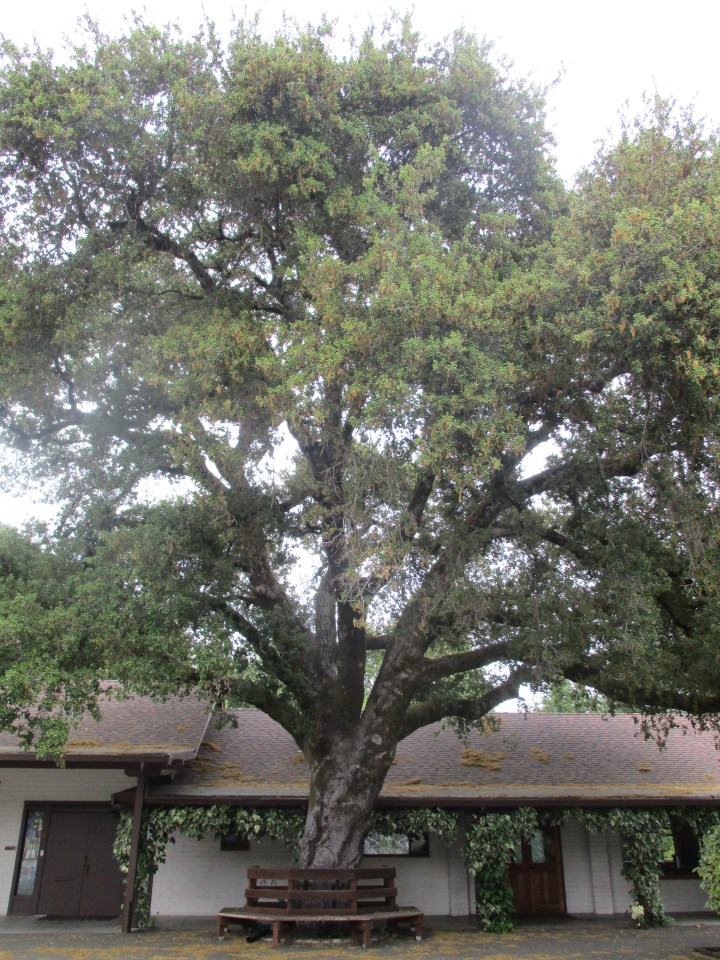
Coast Live Oak

90522The valley oak of the Sacramento Valley, San Joaquin Valley, and coastal valleys to the west, is the grandest oak of North America. Within the coastal half of that range, and extending down past San Diego, the coat live oak, Quercus agrifolia, is a nearly comparable second grandest. The biggest subjects may be as tall as seventy feet, and nearly as wide, with trunks wider than ten feet!

However, there is significant variability. Trees in forest situations do not get as big, and may stay lower than twenty five feet, with shrubby branch structure. While the biggest can get older than two centuries, smaller trees may not live half as long. The canopies of exposed solitary trees might reach the ground, while more social or sheltered trees are likely to shed lower growth with maturity.

Coast live oaks are typically pretty gnarly, and many have multiple flaring trunks. The dark evergreen leaves are only about an inch or two long, and half as wide, with bristly teeth on convex edges. The narrow inch long acorns can be messy. Roots are very sensitive to excavation and excessive irrigation. Sudden Oak Death Syndrome prevents new trees for getting planted in many regions.
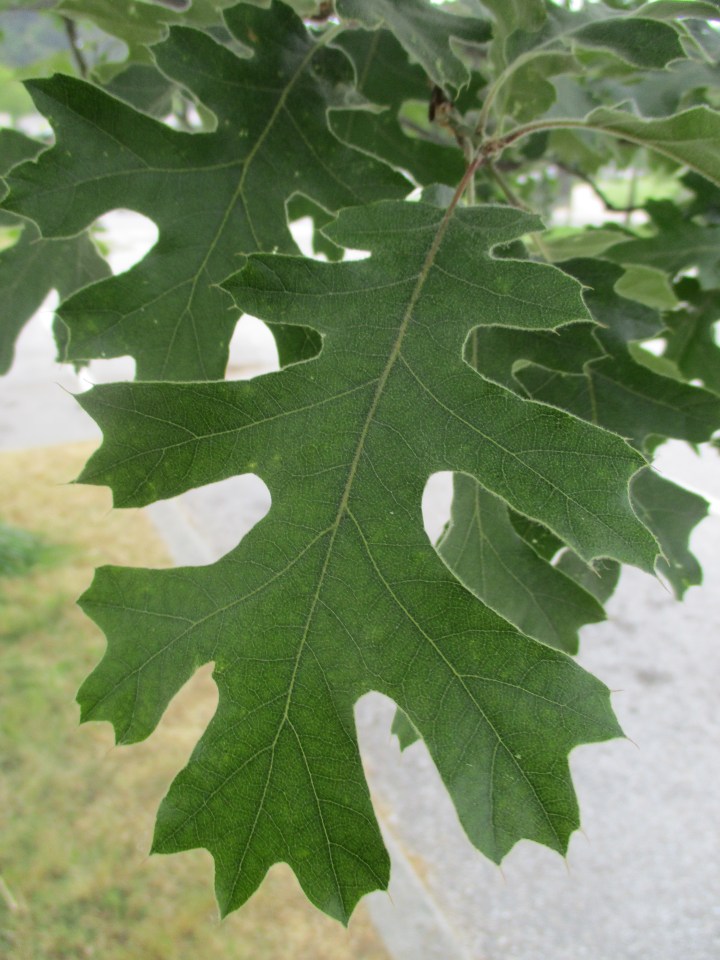
Mighty Oaks From Little Acorns

90522thumbOak, which might seem to be obvious to many of us, was identified by the Arbor Day Foundation as the People’s Choice for American’s National Tree. We certainly like our redwoods and exotic palms in California. Quaking aspen and blue spruce are probably favorites in Colorado. Sugar maple must be the most popular in Vermont. Yet, everyone appreciates the mighty American oaks.
Connecticut, Georgia, Illinois, Iowa, Maryland, New Jersey and the District of Columbia each have an oak as the official state tree. ‘Oak’ is one of the more traditional names for streets and roads throughout America. Just in California, at least eight towns are named after oaks, both in English and Spanish. Oaks put the ‘oak’ in Oaklahoma! (Oakay, maybe that last one is an exaggeration.)

So, now that we know that oak is what most Americans want to be the National Tree, does anyone know what species the oak should be? Well, that will take a bit more work. There are so many in America. There are too many to select from just in California! They are each so unique too. Some grow into grand trees. Others are shrubby scrub oaks. They might be deciduous or evergreen.

It is important to be aware that, just because oaks are the most popular trees in America, they are not necessarily appropriate for home gardens. Some, particularly in California, are best in the wild outside of landscaped areas. Some get too big. Some are too messy with acorns and leaves that fall slowly for a long time, either evergreen or deciduous. Some are susceptible to disease.

It is also important to be aware that big mature oaks, as rugged as the seem to be, are remarkably sensitive to modifications to their environment. Wild oaks that matured in areas that were not landscaped can succumb to rot in only a few years if the ground below them gets landscaped and regularly watered. Oaks planted into new landscapes adapt to the watering they get while young.

For landscapes that can accommodate them, oaks are grand and elegant shade trees that last a lifetime. There are many good reasons for their popularity.


Apologies for posting tomorrow’s article today. Today’s article will be posted tomorrow.

Santa Cruz Island Ironwood

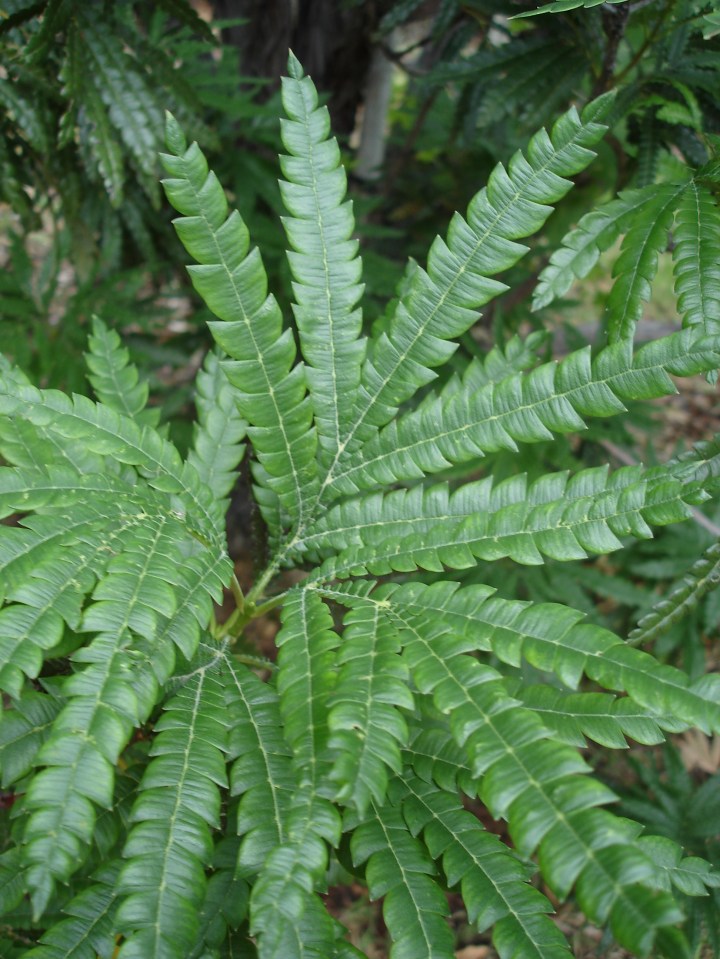
60504A few years ago, it was known as Santa Catalina Island ironwood. However, the rare subspecies native to Santa Catalina Island lacks the distinctively angular foliar lobes of the Santa Cruz Island ironwood, Lyonothamnus floribundus ‘aspleniifolius’. The evergreen compound leaves are about five inches long and four inches wide with three or five narrow leaflets, and look like chicken feet.

Young trees can grow at an impressive rate, but rarely get to thirty feet tall, which is only half as tall as they get in the wild. Most stay rather narrow, and shorter than a two story house. They work nicely in groves, but not as symmetrical groupings. Each tree has a unique personality and form, and some stay smaller than others. The finely shredding bark fades from cinnamon brown to gray.

Six inch wide trusses of tiny white flowers bloom late in spring or early in summer. These circular trusses are flattened, similar to those of toyon but larger. They fade to brown and can hang among the foliage for years. Older trees bloom more than vigorous young trees do. Deteriorating older trees can be cut to the ground and allowed to regenerate with fresh new growth from their stumps.

Redwoods Are So Tall . . .

P90428Redwoods are SO TALL!
How tall are they?
They are so tall that you can see for yourself if you look in this direction . . . from anywhere in North America.
They are so tall that if you need firewood, I can aim one in your direction as I cut it down.
They are so tall that while they drop foliar debris on the Ford and Chevrolet parked below, they also drop foliar debris on Mercury and Saturn in their respective orbits.
They are so tall that while other trees collect kites and Frisbees, they collect airplanes and satellites.
They are so tall that only a few of their seed survive. Most burn up in the atmosphere on their way down.
They are SO BIG too!
How big are they?
They are so big that some have tunnels cut through them so cars don’t run out of gasoline while driving around.
Okay enough of that for now.
Most of the biggest redwoods here were harvested, leaving only stumps to remind us of how big they were. The few trees that were big enough for harvest a century ago, but were not harvested when those around them were, probably exhibited some sort of defect that made their lumber undesirable.
The tree in this picture happens to be one of the few that is big enough now to suggest that it was likely big enough for harvest when those around it were harvested. The trunk is more that six feet wide. Yet, except for the severe lean, no obvious defects were observed. (The vertical edge of the doorway to the left was included in the picture for comparison with the lean of the tree.)
The tree started to lean only recently. If it had taken several years to develop this lean, the top several feet of the trunk would be curved upward, as it would have continued to grow vertically away from gravity while the trunk below it moved. If it moved suddenly but only once several years ago, there would be a kink near the top of the otherwise leaning trunk, from which, subsequent growth would be vertical.
This tree instead leans with a straight trunk from bottom to top, which means that it grew vertically, and then moved into this diagonal position too recently for new vertical growth to develop. Lateral branches are also diagonal, as they maintained their position perpendicular to the trunk. Although redwoods rarely destabilize, this one really seems as if it is about to fall.
Is this destabilization relative to some sort of deficiency that prevented the tree from getting harvested a century ago? I really should investigate.

Horridculture – Weed Eaters

P90410The most destructive tools that so-called ‘gardeners’ have access to are hedge shears. They use them on just about anything within their reach. If a tree is not beyond their reach, they are likely to shear it into a nondescript glob of a shrub, complete with lodgepole stakes and straps that never get removed. Yet, in all their enthusiasm, they will not properly shear hedges that are actually intended to be shorn. Well, I have ranted on that enough.
The second most destructive tools that so-called ‘gardeners’ have access to are weed eaters, which are also known as weed whackers or edgers. Although not actually related to real edgers, they are known as such just because they are so commonly used for the same purpose. Weed eaters are designed to cut weeds indiscriminately, and are quite efficient at doing so. The problem is that they cut or try to cut anything else they encounter.
So-called ‘gardeners’ often gouge the paint off of the bottoms of walls and fences, just because it is easier to cut the weeds there with a weed eater than it is to pull them. What is worse is that they also often cut off the tops of perennials that are trying to regenerate in spring after winter dormancy. Spring or summer bulbs might never get a chance to bloom. Perennials, groundcover plants and shrubbery are not safe from the blatant indiscretion.
The sad little Memorial Tree in Felton Covered Bridge Park gets gouged more than annually by a weed eater. Every time it happens, I am assured that it will not happen again; but if the weeds get cut before I pull them from around the trunk, it does . . . very regularly. I was also assured that the tree would be outfitted with a tree-guard, but as you can see, it has not yet happened. I am told that I can not put my own guard on the trunk.
Those causing this damage are non-horticulturally oriented people who are assigned community service for some sort of infraction, so should not really be expected to know how to use weed eaters properly; not that this is any consolation for the damage. What is worse is that such damage is so commonly caused by so-called ‘gardeners’ who really should know better, and charge good money to take care of the trees they damage and kill
The most recent article about the Memorial Tree, with a link to a previous article that links to previous articles . . . and so on, can be found at: https://tonytomeo.com/2018/10/14/memorial-memorial/

The End Of The Cherry Blossom Festival

P90331After decades of spectacular spring bloom, this pair of flowering cherry trees in the picture above must be removed. They have been deteriorating for a very long time. Below the limber blooming branches of the tree on the right, there is not much more than a bulky rotten trunk, one rotting limb, and a short stub of a limb that was cut back to a bit of viable twiggy growth last year. The tree to the left has only a few more viable but rotten limbs.
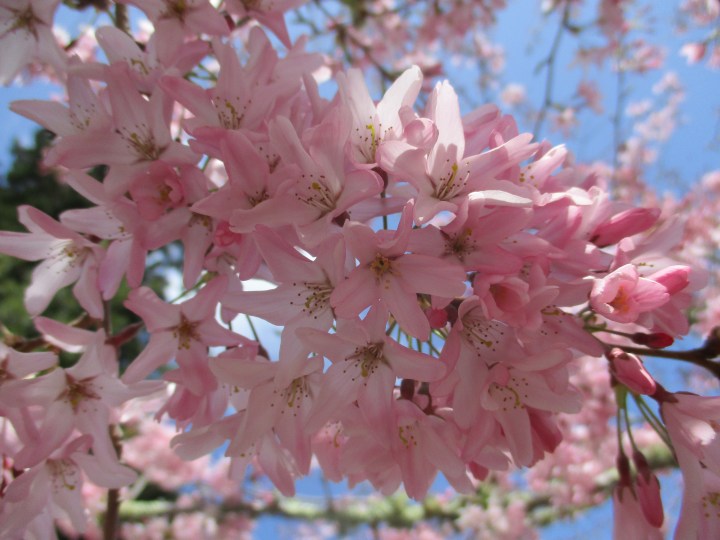
Through this last winter, it was finally decided that we would allow them to bloom one last time, and then replace them with a new pair of trees of the same cultivar. I will cut them down myself. I do not want anyone else to perform this unpleasant task. Nor do I want such dignified and admired trees to be cut down by anyone else. Like I do for other prominent trees, I will write the obituary; a joint obituary for two who were always together.
Since the new trees will be of the same cultivar, they will bloom with the same profuse pale pink spring bloom, and will hopefully last for more than half a century like the originals did. Because the originals had been pruned back so severely as they deteriorated over the past many years, the new trees should grow to be as large within only a few years. They will not be the same though. There will be no adequate replacement for the originals.
The cherry blossoms below are of another pair of trees a bit farther up the road. They are not nearly as old, so could be there for a few more decades. There are a few others, of various ages and different cultivars, scattered about the neighborhood.P90331+P90331++

Horridculture – All Wet

P90327Regardless of their individual innate requirements for water, new plants need to be watered very regularly immediately after they are installed into a landscape. As they mature and disperse their roots, the regularity of supplemental watering becomes less important, and ‘drought tolerant’ plants may not need to be watered at all. Maturing larger trees generally get what they need from the landscape around them.
Automated irrigation systems that are designed for new landscapes are designed for what the plants need while the landscapes are new. As the landscapes mature, the irrigation systems may need to be adjusted accordingly. Drip irrigation or bubblers that were needed to water new trees while they were young and confined should be moved farther from the trunks of the trees as roots disperse, and should eventually be removed and capped.
This is very important, since water applied directly to the trunks of some maturing trees will promote rot and other disease. For some, it promotes buttressing of roots that can displace concrete or other landscape features. If nothing else, it is just a waste of water.
Whoever installed the irrigation to this young London plane tree knew how to do so properly. The bubbler was likely over the confined root systems of the formerly canned tree just after it was installed. It is installed in such a manner that it could have been moved over as the tree grew, replaced with some sort of drip irritation hose to curve around the tree (if such a device had become necessary), or simply removed.
Now that the tree is as mature as it is, the bubbler should simply be removed, and the riser (where the white ‘L’ is) should simply be capped. The tree gets what it needs from the rest of the landscape around it, and really does not need much water anyway. It could probably survive without any supplemental irrigation at all. The bubbler is really just wasting water.
However, because so-called ‘gardeners’ are what they are, the bubbler remains, attached to an unsightly bit of exposed pipe, and wasting water on the base of the trunk of the sycamore. Because this tree and associated bubbler are right next to a parking spot in a parking lot, the pipe is very likely to get stepped on and broken every once in a while. In fact, the fresh Teflon tape on both ends of the pipe suggest that it was repaired quite recently, rather than removed.
Fortunately, the sycamore will not likely be damaged by water applied directly to the base of the trunk.

Pantry

P90324Birds do some odd things. They seem to know what they are doing. The odd things that they do make sense. Nonetheless, some of what they do out there is just plain odd.
I mean, who was the first woodpecker who thought it might be a good idea to bang his head against a tree? What prompted the first sapsucker woodpecker to bore through bark of a healthy tree to lap up the sap from the cambium within? Why do other woodpeckers bore into rotting dead trees for grubs, and to make nests? The different types of woodpeckers seem to be related, but they are after different things. Did one just accidentally bore into the wrong sort of tree, and discover something more than what was expected?
Various species of woodpeckers are surprisingly omnivorous. Those who eat termites also eat other insects, nuts, acorns, berries and fruit. Sapsuckers also eat insects, berries, small nuts and such.
Many woodpeckers are social, and live in significant communities. Those who bore into dead tree tops to nest prefer to live where there are several dead trees tops to bore into, probably because too many nests in the same tree would compromise the structural integrity of the already decaying trunk. Besides, if they all lived in the same dead tree, they would all become homeless at the same time if the tree fell down.
Colonies of some species of woodpecker store nuts or acorns in rotting dead trees. They can store quite a bit in each tree because the holes bored to hold the individual nuts and acorns are not as big as the holes that they nest in, so do not compromise the integrity of the trees as much. Besides, it is easier to defend many acorns and nuts in a few trees than it is to defend them in many trees. Squirrels who want the same acorns and nuts are very sneaky!
The problem with putting all their eggs in the same basket, or all their acorns in a few trees, is that when one of such trees falls, it takes a significant portion of their stored nuts and acorns with it. Once on the ground, it is impossible for them to defend it from squirrels and rats.
This particular rotting ponderosa pine fell and needed to be removed from the roadway that it fell onto before woodpeckers could recover the acorns that they so dutifully stored in it. The precision with which the holes were carved to custom fit each acorn that they hold is impressive. The woodpeckers who did this really know how to manage their pantry.

The Davey Tree

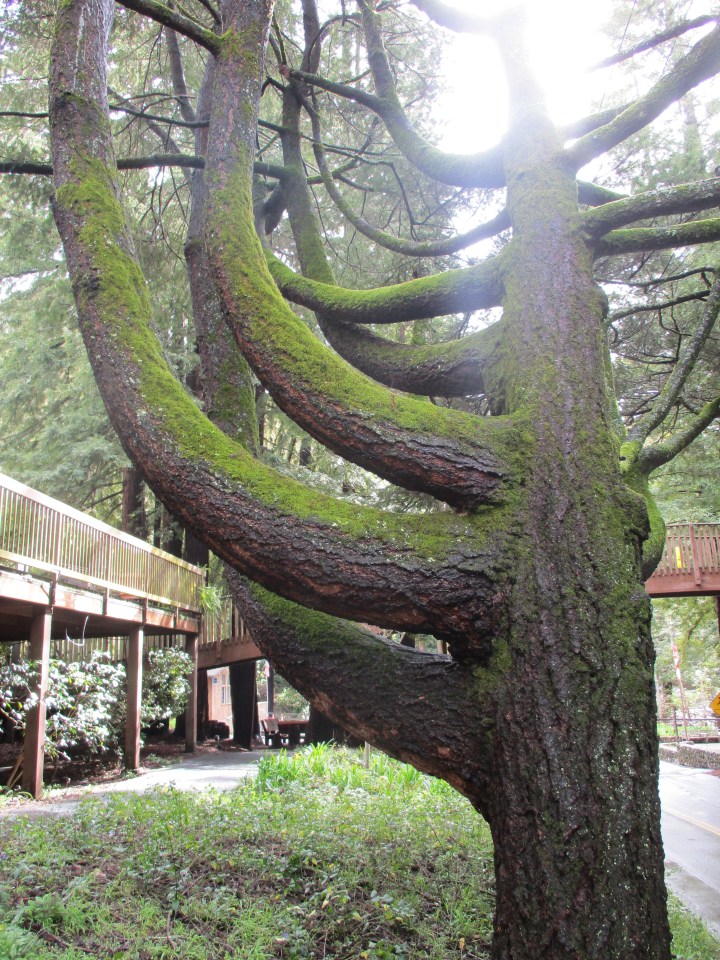
P90317This is no common Douglas fir. It is the ‘Davey Tree’, named after the tree service that so diligently prunes it for clearance from the utility cables above. Yes, I can see as easily as you can how disfigured it is. The plan is to cut it down before it falls apart. At least that is the excuse for cutting it down. It is relatively short an stout, so is likely quite able to support its own weight, regardless of this disfigurement. We really just want it gone because it is so unsightly.
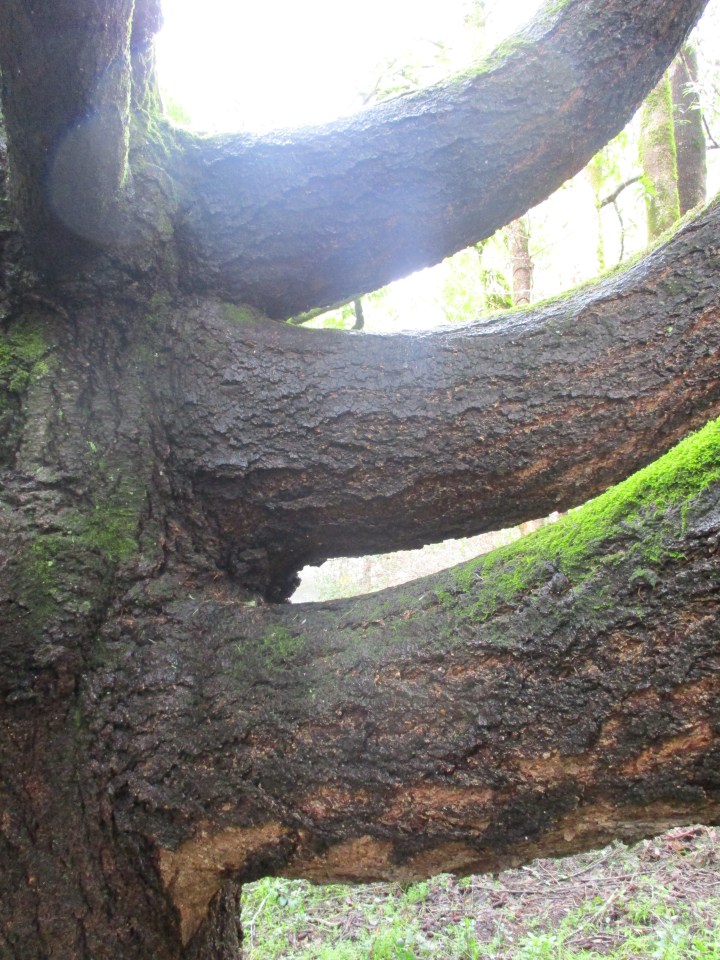
Most who see the Davey Tree are quick to blame the disfigurement on those who prune it for clearance. They do not consider that without such pruning, the utility cables would eventually be ruined and unable to deliver the electricity that so many of us use. Those who prune the trees do what they must to keep the electricity and other utility cables operational. Unfortunately, such work sometimes ruins trees.
As an arborist who sometimes works with other arborists who must perform clearance pruning, I am more likely to blame other landscape professionals. Some landscape designers design landscapes with trees that get too tall or broad within utility easements. Heck, many designers do not even designate where such easements are on the drafts of their landscape plans. Some so-called ‘gardeners’ plant such trees in utility easements with no plan at all. For what they all charge for their services, landscape professionals should know better than to put inappropriate trees into situations where they will eventually need to be mutilated or removed. Not many think that far ahead, or even care.
Anyway, the inappropriate location and disfigurement of the Davey Tree really can not be blamed on anyone. It is a wild tree that grew there from seed.P90317+

Trees Need Clearance From Utilities

30320thumbPalm trunks grow in only one direction; upward, toward sunlight and away from gravity. Each trunk is equipped with only a single terminal bud. If that bud encounters an obstacle, it can not be pruned around it. Palm trunks that get get too close to high voltage cables, or that might sway too close with a breeze, must therefore be removed to maintain minimal clearance from the cables.

Queen palms are notorious for getting planted under high voltage cables because they are so often impulse purchases that get planted without much planning. They are popularly planted along rear fences, exactly where high voltage cables are often located. Mexican fan palms often grow along rear fences as well because that is where birds and rodents are likely to drop the seeds.

Trees with single central leaders, like redwoods, spruces and certain pines, will be disfigured if their main trunks need to be topped for clearance from cables. Removal of such trees is often more practical than this sort of disfigurement. More extensively branched trees like sycamores, ashes, oaks and elms, are more adaptable to clearance pruning if it is not too severely disfiguring.

It is much simpler to not plant trees that get too large under high voltage cables. Elsewhere in the garden, where there is enough lateral (side) clearance, vertical clearance is not such a problem for larger trees. Small trees like redbud, purple leaf plum, photinia and various pittosporums, either do not get tall enough to reach upper cables, or will require only minimal pruning for clearance.

Below high voltage cables, the lower cables are for lower voltage, telephone and television. ‘House-drops’ are the cables that extend from utility poles to houses and other buildings. Although clearance is not so important for these lower risk cables, limbs that lean on them and blow around in wind can be abrasive. Sagging limbs can cause utility cables to sag more than they should.

Unfortunately, those who prune trees for utility clearance are efficient, but rarely arboriculturally correct.