 There are mixed emotions about tree removal permits that so many municipalities need to issue in order for a ‘heritage’ tree to be cut down legally. Most of us want to believe that in America, we have certain rights to do what we want to on the properties that we own. Obviously, that makes the most sense. However, if it were that simple, many more prominent trees that are collective assets to the larger communities would be removed.
As an arborist who writes the reports needed to procure these permits, I see it both ways. There are many trees that are worth preserving for the Community, and there are probably many more that must be removed for the safety of those who live around them.
I sometimes hear of common homeowners who get fined for removing a tree without a permit, just because they were not aware that it was protected by an ordnance. Most have lived in their homes longer than such ordinances existed. Most planted the tree that they were fined for removing.
Conversely, I also hear about developers who just remove whatever trees get in the way of their developments, and then just pay the necessary fines. It is nothing to them because they make so much money from the development.
The picture above is a site that one of my former employers worked on just before I left my job because it was too morally challenging. You can see that there are no significant trees. The tree crew removed all of them.
I was not aware of it of course. The Home Owners Association did not want to pay for my inspections and reports, or for the permits to remove all the big sycamores in the front gardens there. Nor did they want to replace the removed trees with something more proportionate, as the local municipality would have required. They were not worried about getting caught, since everyone there wanted the trees gone.
Now realistically, I would have had no problem writing reports recommending the removal of all the trees, because they were ridiculously disproportionate to their particular application. You can see how tiny the front gardens are. It was just easier and less expensive to cut the trees down illegally, and then not be required to replace them with trees that would have later died ‘accidentally’ anyway. (The tree crew excelled at that too.)
In the end, it is disgraceful that the trees that were required as a contingency when the site was developed years earlier are now completely gone, and will not be replaced, . . . and that no one seems to care.
Horridculture – Metasequoia glyptostroboides
 The easier name is ‘dawn redwood’. I just used the big and fancy Latin name because that is how landscape designers with something to prove say it. If the big name does not impress clients, an explanation of how rare it is, and that it is one of only a few deciduous conifers, will likely do the job. Even back when it was still a fad, I got the impression that was its main function; to impress clients.
It is not even a particularly practical tree. If it gets too big for its situation, it is difficult to contain without disfiguring the canopy. Because the priorities for most were conformity to a fad and to dazzle a client, not much thought went into their appropriateness to their respective landscapes. Consequently, many went into landscapes that were not big enough for them.
Although deciduous, dawn redwood does not even get good color in autumn. It just turns rusty brown, and quite frankly, looks dead.
It is true that there are only a few deciduous conifers. However, the dawn redwood stopped being rare shortly after it became a fad. I mean, how rare can it be if every landscape designer with something to prove gets to plant one?! Isn’t that what happened to the formerly rare yellow clivia after it became a fad?
The only one that I work with now happened to be planted before dawn redwood became a fad. I suppose that makes it okay. It is quite tall now, and has plenty of space to mature. However, I can not help but notice how silly it looks with all the other surrounding coastal redwoods. Although very different, it is similar enough to look like a coastal redwood with some serious problems, especially when it seems to die every autumn.
Vines For Better Or Worse
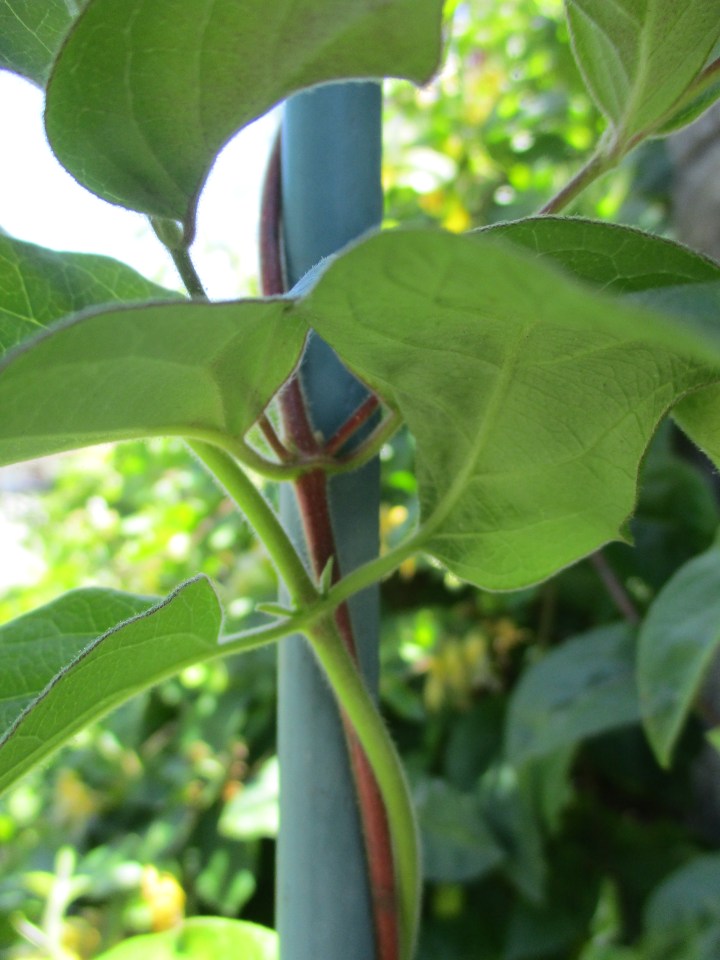 Vines in the wild are downright exploitative. They do not support their own weight, so instead climb or sprawl over shrubbery and trees. Some are satisfied staying down below the canopy of the hosts who support them, as if aware that a healthy host will support them for a good long time. Many vines climb aggressively to the top and overwhelm their hosts, even if it eventually kills them.
There is nothing civil about the technique of the strangler figs, which incidentally includes two popular houseplants, fiddle-leaf fig (Ficus lyrata) and creeping fig (Ficus pumila). They wrap their hosts in networks of stems and roots that strangle the hosts as both the hosts and the clinging vines grow and expand. As the hosts die and rot, the vines develops into self supporting tree trunks.
That is how fiddle-leaf fig, as it is known as a houseplant, grows as a free standing tree rather than as a creeping vine. It is grown from cuttings from the self supporting adult growth rather than the creeping juvenile growth. Conversely, creeping fig is grown from juvenile vines, which find a support to cling to, and ultimately develop shrubby adult growth when they get to the top of the support.
English and Algerian ivies are not quite as aggressive, since they do not intend to kill their hosts. They are not often intentionally grown as vines, and are almost never planted anymore, but their juvenile growth still works as ground cover in many mature landscapes. One of the main problems with ivy is that it is constantly trying to climb walls and trees so that it can bloom and toss seed.
That is not such a problem on concrete walls, but ruins wooden and painted surfaces, and makes a mess of trees. Boston ivy (which is not really an ivy) lacks a juvenile ‘ground cover’ phase, but if kept off of painted and wooden surfaces, happens to work better on concrete infrastructures. It is important to know how a particular vine will behave before selecting it for a particular application.
Carolina jessamine, mandevilla, lilac vine and star jasmine are a few complaisant vines.
Box Elder
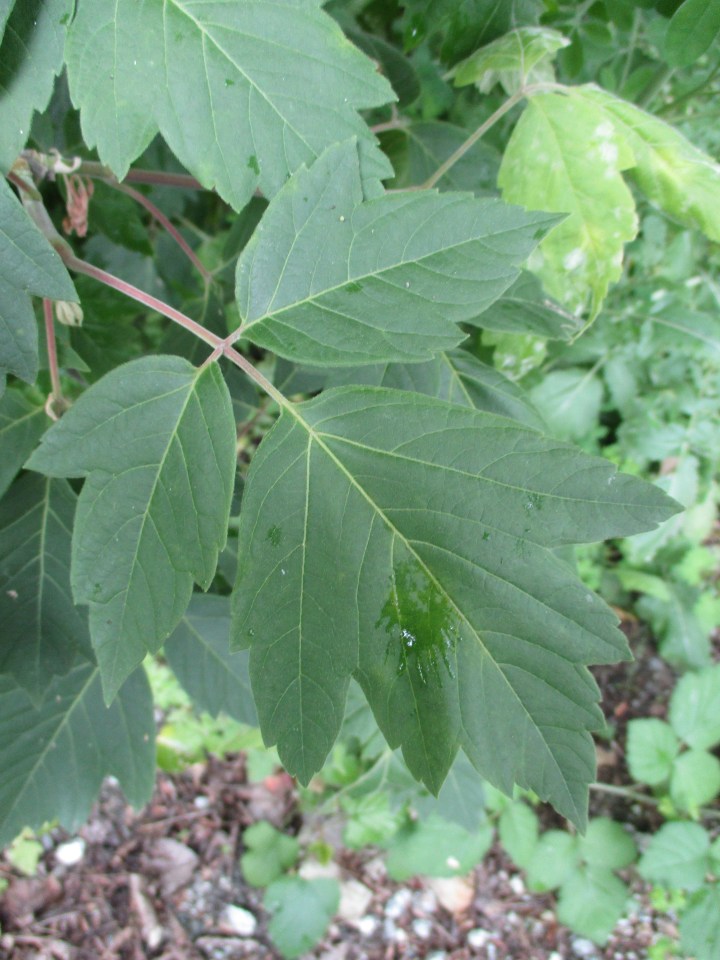 This ain’t no ordinary maple. Although there are other maples with trifoliate leaves (divided into three distinct palmately arranged leaflets), box elder, Acer negundo, is the only maple with pinnately compound leaves (divided into three or more distinct leaflets that are arranged pinnately on a central rachis). Leaflets might be solitary too. Almost all other maples have palmately lobed leaves.
Box elder is considered to be the ‘trashy’ maple. It grows fast, but only lives for about half a century. The happiest barely get to be twice as old. Because it gets more than forty feet tall, possibly with multiple trunks wider than two feet, it can become quite a big mess as it deteriorates and drops limbs. Yet, it is aggressive enough to have naturalized in many regions where it is not native.
Despite all this, and the lack of good foliar color where autumn weather is mild, a few cultivars of box elder have been developed for landscape use. ‘Flamingo’, which is likely the most popular, is variegated with white through summer, after pink new growth fades. ‘Violaceum’ develops smoky bluish growth in spring. ‘Auratum’ starts out yellowish. Mature leaflets are about three inches long.
Spontaneous Limb Failure Is Real
 It sounds like science fiction, but it is not. Every spring and during particular summer weather, limbs can fall from trees without warning, and seemingly for no reason at all. It happens when least expected, while the weather is warm and perhaps humid, but notably without wind. The lack of wind is what makes it so unexpected. It is a phenomenon known simply as spontaneous limb failure.
Those who witness it might think that the arborists they call to clean up the mess will not believe their descriptions of what happened. Yet, arborists are familiar with it. Quite a few species of trees are notorious for it, especially in urban landscapes where they get watered regularly. Most of such trees are either chaparral trees that do not expect much water, or riparian trees that do expect it.
Spontaneous limb failure occurs as warmth accelerates vascular activity, but humidity inhibits evapotranspiration, which is evaporation from the foliage. Accelerated vascular activity increases the weight of the foliage. Inhibition of evapotranspiration limits the ability of the foliage to eliminate some of the excess weight. Limbs break if unable to support the increasing weight of the foliage.
Spontaneous limb failure is not as easy to predict as the more familiar sort of limb failure that is caused by wind. Limbs that get blown down typically exhibit some sort of structural deficiency or disfigurement prior to failure. Some limbs that succumb to spontaneous limb failure do so as well, but most do not. They just happen to be the healthiest and most densely foliated parts of a tree.
Native coast live oak and valley oak are the two most familiar of the chaparral trees that are notorious for spontaneous limb failure. Native cottonwood, willow, box elder and sycamore are riparian trees that are perhaps even more susceptible to spontaneous limb failure. Sweetgum, carob, stone pine and various eucalypti are some of the exotic trees that might drop limbs spontaneously.
In summer, spontaneous limb failure is less likely as growth slows and limbs strengthen.
Campground II
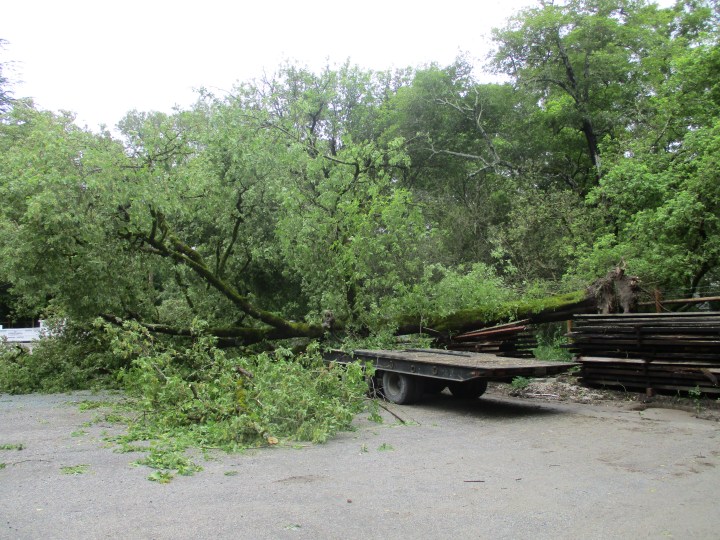 This is a formerly unplanned sequel to the article ‘Campground‘ from last Sunday. That article described my concern for any of the homeless who might camp on the banks of an adjacent creek, below innately unstable and structurally deficient riparian trees. Just a few minutes after the article posted at midnight, the biggest and most deteriorated box elder tree in the area of concern coincidentally fell! No one was there at the time to be hurt.
The tree that fell was located just a few yards to the right of those in the picture of the previous article. It happened to be the only tree that was inside the fence. Therefore, as it fell inward, it did not damage the fence. The trailer that it landed on is for heavy tractors, so was undamaged. Only the top few timbers of a pile of lumber that it landed on were broken, and only because the lumber was recently milled, and stacked so loosely to dry.
The upper picture at the top shows the fallen tree laying on the trailer and loosely stacked lumber, with its dislodged trunk suspended above the ground. The middle picture here shows the base of the dislodged trunk suspended pitiably above the ground, with no roots remaining attached to the soil.
The lower picture below shows how efficiently the trunk pulled out of the crater as if there were no roots holding it down. The few roots that were there were so decayed that none stayed attached to the soil. It is amazing that the tree did not fall earlier! When if fell, it sounded just like one might imagine it would, with a loud but quick crash. There was no sound of tearing or crunching roots. Fortunately, there was no one else there to hear it!
Campground
 There happen to be quite a few campgrounds in the region, with one about a quarter of a mile upstream from where this picture was taken, and another less than three miles past that. Both are primarily used by school age children. The vast redwood forests with creeks flowing through are ideal for such campgrounds.
This is a campground too. I know it does not look like it. It is located between a creek and an industrial building, the eave of which is visible in the top right corner of the picture. The herd of dumpsters that is barely visible at the bottom of the picture might include a dozen dumpsters at at time. (I tried to get both the eave and the dumpsters in one picture.) There really are two rows of barbed wire on top of that fence behind the dumpsters.
Nonetheless, it is a campground. You see, individuals who lack adequate shelter occasionally camp on a flat spot next to the creek, right below the big cottonwood tree in the middle of the picture. It is not a big space, so can only accommodate one or maybe two people at a time. No one has been there for quite a while. Yet, on rainy days like today, it is saddening to imagine someone camping there, so close to inaccessible buildings.
Because the area is outside of landscaped areas, I do nothing to make it any more comfortable as a campground. I only cut away the limbs that fall onto the fence.
The trees are a mix of mostly box elders, with a few cottonwoods and willows, and even fewer alders, with one deteriorating old bigleaf maple. They concern me. Box elders, cottonwoods and willows are innately unstable. All but bigleaf maple are innately structurally deficient. Although bigleaf maple should innately be both stable and structurally sound, the particular specimen in this situation is in the process of rotting and collapsing.
I really do not mind if limbs or entire trees fall into the forested riparian zone. If they fall outward, they do not damage the dumpsters. Only the fence needs to be repaired. What worries me are the potential residents of the campground. Part of my work is to inspect trees for health, stability and structural integrity, and if necessary, prescribe arboricultural procedures to make them safe. I just can not do that here.
UPDATE: Just after this article posted at midnight, a very big box elder off to the right of those in the picture fell with a loud but quick crash. It was probably the biggest and most deteriorated of the box elders in this area, and pulled completely out of the ground to reveal that the roots were so decayed, that none stayed attached to the stump. Seriously, you should see the pictures when they get posted next Sunday.
Six on Saturday: Willow
Rain is rare here so late in the season. It is also potentially damaging to some of the plants in the landscapes, and some of the latest of the spring flowers that are still blooming. Most of the deciduous plants are lush with new foliage on limber stems that are still adapting to the increased foliar weight. Foliage gets even heavier when it gets wet from rain. For the willows, the extra weight is enough to break limbs.
Willow limbs do not often break away cleanly. They instead split apart so that they fall slowly while still attached to the main tree. In the swampy conditions where they naturally grow, the broken but still attached limbs develop roots where they touch the ground, and then grow into new trees. Broken limbs are therefore not a problem for willows. Nonetheless, they are a problem in the landscapes.
1. This looks like mozzarella cheese being pulled apart. My great uncle used to bring some of the good Italian stuff when he came up from Long Beach for some of the Holidays. Oh my, how off topic!
2. This is what it really was. Willow limbs are surprisingly weak this time of year. They don’t just break. They split apart. I should have gotten a picture of it before I cut it up.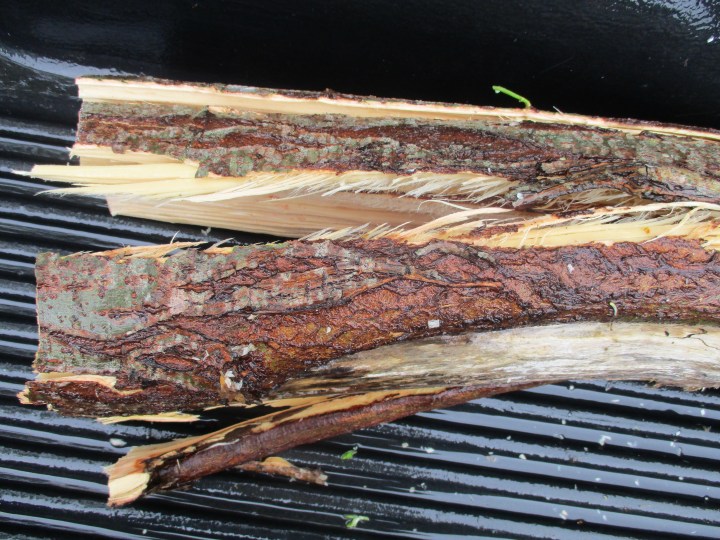
3. It landed right across a walkway, where I could not put off breaking it apart and taking it away. With all the rain that caused it to break, the lawn was too swampy to walk around on.
4. It landed on this bench too, or at least the left half of it. With hundreds of acres of unused and unlandscaped forest out there, why must falling trees land in such inappropriate situations?
5. All that mess was not even a full load. It just didn’t take up much space after it was all broken apart and loaded up. There was plenty of other willow to cut later in the day, and for the next few days.
6. Willow! My niece named him. I knew better than to argue. I never liked the name though. I and almost everyone but my niece knew him as Bill, which is short for Willow. My friend Steven knew him as William.
This is the link for Six on Saturday, for anyone else who would like to participate:
https://thepropagatorblog.wordpress.com/2017/09/18/six-on-saturday-a-participant-guide/
Coast Live Oak
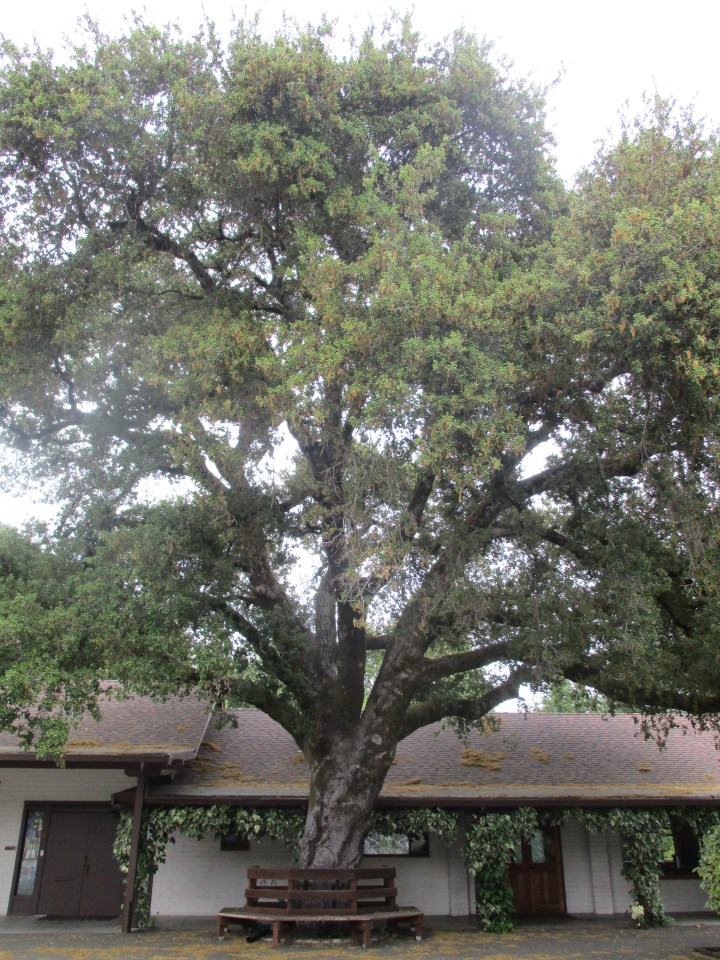 The valley oak of the Sacramento Valley, San Joaquin Valley, and coastal valleys to the west, is the grandest oak of North America. Within the coastal half of that range, and extending down past San Diego, the coat live oak, Quercus agrifolia, is a nearly comparable second grandest. The biggest subjects may be as tall as seventy feet, and nearly as wide, with trunks wider than ten feet!
However, there is significant variability. Trees in forest situations do not get as big, and may stay lower than twenty five feet, with shrubby branch structure. While the biggest can get older than two centuries, smaller trees may not live half as long. The canopies of exposed solitary trees might reach the ground, while more social or sheltered trees are likely to shed lower growth with maturity.
Coast live oaks are typically pretty gnarly, and many have multiple flaring trunks. The dark evergreen leaves are only about an inch or two long, and half as wide, with bristly teeth on convex edges. The narrow inch long acorns can be messy. Roots are very sensitive to excavation and excessive irrigation. Sudden Oak Death Syndrome prevents new trees for getting planted in many regions.
Mighty Oaks From Little Acorns
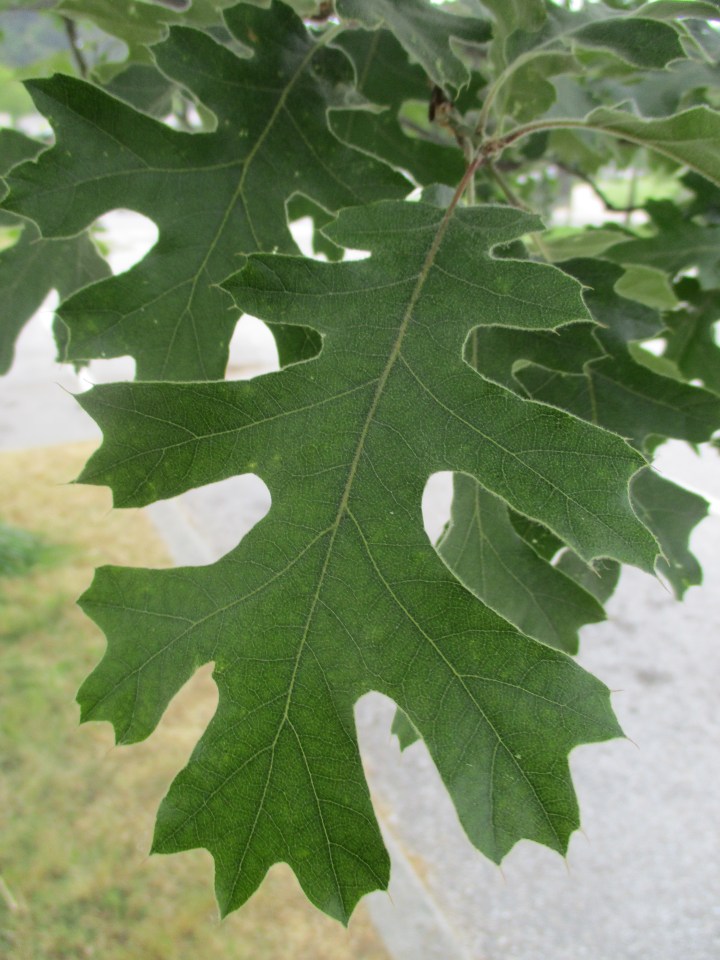 Oak, which might seem to be obvious to many of us, was identified by the Arbor Day Foundation as the People’s Choice for American’s National Tree. We certainly like our redwoods and exotic palms in California. Quaking aspen and blue spruce are probably favorites in Colorado. Sugar maple must be the most popular in Vermont. Yet, everyone appreciates the mighty American oaks.
Connecticut, Georgia, Illinois, Iowa, Maryland, New Jersey and the District of Columbia each have an oak as the official state tree. ‘Oak’ is one of the more traditional names for streets and roads throughout America. Just in California, at least eight towns are named after oaks, both in English and Spanish. Oaks put the ‘oak’ in Oaklahoma! (Oakay, maybe that last one is an exaggeration.)
So, now that we know that oak is what most Americans want to be the National Tree, does anyone know what species the oak should be? Well, that will take a bit more work. There are so many in America. There are too many to select from just in California! They are each so unique too. Some grow into grand trees. Others are shrubby scrub oaks. They might be deciduous or evergreen.
It is important to be aware that, just because oaks are the most popular trees in America, they are not necessarily appropriate for home gardens. Some, particularly in California, are best in the wild outside of landscaped areas. Some get too big. Some are too messy with acorns and leaves that fall slowly for a long time, either evergreen or deciduous. Some are susceptible to disease.
It is also important to be aware that big mature oaks, as rugged as the seem to be, are remarkably sensitive to modifications to their environment. Wild oaks that matured in areas that were not landscaped can succumb to rot in only a few years if the ground below them gets landscaped and regularly watered. Oaks planted into new landscapes adapt to the watering they get while young.
For landscapes that can accommodate them, oaks are grand and elegant shade trees that last a lifetime. There are many good reasons for their popularity.
Apologies for posting tomorrow’s article today. Today’s article will be posted tomorrow.

