Horridculture – Ivy League

P90306English ivy, Hedera helix, is probably the nastiest and most aggressively invasive exotic species that I work with. It climbs high into redwood trees and overwhelms understory plants (that live below the trees). It invades many of the landscapes, and worst of all, it climbs building where it ruins paint and causes rot. It grows faster than we can keep up with it.

English ivy is actually a nice ground cover plant for refined landscapes. I grew it at my home in town. Contrary to popular belief, it does not root into and parasitize the trees that it climbs. Actually, it rarely overwhelms and shades out large trees. It prefers to keep them alive for support, from which it disperses its seed. However, it does promote decay in the trunks that it climbs, particularly where it retains moisture at ground level. Native trees are not accustomed to that.

We try to remove as much English ivy at work as possible, which includes removing it from trees and buildings. So far, with a few exceptions of small bits of ivy that broke off high in the trees that it climbed, I have been able to remove all ivy from the trees and walls that I have worked on.

Others were not so fortunate. When quick and efficient removal of ivy from the bases of as many mature trees as possible is the priority, ivy is more often severed down low, and left to die on the trunks of the infested trees. It looks shabby to say the least, and takes many years to deteriorate and fall away. In the picture above, dead ivy that was severed within the past few years is already being replaced by new ivy, which will also need to be severed.

The same technique happens with ivy on buildings. It gets cut at the foundations, but left on the walls to shrivel and turn brown. The dead ivy in the picture below was reaching upstairs eaves when it was severed, and remains there a few years later.

What annoys me so much about this technique is that it does not take much extra effort or time to tug quite most of the lower ivy from trees and walls. For most situations, all ivy can be dislodged, although tiny aerial roots remain. It is much easier to dislodge while fresh than after it is dried and crispy.P90306+

Redwoods Are Family Oriented

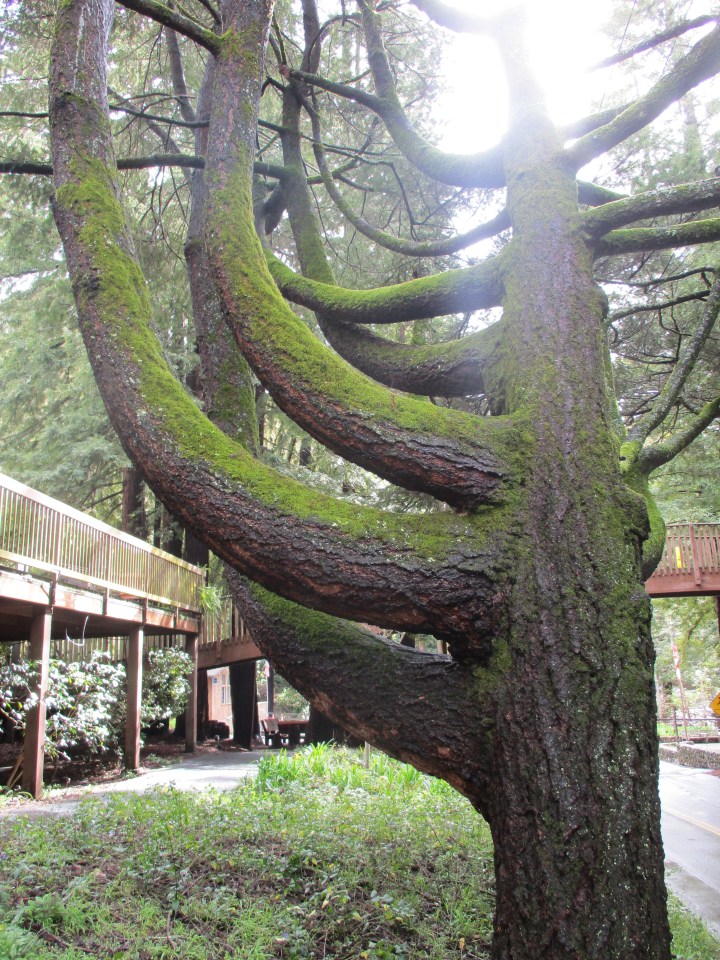
P90223KCoastal redwood, Sequoia sempervirens, are remarkable stable trees. They rarely fall, which is how they get to be thousands of years old. They prefer to live in groups, where they mesh their roots together, and shelter each other from wind. Those that live outside of a group stay shorter than forest trees, and typically develop multiple trunks that function as a group.

However, they are also remarkably weak in regard to their structural integrity. Limbs are easily broken away from their vertical trunks by wind. Snow, which is rare within their natural range, causes significantly more damage than wind, which is probably why their natural range does not extend into snowy climates. Trees with co-dominant leaders (double trunks that divide from single trunks above grade) have potential to split at the union of the double trunks. Such unions are typically at such acute angles, that the trunks press against each other rather than fuse together through impenetrable compressed bark.

Leaning redwoods such as these that were shown earlier this morning, are potentially hazardous, not because they are likely to fall over, but because they might be likely to break. The trunks are designed to support weight vertically. The asymmetrical distribution of weight supported by these two trunks exerts inordinate lateral tension on the trunks. To make matters worse, the trunk to the left is divided into two co-dominant leaders, although the union does not appear to be at a typically acute angle. (The lower trunk is now behaving more as a big limb than as a secondary trunk.)

I would guess that these two trees are genetically identical trunks from the same root system. Such seemingly pliable trunk structure is uncommon, and it is very unlikely that two such similar trees would just coincidentally appear within such minimal proximity to each other. Redwoods often develop multiple trunks from the same root system, particularly as they regenerate after harvest.

The good news is that these two trunks have survived like this long enough to develop ‘reaction’ wood, which is just like it sounds; a bit of extra wood to compensate for compression on the inside of the bend. Also, they are sheltered from wind by the other redwood in the forest around them.

Carpentry

P90217Saint Joseph did not have it so good. He is still the most famous carpenter, and somehow got the most excellent city in the World named after him, but he did not work in a shop like this one. The most well outfitted carpentry shops back then lacked modern power tools, and the selection of woods that are now so easily imported from all over the World.

The best lumber in this shop at the Conference Center (where I work in the landscapes part time) is actually not the exotic sort. Three very important timber crops, (coastal) redwood, Douglas fir and ponderosa pine, happen to be native. A few of the larger of these trees that need to be removed get milled into lumber that gets used here.

Much of the lumber shown in this illustration is recycled from old buildings that were built from local lumber at a time when it was not so practical to import lumber to such a remote location. The rack on the back wall, at the center of the picture, contains old doors that are ready to be recycled. Flooring and moulding were made from native oaks, which are not the easiest to mill, but happened to be the most available. Nowadays, most of the lumber used here is procured from the lumber yard across the road, but it is neither of comparable quality, nor very interesting.

What is most interesting about the carpentry shop is not seen in the illustration above. There are a few on the Maintenance Crew who are proficient with structural carpentry, and one who is a finish carpenter. The finish carpenter is as proficient with carpentry as arborists are with trees that produce lumber. He is very familiar with all the various woods, and what they are useful for. It is his expertise that will ensure that the old recycled wood, as well as newly milled wood, will be utilized accordingly.

More of my bragging about the Maintenance Crew can be found at: https://tonytomeo.com/2018/10/10/horridculture-lessons-from-motivational-posters/ .

Avocado

60217Avocado trees, Persea americana, grown from seed need to be about five years old to produce fruit that can be considerably different from the fruit from which the seed was taken, although such fruit is almost always quite good. Some trees need to be twice as old to produce. Grafted trees from nurseries are specific varieties that can start to produce their specific fruit immediately.

Fruit production is notoriously variable. Some healthy trees may be unproductive for a few years, and then suddenly produce more fruit than the limbs can support. Trees that are very reliable and productive may sometimes be unproductive or significantly less productive for a season. It is nearly impossible to determine which environmental factors inhibited bloom and fruit development.

Mature trees can be more than forty feet tall, with awkward branch structure. The lush dark green leaves are about four to eight inches long. The tiny yellowish green flowers barely get noticed until they deteriorate and fall to the ground like corn meal. The dark green and pear shaped fruit is quite heavy. It develops on the tree, but then ripens after it falls or gets picked and brought inside.

Horridculture – Cruel and Unusual Punishment

P90213This landscape is nothing fancy. It is out in front of a fast food establishment on Ocean Street in Santa Cruz. It is low maintenance, and starkly simple. It would be nice if the so-called ‘gardeners’ would cut back the African iris and English lavender a bit better, but they may have left them like this so that they are less likely to get trampled. The colored chips get replenished regularly, and the trash gets harvested quite efficiently. As I said, it is nothing fancy. The only remarkable feature had been this exemplary crape myrtle in the middle.
Only a few weeks ago, it was a perfect small specimen. Even though it is still quite dinky, the main stems were all at good angles, well spaced and aimed in the right directions. None of the stems were crossing over others, damaged or otherwise misshapen.
I can not explain what happened here since then. Are the so-called ‘gardeners’ trying to make more work for themselves by causing problems that will likely need their attention in the future? Do they just hate their work as much as this abuse implies? Is it possible that someone really believes that ‘this’ is somehow beneficial to the victim?
Each of the two fence stakes is sufficient to support a small tree, if such a tree needs it. If a tree, or in this case, a multi-trunked tree, does not need support, it should not be supported. Otherwise, it becomes reliant on the support. Besides that, these are fence stakes that are designed to be somewhat permanent. Now that they are there, they will probably be there forever. So-called ‘gardeners’ who do this sort of thing are not the sort to remove stakes.
The nylon straps are not flexible to accommodate the expansion of the stems they are tied around. If not removed, they will constrict, or ‘girdle’, the growing stems. What exactly are the straps doing anyway? The two closest to the bottom are tied to one stake, and pass the other to reach the respective stems that they are tied to, rather than tied between each of the two stems and the stake that it is closest to.
Someone certainly put a lot of effort into a whole lot of uselessness that will interfere with the healthy development of this formerly exemplary crape myrtle. Yet, with all this effort, no one bothered to prune it, or even so much as deadhead it. Yes, those are deteriorated floral stems from last summer.P90213+

Greenhouse Envy

P90209KIf there were lawns and fences in this neighborhood, the grass would likely seem to be greener on the other side of the fence. In this situation, the greenhouse probably seemed to be more comfortable than being left out in the storm. This tall Douglas fir tree dropped in to find out. It did not go well. What remains can be seen in the middle of the picture above, just to the right of the fallen fir, and in the close up of the picture below.P90209K+
Miraculously, the two coastal redwood trees that caught and guided the fir to a direct hit on the greenhouse also prevented it from destroying the associated house. Well, at least the redwood on the left did. There would have been less damage if the fir had fallen farther to the right. Regardless, a deck was crushed, an eave was destroyed, but the rear wall of the home was barely nudged. Not even the windows there were broken!
Falling debris punched a few holes in the roof, but without structural damage. The patio of the big building to the right was littered with debris that was easily removed. After limbs are removed from the damaged house, much of the carcass of the fallen fir will remain on the forest floor. It decays efficiently here.
Incidentally, this fir was about to be removed. It had been identified as too risky for the neighborhood. Although they are not visible in the pictures, there are a few other homes in the neighborhood. The cabin that I stayed in for more than a week is just beyond where the top of the fir landed. The stovepipe that is visible in the background of the second of my ‘Six on Saturday – Cabin Fever’ pictures from January 5 is the same stove pipe that is visible on the roof of the home that was nearly destroyed by the fallen fir. https://tonytomeo.com/2019/01/05/six-on-saturday-cabin-fever/P90209K++
(The stove pipe circled by the yellow oval just above the center of the picture above is the same stove pipe circled by the yellow oval just right of the middle of the upper margin of the picture below.)P90209K+++

Six on Saturday: Untimely Death


One of the more unpleasant parts of my work is condemning elderly trees. Redwood and oaks in our region can live for centuries, but none last forever. It is sometimes my job to determine if some of the oldest of oaks have deteriorated to such an extent that they have become unsalvageably dangerous to those around them.

What is worse than that is that there are so many dangerously deteriorated oaks and other trees that collapse before they get removed, and many do so before anyone notices how dangerous they are. Some structural deficiencies and instabilities are concealed to the most thorough of arborists. That is what happened with this big coast live oak, Quercus agrifolia, with a five foot wide trunk, that fell behind Felton Presbyterian Church. I had known for some time that the healthy canopy was heavy and exposed to wind. What I did not know is that the root systems was insufficient to maintain stability when strong wind blew against the healthy canopy while the soil was saturated. The insufficiency of the root system became apparent not only because the tree destabilized, but also because the minimal root system became exposed by the destabilization. There was no evidence of decay or damage within the root system, which are what typically contributes to destabilization.

1. It is amazing that this tree stood for as long as it did with such minimal roots.P90209

2. This is what those minimal roots supported for so long.P90209+

3. Healthy foliar growth on top of the canopy enhanced weight and wind resistance.P90209++

4. Damage was surprisingly minimal.P90209+++

5. This decay within one of the main limbs was a structural deficiency that did not contribute to the destabilization.P90209++++P90209+++++

6. (above) This is the same picture as #5. The red line is at the cross section of where a limb broke or was cut away many years or decades ago. Although the straightness of the zone suggest that it was made by a pruning cut, it is unlikely that the tree was pruned up as high as this section of limb was located, particularly so long ago. As the tree compartmentalized the wound, decay spread inward toward the center from the wound, in a typical pattern that resembles a section of a pie chart, which is marked by the yellow lines. Once it reached the center, decay radiated outward from the center, in a typical circular patter, which is marked by the blue circle. As the center of the trunk rotted and deteriorated, the necrotic zone between it at the original wound continued to rot and deteriorate. By that time this cavity developed, the exterior of the wound had already been compartmentalized by viable wood that did not decay.

This is the link for Six on Saturday, for anyone else who would like to participate:

https://thepropagatorblog.wordpress.com/2017/09/18/six-on-saturday-a-participant-guide/

Horridculture – Disdain For Trees

P90206Okay, we get it; someone really hates trees. That’s fine. Trees are not for everyone. Just cut it down. Put it out of it’s misery. Take away the useless lodgepole stake and strap along with it. Maybe those Canary Island date palms that look like the home of SpongeBob SquarePants in the background will recover from their own form of abuse to compensate for the loss of this seemingly unwanted goldenrain tree.
Apparently, it is not that simple. This goes beyond a dislike of trees, or a mere desire to kill them. This tree seems to have been tortured by someone who enjoys it WAY too much. There were others that were similarly disfigured in this same parking lot in the north of San Jose. They were not pollarded. They were not pruned. There were mutilated, but kept alive for more of the same.
What is worse is that someone was paid for this torture. Property management hired a tree service to ‘prune’ these trees, likely for clearance from lamp poles and parked cars. Was the perpetrator inexperienced, insensitive, or as hateful as the severity of the disfigurement suggests? Well, lets analyze that.
There are plenty of inexperienced people who take jobs in occupations with which they are not familiar. However when the do so, they tend to learn at least the basics about it to avoid doing their work improperly. That obviously did not happen here.
Insensitivity or a lack of concern for the work is possible. However, even someone who does not care about such work is likely to get something about it correct, even if just circumstantially. Well, that did not happen either.
These trees are kept alive because they are more lucrative to the torturer that way. As disfigured as the trees are, they will regenerate new growth that will again need to be pruned for clearance later. Someone who put that much thought into what is being done could have just as easily put forth the effort to do ‘something’ properly in regard to pruning. That is obviously not part of the agenda. The perpetrator really is as disdainful of these trees as the disfigurement indicates.

Oriental Spruce

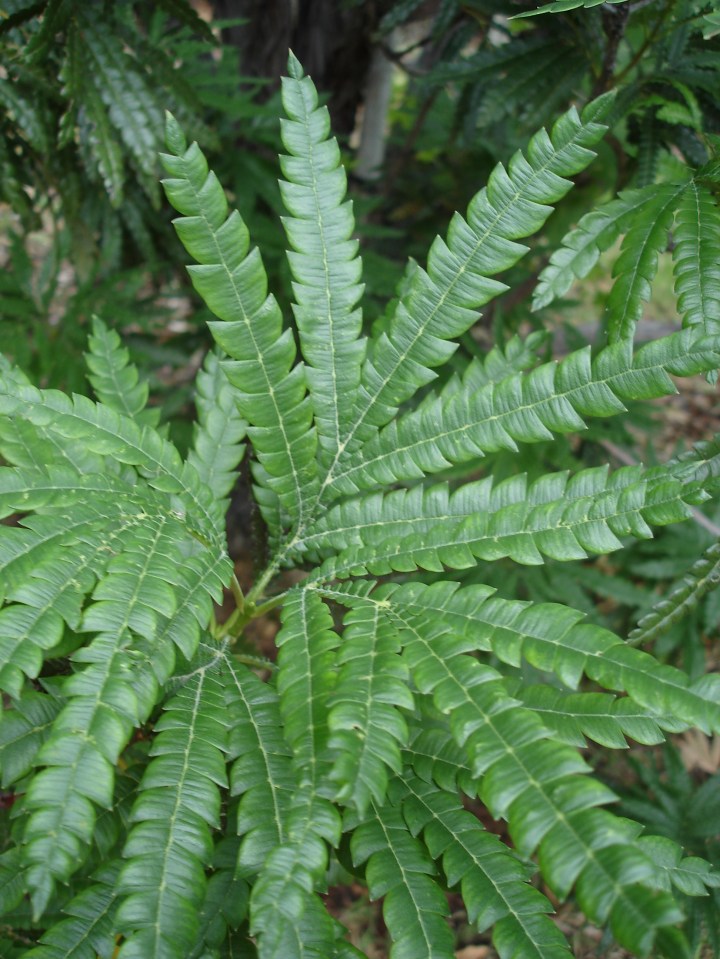
60127If it got as big as it does in the wild, Oriental spruce, Picea orientalis, would not fit into many home gardens. It can get more than a hundred feet tall! Fortunately, it does not often get much more than twenty five feet tall locally. Trees that compete with taller trees in forested landscapes might get to forty feet tall. Their symmetrically conical canopies get about fifteen or twenty feet broad.

The tiny needles of Oriental spruce are less than half an inch long, so are smaller than those of any other spruce. Relative to the finely textured deep green foliage, the densely arranged and neatly angular stems are notably stout. Like other spruces, Oriental spruce is best where it has sufficient space to retain lower stems down to the ground. It can look rather silly with a bare lower trunk.

Garden varieties are more common and stay smaller than the straight species. ‘Skylands’ has yellow foliage, although it fades in warm situations. ‘Aurea’ has paler pastel yellow new foliage that matures to green. ‘Gowdy’ has a narrow columnar form, and grows very slowly. ‘Nana’ develops as a plump low mound that stays less than three feet tall. All like to be watered somewhat regularly.

GreenArt

p90120p90120+It seems that I have been negligent about writing about my colleague Brent Green and some of our crazy adventures in horticulture. I said I would do so when I started writing my articles here way back two Septembers ago. It is easy to get distracted from such topics, particularly since we do such different types of work. Brent is a renowned landscape designer and proprietor of GreenArt Landscape Design in Southern California. I am just a horticulturist and arborist who really should get back to growing horticultural commodities in Northern California. For all of our similarities, there just might be as many differences.

After posting that old video of the Birthday Trees yesterday https://tonytomeo.com/2019/01/19/birthday-trees/, I thought that I should also write more about what Brent does for the urban Forest of Los Angeles, which is probably more interesting than our crazy adventures. I really want to find the old news article about how he busted tree rustlers who were stealing mature Canary Island palms from the embankments of the Santa Monica Freeway, which is pictured above. It is still a sore subject because we know that it continues, and that the trees that were stolen were not returned as promised.

I could write a separate blog about the work that GreenArt does if I were more involved with it. I just do not enjoy design like Brent does. Actually, I am no good at it. I just work with the horticultural aspects of it, and growing material for it. In the future, I will probably be more involved with projects that are not directly affiliated with GreenArt, such as initiatives to maintain and protect trees in public spaces of Los Angeles.

For now I have only this brief and outdated video of the landscaping of Brent’s home, https://www.youtube.com/watch?v=v2IwcuU3KEo .