Six on Saturday: Redwoods Again


Redwoods are such interesting trees. There is always something to write about them. I happen to live and work within the native range of the coastal redwood. I often work with very big redwoods, both in the wild, and in landscaped areas that were formerly wild. There are no other trees that are comparable. The giant redwoods in the Sierra Nevada are bigger, but they are also very different.

1. In most home gardens and landscapes, trees that get cut down get recycled into greenwaste and firewood. Not many are big enough to get recycled into lumber. Even fewer are big enough to get milled into big timbers. This milled redwood lumber is drying before getting milled again into timbers and smaller sizes of lumber that will get used to repair and remodel some of the historical old buildings. A bit of pine lumber is also obtained from the big ponderosa pines nearby.P80825

2. Limbs, foliage, bark and parts of the redwood trees that can not be milled into lumber get chipped. Chips get used as mulch in landscaped areas. After taking this picture, I realized that it is not really a pile of chipped redwood, but is instead chipped wood waste. Chipped redwood is typically green with foliage. Oh well, you get the idea.P80825+

3. The Ewok Village of ‘Star Wars IV – Return of the Jedi’ was in a redwood forest near Fortuna. This is not really an Ewok Village.P80825++

4. It is a Redwood Canopy Tour. People (not Ewoks) can be seen on a platform in the yellow rectangle just above and to the right of the center of the picture. Someone on a zip line can be seen in the white rectangle just below and barely to the left of the center. It looks crazy to me, but many of my colleagues do crazier things at work.P80825+++

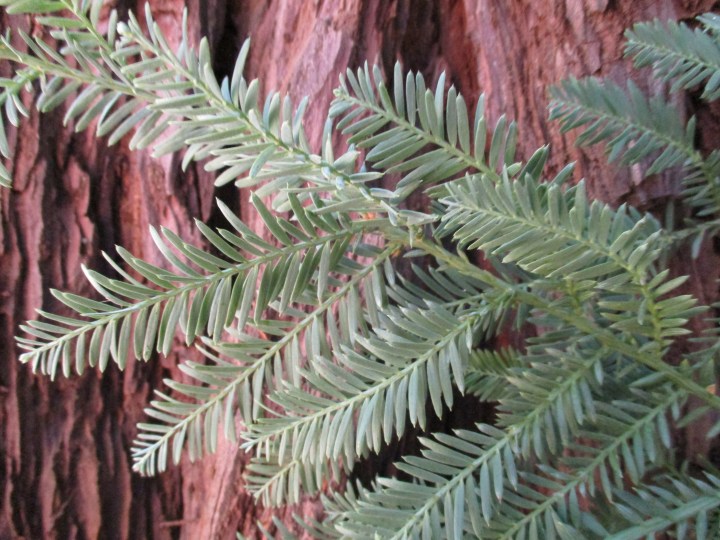
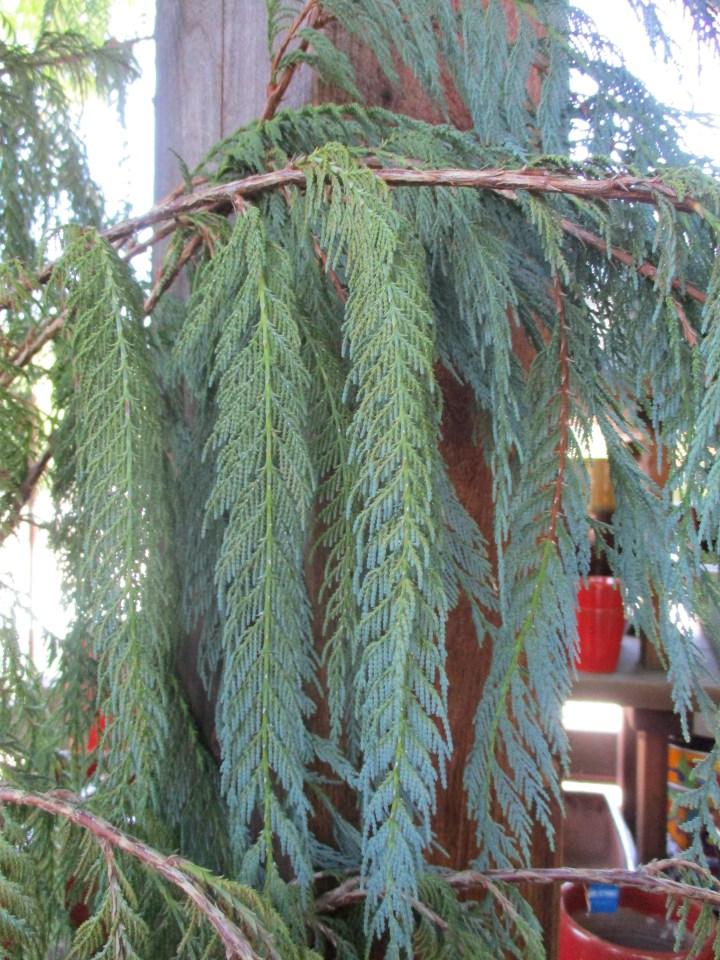
5. Most of us have seen pictures of massive redwood trunks. Most of us have seen pictures of redwood forests. Not so many of us have seen what the foliage looks like.P80825++++
6. This perennial pea has nothing to do with redwoods, but needed to be included as a token flower for this week. Besides it is cool. It is softer pink than the bright purplish pink that is so typical, and is blooming very late.P80825+++++

This is the link for Six on Saturday, for anyone else who would like to participate:

https://thepropagatorblog.wordpress.com/2017/09/18/six-on-saturday-a-participant-guide/

Here are a few links for some of my brief articles about redwood:

https://tonytomeo.com/2018/08/17/dawn-redwood/

https://tonytomeo.com/2018/08/12/general-sherman-tree/

https://tonytomeo.com/2018/08/04/albino/

https://tonytomeo.com/2018/08/04/six-on-saturday-bits-and-pieces-ii/

https://tonytomeo.com/2018/07/14/six-on-saturday-redwoods/

https://tonytomeo.com/2018/05/12/six-on-saturday-tree-ring-circus/

https://tonytomeo.com/2017/10/15/redwoods/

https://tonytomeo.com/2017/10/05/big-tree-in-a-small-town/
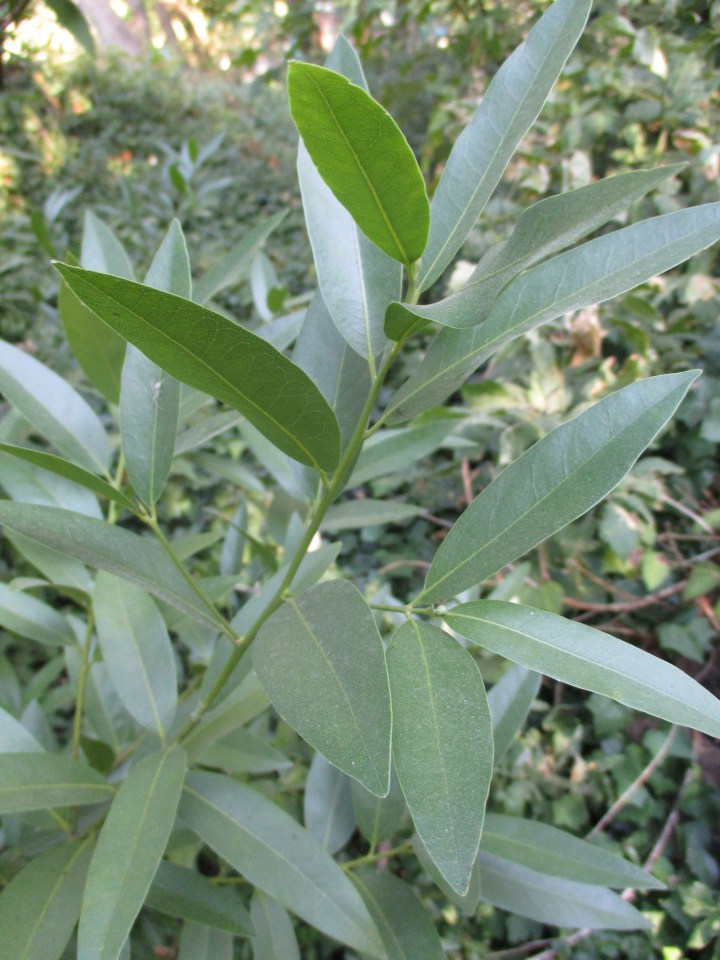
 

California Bay

70823Just because California bay, Umbellularia californica, can be used like Grecian or sweet bay for culinary purposes does not necessarily mean that it should be. California bay has a stronger and much more pungent flavor and aroma. Some might suggest substituting less than half California bay for Grecian bay. However, even if the intensity is adjusted accordingly, the flavor might be off.

As the name suggests, California bay is native to California. However, because it is from rainier climates, it prefers a slight bit more water than it would get naturally in the drier parts of the local chaparral climate. It provides nice cooling shade in large landscapes, but is a bit too dark and messy for refined home gardens. The aromatic leaf litter can annoy delicate annuals and seedlings.

Well exposed trees can eventually get more than thirty feet tall and almost as broad. Forest trees that compete with other trees can get a hundred feet tall! Small trees can be shorn as hedges. If not watered too generously, the roots tend to be rather complaisant. However, old trees can eventually develop massively distended burl growths known as lignotubers at the bases of their trunks.

Dawn Redwood

70816If it has bark like a coastal redwood, and foliage like a coastal redwood, and a slender conical structure like a coastal redwood, it is most likely a coastal redwood. If it turns orangish brown in autumn and defoliates through winter, it is the much less common dawn redwood, Metasequoia glyptostroboides. It is one of only a few distinctive genera of coniferous trees that are deciduous.
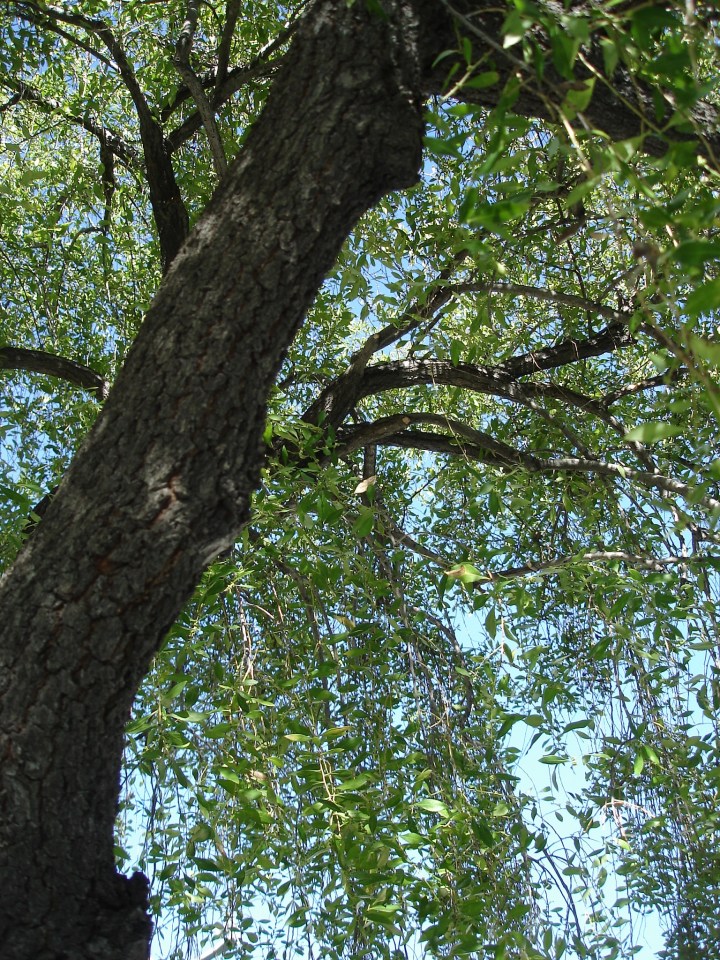
Upon closer inspection, it is not as similar to coastal redwood as it initially appears. Besides being deciduous, the foliage of dawn redwood is softer and lighter grassy green. Individual leaves are more perpendicular to the stems. Trunks are more tapered, so that they are quite lean up high, and quite plump down low. Old trees can form buttressed trunks. Strips of bark might exfoliate.

Dawn redwood is by no means a deciduous alternative to the evergreen coastal redwood. Although it grows about as fast while young, it slows with maturity. Crowded trees get taller but lanky. Exposed trees stay shorter and broader, but because they are still relatively narrowly conical, they do not make much shade at first. Old trees are more than a hundred feet tall, but could get taller.

How Shade Is Made

70816thumbMany of our trees live at our homes longer than we do. Some of our trees were there before we got there. Some of the trees we plant will be there for whomever comes along after we are gone. Trees very often evolve into something very different from what they were intended to be. Nonetheless, since they are the most significant features of our gardens, trees must be selected carefully.
The recommendation that shade trees near the home should be deciduous is cliché but accurate. It makes sense that the trees that provide cooling shade in summer will also allow warmth and light through while bare in the winter. Evergreen trees are better for obscuring undesirable views around the perimeter of the garden, where they will not shade the home too much through winter.

The problem is that many modern gardens are too small for such diversity. Modern homes are so close to each other that evergreen trees are more important for obscuring views. Consequently, evergreen trees that provide privacy between homes and gardens might also function as shade trees. Limited space also means that trees affect neighboring homes and gardens significantly.

This is why so many of the small trees (that are known almost disdainfully by some arborists as ‘microtrees’) are so popular. Japanese maple, flowering cherry and smoke tree that were once popular for atriums and small enclosed gardens are now popular shade trees. Realistically though, some modern backyards are not much bigger than what was once considered to be an atrium.

Small evergreen trees or large shrubbery, like Australian willow, mayten, photinia and the larger pittosporums, work nicely by providing both privacy and shade for small areas. Contrary to popular belief though, evergreens are generally messier than deciduous trees. They drop small amounts of foliage throughout the year instead of dropping most or all of their foliage within a limited season. Flowers or fruit add another dimension of mess, even for deciduous trees like crape myrtle, flowering crabapple and saucer magnolia.

General Sherman Tree

0

The biggest, tallest and oldest trees in the World are all native to California. The biggest trees are the giant redwood, Sequoiadendron giganteum. The tallest trees are the coastal redwood, Sequoia sempervirens. The oldest trees are the bristlecone pines, Pinus longaeva. The biggest and the tallest are two of only three specie of redwood in the World, and except for a few coastal redwood that live barely north of the Oregon border, both are endemic only to California. Most of us know that the coastal redwood is the state tree of California. However, some believe that California is the only state with two state trees, which are the two native specie of redwood.

This gives arborists from California serious bragging rights.

Most of the arborists whom I work with are very familiar with the coastal redwood. Not only is it the most prominent tree in the Santa Cruz Mountains, but it is also a common tree in landscapes of the Santa Clara Valley.

The other two specie are not nearly so common. Neither perform well in landscape situations, and certainly not locally. Even if they did, the giant redwood gets much too bulky to fit into urban landscapes, and the bristlecone pine is a bit too irregular for refined landscapes. Because they both live in somewhat remote regions within California, some very experienced arborists have never seen either of them in the wild. Of course, it is not something we talk about much.

I still have not seen bristlecone pine in the wild. The only specimens I have ever seen were bonsai stock that had not yet been cultivated as bonsai specimens.

In the late 1990s, I had not seen giant redwood in the wild either. I had only seen the unhappy specimens that were planted on the sides of roads between San Jose and nearby towns during the Victorian Period before the urban landscape had become so inhospitable to them. One of my respected colleagues who had seen many of the more interesting trees of California in his travels had not seen them either.

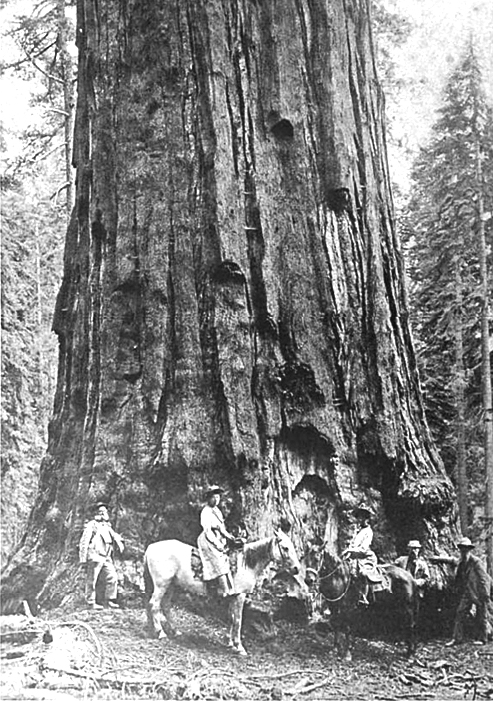
Fortunately, it was nothing that a good old fashioned road trip could not fix. Without much planning at all, we drove out to Sequoia National Park and met with the General Sherman Tree. There was too much snow to get very far, so we did not get similarly acquainted with the General Grant Tree farther up the road. It was one of the most compelling horticultural trips of my lifetime, right up there with going to see the native California fan palm, Washingtonia filifera, outside of Palm Springs, or the Joshua tree, Yucca brevifolia, outside of Palmdale. I know that the picture above is not a good picture of my colleague with the General Sherman Tree. It is from a time when cameras still used film. Getting pictures transferred to a compact disc was merely an option back then. The sepia toned picture below is even older, but it is not mine.00

Kashmir Cypress

70809Plants are usually well suited to the climates that they are native to. Glaucous (slightly reflective grayish) foliage is more common in harsh climates where darker green foliage might get cooked by the sun. Pendulous growth is more common among plants that want to shed heavy snow efficiently. Kashmir cypress, Cupressus cashmeriana, has both, but is from a tropical monsoonal climate.

It is a stately tree that can eventually get taller than fifty feet. Within its native range in the eastern Himalaya, old trees can get three times as tall! Limber stems might hang downward several feet. The minute scale leaves are neatly set on limber stems arranged in flat sprays, similar to, but more defined than those of arborvitae. Foliage is silvery grayish green, and perhaps slightly bluish.

Mature trees do not need much water, but would probably be happier if watered occasionally through summer. Kashmir cypress is unfortunately susceptible to the same diseases and insects that afflict Leyland cypress. That is a serious risk to consider before planting prominent specimens. Incidentally, Kashmir cypress is also known as Bhutan cypress, and is the national tree of Bhutan.

Horridculture – Bullwinkle

P80808This rant may not go in the direction you expect it to. The pictures suggest that this would be about the bad vegetation management crews who severely disfigure trees that get too close to utility cables. It is not.
This is about horticultural ‘professionals’ who plant trees where they will encroach into utility cables, with no regard to what might eventually be done to them in order to keep electrical service reliable and safe. The native oak in these pictures likely grew from seed, so unless someone knows the squirrel who buried the acorn, there is no one to blame. Many of us who enjoy home gardening are sometimes not aware of how tall and wide particular trees can get when we plant them. Horticultural ‘professionals’ should know better! That is what they charge so much money for when they design a landscape.
Palm trees are the worst! They grow only upward, with only a single terminal bud. Once that terminal bud encroaches into a utility easement, there is no option to prune back to another branch that might direct growth around the easement. ‘Pruning’ the only terminal bud back kills the entire tree. Yet, some landscape ‘designers’ continue to prescribe the all too trendy queen palm for the backsides of urban landscapes, even if utility cables are back there like they so typically are.
The oak in these pictures got a Bullwinkle cut, with big ‘antlers’ reaching upward and to the left and right of cables that are directly above. The lower picture sort of shows a ‘step back’ cut into the top for clearance from other perpendicular cables that pass over that edge rather than directly above. The tree is in surprisingly good condition, and gets pruned as properly as possible for the difficult circumstances.P80808+This brief article from a few days ago discusses a few more details about easements. https://tonytomeo.com/2018/08/02/easements-really-should-be-easier/
Knees

P80805When a plant that should be compact or shrubby gets too lanky with exposed lower stems, it is described as ‘leggy’. We do not hear much about plants that develop ‘knees’. Perhaps that is because there is only one species that does so. That one species happens to be very rare here. If there are other specie that develop knees, I do not know what they are.

‘Knees’ are weird appendages that grow upward like stalagmites from the roots of bald cypress Taxodium distichum, particularly where the trees grow wild in swampy conditions. Knees can get quite tall. One of our professors used to tell us that they could do some serious damage to a canoe. Perhaps knees are why bald cypress is locally unpopular in landscapes.

However, I happened to notice that bald cypress is a common street tree in downtown Oklahoma City. Just like most other street trees, they are installed into small tree wells, but otherwise surrounded by pavement. They were remarkably healthy and well structured specimens that were too young to have damaged the pavement. Yet, I could not help but wonder what they will do as they mature. Even before the trunks grow as big around as the small tree wells that they are in, what would happen if knees develop?

There happens to be not one, but two bald cypress at work. The smaller is alongside a small stream. The larger is adjacent to a lawn where the soil is seemingly dry on the surface, but quite soggy just below the surface. This larger specimen is already developing distended burls that seem to be rudimentary knees. Although there is no pavement to break, the tree happens to be shading a picnic area where knees, if they develop, would be quite an obtrusive problem.P80805+

Easements Really Should Be Easier

70802thumbLike Michael Jackson said, “You got an easement on down the road.”. . . or something like that. In older neighborhoods, that is where the utility easements are usually located. These are zones for utility poles that suspend electrical, telephone and television cables. When electricity first became available, that was the easiest place to put the cables, and the practice continued for decades.

Utility easements in middle aged neighborhoods are usually at the rear boundaries of back yards. They were put there to get out of the way of shade trees in front yards, particularly street trees. Where there are alleys in back, easements are on one side of the alley or the other. The same applies to narrow streets with easements. More modern neighborhoods have subterranean utilities.

Those of us who must contend with easements know how difficult they can be. Trees that encroach too closely to the high voltage cables on top of the poles must be pruned for clearance, even if such pruning disfigures or kills them. Lower cables for telephone and cable television sometimes get tangled with vines or big shrubbery because clearance from vegetation is not such a priority.

Utility providers have access to easements to maintain their systems. So do the tree services that have the grim task of pruning encroaching vegetation for clearance from high voltage cables. They do what they must to maintain reliable service; which is unfortunately not always compatible with what we want for our trees. Clearance pruning is too often unsightly, but it is very necessary.

The only way to avoid unsightly and disfiguring clearance pruning to to only plant trees that will not encroach into high voltage cables. Of course, in small gardens with big easements, the choices of trees that stay proportionate to available space are very limited. Except for Mediterranean fan palm or palms that stay very short, palms should never be planted below utility cables. They grow only upward, and can not be pruned around cables, so must be removed when they get too close.

Coppice

P80729Coppiced trees and shrubs are just like pollarded trees, but without the trunk and main limbs. Instead of getting cut back to the same distended knuckles at the ends of disproportionately stout limbs, they get cut back to the same stump just above grade over winter. Some get coppiced annually. Others get coppiced only when they get too big. The coppiced California sycamore in this picture may never get coppiced again.
It was not intentionally coppiced. It had merely been cut down. The trunk was in the middle of where this thicket of secondary growth is now, but all of the canopy was over the adjacent parking lot from which the picture was taken. The tree was so severely and asymmetrically disfigured and leaning that it was unsightly and unmanageable. It really looked ridiculous. Removing the tree and replacing it with a new one would have been more practical than attempting to repair the disfigurement with corrective pruning over many years. Besides, such severe pruning to repair the disfigurement would have caused other disfigurement, and in the end, the tree would still be leaning.
Others California sycamores nearby had been cut down years ago because they were crowded. As the remaining trees continued to grow, those that had been cut down regenerated from their stumps with multiple trunks, and are now getting almost as tall as the others that were not cut down. Some of their smaller trunks will get cut down next winter, leaving them with single, double or triple trunks, but they will not be cut down completely as they were before. Instead, they will be allowed to adapt to their crowded conditions naturally. They are all becoming such appealing trees.
The coppiced but technically cut down California sycamore in the picture will be given the same sort of second chance. While bare in winter, the secondary growth will be pruned to leave only one, two or three trunks to hopefully develop into a new tree on the same spot.