Evergreen Pear

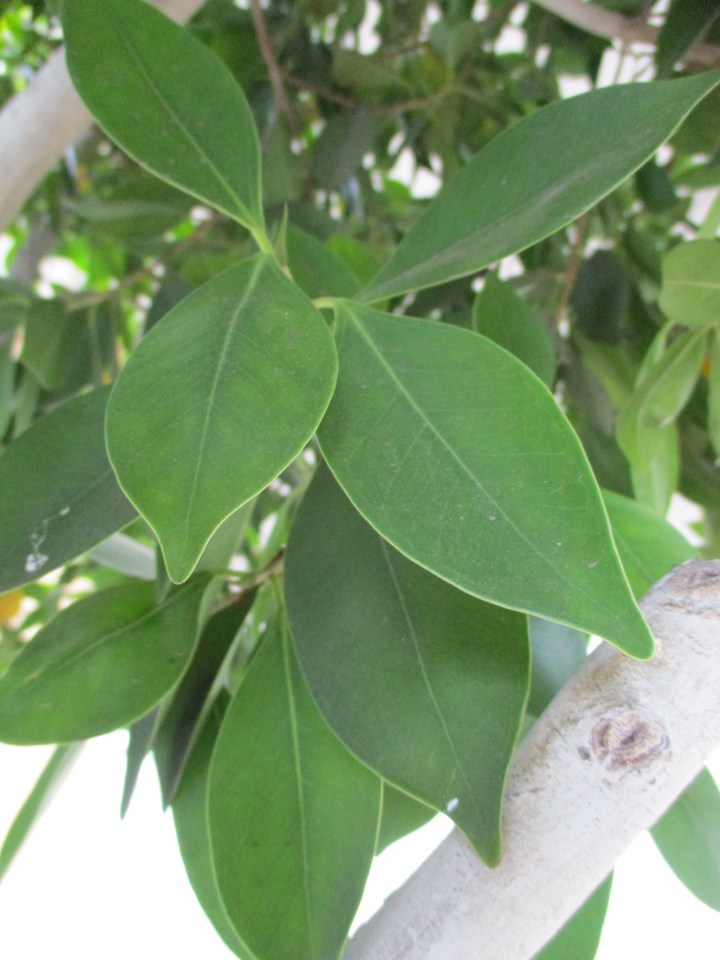
61005If it were not so seriously susceptible to fireblight, the evergreen pear, Pyrus kawakamii, would be a practical evergreen shade tree for small garden spaces. Mature trees do not often get much taller or wider than twenty five feet. Aggressively pruned trees that do not bloom much are less susceptible to fireblight. Regularly groomed trees can live with fireblight for many years or decades.

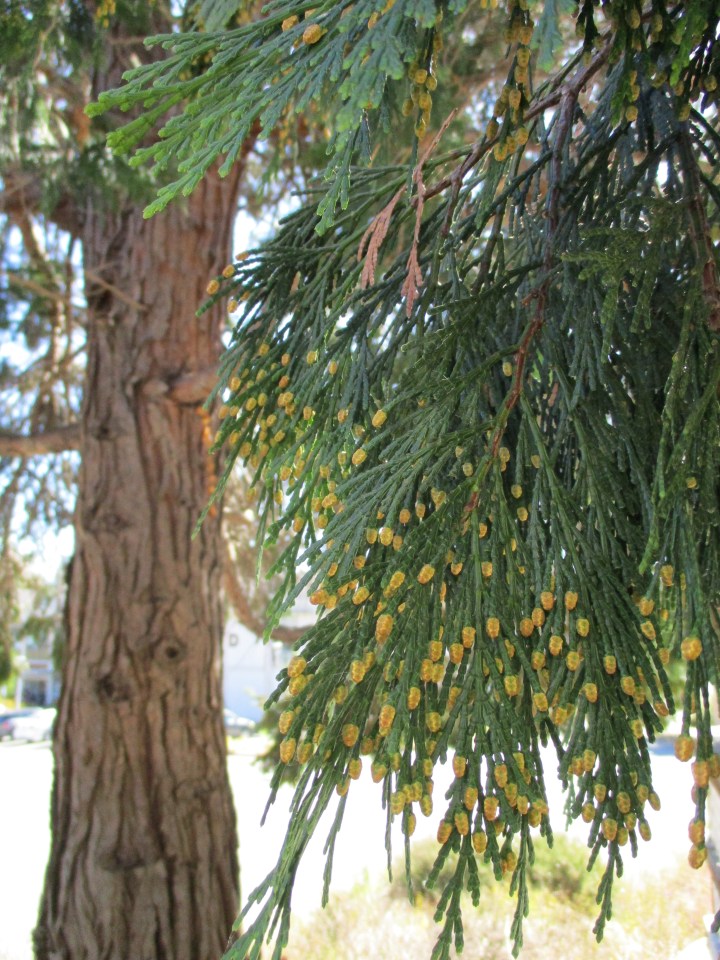
The nicely furrowed bark and irregular branch structure give evergreen pear trees the distinction of larger trees. Lower limbs will probably sag low enough to need pruning for clearance. Clusters of small white flowers, like those of other pears, bloom in spring, but are partly obscured by the evergreen foliage. Distressed trees bloom more profusely and are not so densely foliated in bloom.

California Black Oak

81003The most popular hardwood in California is essentially unavailable in nurseries. California black oak, Quercus kelloggii, provides between a quarter and a third of the hardwood timber harvested in California. One would not know it by its sporadic appearance within mixed forests of the Coastal Ranges. It is much more common in the Sierra Nevada, which might be why no one grows it.

Mature trees can top out at thirty feet with broad canopies if well exposed, or might be more than seventy feet tall and relatively slender if they must compete with other trees. The biggest trees are more than a hundred feet tall. The sculptural trunks are usually less then four feet wide. Trunks of old trees are commonly rotten inside. Gray and smooth young bark gets rough and dark with age.

The distinctively lobed deciduous leaves of California black oak are not much more than four inches long. They can get nearly twice as long on the most vigorous growth, or where shaded. The dark green foliage will slowly turn brown or yellow through autumn, and then defoliate through winter. It can turn a brighter yellow or orange, but then defoliates faster, if the weather gets cool fast.

Flowering Pear

60928Now that they have been so popular for so long, the deficiencies of flowering pear, Pyrus calleryana, (which is also known as Callery pear), are becoming increasingly evident. The dense branch structure and compact form that are so appealing while trees are young compromise structural integrity as trees mature. Symmetrical trees can be severely disfigured if limbs get broken by wind.

In the past, flowering pear had been quite resistant to disease and insect infestation. However, now that there are so many of them within minimal proximity of each other, it is nearly impossible to avoid infection with fire blight. To make matters worse, they share this very contagious bacterial disease with fruiting pear, evergreen pear (fruitless) and apple (fruiting and flowering crabapple).

Otherwise, healthy and well structured trees provide some of the best autumn color for mild climates. Foliage that was rich green through summer becomes bright yellow and orange on a weak season, with more bright red and burgundy with a good chill. The white spring bloom is likewise more colorfully profuse after a colder winter, although some find the fragrance to be objectionable.

Illegally Planting!

P80902K“ . . . others illegally planting whatever they wish . . . illegally.” Someone actually said that about the installation of our little Memorial Tree in Felton Covered Bridge Park. It was within the context of a review of the Park on Facebook, written by someone who has not stopped complaining about Felton since she moved here. It was forwarded to me quite some time ago by someone who documents and files such information that is relevant to hate crimes, and what is now known as ‘hate speech’, which is another completely different topic that we can not get involved with here.

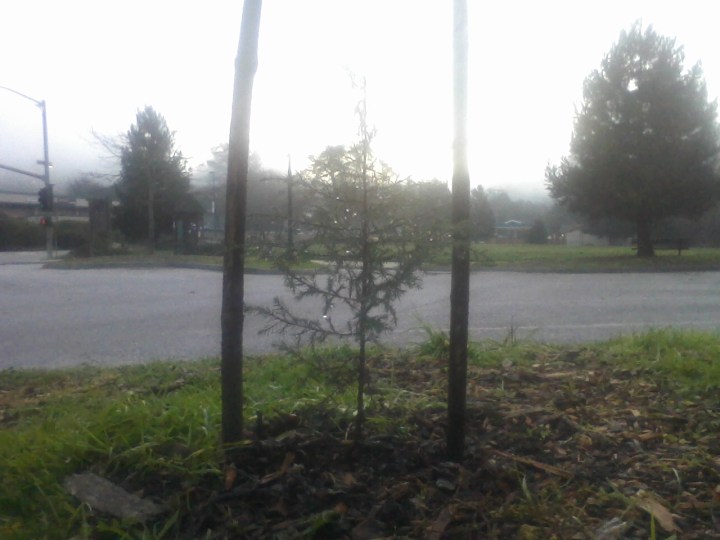
Technically, it is accurate. The tree was planted without a permit, and does not comply with the standards of Santa Cruz County Parks. Compliance would have been quite an expensive imposition. It would have required an expensive #15 (15 gallon) tree, outfitted with lodgepole stakes and straps. The overworked gardener would have needed to take time from his busy schedule to install it. Because the irrigation system to the site is now defunct, the gardener would have needed to irrigate the tree until it got established. It was easier, much less expensive, more horticulturally correct, and socially responsible for us install the tree and maintain it on our own. Call 911 if you must.

There are of course reasons why we should not plant trees or other plant material in parks and public places. We do not want to make more work for gardeners, interfere with the landscape plan, or add plants that are inappropriate to the situation. This Memorial Tree happened to have been planted with the supervision of a horticulturist and arborist (me), on the exact spot where another oak that was installed with the original landscape had been knocked down by a car. Otherwise, in most places in Felton Covered Park, vegetation management, including the removal of large volumes of biomass and invasive exotic specie, should be the priority. (Unfortunately, the overgrowth of invasive exotics is mostly within a protected environmentally sensitive riparian zone.)

The little Memorial Tree has quite a history, even though it is still a baby. I do not want to post links to all the other updates about it, but I can post this link to another article that contains another link to others . . . Oh, you can figure it out if you like: https://tonytomeo.com/2018/04/15/memorial-tree-update-to-the-updated-update-etc-the-sequel-to-all-those-other-sequels/ .

Tree of Heaven

50923‘A Tree Grows In Brooklyn’ documents the resiliency and invasiveness of the common but typically undesirable tree of Heaven, Ailanthus altissima. Once a single female tree get established, the extremely prolific seeds get everywhere, including cracks in concrete. The resulting seedlings conquer wherever they are not dug out. If cut down, they just resprout from the roots.

Male trees smell horrible while blooming for about a month in spring or summer. They are pollinated by flies, so naturally smell like what flies like. The tiny yellowish or tan flowers hang on panicles that can be a foot and a half long. Female blooms are not as big, prolific or objectionably fragrant. However, stems, leaves and all other parts of both genders smell rotten when handled.

Tree of Heaven, which has earned the alternative names of ‘tree of Hell’, ‘stink tree’, ‘ghetto elm’ and ‘ghetto palm’, is no longer a tree that gets planted by choice. It is typically a tree that plants itself, and on rare occasion, happens to grow into a good situation. They should not be allowed to overwhelm more desirable trees, or get too close to concrete or other damageable features.

Young trees grow very fast to about forty feet tall. Older and slower trees do not get much taller, although sheltered trees can get twice as tall, with elegant gray bark. They do not live much more than fifty years. The big pinnately compound leaves are surprisingly pretty. On vigorous shoots, individual leaves can get as long as two and a half feet, with leaflets as long as six inches.

Horridculture – Think Outside The Box

P80912Straight out of college, I worked briefly for a wholesale nursery that grew landscape stock, which included boxed trees. We also recycled a few trees, particularly from the abandoned homes in the neighborhood around the nursery. (The neighborhood, including the nursery, were in the easement of the Norman Mineta Freeway, which in the process of being constructed at the time.) I had believed that the boxed and recycled trees were for ‘instant’ landscapes, the sort that were for clients who did not want to wait for things to grow. It made sense, particularly in our region where so few stay in the same home long enough for trees to mature.

Many trees were good candidates for growing in boxes. Some were naturally small trees. Others had fibrous root systems that did not mind the confinement. Japanese maple, crape myrtle, purple leaf plum, flowering cherry, flowering crabapple, magnolia and various specie of podocarpus all grew well for us, and probably adapted well to their new landscape homes.

Other trees were not such good candidates. We also grew a few specie of oak, pine and eucalyptus that did not want their roots to be confined to boxes. They wanted to disperse their roots as soon as they could. They had no problem doing so while young. However, mature boxed trees needed so many years to recover from their confinement that by the time they recovered, if they ever recovered at all, small trees that were planted at the same time had grown larger. Yet, people paid tens of thousands of dollars for some of the larger boxed trees.

Some clients did not care if the trees died. Some just wanted them to live long enough for their home to sell. Those who purchased the homes often did not care either. Many purchasers just demolished such homes and landscapes to build new monster homes on the sites. Many landscapers only needed such trees to live long enough for their client’s cheque to clear.

For example, the same ‘landscape company’ that was involved with the ‘Shady’ incident ( https://tonytomeo.com/2018/03/18/shady/ ) installed several boxed Italian stone pines nearby, on General Stillwell Drive, also in Marina. The client presented us with a picture of a very mature Italian Stone pine, and instructed us to install the exact same ‘native’ pines. I tried to explain that ‘Italian’ meant that they were not native. I tried to explain that they would take at least half a century to look like the old tree in the picture. I tried to explain that after only twenty years, the trunks of the trees could be wider than the two foot wide parkstrips that they were to be installed into. The client was an idiot; a demeaning and spoiled rotten idiot. We should have walked off the job (after giving him a good spanking and sending him to his room) when he insisted that we “do it”.

We did not walk off the job of course. There was too much money involved. However, I was conveniently not invited to subsequent meeting, and did not return to the site until after the trees had been installed and were developing some very serious problems.

The biggest trees that were available in 36” boxes were procured. No grower wanted to be liable for larger pines. Because of the innately shrubby structure of the species, the trees were not very tall at all, but were quite plump. They were a special cultivar of Italian stone pine that is native to the central coast of California. (?!)

You can imagine what needed to be done to get each 36” wide root system into a 24” wide parkstrip. Yes, the ‘landscapers’ sliced about half a foot off of opposite sides of the already distressed and unhappily confined root systems of each tree. Because the fluffy canopies obstructed the sidewalks and extended out over the curbs, each tree was severely disfigured by clearance pruning that removed about a third of the branch structure and foliage. In the end, only about two thirds of each of the trees that cost $500 each remained, and the client was furious that they were not as big as that half century old tree in the picture that he found online.

Each tree was outfitted with a pair of root barriers, one for the curb and one for the sidewalk, not to prevent the roots from elevating the pavement, but because the ‘landscaper company’ could earn a bit more money by adding them to the bill. If the trees were to survive, their big trunks would push the curb and sidewalk laterally before the roots elevated them vertically.

That was in about 2008, about ten years ago. Miraculously, several of the trees survived! I found their pictures online. (These two pictures look the same, but are actually in two different locations.) The trees have not yet damaged the curbs or sidewalks, but only because they are not much bigger than they were ten years ago.P80912+

Un-Update

P80902KThere is NO news regarding the tiny Memorial Tree in Felton Covered Bridge Park that I so frequently provide updates for. It did not do much this year. I probably already mentioned this when it was busy not doing much in spring. It is in a difficult situation, where too many dogs do what dogs do to tiny valley oaks that are busy not doing much more than trying to survive without regular watering, out in a harshly exposed island in a parking lot. Once it gets going, it should do fine. It is only slow now, but is not unhealthy. It is doing exactly what it should be doing this time of year. By late autumn, it will try to defoliate. Valley oaks are never in a rush for that.P80902K+
This angel’s trumpet is more interesting because it was seemingly deceased. As you can see, it is trying to recover . . . just in time for autumn. Unfortunately, there will not be sufficient time and warm weather for it to mature enough for the new stems to survive even a mild frost next winter. At least it will get a bit of time to recharge the roots so that it can regenerate a bit more vigorously next spring.
There is of course the possibility that it will not get frosted too severely in winter. It is somewhat sheltered by the canopies of nearby trees. We may even try to protect it under a box on the coldest nights.
Realistically though, the loss of such minor growth would not hurt it much. As it matures, it will likely lose much or most of its outer foliar growth annually each winter, and then replace it with new growth each spring. The priority for it now, or at least next spring, is to develop substantial stems that are above where ‘gardeners’ will cut it down with a weed whacker. Once it does that, it will have a relatively permanent framework of resilient trunks that it can get frosted back to.
The main problem since it was installed was not the frost, but unskilled labor with weed whackers. No matter how emphatically we explain to the ‘gardener’ that it is not a weed, his crew cuts it down a few times annually when no one is there to stop them.P80902K++
Naked ladies continue to bloom all over the region. These happen to be in the parking lot of Felton Covered Bridge Park. Several that were surplus in a neighbor’s garden were planted in the corners of the various islands. Unfortunately, because of their locations, most of their flower stalks get trampled and broken off. The picture below shows how exposed they are within an area of substantial traffic. The foliage that develops later does considerably better. It is too substantial to be trampled and ruined completely, and it gets a bit more substantial every year. However, the substantial foliage is not here yet to prevent the flower stalks from getting trampled.P80902K+++
By the way, if you think that I wrote this post because of the (former) lack of a horticulturally oriented topic for today, you are correct.

Big Trees

0

They are the biggest. Giant redwoods are revered for their age and size. It was not always like that.
Many of the biggest giant redwoods were killed merely for bragging rights. Whoever discovered the biggest got to arrange to get it cut down, and then pose on the stump for photographs. Some trees were cut down just so the rings could be counted. Many felled trees were just left to rot where they fell. It was not practical to transport the lumber out of the remote regions of the Sierra Nevada where the trees lived. That was at a time when ‘sportsmen’ shot from trains into herds of wild buffalo, only to pose with the biggest dead carcass they could find in the aftermath, and then leave all of the deceased to rot on the prairie.
So, at about the same time in history that the related coastal redwood was being harvested so indiscriminately for lumber, the biggest of the giant redwoods were killed primarily for sport. Even in regions from which lumber could have been transported from, no one could figure out how to get such massive giant redwoods onto the ground without fracturing the lumber within. Because their wood is so brittle, smaller giant redwoods that were harvestable were simply cut and split into shakes, grape stakes, and fence posts and rails. Young and healthy specimens of the biggest trees in the World were used for the smallest and most unglamorous forms of lumber.
The biggest of the giant redwoods are of course protected now, mostly within national parks. They are quite accessible to those who want to visit and admire them. I got this picture with one of my esteemed colleagues in front of the General Sherman tree in wintertime back in the early 2000s.

Six on Saturday: Redwoods Again


Redwoods are such interesting trees. There is always something to write about them. I happen to live and work within the native range of the coastal redwood. I often work with very big redwoods, both in the wild, and in landscaped areas that were formerly wild. There are no other trees that are comparable. The giant redwoods in the Sierra Nevada are bigger, but they are also very different.

1. In most home gardens and landscapes, trees that get cut down get recycled into greenwaste and firewood. Not many are big enough to get recycled into lumber. Even fewer are big enough to get milled into big timbers. This milled redwood lumber is drying before getting milled again into timbers and smaller sizes of lumber that will get used to repair and remodel some of the historical old buildings. A bit of pine lumber is also obtained from the big ponderosa pines nearby.P80825

2. Limbs, foliage, bark and parts of the redwood trees that can not be milled into lumber get chipped. Chips get used as mulch in landscaped areas. After taking this picture, I realized that it is not really a pile of chipped redwood, but is instead chipped wood waste. Chipped redwood is typically green with foliage. Oh well, you get the idea.P80825+

3. The Ewok Village of ‘Star Wars IV – Return of the Jedi’ was in a redwood forest near Fortuna. This is not really an Ewok Village.P80825++

4. It is a Redwood Canopy Tour. People (not Ewoks) can be seen on a platform in the yellow rectangle just above and to the right of the center of the picture. Someone on a zip line can be seen in the white rectangle just below and barely to the left of the center. It looks crazy to me, but many of my colleagues do crazier things at work.P80825+++

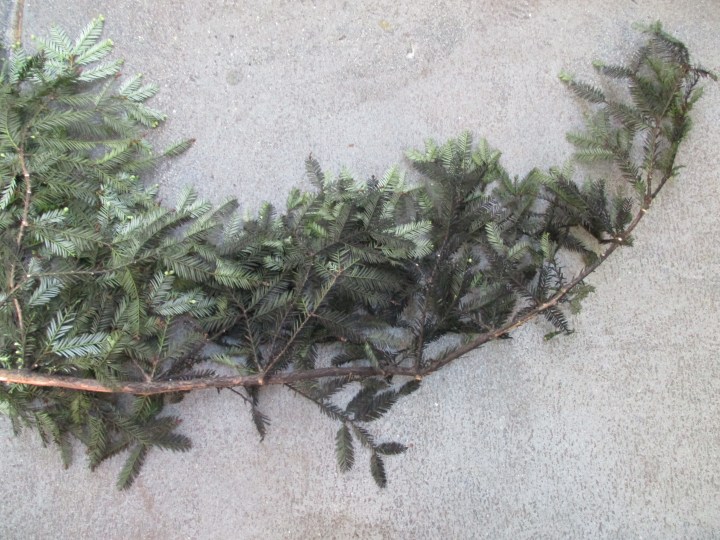
5. Most of us have seen pictures of massive redwood trunks. Most of us have seen pictures of redwood forests. Not so many of us have seen what the foliage looks like.P80825++++

6. This perennial pea has nothing to do with redwoods, but needed to be included as a token flower for this week. Besides it is cool. It is softer pink than the bright purplish pink that is so typical, and is blooming very late.P80825+++++

This is the link for Six on Saturday, for anyone else who would like to participate:

https://thepropagatorblog.wordpress.com/2017/09/18/six-on-saturday-a-participant-guide/

Here are a few links for some of my brief articles about redwood:

https://tonytomeo.com/2018/08/17/dawn-redwood/

https://tonytomeo.com/2018/08/12/general-sherman-tree/

https://tonytomeo.com/2018/08/04/albino/

https://tonytomeo.com/2018/08/04/six-on-saturday-bits-and-pieces-ii/

https://tonytomeo.com/2018/07/14/six-on-saturday-redwoods/

https://tonytomeo.com/2018/05/12/six-on-saturday-tree-ring-circus/

https://tonytomeo.com/2017/10/15/redwoods/

https://tonytomeo.com/2017/10/05/big-tree-in-a-small-town/


California Bay

70823Just because California bay, Umbellularia californica, can be used like Grecian or sweet bay for culinary purposes does not necessarily mean that it should be. California bay has a stronger and much more pungent flavor and aroma. Some might suggest substituting less than half California bay for Grecian bay. However, even if the intensity is adjusted accordingly, the flavor might be off.

As the name suggests, California bay is native to California. However, because it is from rainier climates, it prefers a slight bit more water than it would get naturally in the drier parts of the local chaparral climate. It provides nice cooling shade in large landscapes, but is a bit too dark and messy for refined home gardens. The aromatic leaf litter can annoy delicate annuals and seedlings.

Well exposed trees can eventually get more than thirty feet tall and almost as broad. Forest trees that compete with other trees can get a hundred feet tall! Small trees can be shorn as hedges. If not watered too generously, the roots tend to be rather complaisant. However, old trees can eventually develop massively distended burl growths known as lignotubers at the bases of their trunks.