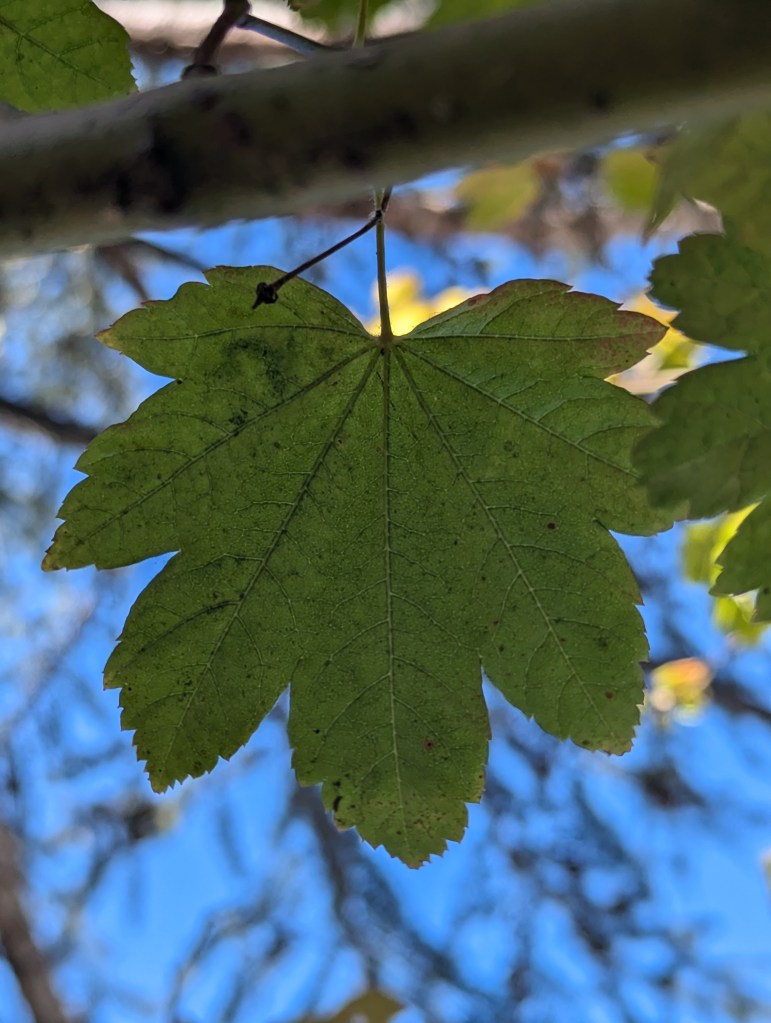
Japanese maples became so popular for their novelty that they are no longer novel. The diversity of their many cultivars is their primary appeal now. Vine maple, Acer circinatum, lacks such diversity, but is actually more novel. It is native from Mendocino County to the southwestern corner of British Columbia. Yet, it is very rarely available at nurseries here.
Vine maple has not been in cultivation for nearly as long as Japanese maple has. This is why its diversity is limited to not much more than a dozen cultivars. Its cultivars are even rarer than the simple species. Only a few ever become available, and almost exclusively by online purchase. Consequently, with very few exceptions, they are initially very small.
Vine maple grows somewhat like Japanese maple, typically with a few sculptural trunks. With regular pruning, it can stay as short as ten feet. It rarely grows more than twenty feet tall. The lobes of its palmate leaves are wider than those of Japanese maple. Leaves are only about three inches long and wide. Foliage develops bright orange color for autumn.
The taller trees are typically the first to admit that summer is finished and that it is now autumn. Perhaps because they are higher up and into the changing weather more than smaller plants that are sheltered and closer to the ground. Some trees are changing color nicely. Others are thinking about it. Evergreens are, . . . well, evergreen; so they may not seem to change so much. Nonetheless, autumn is here, and most plants will consequently be going dormant for the winter, or at least slowing down a bit.
For many trees and other plants that need to be pruned, the next few months will be the best time for it. Because they are more or less dormant, they are not very aware of whatever procedures they are subjected to. When they wake up in spring, they simply adapt to the earlier pruning and start growing as if not much happened to them. Dormancy is like a natural anesthesia for trees and plants.
Conversely, the end of winter and beginning of spring is the worst time to prune many trees and plants because they are just emerging from dormancy, so are wide awake! If necessary, minor pruning done properly is generally tolerable, but should realistically be done either before or after that time. Maples, birches, mulberries and figs express their disapproval of late pruning by bleeding profusely, and sometimes for a long time.
Deciduous trees are most dormant by winter when their leaves have fallen off. Pruning them a bit earlier would probably be harmless, but deprives them of their colorful foliage. Maples, gingkoes, poplars and mulberries typically defoliate earliest. Oaks, elms and sweetgums (liquidambars) take their time, holding onto their leaves until they get knocked out by wind and rain. Oaks and elms are not very colorful anyway. Sweetgums though can look too good to get pruned late into winter!
Arborists are physicians of trees, so can prescribe recommended pruning and maintenance procedures. Many trees, like Chinese elms, fruitless mulberries and willows, need more attention than others. Austrian black pines and Eastern redbuds are not so needy. Blue spruces that are allowed to remain branched to the ground and have enough space around them may never need a visit by an arborist.
Regardless of how much attention any particular tree needs, when it develops a problem that is out of reach, it should be assessed by an arborist, and hopefully pruned accordingly. Because trees are the most substantial features of the landscape, and can develop worse problems if not maintained properly, it is imperative to procure the services of qualified arborists; and not trust such important tasks to a gardener or anyone who can find a chain saw and pick up. Fortunately, certified arborists can be found at the website of the International Society of Arboriculture (ISA), at www.isaarbor.com.
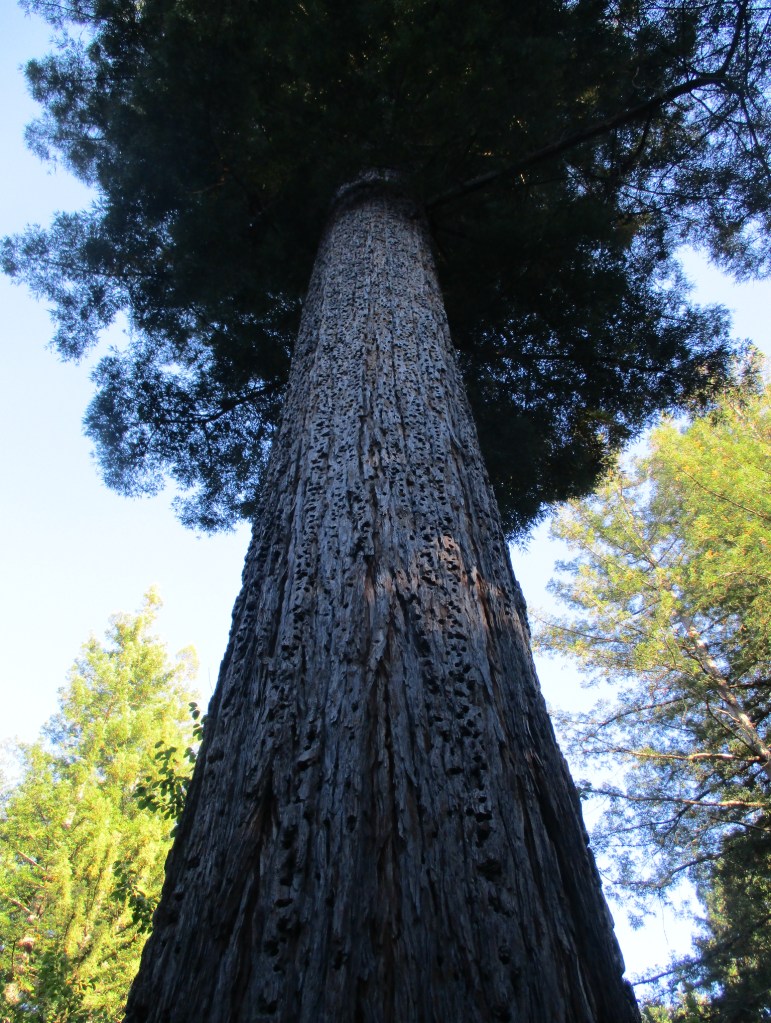
Not every garden can accommodate coastal redwood, Sequoia sempervirens. Wild trees can grow hundreds of feet tall, with trunks as wide as thirty feet! None are so big in home gardens, but only because they are still young. They can live for more than two thousand years. By that time, those in urban landscapes are very likely to become major concerns.
Realistically though, urban trees are generally more compact than wild trees. There is no need for extreme height without competition from other similarly tall trees. Besides, lower trees are less vulnerable to wind. Warm and dry wind can desiccate foliage. Strong wind can dislodge branches. Limbs that fall from very high canopies are extremely hazardous.
Almost all modern coastal redwoods from nurseries are of the cultivar ‘Soquel’. They are strictly conical and symmetrical in form, with uniform foliation. ‘Aptos Blue’ exhibits more relaxed form and very slightly bluish foliage. ‘Santa Cruz’ should be more available than it is since it is more resilient to arid warmth. Old seed grow trees are genetically variable. For old formal gardens, they are less formal than younger trees.
Banana trees, much like palms, arboriform yuccas and cordylines, are herbaceous trees. They develop no secondary xylem, or wood. What seems to be trunks are pseudostems, which are just leaves in very tight bundles. These pseudostems grow from subterranean corms, which can grow rather big. Each pseudostem is monocarpic, so dies after bloom.
Although they are very easy to grow, banana trees are not very popular. They can be too easy to grow, and become overwhelming. In some climates, frost can ruin their foliage for part of the year. In some exposures, their foliage can get shabby from wind. Some expect generous and frequent applications of fertilizer. All want generous and frequent irrigation.
These characteristics are contrary to growing banana trees merely for appealing foliage. Realistically, that is what most are for. Those of the Ensente genus are fortunately easier to maintain, but fruitless. Their lushly huge leaves are spectacular, relatively durable and generate much less debris. However, after a few years, they die without generating pups.
Banana trees of the Musa genus generate fruit, although some are primarily ornamental. A few produce delightfully colorful fruit that is too small, seedy or starchy to be palatable. Musa are more pervasive although less popular than Ensente. While Ensente come and go, Musa are reliably perennial. Several produce enough pups to potentially be invasive.
Musa, unlike Ensente, therefore develops colonies of a few to many pseudostem trunks. A few new trunks can replace each old trunk faster than they can deteriorate after bloom. Removal of deteriorating old trunks promotes growth and fruiting of new trunks. So does culling of congested new trunks. They propagate very easily by division with intact roots.
Because banana trees are tropical, they are unfamiliar with the seasons here. They grow fast with warmth but very slowly without it. They bloom randomly though. Flowers that try to bloom during autumn may stagnate long enough to rot through winter. Late fruit can do the same. Fruit that begins to develop early is much more likely to finish prior to autumn. Some cultivars develop faster.
Sequoia sempervirens, coastal redwood is the Official State Tree of California, and the tallest species of tree in the World. One large specimen can contain more lumber than many acres of Douglas fir (really). While some trees ensnare kites, redwoods collect satellites. Redwood lumber can be delivered anywhere in western North America simply by aiming a tree in the direction of delivery while cutting it down. Redwood shadows reach Japan at dawn and New England at dusk. The moon is covered with craters because it could not dodge the growing redwoods while orbiting over California. You can see for yourself how tall redwoods are just by looking in this direction from wherever you are in the World. Unfortunately though, not all of the debris that falls from the huge canopies of redwoods burns up in the atmosphere on its way down. Such huge canopies generate a lot of debris. Almost all of it is finely textured foliar debris. Some is twiggy detritus. The worst of it are significant branches. The descent of most of such branches is slowed by lower branches and foliage that they encounter on their way down. However, the lowest branches of some canopies are very high up, and falling branches resume acceleration after falling past them. Also, some falling branches fall outside of their canopies. Even branches that weigh only a few pounds can be extremely dangerous. Many falling branches weigh many pounds, and some are as big as trees. The fallen branch in the picture above is only several feet long and about three inches wide, (and happened to fall through the only three inch wide plank in a pedestrian bridge. The replacement plank needed to be custom cut.) I am annoyed by this relatively minor damage, but also relieved that it was not worse.
Dwarf Alberta spruce is more like a strictly conical shrub than a small tree.
Unlike other related white spruce, which get more than fifty feet tall, dwarf Alberta spruce, Picea glauca albertiana ‘Conica’, stays smaller than its Latin name, rarely getting more than seven feet tall. It is so dense and conical that it should never need to be pruned. Shearing only damages its short light green to grayish green needles. Dwarf Alberta spruce is compact enough to live in large tubs or urns, as long as its sensitive roots are well insulated. (Concrete or wooden planters are well insulated, so do not transfer too much heat to the roots within. Ivy or ground cover cascading over and shading planters also helps.) Foliage should be sheltered from harsh exposure, since it can be desiccated by warm breezes or reflected glare, like from large windows or light colored south facing walls.
Binding nursery stakes should be replaced with less restrictive staking and straps.
After all the unnatural things that plants must endure to get into gardens and landscapes, it is amazing that they are as happy as they are to perform. Most come from very different climates, only to be grown in artificial nursery conditions while confined to containers, then get shipped to other different climates where they get planted in foreign soil, and are expected to adapt. Nonetheless, they still provide flowers, fruit, vegetables, shade and all that we expect from them!
Trees must suffer even more. Their lower growth that should enhance trunk growth gets pruned away prematurely. Trunk growth is further inhibited by staking, which is ironically necessary for straight and vertical trunks. Fortunately, most trees recover from these procedures.
Weaning trees off their original stakes can take a bit of work though. Because of their lanky trunks and disproportionately bulky canopies, most new trees need help to stand up against the wind. Except for palms and a few stout trees that are allowed to keep their lower growth, such as redwoods and some pines, almost all trees need to be staked when planted. However, their trunks should not be bound so tightly that they rely on their stakes for support.
Stakes that are proportionate to new trees should be installed as the trees get planted. They should ideally be a few inches away from the trees and stand as high as necessary to provide adequate support. A small tree (such as #5 or 5 gallon) may need only a single stake. A larger tree (such as #15 or 15 gallon or larger) typically needs two stakes on opposite sides. The original ‘nursery stakes’ that are bound to the trunks should then be removed as trees then get tied to their new stakes. Trees will need to be supported during this process.
Trees like red maple or flowering pear that have stronger trunks that do not bend much may only need to be tied at the top, just above their lowest limbs. Most trees have more flexible trunks though, so also need to be tied lower down, generally about halfway between the ground and the top tie. Very flexible trees, like many eucalypti, may need to be tied in even more places. Since there are rarely branches on the trunks to keep the lower ties from sliding downward, the ties may need to be nailed to the stakes.
Ties should wrap around the trunks and cross over before wrapping around the stakes; in a ‘figure 8’ pattern. This limits abrasion from the stake against the trunks. Ties made from recycled tires with bailing wire at the ends are ideal and easiest. For larger lodgepole stakes, recycled tire ties without wire can be nailed directly to the stakes. Ties should only support trees as they blow away from their stakes or bow from their own weight, but should not bind them firmly to the stakes. This way, trees need to become able to support their own weight.
As trees mature and no longer need support, stakes and ties should be removed. Stakes and ties that get left too long can actually interfere with trunk development, and cause significant damage and abrasion as trunks expand.
Palm trees qualify as trees only because of their size and form. The most familiar sorts here develop trunks, and many grow quite tall. The smallest houseplant palms can grow as tall as dwarf citrus trees. Mexican fan palm can grow nearly a hundred feet tall. Palms are monocots, though, so are not actually woody. Technically, they are herbaceous trees.
Palm trees share this distinction with several other herbaceous trees. Banana tree trunks are just tightly rolled leaves. Tree ferns elevate their growth on roots that grow downward through rotting stem growth. Neither banana trees nor tree ferns can generate branches. Sago palms, cabbage trees and arboriform yuccas develop branches, but without wood.
Some palm trees develop a few trunks, but almost none develop branches above grade. Date palms can, but rarely branch. Doum palms typically branch, but are extremely rare. Any other branching palm trees are either aberrative or not really palm trees. Palm trunks do not grow wider as they grow taller. Adventitious roots can become buttressed, though.
All palm trees are evergreen, with either pinnate or palmate foliage. Feather palms have pinnate foliage. Each leaf consists of a central rachis that supports many narrow leaflets. Fan palms have palmate foliage. Each leaf radiates from the terminus of its stout petiole. Both basal leaflets of feather palms and petioles of fan palms are typically horridly spiny.
Since palm trees can not branch, they are not conducive to pruning to direct their growth. Their big but solitary terminal buds grow only upward and maybe away from shade. Any that reach high voltage cables can not go around, so necessitate removal. Clearance for overhanging obstacles is a major consideration for situating new palms. Some grow fast.
While unconducive to directional pruning, most palm trees benefit from grooming. Only a few shed their old foliage naturally. Most get shabby by retaining it. Many, particularly fan palms, eventually become combustible or infested with rodents. However, some may be visually appealing with neat beards of old foliage. Only arborists can groom large palms.
Palms take commitment. Some of the most popular grow too big for their situations. Most grow so tall that only arborists can maintain them. None are conducive to pruning to limit their natural height. Individual palm trunks rely on their single terminal buds, which grow only upward. Diversion is not an option for any palm that encroach into electrical cables.
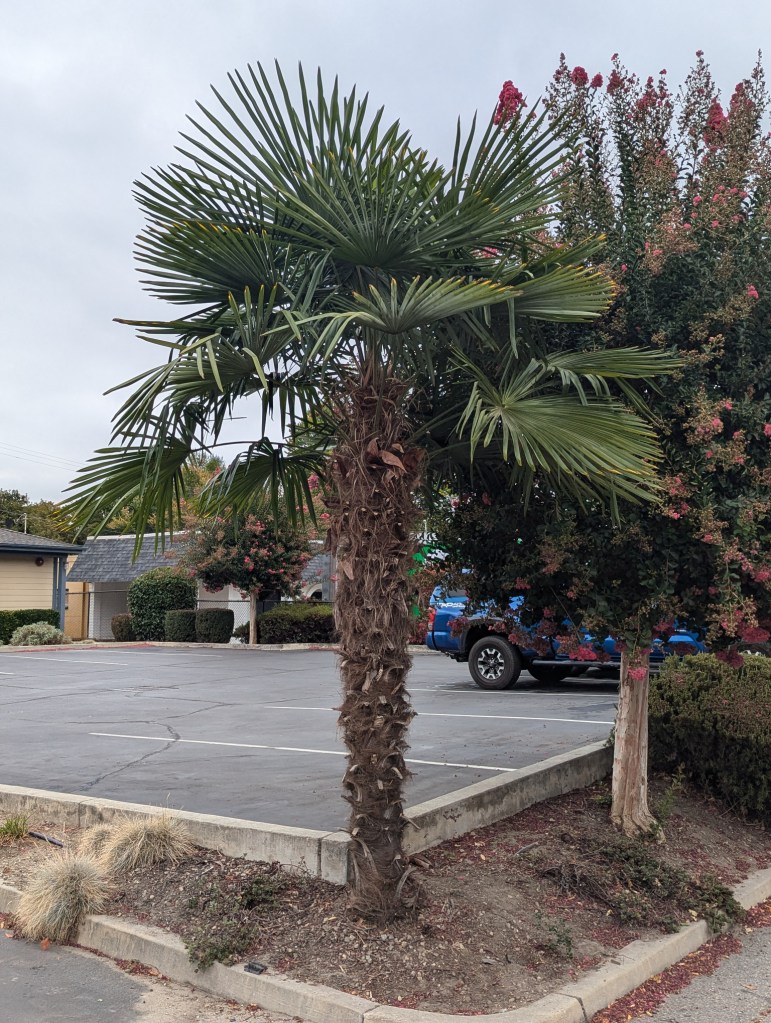
Windmill palm, Trachycarpus fortunei, is one of the more complaisant of palms. It can not grow around utility cables, but otherwise does not grow obtrusively big. Young trees can grow fast to fifteen feet tall, but then grow slowly to double their height. Only a few elderly trees grow as tall as forty feet. Their foliar canopies are generally less than ten feet wide.
Trunks of windmill palms are distinctively shaggy. Pruning dead fronds as closely to their trunk as possible promotes a neater appearance. Because growth decelerates with age, trunk shag is typically wider higher up. Trunks are about half a foot wide, but seem twice as wide since they are so shaggy. Gathering seed from pollinated female trees is simple.
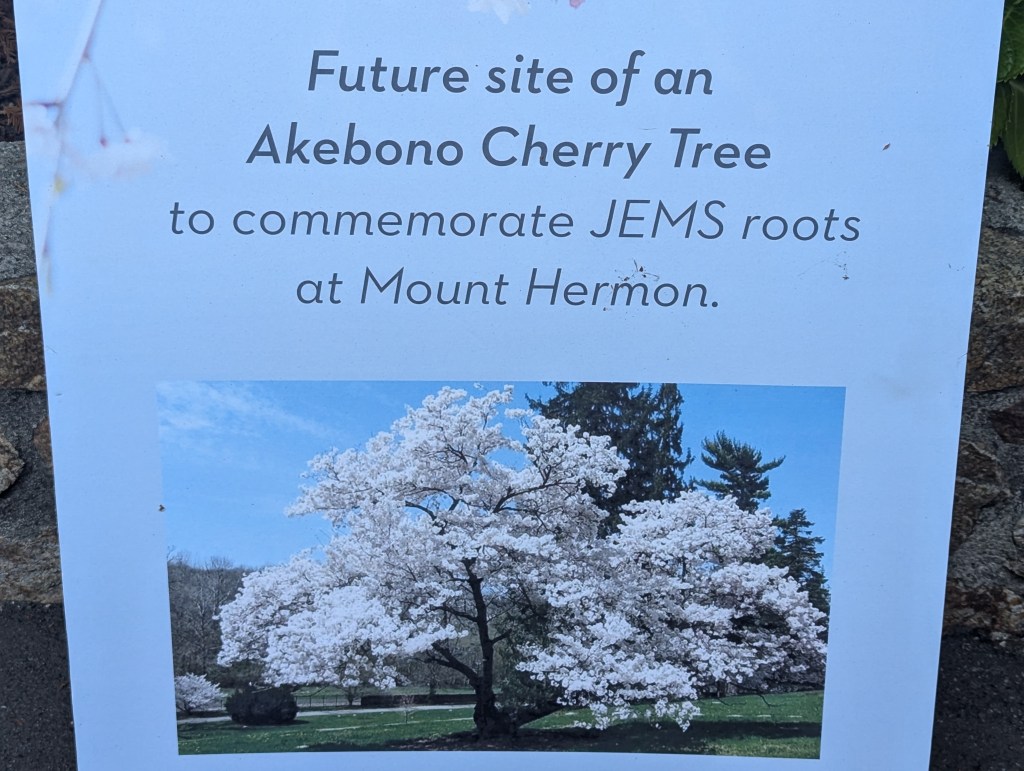
Yoshino is such an elegant name! It is the middle name of one of my nieces. A few of the flowering cherry trees here are very likely cultivars of Yoshino flowering cherry. Another recently arrived. It is a Commemorative Tree from the Japanese Evangelical Missionary Society, which we know simply as ‘JEMS’, for three quarters of a century of involvement with Mount Hermon Christian Conference Center. Its cultivar name is ‘Akebono’. We do not install many trees here, and we are more concerned with cutting trees down, but this tree is very special. It is situated very prominently on the central Mall at Mount Hermon where its spring bloom will be spectacular. It already seems to be a venerable Historical Tree that lacks only age. Now that it is here, it will acquire that eventually.
1. The Japanese Evangelical Missionary Society, or JEMS commemorated three quarters of a century of involvement with Mount Hermon with this gift of a flowering cherry tree.
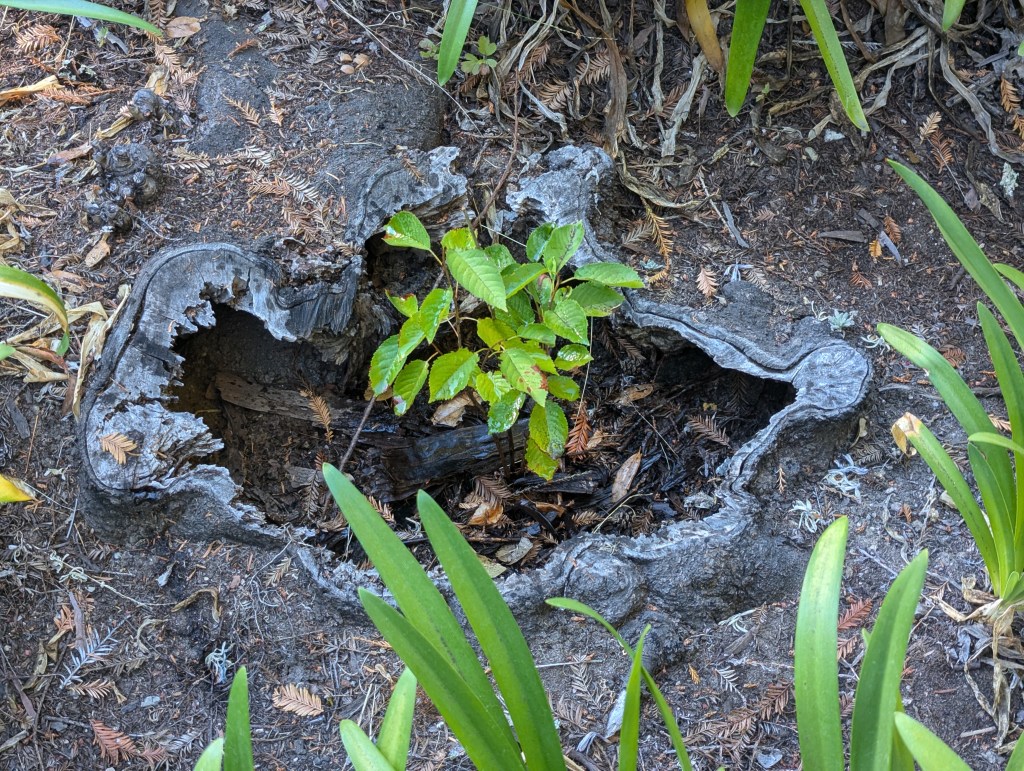
2. Unfortunately though, the pair of tiny flowering cherry trees that I installed to replace a very deteriorated and elderly pair of the same is already obsolete before it got to grow.
3. This pair of tiny flowering cherry trees grew from suckers from the original ungrafted pair, so are genetically identical, and are installed within the stumps of the original pair.
4. The new Commemorative Flowering Cherry Tree is much more prominent and better situated than the original pair, which was there prior to some of the adjacent pavement.
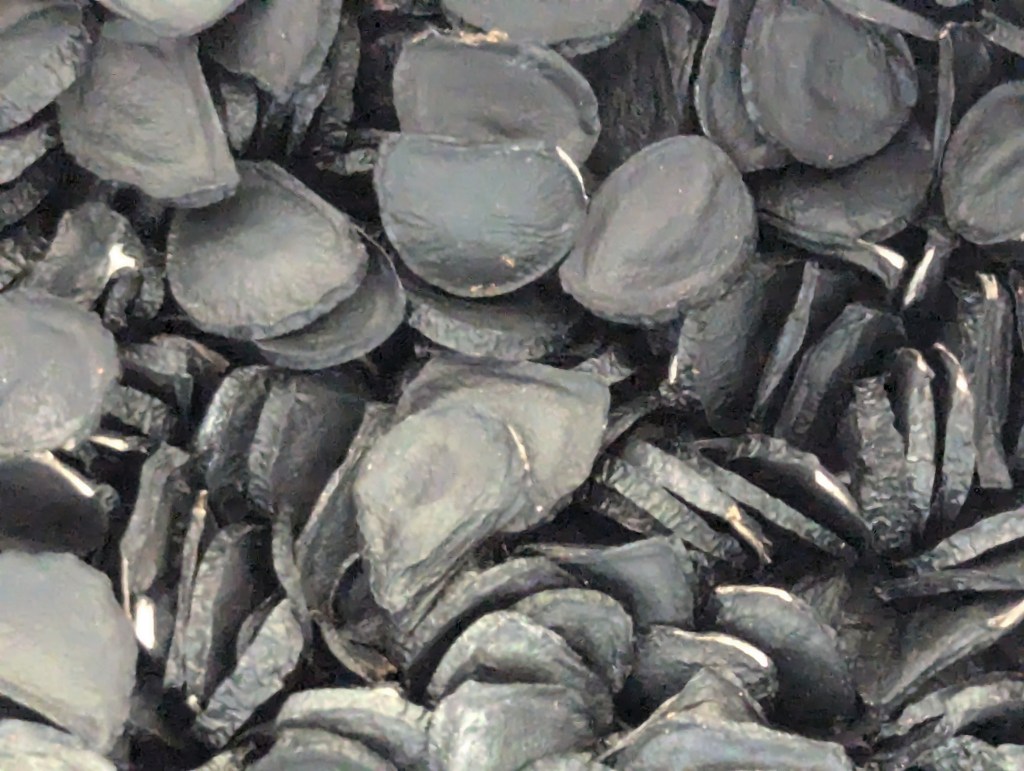
5. In other news, seedpods from (Hespero)Yucca whipplei, chaparral yucca, supposedly without its specialized pollinator, generated quite a few of what seems to be viable seed.
6. Also, Hedychium gardnerianum, kahili ginger that bloomed prematurely for the first several days of August is blooming again and more appropriately for the end of summer.






 Tony Tomeo