Furcraea foetida ‘Mediopicta’

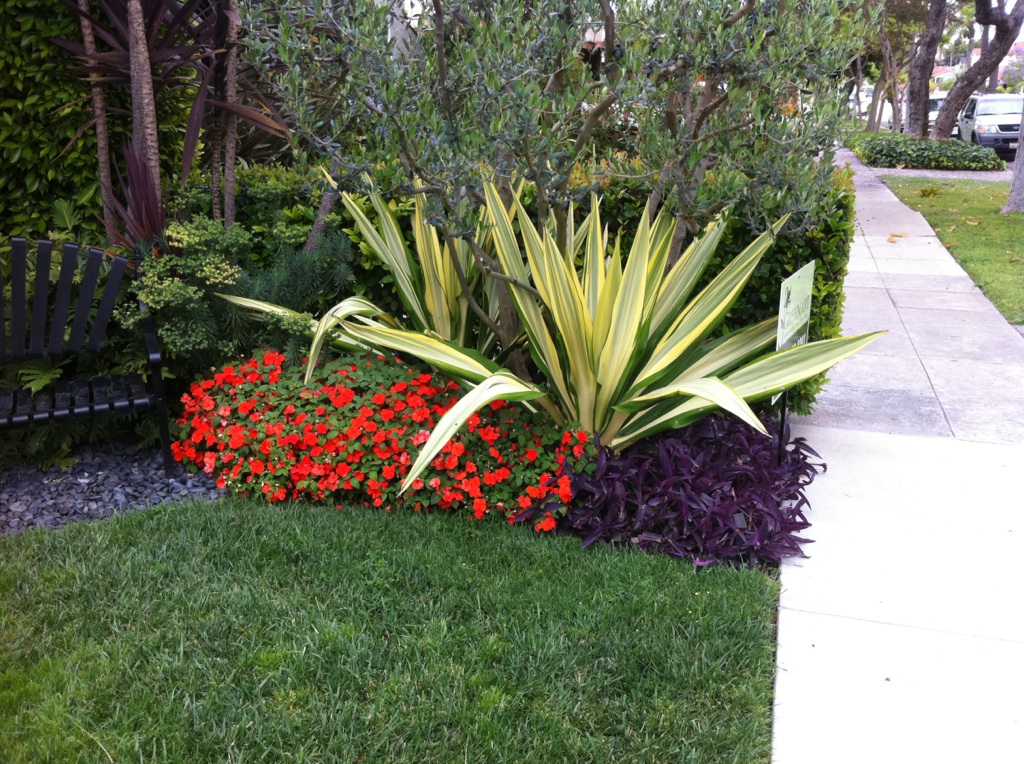
Furcraea foetida ‘Mediopicta’ looks like a big Yucca or a small Agave.

As spectacular as the bloom of Furcraea foetida ‘Mediopicta’ is, it is actually not the most desirable feature. Solitary flower spikes grow intimidatingly fast up past second story windows, and spread out several feet wide with small but abundant pale white flowers. They are certainly impressive, but are also the final act for mature plants just before they die.

Fortunately, they take several years to mature, so provide big bright yellowish green variegated foliage for many years. The other good news is that as they die, herds of pups (known as ‘bulbils’) develop and fall from the huge inflorescences. There are far more than enough pups to replace the original plants and to share with all the concerned neighbors who witnesses the crazy bloom.

Furcraea foetida ‘Mediopicta’ is not quite as tough as unvariegated (green) furcraeas, so it can be damaged both by frost or harsh exposure to sunlight. It is also a bit smaller, staying less than five feet tall (prior to bloom of course) and seven feet wide. Too much watering can cause rot.

Hosta

Hosta exhibits a lushly woodsy style.

Even for some understory species, shade can inhibit bloom. For Hosta, that would not be much of a problem. Its late summer bloom is merely an added bonus to its lushly colorful foliage. Actually, the foliage is more appealing without its tall floral spikes. Such bloom is prettier in a vase anyway. The hanging white or lavender flowers are an inch or two long.

Where summer weather is cooler, some Hosta can grow three feet tall and twice as wide. Locally, only a few of the largest cultivars can grow as wide as three feet during summer. Then, they defoliate by winter. Most have broadly rounded leaves, but a few have narrow or wavy leaves. Many have paler green, yellow or white variegation, or glaucous foliage.

Hosta is uncommon here, probably because it may be somewhat demanding. It requires very regular watering to avoid desiccation. It craves organically rich soil or potting media. Fertilizer can enhance lushness, but can burn foliage if just slightly excessive. Slugs and snails can ruin foliage. However, Hosta are understory plants that tolerate a bit of shade.

Pittosporum tobira ‘Variegata’

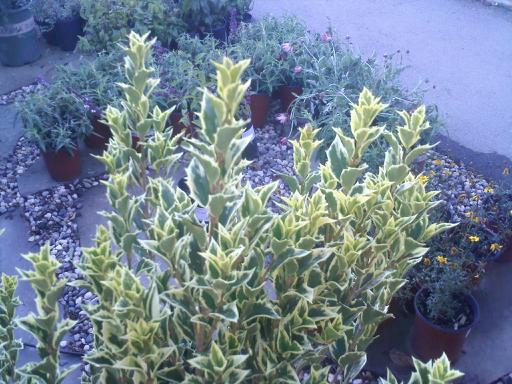
Pittosporum tobira ‘Variegata’ makes good hedges.

Almost all pittosporums appreciate sunlight and warmth. Pittosporum tobira ‘Variegata’ is no exception. However, it tolerates a bit of more partial shade than most. Furthermore, its grayish and creamy white variegation brightens shady situations. Its distinctively convex and glossy leaves are a bit flatter and broader where shaded. Shade inhibits bloom also.

Pittosporum tobira ‘Variegata’ is more popular as a foliar hedge anyway. Its small trusses of pale white flowers are neither prominent nor colorful. They can be delightfully fragrant in abundance, though. Stems are quite stout and can eventually grow more than six feet tall. They are resilient to frequent pruning and hedging, and can be cut back if necessary.

Pittosporum tobira ‘Variegata’ seems to lack a common name that is genuinely common. That is why its botanical name is most popular. Some know it as mock orange, but this is also a common name of Philadelphus. Some know it as Australian laurel, but it is neither a laurel nor from Australia. Regardless of name or origin, it is content with local climates. Once established, it is undemanding, and may need no watering.

Gold Dust Plant

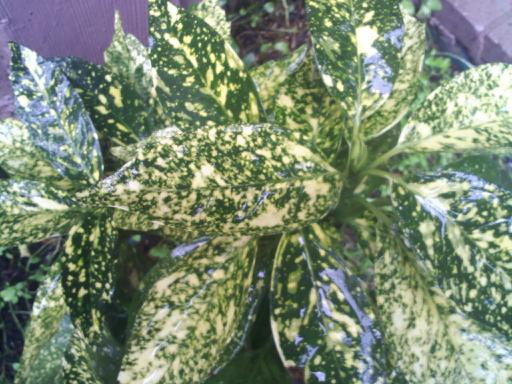
Gold dust plants actually prefers partial shade to full sun exposure.

Like so many hollies, the gold dust plant, Aucuba japonica ‘Variegata’, is grown more for its glossy foliage than for flowers or berries. The tiny dark red flowers that bloom in the beginning of spring are barely visible. Clusters of bright red half inch wide berries that ripen in autumn and winter are almost never seen without a male pollinator. Yet, the three inch wide and three to five inch long leaves are colorful enough with their splattering of light yellow spots. Gold dust plant grows rather slowly to about six to eight feet tall and wide, and does better in partial shade. Foliage can get roasted if too exposed to sunlight.

Silverberry

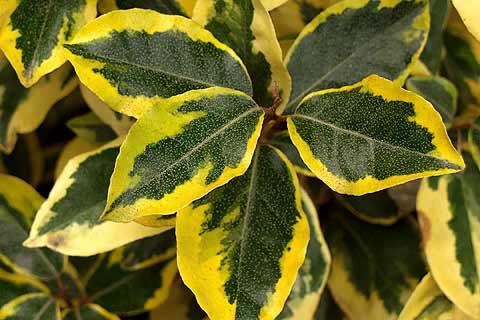
Most modern silverberry is variegated with yellow or white.

Old fashioned silverberry, Elaeagnus pungens, has always been useful for large informal hedges and barriers in difficult locations. It may not be as refined or as bright green as other plants that are more commonly used for formal hedges; but it is more adaptable to harsh exposure, since it has no problem with heat and reflected glare.

If necessary, silverberry can be shorn like privets, but is at its best with only occasional selective pruning to keep it within bounds. Without pruning, it can grow to more than ten feet high and nearly as wide. Despite its slower growth at maturity, it grows faster and fills out quite efficiently while young.

All parts of silverberry are covered with slightly raspy and silvery or ‘rusty’ tomentum (fuzz – although it is not exactly ‘fuzzy’). The one to two and a half inch long leaves often have undulate margins. The less than abundant, half inch long brownish berries taste better than they look. Somewhat spiny vigorous stems efficiently deter intrusion. Trespassers that might get through them once will not try again. 

Modern cultivars (cultivated varieties) are neither as rugged as the straight species, nor as large, but have more colorful foliage. Leaves of ‘Variegata’, which is shown in the illustration, have lemony yellow or nearly white margins. ‘Marginata’ has brighter white leaf margins. ‘Maculata’ leaves are instead equipped with bright green margins around bright yellow centers. ‘Fruitlandii’ has larger silvery leaves.

Holly-Leaf Osmanthus

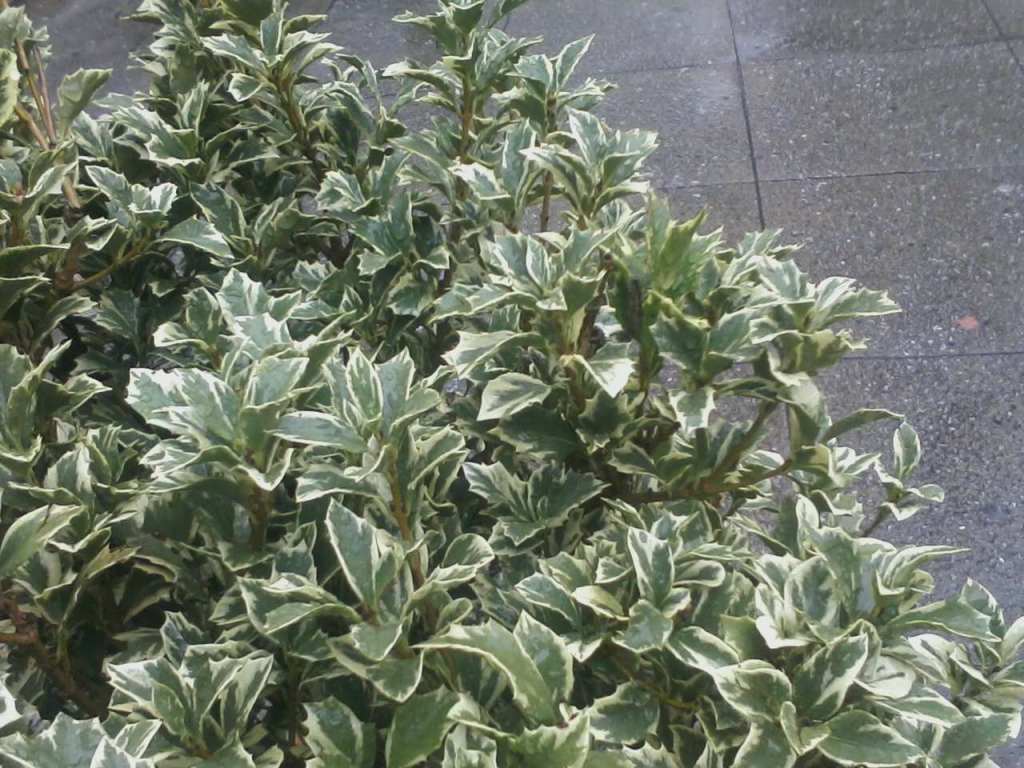
Holly-leaf osmanthus resembles both English holly and Euonymus.

English holly happens to be one of my all time favorite plants, even though it rarely produces the abundant berries that are expected of hollies. Its deep rich green foliage is so glossy and distinctively textured. Because English holly does not mind partial shade, the variegated varieties can add a bit of color where it is too dark for most other plants to bloom. I really do not mind that it is so prickly.

For those who do mind, the holly-leaf osmanthus, Osmanthus heterophyllus (or ilicifolius) is a worthy substitute for English holly that is just as happy with partial shade. The foliage is very similar in appearance, but a bit less glossy, and much less irritating. Holly-leaf osmanthus is sometimes mistaken for English holly, but can be distinguished by its opposite leaves. English holly has alternate leaf arrangement.

Mature holly-leaf osmanthus can get as large as English holly, but rarely does. It is more often less than 10 feet tall and wide, and is somewhat more adaptable to shearing into hedges. ‘Variegatus’, the most popular variety with pale white leaf margins, grows a bit slower and stays more compact, and actually looks better in partial shade than out where it is too exposed. Holly-leaf osmanthus flowers that bloom about now are not much to look at, but produce a delicate fragrance if the weather gets warm.

Holly Olive

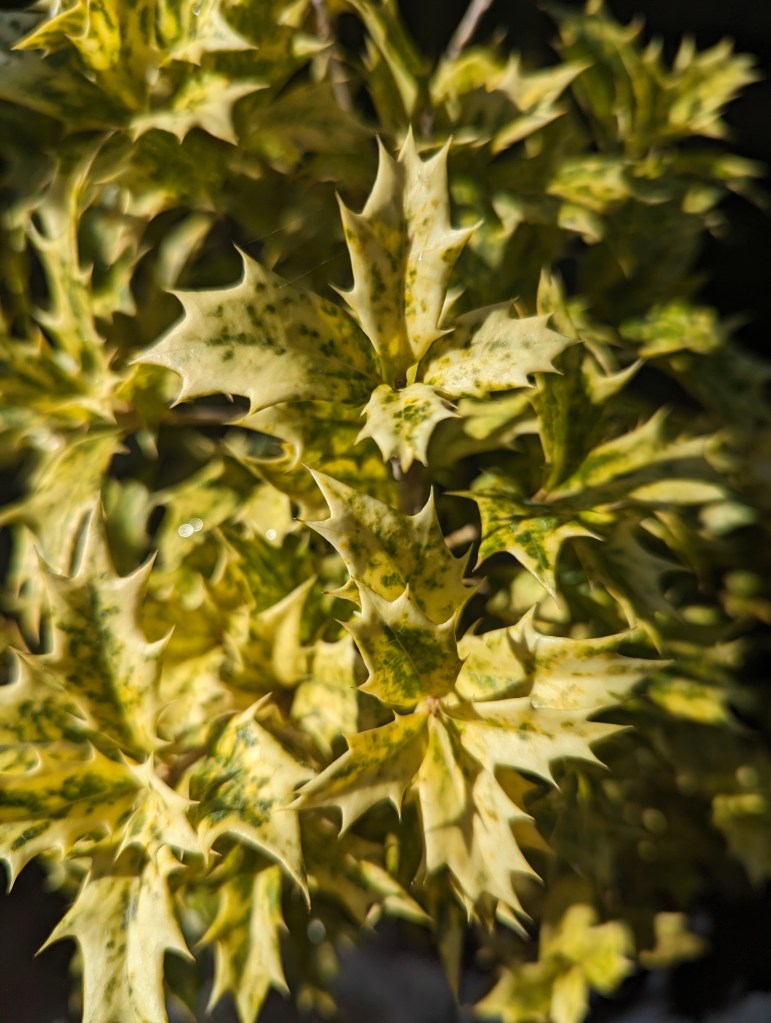
‘Goshiki’ is a popular holly olive.

English holly provides traditional cut foliage, preferably with a few berries, for Christmas. It is annoyingly prickly, though. This is why holly olive, Osmanthus heterophyllus, is now a more docile option. Its foliar texture is very similar, but with slightly dulled foliar spines. It is gentle enough for corsages and boutonnieres. However, it generates no red berries.

Holly olive is popular as small and perhaps decorated potted plants for Christmas decor. Afterwards, it adapts to home gardens more efficiently than typical Holiday potted plants. Such potted plants should not retain any mylar wrapping for too long. It inhibits drainage. Also, any small decorations or fake berries should not remain as stems eventually grow.

Most popular cultivars of holly olive are variegated. ‘Goshiki’, with more yellow or creamy white blotches than green, is the most popular here. Unvariegated holly olive is a classic dark drab green. All cultivars work splendidly as formal hedges. Alternatively, they might slowly grow taller than fifteen feet. The evergreen foliage becomes less spiny higher up. Tiny flowers are sweetly fragrant.

Sweet Flag

Sweet flag is a riparian perennial that performs well in saturated soil.

After many centuries of being grown for use in herbal medicine, sweet flag, Acorus gramineus, is still a popular evergreen perennial; but is now appreciated more for its low mounds of grassy foliage. ‘Ogon’, one of the most popular cultivars, has light yellow variegated foliage that contrasts well with deep green foliage, or brightens partially shaded spots in the garden. Individual clumps grow quickly to about eight inches tall and broad, and then spread slowly by producing more shoots. New plants are easily propagated by division. Sweet flag likes plenty of water, and does well in partially submerged pots in koi ponds, or poorly drained spots.

Euonymus fortunei

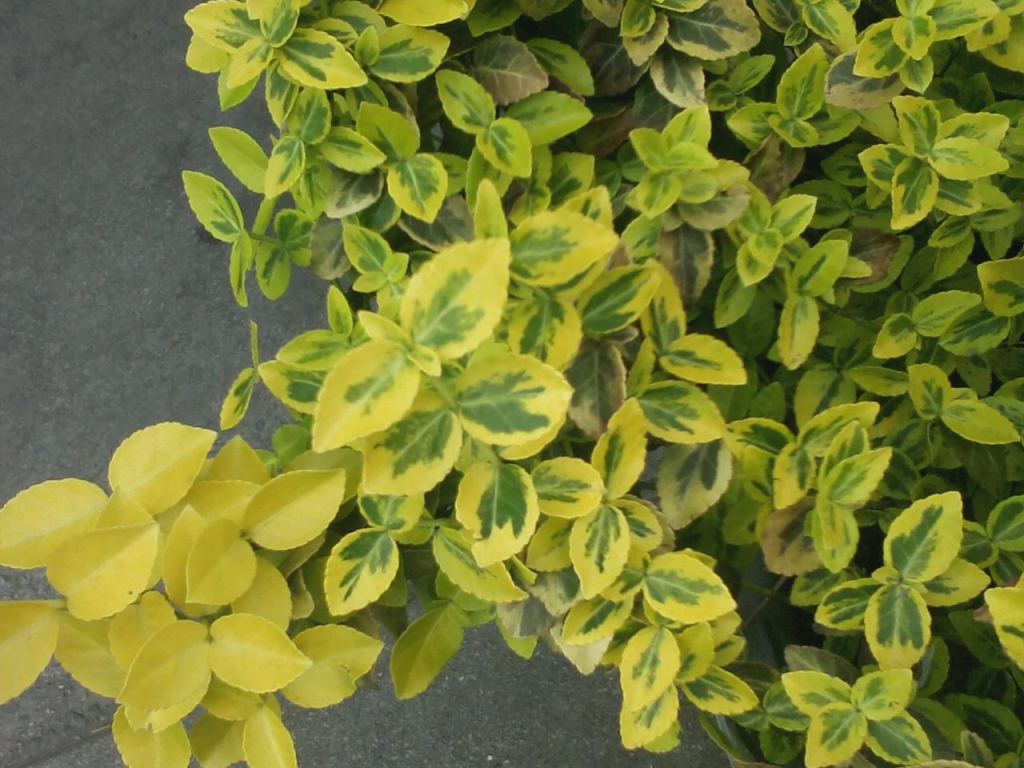
Euonymus fortunei can be shrubby or vining.

Like ivy, Euonymus fortunei creeps along the ground while juvenile, then climbs as a clinging vine where it finds support, and finally produces shrubby adult growth that can bloom and produce seed when it reaches the top of the support. Most cultivars (cultivated varieties) are juvenile plants that make good small scale ground cover that will eventually climb and mature to adulthood if not contained. As vines, they work nicely on concrete walls, but should not be allowed to climb wooden walls or painted surfaces that they can damage with their clinging rootlets. Cultivars that are grown from cuttings of adult growth are strictly shrubby.

The finely serrated, paired leaves are about three quarters to two inches long and about a quarter to one inch wide. The most popular cultivars of Euonymus fortunei that are grown for their variegated or yellow foliage do not grow too aggressively or get too large. Those with green, unvariegated foliage can slowly but eventually climb more than three stories high. Docile variegated plants can sometimes revert to unvariegated and become more aggressive. (Reversion is mutation to a more genetically stable state.)

Holly Olive

Holly olive resembles English holly.

If the foliar spines (teeth on the margins of the leaves) of English holly are too nasty, holly olive, Osmanthus heterophyllus, might be a more docile option. It lacks the occasional bright red berries and the very glossy finish on the leaves, but is much easier to handle than real holly is, since the spines are not nearly as sharp. If you look closely, you can see that the one to two and a half inch long leaves have opposite arrangement (are in opposing pairs along the stems) instead of alternate arrangement (are single along the stems) like those of holly.

The more popular varieties of holly olive have some sort of variegation of white or gold. Variegation can be spots, blotches or more refined margins. Most of the modern variegated varieties prefer to stay less than six feet tall. The old fashioned unvariegated holly olive can get more than twenty feet tall when very old, but the upper foliage lacks the distinctive foliar spines of lower foliage. The tiny and mostly unnoticed flowers are pleasantly fragrant.