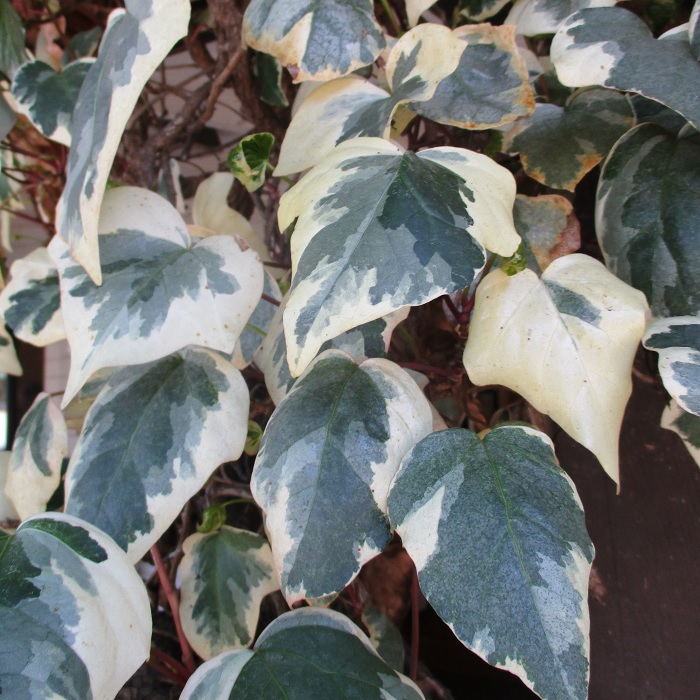
 This is one of those plants that many of us have strong feelings about. Many of us who remember it from when it was more popular in the 1970s might consider Algerian ivy, Hedera canariensis, to be an aggressively invasive weed. Those of us who are less familiar with it might appreciate it as a vigorous and resilient groundcover that gets dense enough to exclude most other weeds.
Without regular pruning for confinement, Algerian ivy grown as groundcover becomes a vine to climb trees, fences, walls and anything else it can get into. As the vines mature and get closer to the top of their support, they develop shrubby adult growth. Algerian ivy can easily ruin the surfaces that it climbs, or overwhelm shrubbery and trees, but might not be so bad on bare concrete walls.
Well contained Algerian ivy might get about two feet deep. The glossy dark green leaves are about six inches wide, with three or five rounded corners. Leaves of vining or adult growth are smaller and more rounded. New plants are very easy to propagate from cuttings or by layering. ‘Ghost ivy’ is delightfully variegated with white, but usually loses variegation as new growth replaces the old.
 When the weather warms up a bit between frosty weather and winter storms, the rich fragrance of winter blooming daphne, Daphne odora, is at its best. The domed trusses of tiny pale pink flowers are not much wider than a quarter, so are easy to overlook while investigating the source of the fragrance. ‘Aureomarginata’, the standard cultivar, has glossy evergreen leaves with narrow pale yellow margins. Mature plants are only one or two feet high. All parts of the plant are incidentally toxic.
 Tony Tomeo