Squash For Summer And Winter

80425thumbConsidering that some of the winter squash can last right through winter and into spring, there really is a squash for every season. By the time the last of the winter squash run out, the first of the summer squash will be ready later in spring. They get an early start here, and continue until frost. By that time, the earliest of the winter squash will be ready for autumn, and will last through winter.

However, they all get planted about now. There is no such thing as cool season squash. They are all warm season vegetables (actually fruits). The vines and foliage all grow like weeds while the weather is warm, and then succumb to frost at the end of their season. They all grow very easily from seed, but because each garden needs only a few plants, they are often planted as seedlings.

The main difference between summer and winter squash is that summer squash plants continue to produce many smaller fruits while the weather is warm, and winter squash plants produce only a few larger and firmer fruits that develop slowly while the weather is warm, and then finish ripening as the vines that produce them die in autumn and winter. One begins where the other finishes.

Zucchini is the most familiar summer squash here. It is most productive if regularly deprived of its tender juvenile fruit, and is notably less productive if the fruit is allowed to get bigger and tougher. Pumpkin is the most familiar winter squash here. It is expected to produce only a few big and firm fruit that take all season to develop. Extra juvenile fruit may get plucked to favor one or two fruits.

Summer squash deserve more prominent locations in the garden because the fruit gets harvested regularly. Zucchini grows as a large plant, but stays somewhat confined. Winter squash want the same sort of rich garden soil and watering, but can be put out of the way. Except for plucking a few extra fruit, not much more needs to be done to them. Some like to climb fences. Pumpkin vines can be directed to the edge or just outside of the garden.

Summer Vegetables Enjoy Warming Weather

40910thumbIf there are any cool season vegetables left in the garden, they should probably be harvested pretty soon. If left too much longer, they will be ruined by warming weather. Cabbage will bolt (start to bloom) once it realizes that it is spring. Cauliflower and broccoli, which are juvenile flowers, will become bitter as the flowers mature and try to bloom. Besides, they all need to get out of the way.
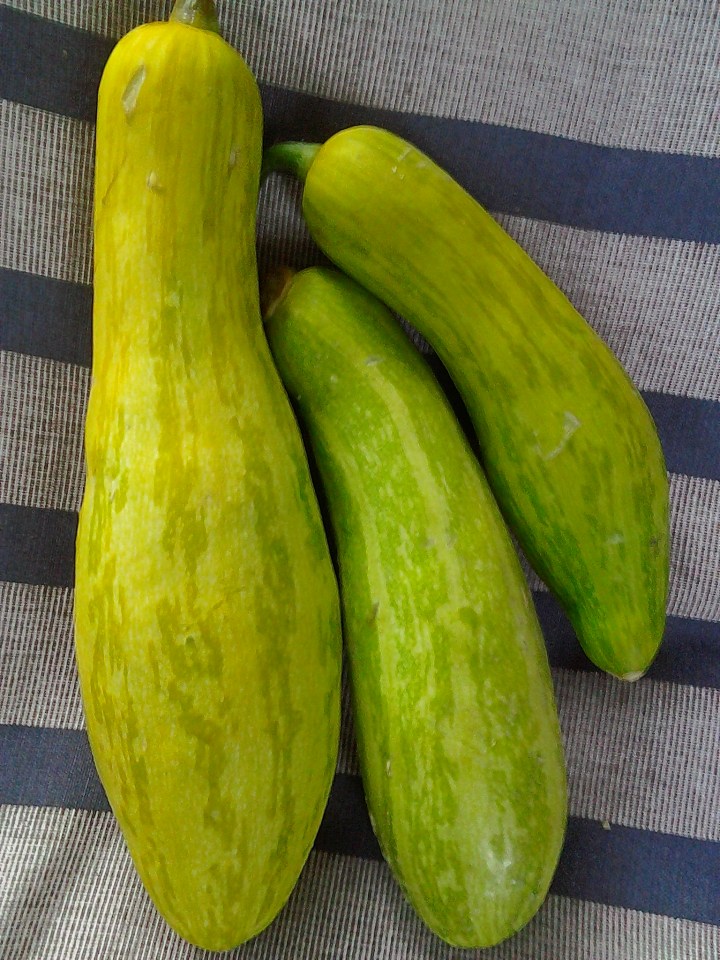
Warm season vegetables need the space. Tomato, pepper, eggplant, zucchini and other squash plants are ready to disperse their roots and get to growing. They are usually planted as seedlings because only a few of each are needed. A few seedlings of each type are more reliable, but not much more expensive than a packet of seeds; and they do not need to take the time to germinate.

However, because they are so easy to grow, seed for zucchini and other squash, as well as melon, are popularly sown directly where plants are desired. There was no need to sow them indoors earlier to plant in the garden as seedlings now. Onions can be grown from seed for late harvest, or they can be grown from juvenile onions known as ‘sets’ for earlier harvest or for green onions.

There are two main reasons why cucumbers, beans and corn should be grown from seed, although cucumber seedlings can be practical if only a few are desired. Otherwise, so many individual plants are needed that it would be relatively expensive to purchase enough seedlings. The main reason for sowing seed directly is that their seedlings are sensitive to the stress of transplanting.

Tomato, zucchini and beans are likely the most popular of warm season vegetables because they are so productive and reliable, even in limited space. Pole beans can be grown on trellises against fences or walls in very tight spots. Corn is less popular because it needs so much space, and needs to be watered so regularly. Too few plants may not be adequate for cross pollination. Pepper and eggplant, as well as okra, are not too demanding, but appreciate rich soil, regular watering and warm exposure.

Warm Season Vegetables Start Now

P80312The calendar does not always agree with the weather. It really is about time to start replacing aging cool season vegetable plants with fresh new warm season vegetable plants. Earlier warm and dry weather had suggested that it was getting late. More recent frosty weather followed by rain suggested otherwise. Regardless, there is no point in arguing with what the calendar determines.
The last seedlings for broccoli, cauliflower, cabbage and Brussels sprouts (for those who are able to grow them) should be well established in the garden. There should be enough cool weather for them to finish before the heat of summer causes them to go bitter. No more should be planted this late. Also, the last seed for beets should have been sown already. Peas should finish soon.

Warm season vegetables like tomato, pepper, squash, cucumber, corn and bean are the main concern now. Tomato and pepper are most easily planted as seedlings purchased in cell packs. A packet of seed costs as much as a cell pack, but must be sown and grown into seedlings, which is extra work. If necessary, varieties that are unavailable in cell packs can be grown from seed.

The other warm season vegetables grow so fast from seed that there is no advantage to planting them as seedlings here. Some would be distressed from transplant as seedlings. Besides, so many individual plants of each type are typically grown together that it would be expensive to purchase so many cell packs. Squash might be an exception if only a few plants would be enough.

Bush beans may seem like they would be easier to grow than pole beans because they do not require support. However, pole beans can grow on the sunny side of a fence in the background of a vegetable garden, utilizing otherwise useless space. If it would not damage the fence, string can be strung in a zigzag pattern (up and down) between nails pounded part way into the top and bottom of the fence. If the string is held an inch or so from the fence (at the heads of the protruding nails), bean vines would be happy to climb it.

Too Late For Pie

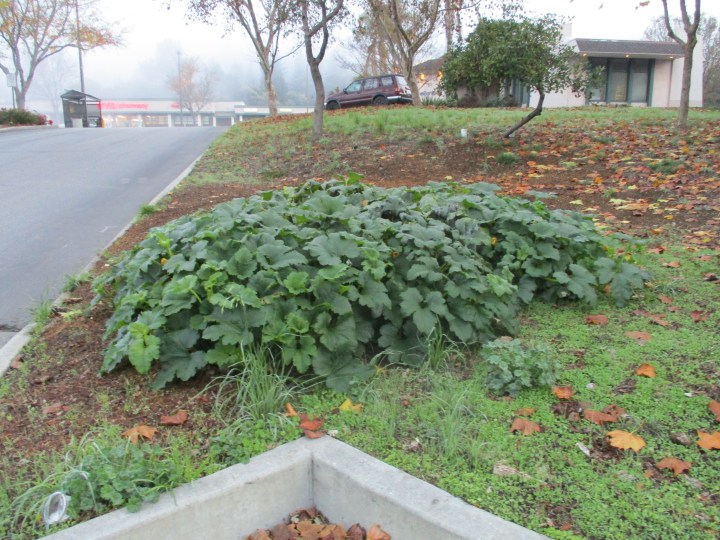
P71203Just a few feet downhill from where the old valley oak had lived for centuries (https://tonytomeo.wordpress.com/2017/09/11/goodbye-to-an-old-friend/), a pumpkin vine appeared shortly after the big oak stump was ground out. That was in late September, so was much too late for it to do much; or so I thought.
The vine grew very quickly! It is hard to say if it got water from a leaking pipe. A valve manifold that is visible in front of the stump in the original picture is completely obscured by the foliage of the vine in the second picture. With all the heavy work that was done right on that spot, it would have been very easy for a pipe or exposed valve to get damaged. (Water from a previously leaky pipe or valve could have contributed to the demise of the tree, by promoting the development of excessively heavy foliage that caused the large limbs to break and fall.)

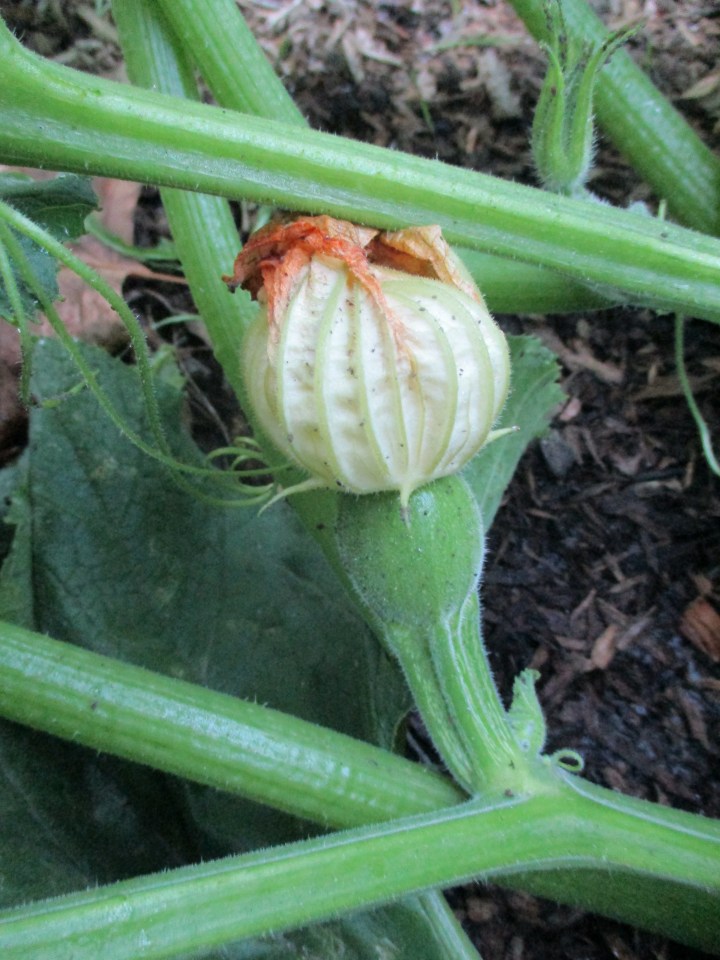
Despite the vigor and size of this remarkably healthy pumpkin vine, no fruit developed. Only a few undeveloped fruit can be found now, and the weather is getting too cool for it to mature. The foliage and flowers are already starting to succumb to mildew and decay, and will eventually get frosted. If there is any fruit obscured by the foliage, it will become visible when the foliage collapses.

Regardless, the pumpkin vine really seemed to have fun while it had the chance. How many of us get to grow pumpkin vines this big through an entire growing season? It got plenty of sunlight, and must have been getting water from somewhere. The soil is good there. As you can see in the picture, it had plenty of room to grow.

What is so special about that spot? If there is not a water leak that needs to be repaired, what else could be grown there next year?!P71203+

This Is No Food Blog

P71129There are not many things that will grow in my zone that I will not at least try to grow if I have the space and resources to do so. I really like to grow fruits and vegetables, particularly those that I am familiar with from when I was young. They are just as productive now as they were then. The only problem is that I do not know how to cook. I can freeze, can or pickle large quantities of produce, but cooking is something that I leave to experts.
I notice that almost all garden columns or blogs include recipes for the produce grown in home gardens. Mine does not. Except for a few recipes for pickles, jams and jellies, I just do not have any recipes that I would share.

When I get big winter squash, I really do not know what to do with them. I sometimes give them away to those who will cook them. Sometimes, I just cut them up, cook them, and then freeze what I can not eat. They are fun to grow, and I really like how I can keep them around for such a long time before I get around to cooking them; but they would be so much easier to work with if they were small like summer squash.

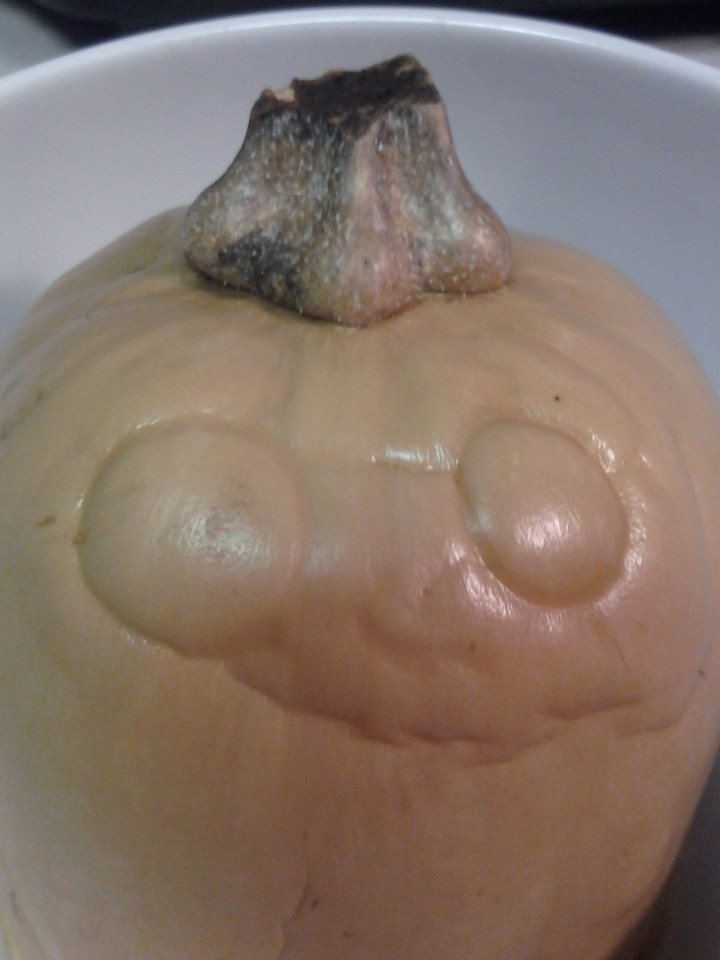
This weird squash was on the kitchen counter for a long time. Before it was cooked, it was very smooth, without any lumps, bumps or beady eyes. It was not ridiculously big. In fact, I only cut in half and ate it in two days. At the time, I was in a situation where I had a microwave oven in which to cook it, so I did so for several minutes. With a bit of butter, the first lower half was quite good, and separated nicely from the outer skin. I cooked the upper half in the same manner on the second day. It was making weird noises as it cooked, as if it were very unhappy about something. It was hissing and spitting for the several minutes that it was in there.

When I opened the door, this is what I found staring back at me from a small puff of steam! It looked angry! Apparently, it did not like to be cooked that way; or perhaps it was just a hateful squash. Regardless, it was rather creepy, and difficult to enjoy. I peeled the outside away and discarded it, but could not help to think that it was still watching me from the trash can with those beady tan eyes and crooked mouth! I do not think that I will be growing this variety again.

Anatomically Correct Horticulture

P71026Certain fruits and vegetables were so much more palatable before studying botany. Knowing what they really are sort of puts a damper on things.

Real fruits, including those known as vegetables, are no problem. We all know what they are, and they have the seeds to prove it. Just like flowers reward pollinators with nectar, many plants use fruit to get animals and people to disperse their seeds. Therefore, the fruit is designed to be eaten.

The majority of vegetables are fine too. It seems natural to eat leaves, stems, roots and even flowers. Things get a bit weird with petioles of rhubarb, celery and cardoon, since the leaves are not eaten. Cinnamon bark and saffron stamens also seems a bit odd. What about maple syrup? Is it a vegetable too?

Then there are fruits and vegetables that are not what we think they are.

You will never look at a potato the same way knowing that it is a subterranean stem known as a stolon. If it is looking back at you, it is because it has eyes, which are actually modified axillary buds, which only stems are equipped with. It it were a modified tuber or or a tuberous root like most of us think it is, it would not have these eyes.

Pineapple might be watching too, with its many eyes. Each eye actually represents a flower. What we think of as a pineapple fruit is actually a densely crowded collection of distended and fused flowers. Does that mean it is a vegetable like broccoli or cauliflower?

Strawberry is sort of fruity; but only what we think of as strawberry ‘seeds’. They are actually single seeded fruits known as ‘achenes’. Really, those little black things are outfitted with everything that they need to be classified as fruit. The red part of the strawberry is only a ‘receptacle’ for the achenes.

Everyone knows that fig trees do not bloom. So, how do they make fruit? Well, they technically don’t make any visible fruit; but they do bloom. What we think of as a fig fruit is actually a weird inside out inflorescence, with minute flowers on the inside. Each species of fig is pollinated by a particular species of minute wasp that enters the inflorescence through a very small hole at the end. Minute achenes about the size of strawberry achenes are the crunchy bits in ripe figs. To make figs even more unappealing, some wild figs contain the eggs and larvae of the wasps that went inside to deposit their eggs before dying there. Yum. Most garden varieties attract the wasps, but lack the necessary floral parts for the wasp to want to leave their eggs there. They therefore do the job of pollinating without dying inside.

Vegetables Grow All Year Here

71018thumbThe difficult part is pulling up the warm season vegetable plants while they still seem to be productive. It gets much easier after that. Putting new cool season vegetable plants back into the garden is much more gratifying. Vegetable gardening never stops here. One season starts before the previous season ends. If cool season vegetable plants get a late start, they take longer to produce.
If there is enough space in the garden, the cool season vegetable plants can go somewhere else, while the warm season vegetable plants finish with what they might still be working on. Tomatoes might last until frost. Even when it get too cold for the foliage, green fruit can still ripen on the vine, and a bit more on the kitchen windowsill. Green tomatoes remaining after that can be pickled.

If the soil does not need too much amendment, and the spacing works out well, new cool season vegetable plants can be planted in with the warm season vegetable plants so that they can start to grow and disperse roots while the warm season vegetables finish. By the time the warm season plants succumb to cooling weather, the new cool season plants will already be maturing nicely.

This technique does not work so well with last season’s tomatoes only because they are so greedy with nutrients. Fertilizer might compensate for plants that seem slow where tomatoes had been previously. A bit of amendment can be added to the soil when new cool season plants get planted, and more can be added between them when old warm season vegetable plants get removed.

Broccoli, cabbage and cauliflower should all be planted as seedlings, so can work nicely with interplanting with aging warm season vegetable plants. Since only a few of each type are needed for a well outfitted garden, one or two cell packs of six or eight plants each should be sufficient. Each cell pack does not cost too much more than a packet of seed. Seedlings get established quickly.

Beets, carrots, lettuce, spinach and peas should be grown from seed sown directly into the garden, so do not work so well with interplanting. Too many individual plants of each type are needed. It just would not be practical to grow them from cell pack seedlings. Besides, they grow so efficiently from seed. Kale can be grown either from seed of seedlings. It might be too late for cucumbers.

Pumpkins Wait For No One

71004thumbThings might have gone better for Cinderella if she had taken a Buick to the ball instead of that detrimentally punctual pumpkin coach. It was on such a tight schedule! It might have seemed like a good idea on the way too the ball. It certainly was a unique ride. The problem was that it made no accommodation for Cinderella’s tardiness at midnight. It adhered firmly to its own strict schedule.

Pumpkins and other vegetables are just as punctual in our own gardens. Pumpkin leaves eventually succumb to mildew late in summer. This year, they might be a bit more worn out than they typically are by this time, because of the surprisingly warm weather a while back. They are just finishing up anyway. They only need to sustain fat pumpkin fruit as it ripens for the next month or so.

Some of the oldest leaves might get cut away if they get so dry and crispy that they are obviously no longer viable. The best and most functional leaves will be farthest from the roots. Unfortunately, that is also where the ripening pumpkins are. They need the leaves to sustain them, but they also need sunlight to color well. Leaves that shade fruit should be bent away, or cut away if necessary.

For even ripening, pumpkins should be grown on their sides, and turned or rolled a quarter turn every few days or so. There is no precise formula, but they should not be turned in the same direction too much. Otherwise, they get twisted off their stems. They can be grown standing on their flower ends if they sometimes get turned on their sides to expose their flower end undersides.

Regular turning also promotes symmetry, and should prevent the fruit from sitting in the same position long enough to rot. Just to be safe, in well watered gardens, or where the soil is constantly moist, it might be a good idea to put small boards under pumpkins. Unfortunately, there is no remedy for damage caused by the heat. Damaged pumpkins will just make uglier jack-o’-lanterns.

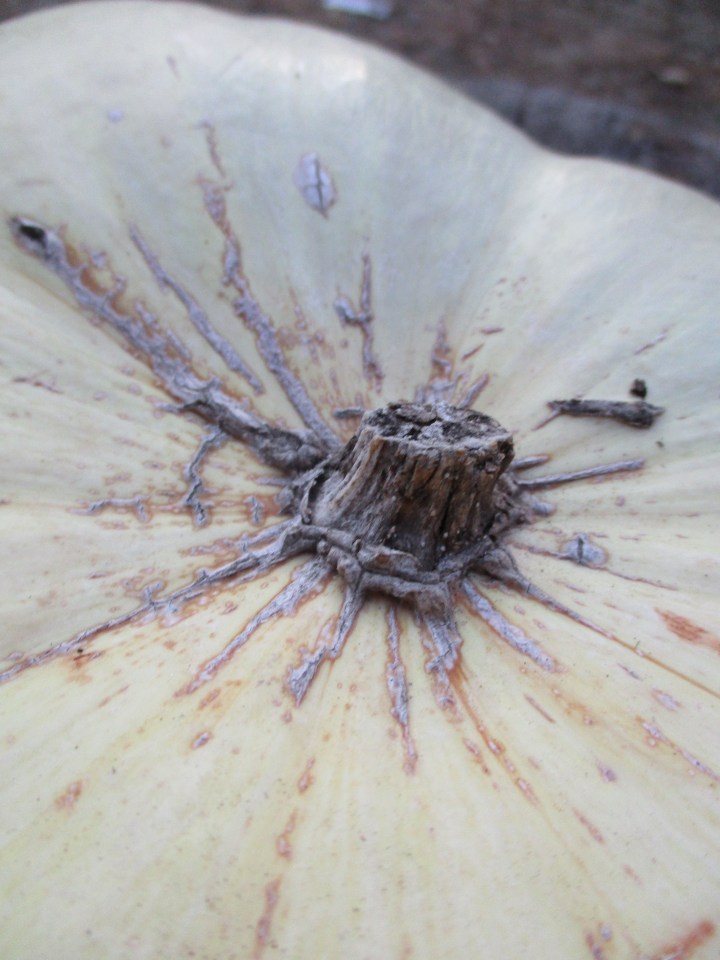
Big bright orange pumpkins with thin shells work best for jack-o’-lanterns. Smaller brownish orange pumpkins with thick shells are grown for baking and pies. Their external appearance is not as important, although well ripened pumpkins have better flavor. White, pink, green, yellow, red and even blue gray pumpkins are just weird. They look great for Halloween, but do not taste like much.

Baker Creek Seeds

new-baker-seal1

The problem with growing the same reliable plants that I have been growing for so long is that I rarely get to try something new. Seriously, my rhubarb was in the garden long before I was born, and will be around long after I am gone. I will probably never grow a different variety of rhubarb. The same goes for my lily-of-the-Nile, geraniums, many varieties of bearded iris, all nine apple varieties and all fourteen fig varieties! Sustainability can be such a bother. Only on rare occasion, I grow something from seed that I do not already have available. I do it in moderation; and I do not feel too guilty about it.

California is the best place in America for gardening, but ironically, we do not have as much variety of vegetable seed to choose from as other regions do. We can get all sorts of weird kale and heirloom tomatoes, including some that were recently developed to exploit the heirloom tomato craze; but if it is not a hip new fad, we might not have access to it. (Yes, ‘new’ ‘heirloom’ varieties) I still get my favorite simple and common vegetable seed from the local hardware store like I did when I was a little kid. There is not much in between. Most vegetable seed here is either very simple and common, or hip and trendy.

Baker Creek Seeds is one of my favorite seed suppliers, both for the formerly common varieties that I grew up with, as well as varieties that might be common in other regions, but not available here. I know it sounds silly, but we just do not have much variety of collards, okra, beets and turnip greens to choose from. The catalog of Baker Creek Seeds, which can be found at rareseeds.com, has it all. If you can not find it in their catalog, you probably do not need it. Although I cringe to say so, Baker Creek Seeds has more heirloom varieties than any other supplier I can think of.

I cringe at the term ‘heirloom’ because I do not like fads or crazes. Baker Creek Seeds does it differently though. Their heirlooms are legitimate and documentable, with nothing to prove, even if some of them look like the ordinary modern varieties. The tomatoes do not need to be blotched, striped, wrinkled, black, purple, ugly, or whatever it takes for them to be marketed as ‘heirloom’, although a few of them are. Some were developed by the Amish. Some were developed by Early American settlers. Some Baker Creek Seeds are heirloom in other cultures, but new introductions here. You just need to take a look at what they have.

All of Baker Creek Seeds are ‘pure’. This means that they are NOT genetically modified. This is their ‘Safe Seed Pledge’:

“Agriculture and seeds provide the basis upon which our lives depend.  We must protect this foundation as a safe and genetically stable source for future generations.  For the benefit of all farmers, gardeners and consumers who want an alternative, we pledge that we do not knowingly buy or sell genetically engineered seeds or plants.  The mechanical transfer of genetic material outside of natural methods and between genera, families or kingdoms, poses great biological risks as well as economicc, political, and cultural threats…”

This makes their work significantly more difficult. Any seed that fails to meet their strict standards can not be marketed. Sadly, some heirloom corn varieties are no longer available because they became contaminated by pollen from genetically modified corn. While so many unscrupulously exploit the ‘sustainability’ fad with products that are contrary to sustainability, Baker Creek Seeds is the real deal. They can be found at rareseeds.com.