 Lawns composed of turf grasses are the most functional, but also the most demanding forms of groundcover. That is old news. There are so many other less demanding low growing plants that that can cover the ground in areas that are not used like lawns are. Sometimes they work nicely just to control weeds. Sometimes they help to control erosion on otherwise unlandscaped hillsides.
Like all other plants in the garden, groundcover plants must be appealing. There is no point in growing plants that look no better than the bare soil they are intended to obscure, or the weeds they are intended to control. Some provide good foliage. Some bloom nicely. Many do both. Although not as resilient to wear as turf grasses, some groundcover plants tolerate some degree of traffic.
There are of course all sorts of groundcover. Only a few want as much water as lawns need. Some need no watering at all once established. Some are low growing shrubbery like sprawling forms of ceanothus, coyote brush, cotoneaster, coprosma and juniper. Others are vines like honeysuckle and ivy. Some of the best are creeping low perennials like iceplant, gazania and African daisy.
Low growing shrubberies may not be practical for confined spaces. When they run out of room to grow laterally, they tend to pile up on themselves, and some types can eventually get quite deep. Some types look silly if pruned around the edges for containment. Vines however need to be pruned around the edges, as well as out of trees and shrubbery. Some vines eventually get deep too.
Sprawling perennial groundcovers are the lowest and tidiest of groundcovers. They might not be as practical as shrubbery or vines for large areas, but are more often the better options for tight spaces. They do not mind getting pruned around the edges, and generally do not need any other pruning, although some look better if mown annually. Periwinkle and Saint John’s wort can get deep enough to get sloppy. Many other perennial groundcovers stay low enough to barely get disheveled by light trampling.
 The popular wisterias that bloom so profusely before their new foliage appears in spring are Chinese wisteria, Wisteria sinensis. Others specie are rare. The impressively longer floral trusses of Japanese wisteria are not as abundant, and bloom late amongst developing foliage. American and Kentucky wisteria are more docile small vines, but their floral trusses are both short and late.
 Foliar tapestries are impressive in the right situation.

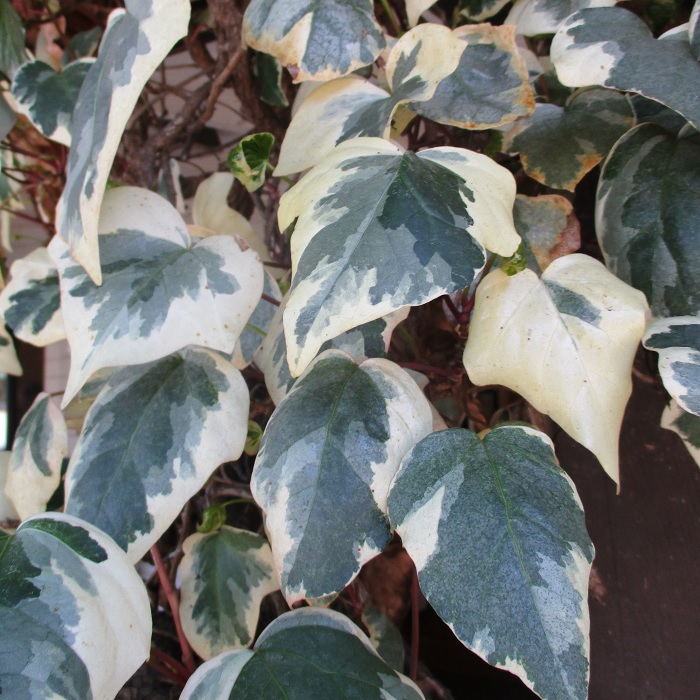 This is one of those plants that many of us have strong feelings about. Many of us who remember it from when it was more popular in the 1970s might consider Algerian ivy, Hedera canariensis, to be an aggressively invasive weed. Those of us who are less familiar with it might appreciate it as a vigorous and resilient groundcover that gets dense enough to exclude most other weeds.
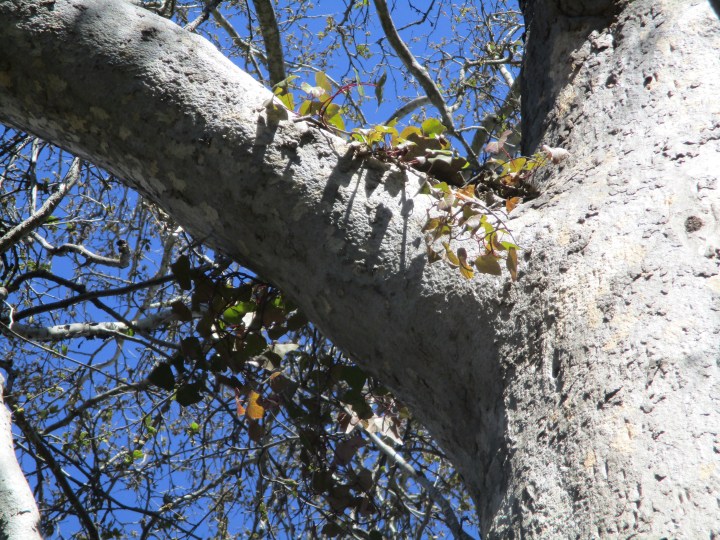
 The ivy in this sycamore did not just climb up from the ground to hang over this big limb. If you look closely, you will see no vine coming up from the ground. This small patch of ivy as well as a small pyracantha, are growing in a decayed cavity on top of the big limb. The ivy may have climbed up a long time ago, and then rooted into the cavity before the original vine was somehow removed. Alternatively, the ivy might have grown from a seed that was dropped by a bird or ivy vines that are higher up in nearby box elder trees. It is impossible to say now.
 This is no timid vine! Flame vine, Pyrostegia venusta, is related to the lavender trumpet vine and blood red trumpet vine, and is just as vigorous. Although it can not be recommended for tight spaces or small refined gardens, it excels at obscuring concrete walls. It only needs wires or stakes to be convinced to climb. If it gets too big, it can be cut back after bloom to regenerate quickly.
 Tony Tomeo