 This is a recycled picture that still annoys me. There was another that I did not want to use because it happens to be from a landscape that I sometimes work in.
The picture that I did not use shows a variety of annuals in a half wine barrel that is set on cobble stone that fills a square that is about five feet by five feet that was cut out of an asphalt paved area.
So:
The area was paved to function as a patio.
A square was cut into the pavement perhaps because there was too much pavement.
The square was filled with stone because there was too much exposed soil where there should have been pavement.
A half wine barrel of various annuals was installed on top of the stone as if a square filled with stone was not adequately in the way.\
The half wine barrel and stone should be removed so that the are can be paved as usable patio space. . . like it had originally been.
It reminds me of a monologue by the renowned comedian, Bill Cosby. He discussed the small compartment that is designed to keep butter from getting too cold within a refrigerator that is designed to keep food cold, within the home that is heated to keep the interior from getting too cold.
Now, back to the picture above. It annoys me even more because it is not the result of a series of mistakes by several different volunteers working in the landscape that I did not post a picture of. It was done by so-called ‘professionals’, like those I briefly worked for a few years ago.
The area was paved. I might add that it was paved quite well. Then, either because there was too much pavement, or because someone wanted to sell more junk, potted plants and the associated irrigation system were installed onto the pavement, so that the affected portion of pavement is now useless.
How does this makes sense? It should have been done properly when the pavement was installed only a few years ago. I would guess from looking at it that the pavement was done properly, but someone just wanted to sell more infrastructure.
The bigger urn in the foreground is planted with pink jasmine on a trellis. I explained the problem with the vine not getting released from its bindings last week. https://tonytomeo.com/2018/11/28/horridculture-well-done-stakes-are-rare/ Not only does a bundled thicket of stems remain in the middle, but all the new growth is crowded on top of the trellis because the landscape ‘professionals’ planted a big vine on a tiny trellis, and then neglect to maintain it. What is the point of a trellised vine in the first place? I mean, what does it ‘do’? Wouldn’t something shrubbier or a cascading perennial have been more appropriate? Do we really want to see the bare soil and accumulated cigarette butts below the vine? What about the landscape behind the potted plants? Why obscure that? Why create more obstacles for those who sweep or blow debris from the area.
Just look at all the pointless infrastructure in this useless space. Rather than a nice well designed landscape adjacent to clean and usable pavement, we have pointless potted plants cluttering the area, leaking water that stains the now useless pavement, and just getting in the way!
Ornamental Grape
 Boston ivy is not really ivy at all; but is more closely related to grape. Along with creeping fig, it is one of the two best vines for freeway sound-walls. It protects the walls from graffiti and muffles sound. Unlike creeping fig, which is evergreen, Boston ivy is surprisingly colorful through autumn. Unfortunately, it clings to whatever it climbs with holdfast discs, so ruins paint, stucco, and any other surface it gets a hold of.
Then there is ornamental grape, Vitis vinifera. It is about as colorful as Boston ivy, and can climb almost as aggressively to thirty feet, but lacks the damaging holdfast discs. It is nearly fruitless, which may seem like a waste of an otherwise perfectly good grape vine; but it will not make much of a mess until it defoliates. If any of the tiny fruit actually matures, it will almost certainly get eaten by birds before anyone notices.
Since it does not grip so tightly to what it climbs, ornamental grape can get rather shrubby. Outer growth can overwhelm and shade out inner growth, and can eventually produce a thicket of dead canes. Pruning back superfluous shrubby growth while bare in winter promotes more vigorous new growth the following spring and summer. Ornamental grape likes full sun exposure.
Horridculture – Well Done Stakes Are Rare
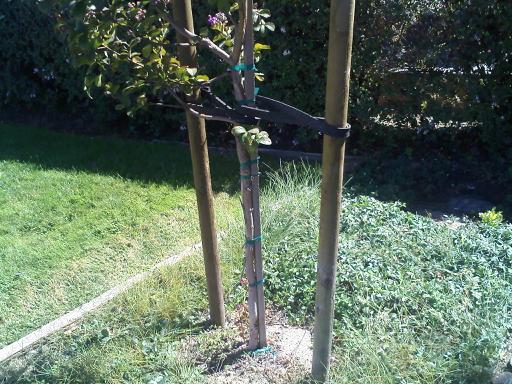
Stakes are temporary. That is what so called maintenance ‘gardeners’ do not seem to understand. Stakes should not stay any longer than necessary, so need to be removed sooner than later, depending on their function. Stakes that are left too long can interfere with the healthy development of the trees and vines that they were intended to help.
Nursery stakes are used either to straighten the trunks of developing trees, or to support climbing vines. They must be removed when the trees or vines that they worked for get installed into the landscape, or as soon after installation as possible. Some flimsy trees may need their stakes for more than their first year.
The problem with leaving trees bound to their nursery stakes for too long is that they rely on the stakes for support as they grow, so do not put much effort into supporting their own weight.
The picture above shows a coast live oak that was staked properly with landscape stakes to the side, but while still bound to the original nursery stake. Because the tree was bound for too long as it grew, it may be too flimsy to support itself without bending when the binding nursery stakes eventually gets removed. For this particular tree, the bindings may need to be removed in phases so that the tree can learn to support itself before the last binding is cut loose.
The problem with leaving vines bound to their nursery stakes is that they remain bundled in the middle while new growth spreads out more naturally. Vines should instead be unbound and spread out onto their support, even if they need to be bound to the new support like they were bound to their nursery stake. Only a few vines that will get cut to the ground annually or after their first growing season, such as Boston ivy and creeping fig, can remain bound through their first year, only because the whole mess will be pruned to the ground, and replaced with new growth later.
The picture below shows a pink jasmine vine that is still bound to its stake, right in front of a disproportionately small trellis. The bundled mess of stems in the middle is partially obscured only because the tangled upper growth is so overgrown. There are so many problems with this unfortunate potted pink jasmine that it will be a topic for next week.
Landscape stakes are very different from nursery stakes. They are not needed to straighten trunks of trees, but are merely used for a little bit of support while new trees disperse their roots. When trees have adequately dispersed their roots and are stable enough to stand up to a bit of wind on their own, landscape stakes must be removed. They are not as likely to interfere with the development of structural integrity like nursery stakes do, but can interfere with root dispersion and development of adequate stability if trees become reliant on them for support.
The flowering cherry tree in the picture below obviously does not need the support of the unsightly landscape stakes that remain partly strapped to the trunk. The stakes did not compromise stability only because the tree is so naturally stout. The stakes really are unsightly though. So is the overgrown Boston ivy on the trunk and up into the canopy, . . . and the mutilated stubs and stems that were ‘pruned’ by the maintenance ‘gardeners’. Seriously; what kind of ‘gardener’ does this sort of atrocious work?! Well, those topics can be addressed at another time.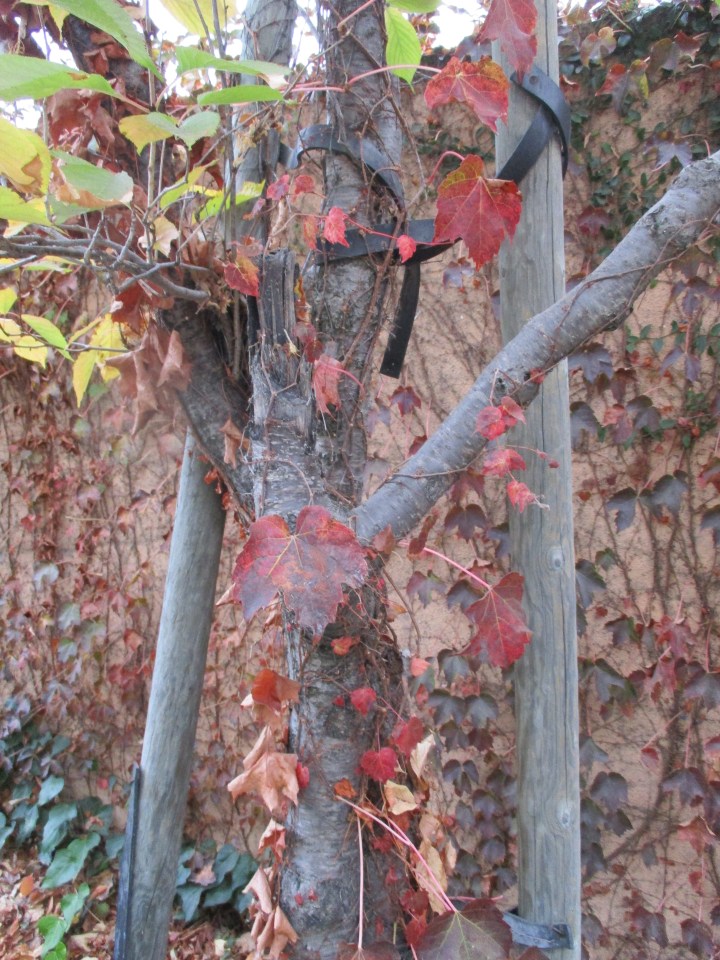
Cape Honeysuckle
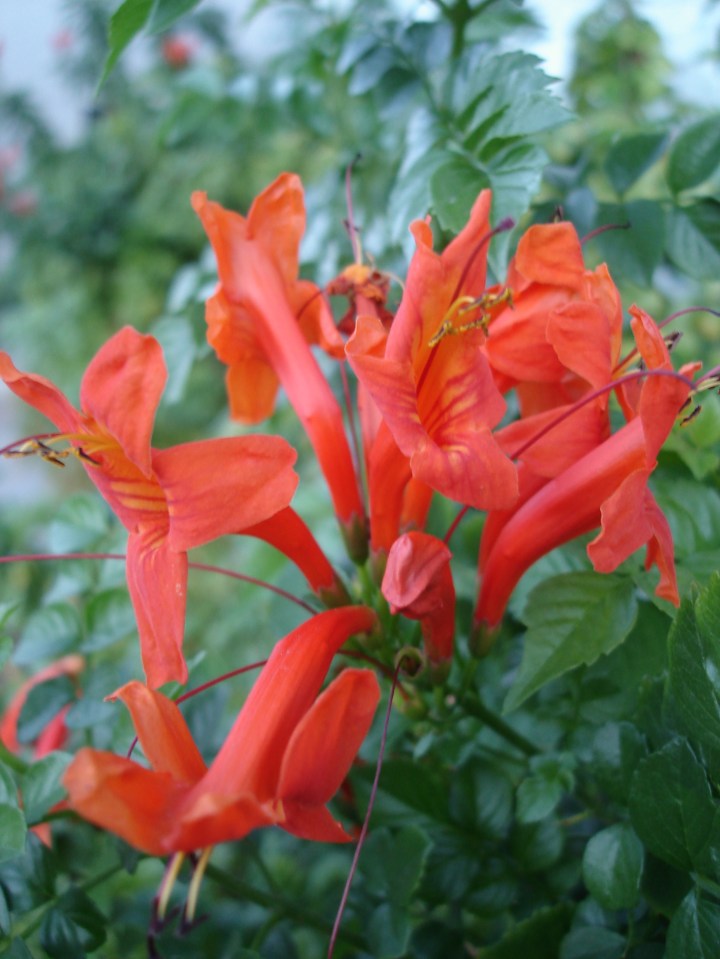 It may not bloom profusely, but cape honeysuckle, Tecoma capensis, blooms sporadically at random times throughout the year, and often while not much else is blooming. The bright reddish orange flowers contrast nicely against glossy evergreen foliage. Some blooms are slightly more reddish, while others are slightly more orangeish. A somewhat more compact cultivar blooms with light yellow flowers.
The long and limber stems of cape honeysuckle can not decide if they want to grow as vines or as shrubbery. They can be tied back and espaliered against a fence or trellis, or pruned and left to stand on their own. Large plants can get higher than the eaves. Overgrown thickets of stems can be cut down to the ground at the end of winter. They can regenerate and resume blooming before summer.
The narrow tubular flowers are about two inches long. They develop in terminal trusses, but only a few within a truss bloom at the same time. Shade inhibits bloom. Fertilizer seems to inhibit bloom by promoting vigorous vegetative growth. Fortunately, these vigorous shoots eventually bloom as vigorously as the grew. The four or five inch long leaves are pinnately compound, with five to seven small serrate leaflets.
Groundcover Is Carpeting For Landscapes
 If shade trees are the ceilings, and hedges and shrubbery are the walls, then turf and other groundcover plants are the floors of some of our outdoor living spaces. Except for turf grasses, most groundcovers are not as useful as hardscapes like pavement and decking, but they perform other functions in areas that do not get such use. Groundcovers inhibit weeds, erosion, dust and mud.
Turf grasses used for lawn are of course the most popular groundcovers, and are a separate topic from other groundcover plants that grow over unused or lightly used ground. Because they need not tolerate traffic, these other groundcover plants need not be as resilient, or as flat as turf grasses are. They can be perennials, vines or low sprawling shrubbery. Most, but not all are evergreen.
Groundcover plants work something like mulch, although most want to be watered. They inhibit weed growth by occupying the space that weeds want. Many hold soil together with their roots. They may seem like they would compete with other plants, but groundcover plants insulate the soil, which makes it more comfortable for other plants. Many retain more moisture than they utilize.
Gazanias and iceplants are two of the most popular perennial groundcovers. They tend to replace their own growth regularly as old stems decompose below new growth that spreads over the top. They therefore do not get very deep. Some gazanias eventually develop bald spots. When they get trimmed around the edges, the scraps can be plugged back into bald spots as cuttings.
Cultivars of myoporum, cotoneaster, ceanothus, rosemary, juniper and other low and sprawling shrubbery that make good groundcover must not be confused with cultivars that grow as upright shrubbery or even trees. There is a big difference between creeping myoporum that stays less than a foot deep, and shrubby myoporum that can get almost thirty feet tall! Also, vines used as groundcover, like ivy and honeysuckle, should be maintained as such, and not allowed to climb trees, shrubbery and other landscape features, like vines naturally want to do.
Mandevilla
 Pink, red or white are the only choices. There happens to be a darker shade of red. Yellow throats are more conspicuous in white flowers. Otherwise, there is not much variation of color amongst the various mandevillas. The flowers are very similar in both color and form to those of related oleander, but are larger. Some are as wide as three inches. Small flowers can have pointed petals.
Mandevilla vines are surprisingly vigorous and sneaky. The lower portion of a mature plant may seem to be rather tame while it extends aggressively twining vines into trees above. Vines on small trellises can get congested on top. Pruning upper growth helps to even out growth and bloom. Exposed vines are likely to get killed back by frost in winter, but should regenerate efficiently.
The evergreen foliage is quite glossy. Some varieties have interestingly rippled leaves. Partial shade is best for rich green foliar color. Full sun can scorch leaves. Dipladenias are very similar to mandevillas, but are shrubbier and more compact, with smaller flowers and leaves. They are probably a better option for large pots. Sap of both mandevillas and dipladenias is caustic and toxic.
Blue Dawn Flower
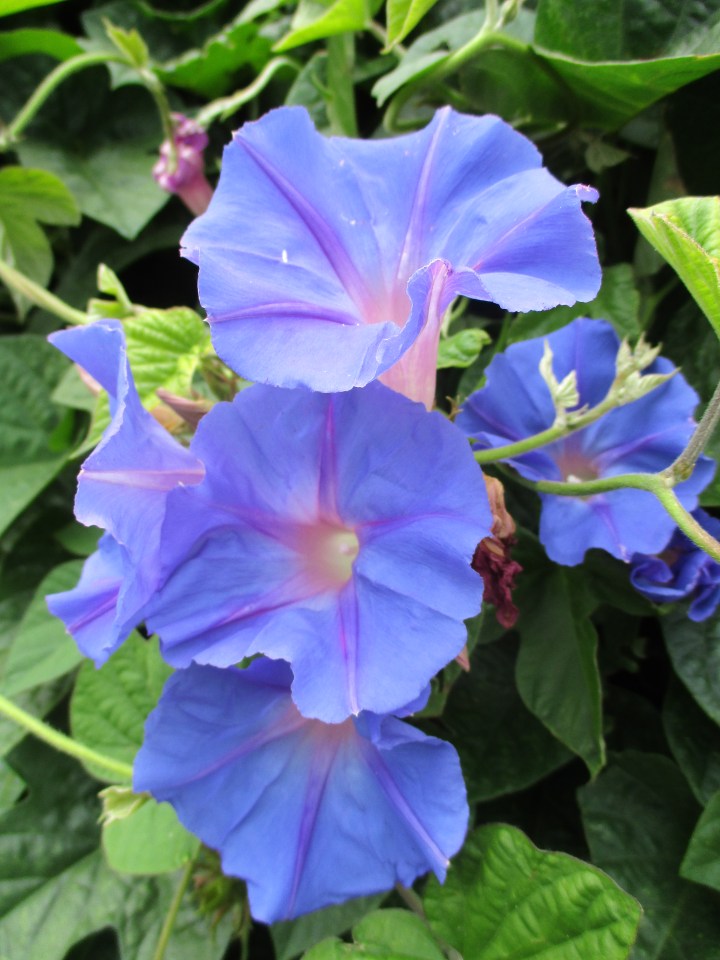 Even within its native range, blue dawn flower, Ipomoea indica, can be a problem. There are not many other plants in some coastal regions of Peru that can avoid getting overwhelmed by the aggressive wiry vines. These vines grow roots where they touch soil, so can spread indefinitely over the ground. Vines that succumb to frost over winter regenerate as if nothing ever happened.
Three inch wide flowers are rich purplish blue when they open at dawn. They then fade through the day, only to be replaced by fresh new flowers the following morning. Bloom continues from spring until autumn, and can get profuse at times. The lush rich green leaves are cordate (heart-shaped) or lobed (with only three lobes). Too much fertilizer promotes growth but inhibits bloom.
Blue dawn flower’s main weakness is a dependency on water. If it gets too dry briefly in summer, it can die back like it does with frost, and then recover once it gets water, but it will not survive for very long if it stays dry. As aggressive as it is, it should not spread very far from landscaped areas or riparian areas where summers are too warm and dry for it.
Anemone Clematis
 Like Ginger and MaryAnn, choosing between the flashier hybrids of clematis and the anemone clematis, Clematis montana, might not be so easy. The fancier hybrids have the bigger, bolder and richly colored flowers that the genus is known for. Anemone clematis has smaller and more subdued flowers in soft pastel hues, but is more prolific, more vigorous, and blooms for nearly a month.
The simple spring flowers look something like those of dogwood, except that they are on wiry deciduous vines that are already outfitted with new foliage. Most are soft white with only four petals and prominent yellow anthers. Some are blushed, pale pink, rose pink or pinkish mauve; and some have more petals or fluffier ‘double’ flowers. The largest flowers are a bit wider than two inches.
The vines are more vigorous than those of clematis hybrids, but are not as aggressive as most other vines or winter clematis. With pruning, they can behave on small gate arbors, although shorter trellises would probably be too confining. If vines escape confinement, they can eventually climb more than thirty feet. The distinctively lobed trifoliate leaves are olive drab, and handsomely rustic.
Grapes And Vines Of Wrath
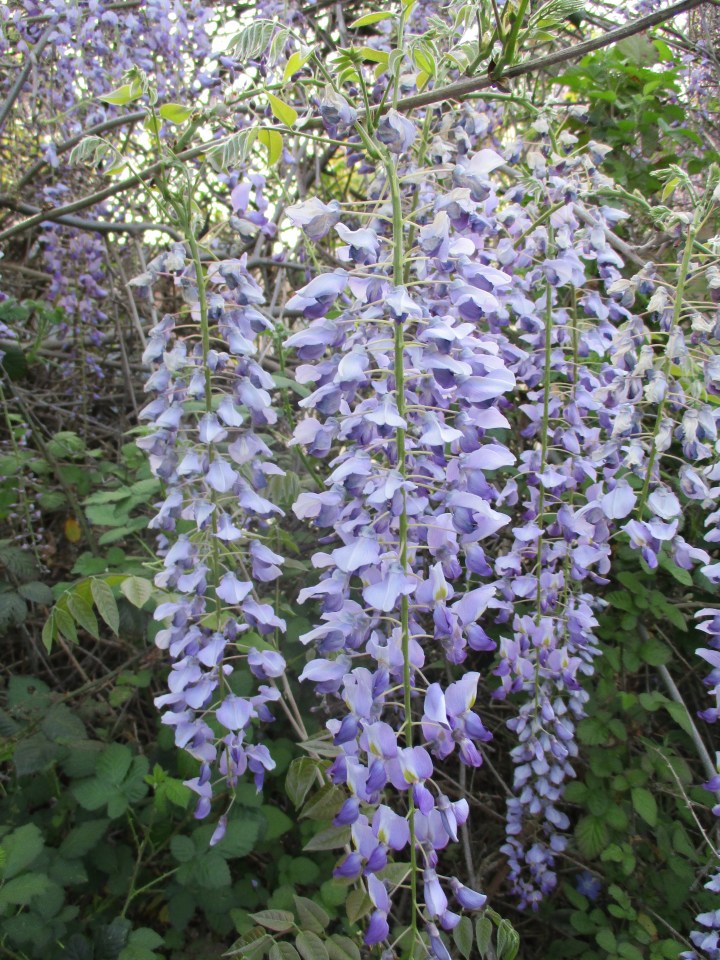 Anyone can plant a grapevine. With a bit of work, almost anyone can make a grapevine grow. Most who put forth the effort can figure out how to prune and cultivate a grapevine. Yet, grapevines so often get very out of control. They easily escape confinement, overwhelm nearby plants, climb into trees and overburden their trellises or arbors. It is easy to forget how aggressive they can be.
The primary problem with aggressive vines is that they require pruning for confinement. The most aggressive vines need the most aggressive pruning. Grapevines can actually be quite docile if pruned properly. Chinese wisteria and red trumpet vine need even more aggressive pruning, and will never be completely tamed. It is important to know the personality of each vine in the garden.
The secondary problem with aggressive vines is they are expected to conform to unrealistic confinement. Small trellises that are lower than about eight feet, including common gate arbors, spires and obelisks, are really only big enough to accommodate docile small vines like clematis (hybrid), American wisteria, well pruned mandevilla and vining annuals like morning glory and pole bean.
Chinese wisteria, large types of bougainvillea and other big and heavy vines need big and stout trellises or arbors. Lattice will not do. Chinese wisteria becomes entangled with lattice, and then crushes it as the vines expand. Bougainvillea does the same to a lesser extent, but then pulls the lattice apart as the intertwined vines sag from the increasing weight of foliage and growing vines.
Clinging vines like creeping fig and Boston ivy present another problem. They are not interested in trellises or arbors. They do not grab onto support by twining stems or tendrils. They instead cling directly to surfaces with specialized aerial roots that damage paint, stucco or even bare wood fences. Clinging vines should therefore only be allowed to climb surfaces that they will not ruin, such as concrete walls. They are better vines for freeway soundwalls than for home gardens.
Clematis
 There are so many different specie involved with the extensive breeding of the modern cultivars of clematis that they are not even assigned full Latin names. They are simply known as ‘clematis’ (without a specie name), with a respective cultivar name. Clematis X jackmanii is the oldest known hybrid, so the name is often applied to other hybrids, whether or not they are actually related.
The big broad flowers are abundant and spectacular this time of year, but unfortunately do not last long. Bloom finishes before the weather gets much warmer, leaving unimpressively rustic foliage on wiry vines. The vines might reach ground floor eaves, and are just the right size for small gate arbors. If necessary, old plants can be lightly groomed of twiggy growth while bare through winter.
Flowers are rich shades of blue, purple, red, pink or white. Many are bi-colored, and some have ruffled centers. During full boom, there may be more flowers than foliage visible. Foliage is a dark shade of olive green, with a dull matte finish, which is actually a perfect background for the rich color of the bloom. Roots like rich, moist and cool soil, while the vines climb into sunnier situations.

