The flowers of the two different specie known as cockscomb do not seem to be as closely related as they are. Celosia cristata exhibits two or three inch wide, weirdly stunted and crested blooms that resemble the combs of roosters, although the most popular varieties are so densely furrowed that they look more like fuzzy little brains. Celosia plumosa, as the name implies, has plumose flowers that look more like three or four inch long pampas grass flowers than like anything associated with chickens. What they have in common is their very bright red, orange, yellow, pink or white blooms. Foliage can be bright green to rich bronze.
As short lived annuals, cockscombs blooms only for about two months from the middle of summer to autumn. As cut flowers, they can last a week or two. However, because those popularly grown as summer annuals are mostly less than a foot tall, the flower stems are rather short.
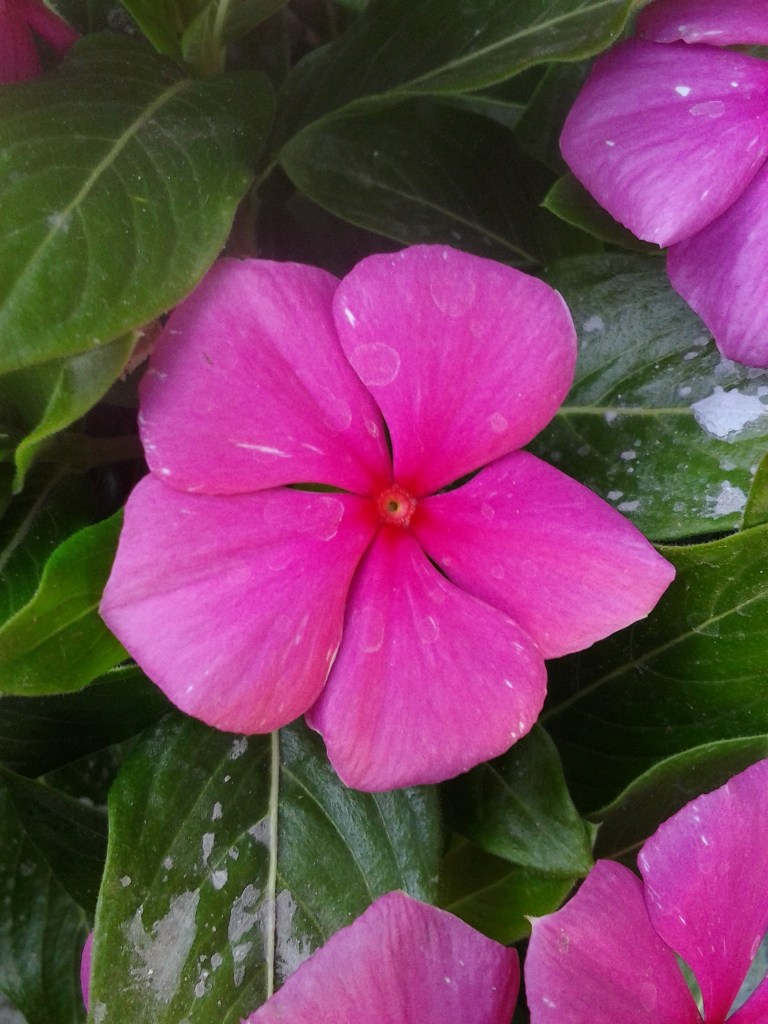
So many of the pretty warm season annuals planted last spring are now at their best. Sweet alyssum, lobelia, verbena, moss rose and busy Lizzy never stop blooming, and only get more colorful as they grow through the season until they get replaced by cool season annuals in autumn. (It is unfortunate that busy Lizzy, which had been a standard warm season annual for so many years has become less available due to disease.) However, French marigold, petunia, floss flower, cosmos, statice, pincushion flower (scabbiosa) and zinnia need a bit of attention to perform as well that long.
These few warm season annuals can get tired of blooming if not ‘deadheaded’ (groomed of deteriorating flowers). Deadheading not only keeps plants looking a bit neater, but also prevents the diversion of resources needed for continued bloom into the generation of seed. As far as these blooming plants are concerned, seeding for the next generation is their priority anyway. As long as they are not allowed to set seed, they will continue to try, by producing more flowers to replace those that fade and get removed without setting seed.
Cosmos, statice and pincushion flower can continue to perform adequately without deadheading. The main advantage of deadheading these annuals is the removal of fading flowers. (There probably will not be much left for cosmos.) Many people actually prefer to leave fading cosmos flowers to disperse their seed for the following year.
Petunia is perhaps one of the more demanding of warm season annuals. It often needs to be clipped back in the middle of the season, right when it is expected to bloom the most. The best way to avoid serious pruning at one time it to keep plants snipped back lightly but continually as they grow, so that they can not develop the awkwardly long and weirdly jointed stems that eventually stop blooming. Short stems that stay close to the roots are the healthiest and most productive.
The various types of cockscomb are odd warm season annuals that become available halfway through summer, just in time to add color if some of the annuals planted earlier in spring are not performing adequately, or are finishing early. Of course, all of the other warm season annuals will still be available in nurseries until it is time for cool season annuals next autumn.
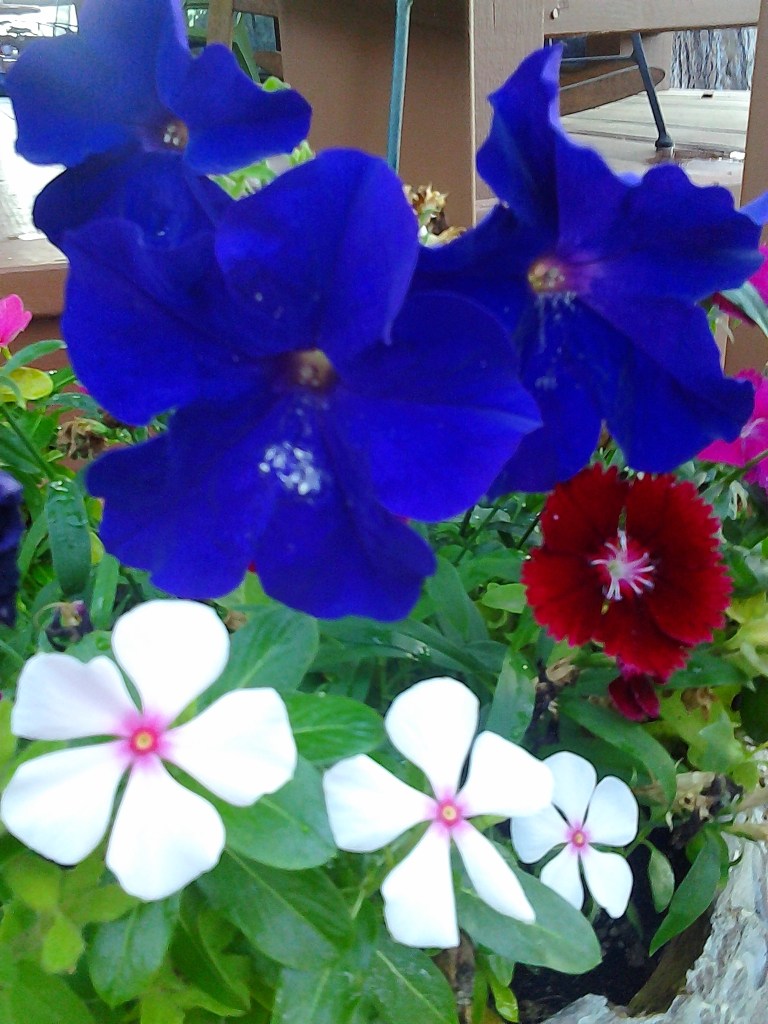
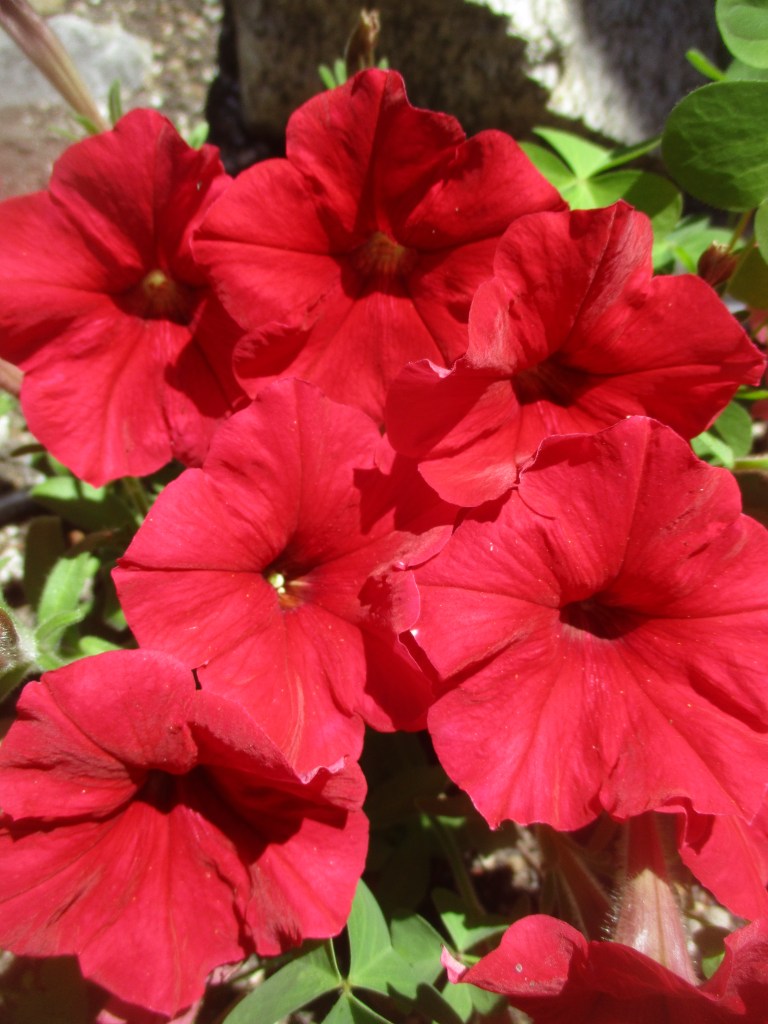
There are too many varieties of petunia to be familiar with nowadays. The species name is Petunia X hybrida because almost all are hybrids of two primary species, as well as a few others to complicate the situation. The color range of the bloom of these hybrids now lacks only a few colors. (GMO orange petunias are only beginning to become available.)
Besides an impressively extensive color range, bloom can be spotted, speckled, striped, blotched, haloed or variegated by too many means to list. Flowers can be rather small or as wide as four inches. Some are surprisingly fragrant. Some have frilled double flowers. Stems of cascading types may sprawl wider than three feet while only a few inches high.
Petunias are warm season annuals that perform from spring until frost. They can survive as perennials for a few years if cut low for winter. Cool season annuals can obscure and shelter them until they resume grown in spring. They prefer rich soil, systematic watering and sunny exposure. Although mostly sterile, some appreciate occasional deadheading. Trimming during summer may promote fluffier growth for lanky stems.
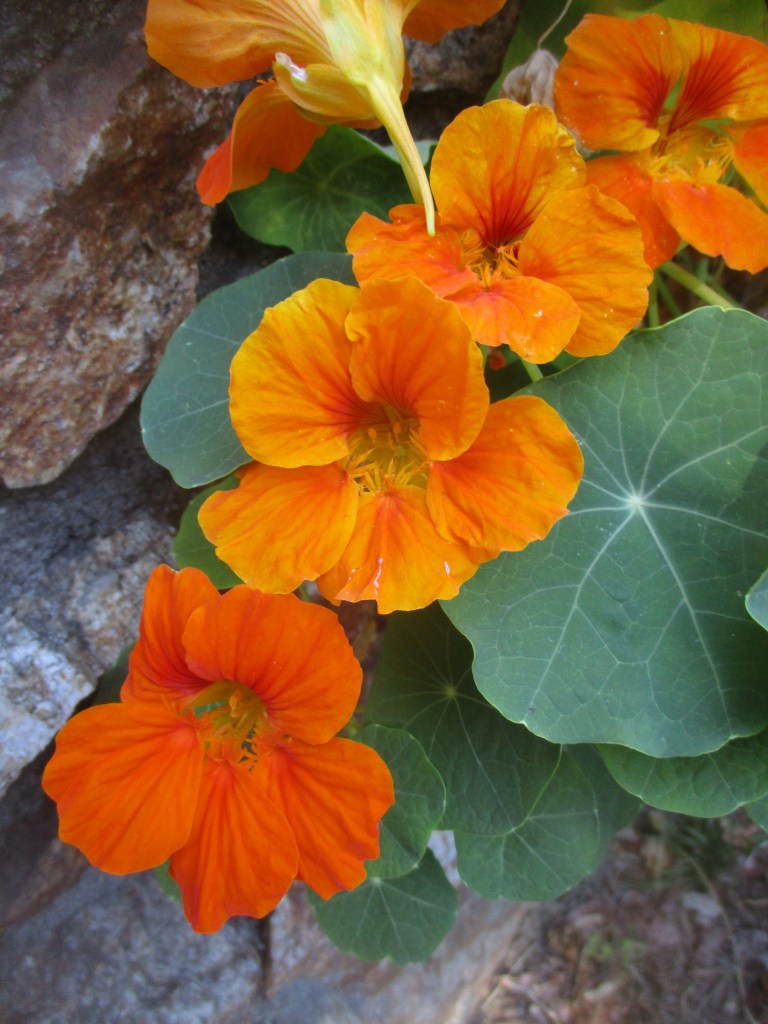
Whether feral or planted intentionally, nasturtium, Trapaeolum majus (which is actually a hybrid with two other species) is a delightful flower that just about everyone appreciates. Its eagerness to self sow and possibly naturalize in riparian situations attest to how easy it is to grow. Seed for many varieties is readily available. Feral plants provide feral seed.
Bloom of domestic nasturtium can be various shades, tints and hues of yellow, orange or red. Flowers can be striped or blotched with colors of the same range. Some are double. The palest yellow is almost creamy white. The darkest red is almost brown. Feral plants, after a few generations, generally revert to blooming with simple bright orange or yellow.
Plants are more or less annual, but can replace themselves almost as readily as they die out. Those that perform through spring and summer succumb to cooling autumn weather, as their (feral) seedlings begin to replace them for autumn and winter. Those that perform through winter may succumb to frost where winters get cool, but also self sow feral seed for next spring.
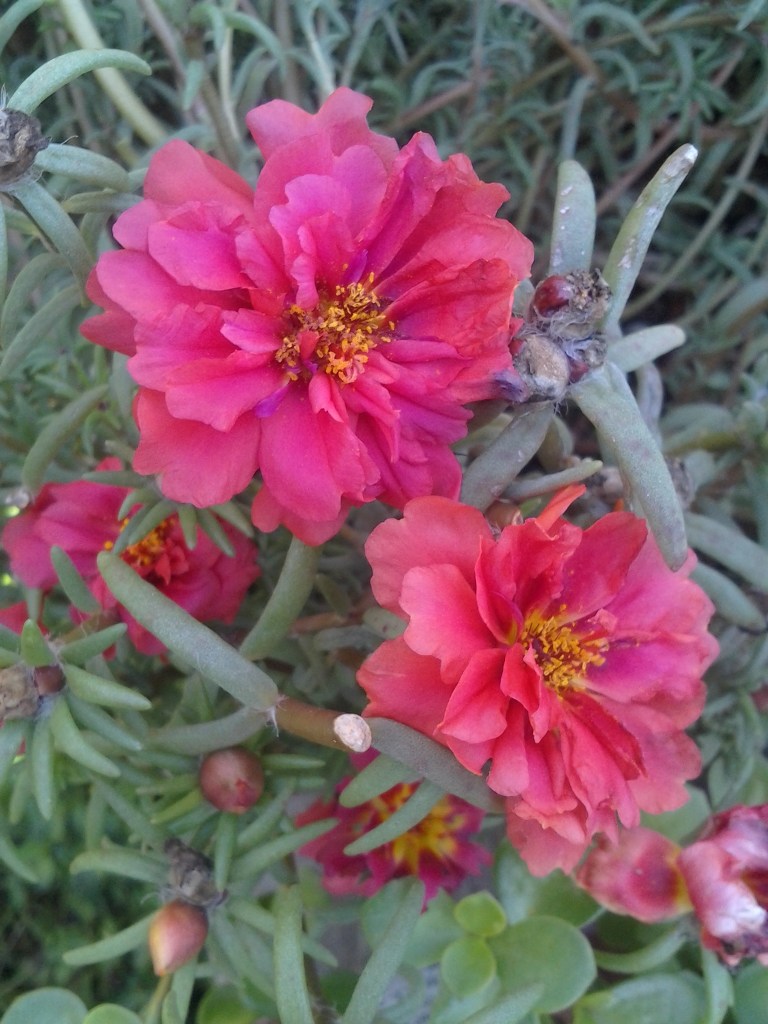
The recent unseasonably warm weather was no problem for any remaining moss rose, Portulaca grandiflora. They usually start to look rather tired as the weather gets cooler this time of year, and eventually succumb to the first frost. Where allowed to do so, they can regenerate next year from seed. I like to collect their seed during the summer or autumn so that I can sow them after the last frost of the following winter. Through spring and summer, I find that additional plants are easy to grow from cuttings.
The inch wide flowers are white, pink, red, orange or yellow, with only a few ruffled petals. Modern varieties that have rufflier ‘double’ flowers and richer colors still seem to be less popular than the more delicate traditional types. The cylindrical and succulent leaves are only about an inch long. The small plants can get more than six inches deep where they are happy or crowded. Moss rose likes good exposure and decent soil, but does not need the rich soil that most other annuals demand. Nor does it necessarily need such regular watering.
Angelonia is one of those warm season annuals that can actually survive through winter as a pernnial to bloom again next spring. It may even want to continue to bloom untill frost. The flowers can be blue, purple, red, pink or white, and look something like small snapdragon flowers. Most have spots or stripes of an alternate color or two in their throats. Some modern varieties have fragrant flowers. Plants can get a foot or two tall, and almost as wide. In sheltered spots, angelonia can be cut back as soon as it starts to look tired in autumn. Exposed plants might be happier if cut back significantly later, as winter ends. Old growth may be unsightly for a while, but can protect interior stems and roots from frost. Besides, pruning stimulates new growth that will be more susceptible to subsequent frost.
As the name implies, ‘annuals’ need to be replaced ‘annually’. What is worse is that they do not even function for an entire year, but only for a specific season. Cool season annuals mostly work from autumn to spring. Warm season annuals mostly work from spring to autumn. Calendula is a popular cool season annual that may not last even that long, since it can mildew half way through winter.
Now that it is time for cool season annuals, it can be unpleasant to remove warm season annuals that are still performing well. In mixed plantings, new annuals can be phased in through autumn as older annuals deteriorate. Busy Lizzie (impatiens), wax begonia and other warm season annuals that are actually perennials can get cut back and overplanted with cool season annuals. The cool season annuals that temporarily overwhelm them can provide shelter from frost. As the cool season annuals finish next spring, the warm season ‘annuals’ can regenerate
However, not all cool season annuals need to finish next spring. Sweet William, cyclamen, chrysanthemum and the various primroses are popular cool season annals that are actually perennials. When the time comes, they can be overplanted with warm season annuals, so that they can regenerate the following autumn. In cool spots, sweet William and some primroses can actually perform all year. (Some people are allergic to primroses like poison oak.)
Alyssum and nasturtium really are annuals, but can function both as warm season and cool season annuals. They sow their own seeds so that new plants can reliably replace old plants without being noticed. The old plants only need to be pulled as they deteriorate. Alyssum is white, or pastel hues of pink or purple. Nasturtium is just the opposite, with bright hues of yellow, orange and red, with only a few pastel options.
Pansies and smaller violas are the two most popular of cool season annuals, since they function like petunias for cool weather. They lack few colors. Most have two or three colors. Ornamental cabbage and kale produce big and bold rosettes of pink, white or pink and white foliage. Kale has weirdly distinctive foliar texture. White, lavender, pink, purple and rose stock is the most fragrant of cool season annuals, and taller varieties are great for cutting. Iceland poppy has delicately nodding flowers on wiry stems. They can be pastel hues of white, pink, yellow, orange or soft red.
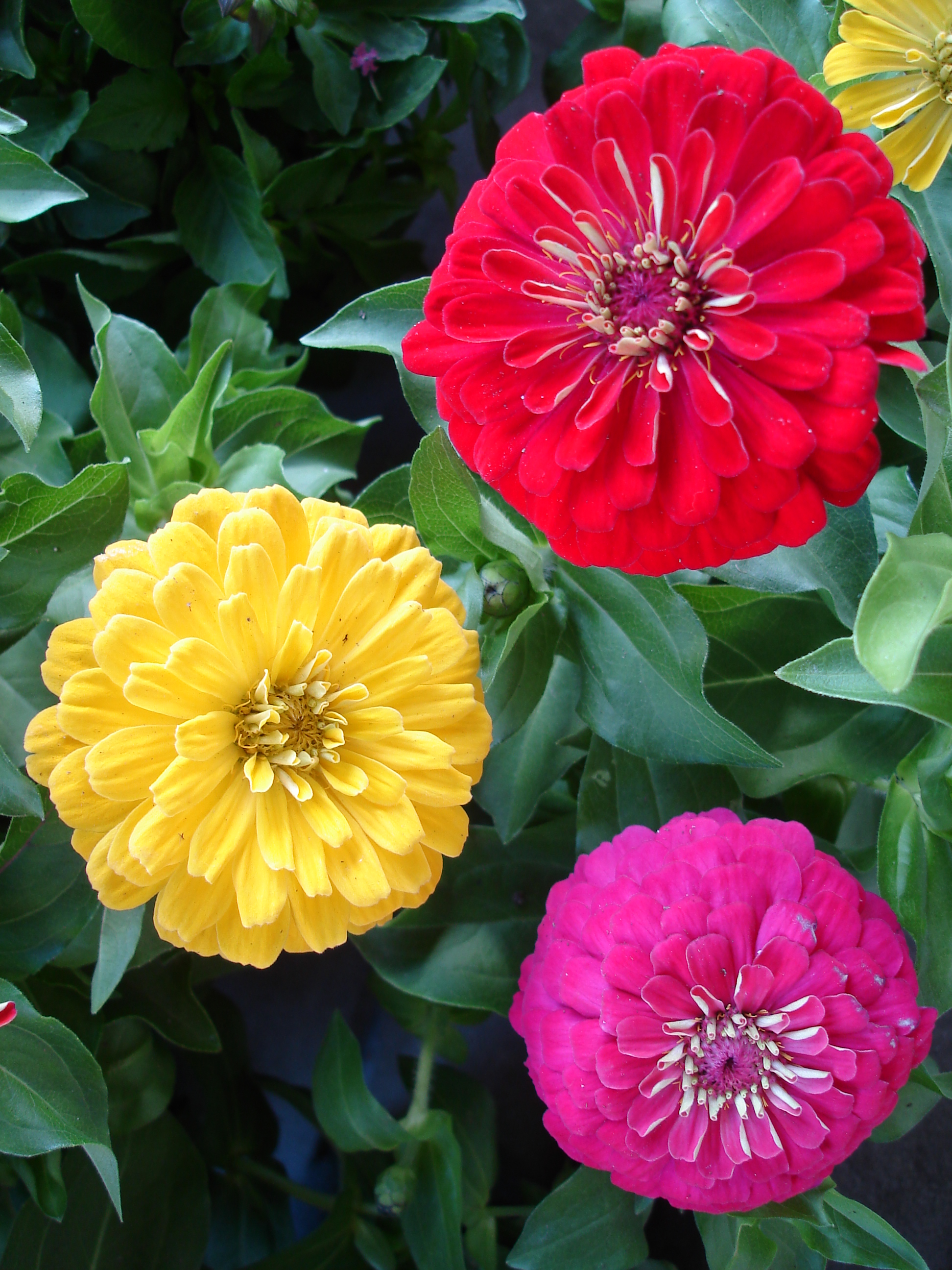
The lineage of modern zinnias is too complicated to describe. Most are still known as Zinnia elegans, even though they have been bred extensively with several other specie to produce an impressive variety of flower forms and colors. The shortest varieties get only a few inches tall. Big varieties get about two and a half feet tall.
The two to five inch wide flowers, which bloom in phases from spring until autumn, can be yellow, orange, red, purple, pink, salmon, peach, chartreuse or bronzy brown. Some are striped or freckled.
Some flowers look like colorful daisies, with big petals (ray florets) neatly and flatly arranged around prominent centers (disc florets). The overly abundant petals of pom-pom types make rounded blooms with nearly obscured centers. Most are fuller than the daisy types, but not as plump as pom-poms.
Zinnias are warm season annuals that like good exposure and rich soil. The paired leaves are slightly raspy, like kitten tongues, and can be susceptible to powdery mildew. Deteriorating flowers should be deadheaded, although a few can be left for seed.
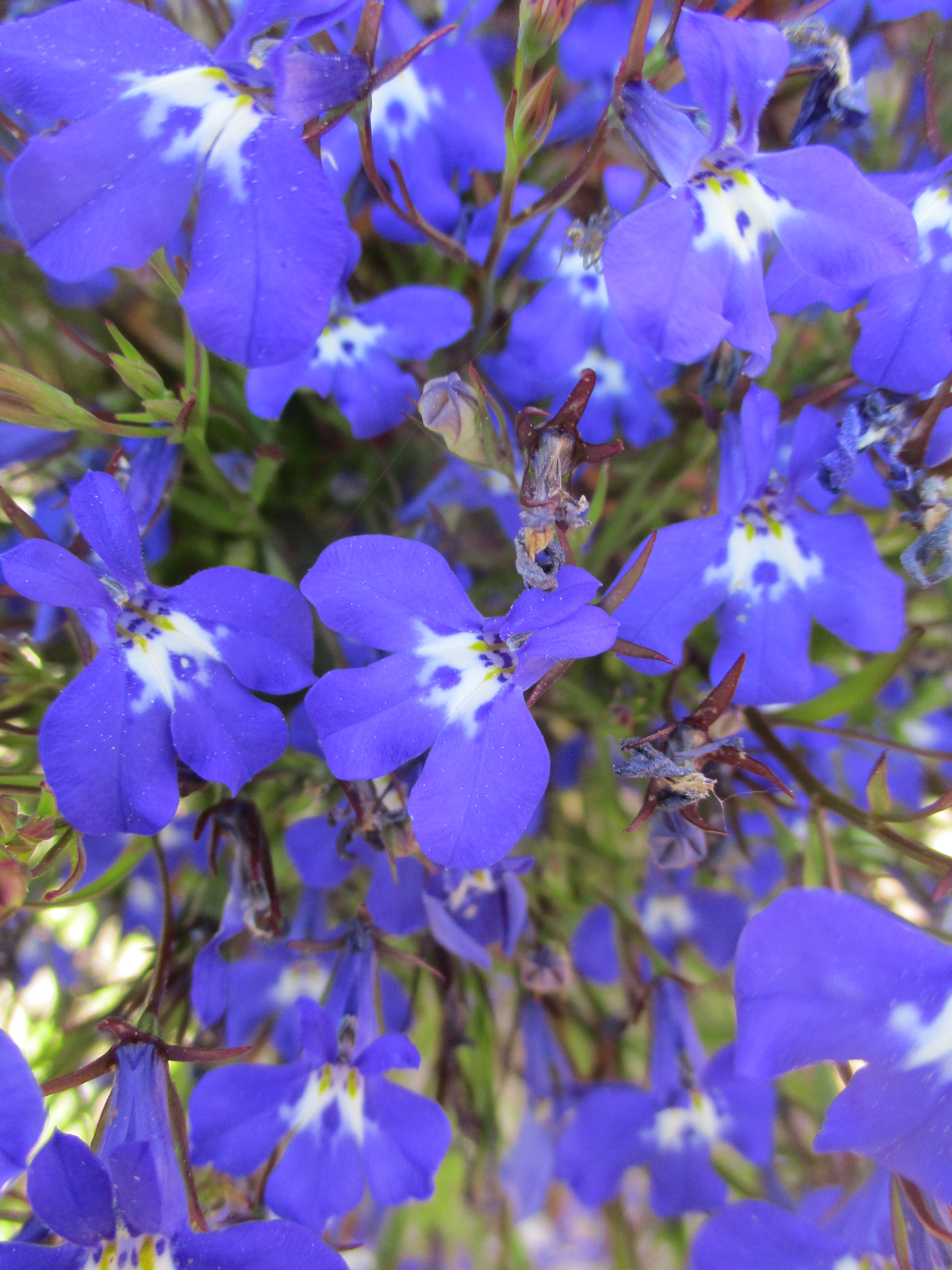
No other bedding plants exhibit such rich blue as trailing lobelia, Lobelia erinus. Cultivars with white, purplish pink, purple or sky blue bloom are still not quite as popular as the favorite cobalt blue bloom. Individual flowers are tiny but very profuse and uniform. Some have white centers. The narrow leaves are tiny as well, and finely textured. Some cultivars have dark purplish bronzed foliage.
Individual plants are only about three to six inches high and wide. Cultivars that are more rounded and densely foliated are excellent for edging. They are very popularly planted in single rows, and alternating with alyssum. Trailing types exhibit wispier growth that stays a bit lower and spreads a bit wider. They do not trail far, but cascades nicely from urns and hanging pots of mixed annuals.
Although grown as a warm season annual, trailing lobelia can survive as a short term perennial where winters are mild. Fresh new growth develops out of the centers of overwintered plants about now. If pressed gently into the soil just before they are replaced by new growth, scraggly outer stems can develop roots. They just might grow into new plants before the originals eventually die off.
So many annuals are actually perennials. They just get dug and replaced because they are not pretty enough during their off season. For warm season annuals, winter is the off season. For cool season annuals, summer is the off season. However, if left alone, many annuals that are actually perennials go dormant so that they can survive through their off season to regenerate and perform again for another season, or several seasons
Cyclamen and various primroses are cool season annuals that are in season now. Cyclamen will go dormant and defoliate as the weather gets warm in summer. Primroses do not defoliate, but get rather runty through warm weather. If planted with other light duty warm season perennials that take over for them, no one notices. For example, primroses are colorful enough now to distract from tired fleabane. By the time primroses fade, the fleabane takes over.
Chrysanthemums are among the flashiest of perennial annuals, but also have a short season. They typically get planted while blooming in autumn, but finish their bloom cycle before winter. After all the rain and cool weather . . . and then a bit of warm weather, some are already dying back to the ground; but closer examination might reveal new growth already emerging from the roots!
Nasturtiums can obscure regenerating chrysanthemums nicely. If the frost sets them back, they recovery quickly. They will bloom more colorfully by spring, and continue until summer gets too warm. By that time, the chrysanthemums should be filling out nicely to bloom by autumn. As the chrysanthemums finish, the nasturtiums will have sown their seeds, so that the process can start over again. Neither chrysanthemum nor nasturtium need to be removed while out of season. They only need to be pruned back and groomed accordingly.
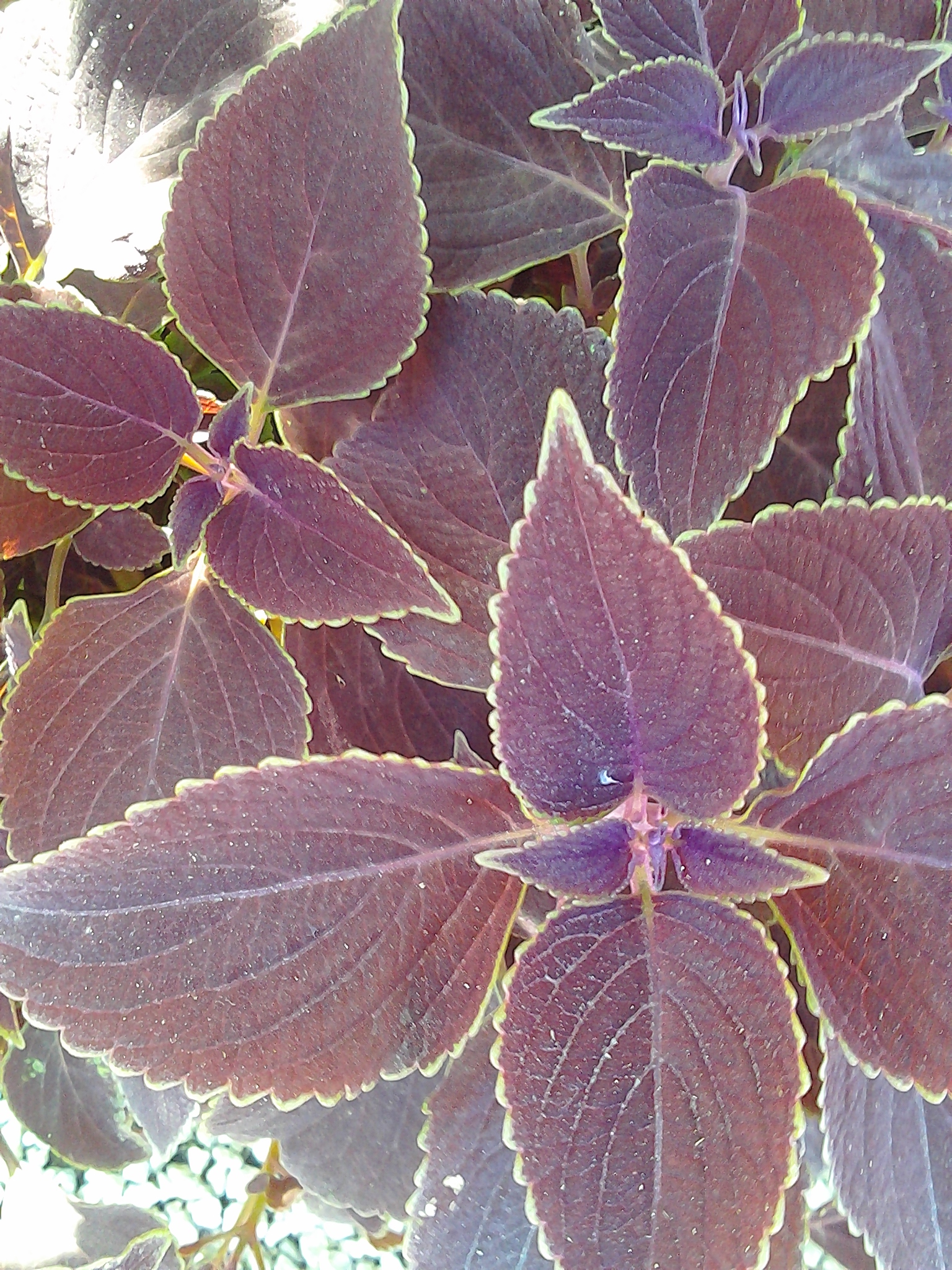
Coleus, impatiens, fibrous begonias and maybe even polka dot plant that were only moderately damaged by frost might be salvageable if they can stay put long enough. That is the advantage of growing them in pots with other small perennials that will cover for them when they die back or need to be pruned back.


 Tony Tomeo