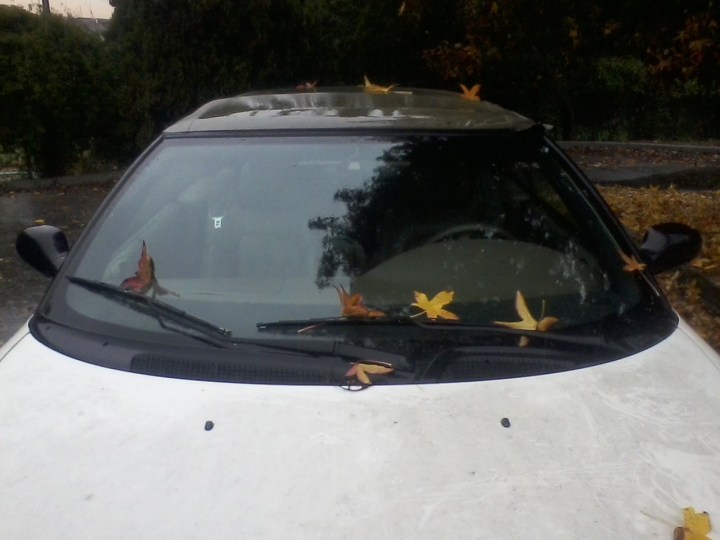
 The old Chrysler looks different this time of year. Like dogs, cats, horses and deciduous plants, it adapted to the weather.
That tan canvas structure above the cab is known as a ‘roof’. It was there all along, but folded up behind the back seat. It was merely unfolded over the top of the cab. The ‘roof’ comes in handy this time of year, not only for keeping warmth within the cab, but also for keeping things out of the cab. Allow me to elaborate.
You may nave noticed that the Chrysler is wet. This is a direct result of mysterious droplets of moisture that fall from the sky. We discussed them earlier. They are known ‘rain’, and are falling from the sky presently. The ‘roof’ keeps the ‘rain’ out of the cab. Otherwise, the cab and everything in it would be as wet as the ‘roof’ is now.
The yellow, orange and reddish brown things strewn about are sweetgum leaves. You may not recognize them now because they are not green. They change color when the weather gets cool this time of year, and then get dislodged by meteorological events such as wind and the presently observed ‘rain’. The ‘roof’ excludes them from within the cab of the car.
The two devices at the bottom of the windshield are another adaptation to ‘rain’ known simply as ‘windshield wipers’. When in operation, they pivot from where they are affixed just below the windshield to literally wipe the the wet ‘rain’ away. They are a rather ingenious invention, since ‘rain’ on the windshield tends to inhibit visibility.
Just as a thick coat on a dog or horse can predict an unusually cool winter, the molting of the Chrysler is directly related to the weather. Although it can not predict ‘rain’ as early as dogs and horses can predict cold weather, it quite reliably happens immediately prior to ‘rain’. It is a good sign for the garden.
The ‘rain’ that falls immediately after the molting is composed of water, which is very important and useful to gardens and forests after such a long dry summer. As we discussed earlier, some of the water gets into the aquifer where it is stored for later use in and around our homes. We are very fortunate to have a Chrysler who is so proficient at predicting the delivery of the water that we need so much of.
 Like something from an old fashioned science fiction movie, this anomaly appeared in a roadway overnight. There are several more in other roadways and elsewhere about town. They are quite wet. In fact, they are composed almost completely of water. What is even weirder is that the water that they are composed of actually fell mysteriously from the sky overnight as many countless droplets all over town! Many of these droplets migrated into low spots such as this one to form what we now see in this picture.
 Something really crazy happened last night. From out of nowhere, a profusion of drops of water started to fall from the sky! It continued to fall for a while, and got everything wet. Soil that had been dry and dusty became rather muddy. As crazy as it sounds, it is not impossible, and actually happened repeatedly last autumn, winter, and into spring. In fact, it was so abundant that the San Lorenzo River filled with all this strange sky water, and flooded worse than it had since the flood of 1982! People in other less arid climates are more familiar with this sort of thing. It is actually no mystery. It is known simply as ‘rain’.
 Tony Tomeo