Microclimates Are Distinct From Climates

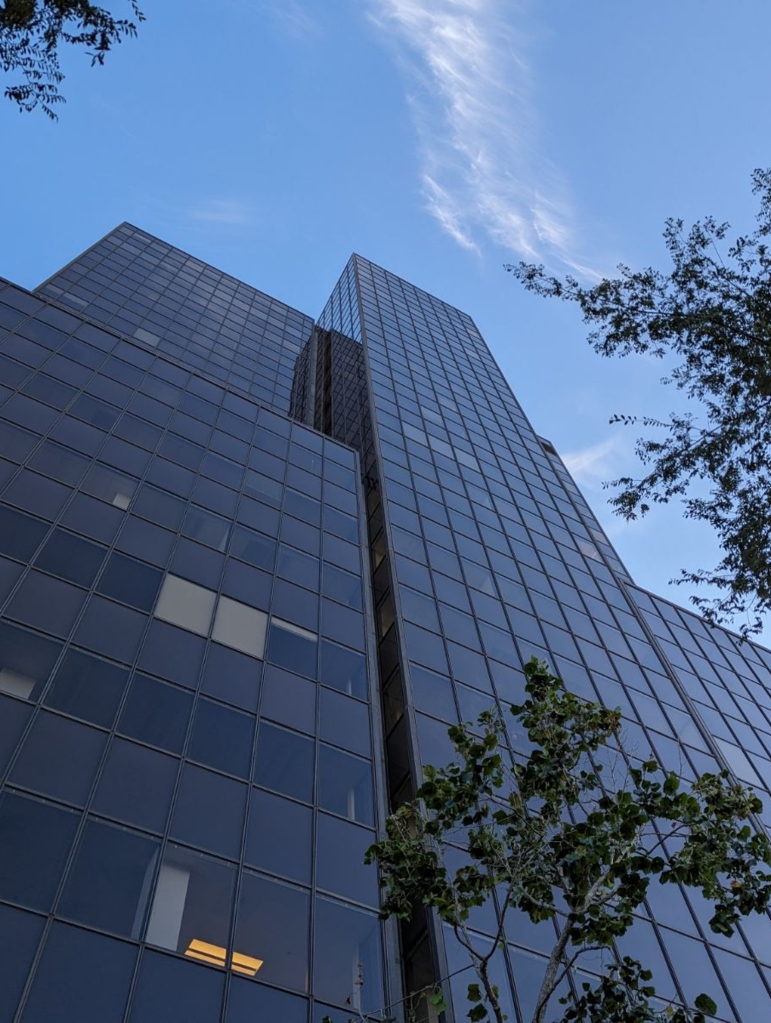
Larger buildings inevitably produce larger microclimates.

Climates and geology are why cinema and television industries are so established here. Cinema evolved in Niles before relocating, with the evolution of television, to Hollywood. The diversity of local climates, geology and associated scenery was the primary appeal. Farmers of all sorts had already been exploiting such climates as well as microclimates.

Climate is a regionally prevalent pattern of weather. Mediterranean or chaparral climates are prominent locally. Coastal, desert and alpine climates occupy other relatively nearby regions of California. Variations of geology influence weather, which determines climate. This comprises mountains, valleys, various altitudes and proximity to the Pacific Ocean.

Microclimates, as their designation suggests, are small climates within big climates. With such a mix of climates here, microclimates might be difficult to distinguish. Some climate zones of steep coastal hillsides are very narrow, for example. Yet, if they are distinct from those for higher and lower elevations, they are climates. Microclimates are even smaller.

For microclimates, exposure is as relevant as endemic climates. Such exposure can not change climate, but modifies its influence. For example, large eaves and warm walls can provide localized shelter from frost. Southern slopes of hilly terrain are likely a bit sunnier and warmer than northern slopes. Buildings and fences shade garden area to their north.

Many microclimates, such as those that involve terrain or forest shade, are natural. They are generally less dynamic than unnatural microclimates. Forest shade changes only as fast as associated trees grow or die. Only major disruption, such as fire or timber harvest, accelerates such slow change. Terrain may not change significantly for millions of years.

Unnatural microclimates are more dynamic and unpredictable. Taller modern homes and fences shade more within adjacent gardens. Skyscrapers can extend their shadows into gardens a few blocks away. Conversely, some can reflect sunlight to adversely increase heat and glare. Expansive and unshaded pavement likewise increases ambient warmth.

Environmental Factors Silently Influence Bloom

California poppy dramatizes favorable weather conditions.

Superbloom occurs only about once every decade or so. It is very unpredictable though. It can happen for two or even three consecutive springs. Alternatively, it may not happen for two decades. It can be as early as late February, or as late as late May. It can last one or a few weeks. Superbloom is as variable as the environmental factors that influence it.

Actually, all bloom relies on influence from variable environmental factors. That is how it knows how and when to bloom. It is also why many species are so irregular about doing so. Various species prioritize reliance on various environmental factors. Therefore, some may bloom early or late while others adhere to stricter schedules. It can get complicated.

Warmth is undeniably the most significant of environmental factors that influence bloom. Cool weather inhibits bloom, even as growth resumes at the end of winter. Then, warmth accelerates bloom, mostly during spring, but also into summer. Many species continue to bloom as long as the weather stays warm. Very few prefer to bloom during cool weather.

As mentioned, the influence of environmental factors can get complicated. Many species actually require sustained winter chill, or vernalization, to bloom well. It is how they reset their growth seasons to begin in winter. Peony is unreliable here because of inadequate chill. After unusually cool winter weather though, flowering cherry and lilac bloom better.

Humidity is another important environmental factor. Although it does not stimulate bloom for more than a few species, it can prolong bloom. Some flowers, particularly from humid climates, can desiccate with aridity. Conversely, even flowers from desert climates retain hydration better with humidity. Also, rain provides water for areas that lack any irrigation.

Species from mild but not tropical climates might rely more on photoperiod than weather. Poinsettia in the wild does not experience sufficient chill to distinguish winter. It monitors the photoperiod, which is the duration of daylight, instead. It knows to bloom when nights are longer than days. A few species use the same very consistent technique to bloom for other seasons.

There’s No Place Like Home.

Desert ecosystems are fascinating, but so are local ecosystems.

Vacation was excellent! I do not get out much, but when I do, I feel as if I enjoy it more than those who travel regularly. The simplicity of my travel allows me to enjoy it more intimately than those who travel more elaborately and put more effort into enjoying what they should probably just enjoy more effortlessly. Anyway, I went to the Pacific Northwest for two weeks, returned for two weeks, and went to the Southwest for two weeks. Actually though, my trip to the Pacific Northwest was limited to Western Oregon and Western Washington, and my trip to the Southwest was limited to the area between Los Angeles and Phoenix. Regardless, it was excellent, and I encountered several climates and ecosystems that are very different from what I am accustomed to. I drove through dense rainforests dominated by massive Douglas firs as well as sparsely forested deserts dominated by sporadic saguaro cacti. Winters are much cooler in some regions than here. Summers are much warmer in some regions than here. It was all so fascinating. I encountered so much vegetation that I would like to grow here, and brought a bit of it back, but can not grow everything that I find intriguing within other regions. However, as excellent as it all was, it also reminds me that I prefer to be here, within the climates and ecosystems that I am most comfortable with. Winters do not get too cool. Summers do not get too warm. I may not be able to grow all the cultivars of apples that prefer a bit more chill in Washington, or all the cacti that prefer more arid warmth in Arizona, but realistically, even if I could work in the garden constantly, I could not possibly grow everything that performs well here.

Timeout

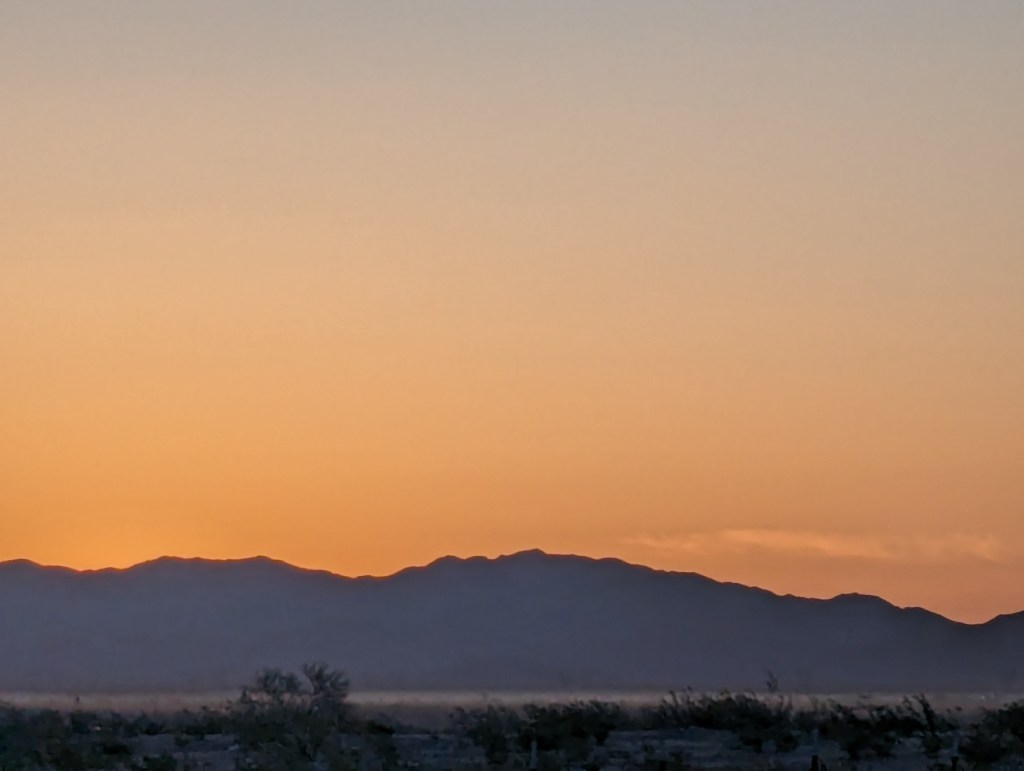
A moment before sunrise over Phoenix.

Apologies for my absence.

Perhaps no one noticed. Most of my posts were automated prior to my departure, and I managed to compose a few brief articles for what was not automated; so ultimately, there was no lapse of posting. I may have only been negligent with response to comments for the last two weeks.

Realistically though, I have been intending to discontinue blogging and recycling old articles, and to post only my weekly gardening column, in two parts, on Mondays and Tuesdays. I merely have not done so yet.

Anyway, my trip, although very different from how it was planned, was totally excellent! Just a short distance from the turnoff for the southbound San Diego Freeway towards my primary destination in Los Angeles, I was diverted to my secondary destination northwest of Phoenix. I missed the desert scenery as I drove all night to arrive shortly before four in the morning, and began my vacation exhausted. Although I missed out on some of my plans in Los Angeles, I got more time in Arizona. The weather was weirdly excellent, with a weirdly torrential thunderstorm right in the middle of it. It was too early in the year to collect the seed that I wanted, but I really was not expecting to find any anyway. I did happen to procure a hedgehog cactus of some sort. I decided that, since my return was already delayed by a day, that I may as well delay it for two days. (I had brought some of my work with me, so was able to tend to it prior to my return rather than after.) Therefore, I came to my original primary destination in Los Angeles secondarily, stayed to help Brent with the View Park Garden Tour on Sunday, and returned home on Monday.

Mediterranean Climate Is Quite Californian

New Zealand natives perform well here.

“Mediterranean” translates from Latin to “middle of land”. The Mediterranean Sea is in the middle of the land of those who named it. Other regions were either unimportant or unknown to them until the Sixteenth Century. Nowadays, most people of the World are aware of many other regions. A few of such regions also enjoy a Mediterranean climate.

Such climates are obviously not confined to the regions of the Mediterranean Sea. They merely resemble such climates. Some extend eastward into Western Asia. Others are in eastern and southern Africa, southwestern South America and Columbia. Larger regions of such climate are in southern Australia. The closest are here in western North America.

Even these limiting regional designations are debatable. Many horticulturists consider climates of New Zealand to be typical Mediterranean. Such climates are mostly between thirty and forty five degrees north and south. However, some might exist within northern India and southern China. Ultimately, climate is meteorological rather than geographical.

Mediterranean climates receive almost all of their rain during winter. Rain is very minimal through summer. Even if it is twice as abundant in other similar climates, it conforms to a similar schedule. Although winter chill is adequate for many species that need it, frost is mostly minor. Locally, summer weather does not often become too uncomfortably warm.

Native species know what to expect from local climate. So do exotic species from similar climates. Some may prefer more or less winter rain, summer heat or winter chill. Almost all can tolerate warm summers without rain, though. Such weather conditions are normal for them. Therefore, the most adaptable exotic species locally are from similar climates.

This includes species of Eucalyptus, Pittosporum and Callistemon from Australia. Aloe, Agapanthus and Morea are from South Africa. Phormium and Leptospermum are from New Zealand. Oleander and the various species of Lavandula are truly Mediterranean. In the past, a few exotic species adapted too efficiently to become invasively naturalized. Horticulturists are now careful to not import such potentially aggressive species.

Irrigation Resumes With Drier Weather

Spring gets progressively drier and warmer.

Spring, in several regards, is like autumn in reverse, or vice versa. Bloom increases for spring but decreases for autumn. Foliage increases for spring but decreases for autumn. The two seasons are in opposition. In this chaparral climate, the rainy season that began last autumn ends now. Irrigation that became redundant then becomes necessary now.

Diminishing rain is not the only reason that irrigation becomes more important for spring. Spring weather also becomes warmer and more arid, or less humid. Warmth and aridity increase evaporation of moisture that rain deposited not long ago. Increasing day length, intensifying sunlight and warmth accelerate plant growth. Such growth consumes water.

This need for moisture is progressive, though. Vegetation certainly requires more water as the weather becomes warmer and drier. However, it does not yet require as much as it will require later during summer. By then, the weather will be even warmer and drier, and the days will be even longer. Irrigation should increase accordingly in regard to weather.

Unfortunately, there are no simple formulas to determine how much irrigation is needed. Some vegetation with shallow roots may require frequent but moderate irrigation. Some vegetation with deep roots may prefer less frequent but more copious irrigation. Rain is possible at any time. It can briefly interfere with the most efficient of irrigation schedules.

Soil also affects irrigation. Sandy soils drain efficiently, but do not retain much moisture. This may not be a problem for some species that tolerate occasionally dry soil. It may be more of a concern for species that prefer more regularly moist soil, though. Dense soils retain more moisture, but do not drain as efficiently. Soil amendments can improve soils.

Manual irrigation is easier to monitor than automated irrigation, but can be tedious. That is why most irrigation is automated nowadays. Automation is more likely to be excessive than insufficient. Desiccation, wilting and other symptoms of insufficiency of irrigation are obvious. Symptoms of saturation may not become obvious until too late for remediation.

Wind Is Messy And Hazardous

Trees lose limbs to strong wind.

Arborists become more popular after storms. That is when consequences of negligent tree maintenance become more apparent. Wind dislodges limbs and destabilizes whole trees. Unfortunately, the most diligent of tree maintenance can not prevent all damage. Trees and other vegetation are naturally vulnerable to frequently stormy winter weather.

Deciduous trees try to be less vulnerable to wind by defoliating prior to winter. Without foliage, they are less resistant to wind. In other words, they are more aerodynamic. Wind blows through them rather than against them. Some unfortunately defoliate slowly within the mild climate here. With such minor chill, some retain foliage until spring replacement.

For example, some sweetgum still retain much of their foliage. That is an advantage for the display of their autumn foliar color. It is a major disadvantage for their aerodynamics though. As a deciduous species, it does not expect to be so vulnerable to wind through wintry weather. What is worse is that sweetgum trees are innately structurally deficient.

Evergreen trees and other vegetation seem to be less concerned about wind. Actually, they merely employ different defensive tactics. Most cypress and some spruce are too dense and sturdy for wind to penetrate. Many pines develop sparse canopies that wind blows through. On the coast, coast live oak stays low and broad for wind to blow over.

Regardless of their efforts, trees of all sorts are vulnerable to damage from wind. Falling limbs or entire trees are very hazardous. Also, they can damage or destroy what they fall onto. That is why timely maintenance of trees is so very important. Any tree that becomes too hazardous to salvage necessitates removal. All trees eventually age and deteriorate.

Also, all trees, as well as all other vegetation, are messy. Some are messier than others; and many get messier as a result of wind. Some of such mess clogs eavestroughs and downspouts when they are most helpful. Detritus fills curbside gutters also. Actually, it gets everywhere. Its removal will be easier between the windy storms that generate it.

Mojave

Joshua trees seem to be scarce near Joshua Tree.

About a quarter of California is desert. Most of that desert is part of the Mojave Desert. Much of it is very sparsely populated. All of it is fascinating to those who appreciate it.

Not many people live in the desert because the climate is so harsh, and because there is not much reason for many people to be there. Not far north of Los Angeles, which is the second most populous city in America, is one of the most sparsely populated regions of America within the Mojave Desert. It is unpleasantly hot and dry there all summer. It is certainly not the sort of place that should be appealing to horticulturists, although it is.

Brent sent me this picture from a place where he vacations near Joshua Tree. If there are Joshua trees near Joshua Tree, they are not visible within this picture. Actually, no trees are visible within this region where shade must be very important. The vegetation that is visible does not seem to be substantial. Vegetation is completely lacking within the fenced area. That small pile of firewood must have been brought from somewhere else. (Although nights are pleasant or warm between hot days, they can get very cold between cool days of winter.) I do not know what that building is. Without substantial vegetation, neighboring residences are visible in the distance.

Part of the allure of deserts for horticulturists is the very distinctive vegetation that lives only there. Part of the allure is the minimalism of such vegetation. Although many species live there, they are not very distinctive. Many resemble each other. In other words, much of the vegetation of the desert is easy to ignore. It is less distracting than that of other ecosystems that are more popular with those who are not horticulturists.

Horridculture – Weather

So close to ripening!

The weather here made national news on Sunday night. It was apparently quite a storm, with unusually windy wind. A few trees fell in the neighborhood. The roads were messy with debris. The electricity at home was disrupted. Otherwise, to me, it did not seem like a particularly bad storm. After all, this is winter.

HOWEVER, on Saturday, even before the worst of the weather on Sunday, the wind knocked over my small ‘Ponderosa’ lemon, only a few hours after I posted a picture of one of its two developing fruit. It is a dinky tree in a #1 can, but its lemons are disproportionately large. As I mentioned on Saturday, I should have removed the lemons to divert resources to vegetative growth, but wanted to see if they would develop and ripen. The weather did it for me.

Now I am annoyed. I do not like to be one who complains about the weather. There is not much to complain about in that regard here. This is a pleasantly mild climate that lacks the sort of severe weather that other climates must contend with. The gust that blew over the small lemon tree was not nearly as strong as those that blew over trees within the surrounding forests and neighborhoods. I am just annoyed that after letting the lemons grow as much as they did, their effort will now be wasted.

The two lemons did not develop as they should have, but are still bigger than average ‘Eureka’ or ‘Lisbon’ lemons. I put them aside to ripen if they can. I doubt that they will. I can prune the small tree to remove the stems that had previously supported the two lemons, and make cuttings of them, to grow more small trees. Actually, I should have done this anyway.

Six on Saturday: Bad Botany II

Botany is bad this week for a different reason than it was last week. It is lacking. I mean, there is none. Only common names are mentioned. The first picture, which is not mine, includes too many different species to cite. Even if I wanted to, I could not identify all of them from this picture, and I can not remember what all of them are. The other pictures conversely show only a few common species that need no introduction.

1. Brent sent this picture of a view from his primary landscape design studio west of Los Angeles. The Jungalow is obscured by overgrown vegetation on the left. More species of flora inhabit this compact garden than all the combined acreage that I work and live on.

2. Scenery from my work is very different. Redwoods are the primary species. The bland foliage to the left is tanoak. Only a few species of trees grow wild here. The scenery from my writing studio is embarrassingly less interesting, but that is a topic for another time.

3. Banana trees live at work because I like a few species that, to me, seem to be the sort of vegetation that is more common in the Los Angeles region. They got frosted at home.

4. Roses, which are in the background of the banana tree, are more popular here than in the Los Angeles region, and are actually dormant for winter. This one does not generate new canes from its base though, which is why it is now so gnarly after dormant pruning.

5. European white birch are also dormant during the slightly cooler wintry weather here. I can easily relocate feral specimens like bare root stock. Cooler weather has advantages.

6. Bay and box elder obscure this local sunset that looks like it should be in Los Angeles.

This is the link for Six on Saturday, for anyone else who would like to participate: https://thepropagatorblog.wordpress.com/2017/09/18/six-on-saturday-a-participant-guide/