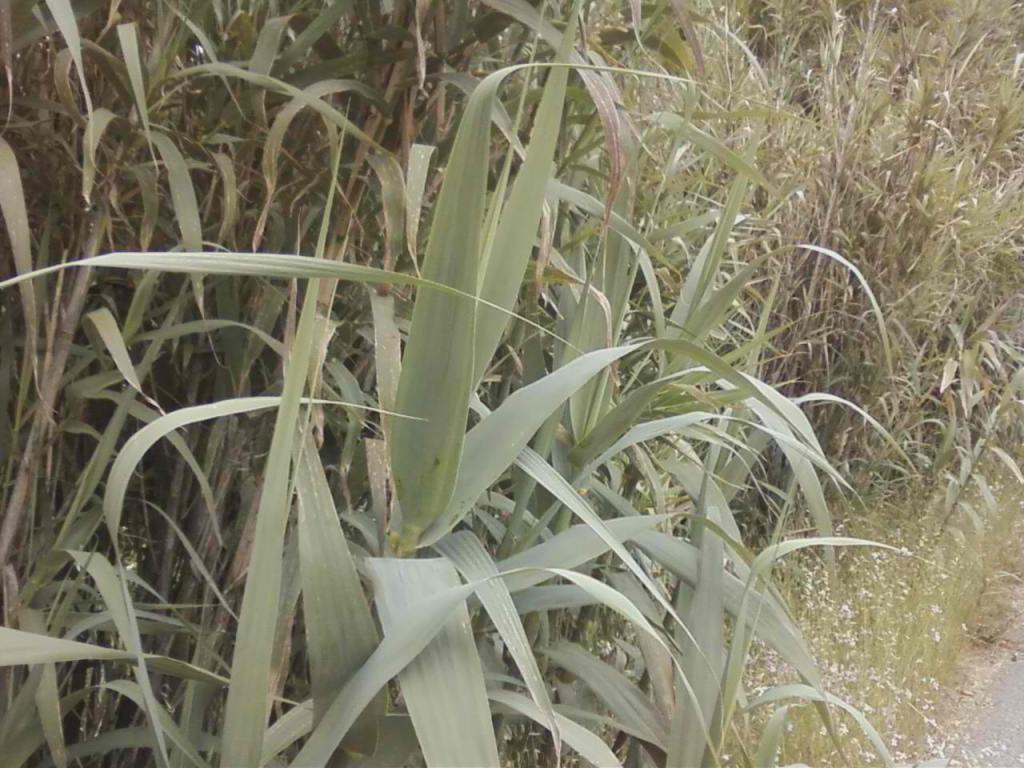
Giant reed is a horrid weed within many ecosystems.
The earliest infestations of giant reed, Arundo donax, that clogged tributaries of the San Joaquin and Sacramento Rivers supposedly grew from pieces used as packing materiel for cargo from China. It was simply dumped into the rivers as cargo was unloaded in port cities like Stockton and Sacramento. How it got to China from its native range in the Mediterranean is unclear.
Because it is so aggressive and invasive, giant reed is almost never found in nurseries. In many rural areas, particularly near waterways, it is listed on the ‘DO NOT PLANT’ list. However, giant reed can sometimes be found in old landscapes where it was planted before it became so unpopular. It can also grow from seed in unexpected places.
Once established, giant reed can be difficult to eradicate or even divide. It spreads by thick rhizomes that resemble the stolons of bamboo, but not quite as tough. It is often mistaken for bamboo. Where it gets enough water, it can get nearly thirty feet tall, with leaves about two feet long.
Where it can be contained and will not become an invasive weed by seeding into surrounding areas, giant reed can provide bold foliage that blows softly in the breeze. ‘Versicolor’ (or ‘Variegata’) has pale yellow or white variegation, and does not get much more than half as tall as the more common green (unvariegated) giant reed. Incidentally, the canes of giant reed are used to make reeds for musical instruments.
Wildflowers may not be what they seem to be. California poppy, various lupines, various sages and several others are native species. Saint John’s wort, periwinkle, mustard and several others are not native. They are exotic but naturalized, so can proliferate as if they are native. In other words, several of the most familiar of wildflowers are invasive weeds.
In fact, some of the most invasive weeds were once more popular for their pretty flowers. These includes Saint John’s wort and periwinkle. Pampas grass, various brooms, yellow flag iris and Hottentot fig are more examples. Mustard likely originated as a home garden vegetable. Many grassy weeds were livestock fodder. Not many weeds were accidental.
Nonetheless, invasive weeds are here and established within local ecosystems now. By their simplest definition, weeds are merely unwanted vegetation. Native brambles qualify as invasive weeds as they invade home gardens. Because they are native, though, they are not invasive in the wild. Most of the most aggressive weeds just happen to be exotic.
Invasive weeds become invasive because of their various unfair advantages. Many lack pathogens that limit their proliferation wherever they are native to. Many lack competition from vegetation that they shared their natural ecosystems with. A few may actually prefer local climate to their natural climates. Weeds exhibit too much variety for generalization.
Although, generally, invasive weeds are accelerating their growth with warming weather. Most are proficient at growing faster than their competition and other preferable species. Several bloom and disperse seed before some deciduous species foliate. Weeds exploit resources before desirable species can. Several rampantly overwhelm their competition.
This is therefore a convenient time for weeding, before invasive weeds grow much more. Their roots will disperse more and be more difficult to pull from drier soil later. With more time, most weeds disperse more seed for subsequent generations. Diligence now might not eliminate all weeds for very long, but it helps. Later, weeds should be less abundant.
Lemna minor is the common duckweed that infests the drainage pond. It is SO extremely prolific that I doubt that a huge herd of koi could eat it all. It appeared within the pond about as soon as the pond started to fill with water. It was undoubtedly brought by the first ducks to arrive while the pond was no bigger than a large puddle. It was no surprise, since duckweed inhabits most ponds. However, its profusion exceeds expectations. It can get so dense that it spreads into the area of the fountain. The turbulence of the dispersed water mixes some of the duckweed below the surface, but it does not stay there for long. If it does, its absence makes no noticeable difference to the density of what floats on the surface. It looks like a very tightly mown lawn. It is not so dense now that it has been frosted through winter, but is nonetheless more dense than expected. It typically disappears after the first few minor frosts, but has not done so yet, even after more minor frosts than typical. It lingers like some sort of unnatural pollution on the surface of the pond. YUCK! At this rate, it may not completely disappear before it is time for it to reappear during warming weather of late winter and early spring. It supposedly makes superb compost, but no one has time to scoop it off the surface of the pond. Besides, I doubt that it would not more than replace whatever we scoop, particularly since it already did so when we tried scooping in in the past. It seems like a harmless weed that is confined to the pond, but is so obnoxiously prolific and persistent within a pond that would likely be more visually appealing without it.
Dodder is likely the second most common parasitic vegetation here. Only mistletoe is more common. Yet, it is very rarely encountered within home gardens. When it does appear, it seems to do so spontaneously, with its source difficult or impossible to identify. Its many species can also be difficult to identify, since most are so visually similar. This species seems to be a bit greener than most, which are typically somewhat yellowish or even orangish. Only its genus of Cuscuta is known. If its wiry twining stems resemble those of bindweed, it is because the two are related. Unlike bindweed, dodder lacks, leaves, roots and perhaps a few other otherwise important parts that it does not need because it draws resources from its hosts, which, for this example, is red yucca. Most are yellowish or orangish because they do not need chlorophyll to photosynthesise for themselves while they rely on their hosts to do so for them. Dodder looks like something from science fiction. Not only does it parasitize its hosts, and exploit them for their resources, but it is also very invasive and persistent. Like mistletoe, it is difficult to remove completely from its hosts, and any small bits that remain regenerate efficiently. Its seed remain viable for many years. Even if visible dodder growth is completely eradicated, it may have tossed seed that can grow two decades later! Because dodder is parasitic and mingles so thoroughly with its hosts, herbicides are impractical for its eradication. Sometimes, infested host vegetation is too thoroughly infested to be salvaged. Dodder has an extensive host range, so can infest other species in the landscape even after original hosts are removed. Dodder may look interesting, but should not be allowed to grow wild. When removed, it should be disposed of rather than composted.
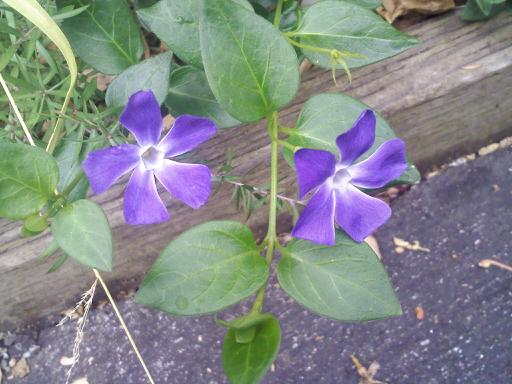
Conflict would likely erupt from any discourse between the city mouse and the country mouse regarding the topic of periwinkle, Vinca major. In rural areas, periwinkle can aggressively invade any area that stays even slightly damp through summer; and it is nearly impossible to eradicate. In urban areas, periwinkle can be a useful and appealing ground cover for difficult situations. It clings to steep embankments, and ventures into shade that is too dark for other ground covers.
Periwinkle can mound up to more than a foot and a half deep with wiry stems and rich green leaves about two and a half inches long. It looks neater and stays lower if shorn or mown down just before new growth develops at the end of winter. Two inch wide sky blue periwinkle flowers bloom mostly as new growth develops through spring, and can bloom sporadically through the end of autumn. ‘Variegata’, with wide white leaf margins, brightens up urns or planters of mixed ferns, and also looks good cascading from planters of mixed annuals or perennials.
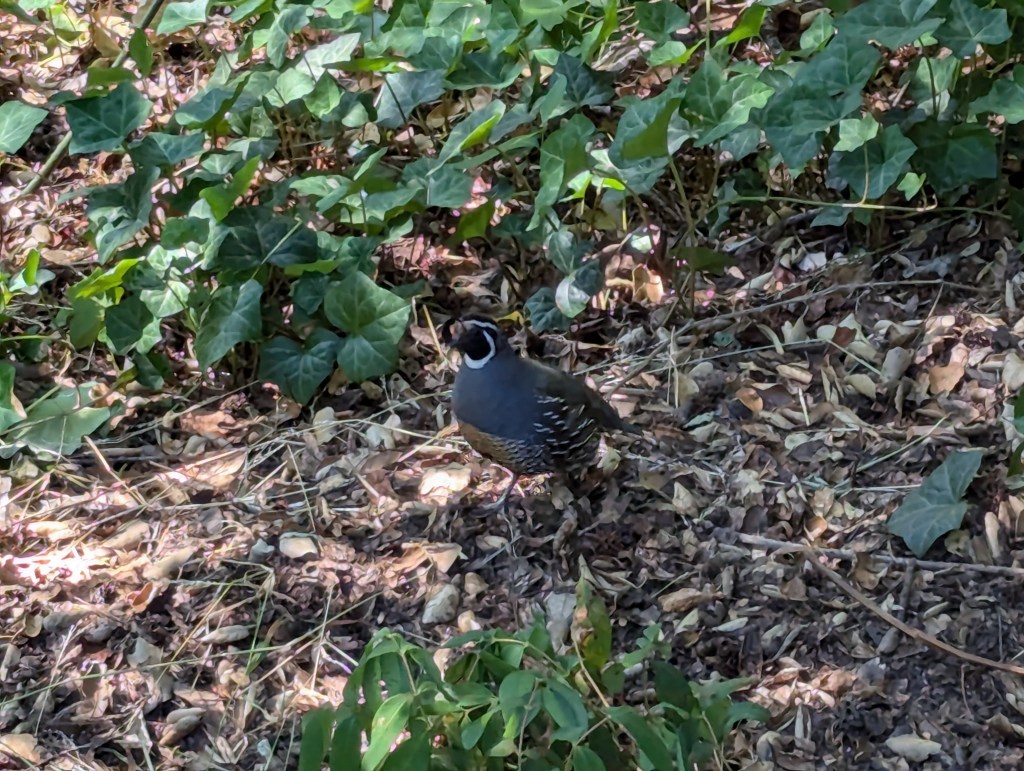
California quail are the Official State Bird of, as one might guess, California. They are delightfully plump but small game birds that are on the ground more than anywhere else. They fly only when necessary, and seem to avoid landing in trees or shrubbery. They effectively avoid predators by running into thickets of vegetation that their predators can not follow them into. Some believe that they sound like they say “Chicago” when they talk to each other. Actually though, they say “Hey Paco!”, in a politely mellow tone. They are a chaparral species that venture into adjacent forests such as the redwood forests here. Relatively colorful males, such as this, are typically followed by their visually subdued female mates after spring, and by now are likely to be followed by a herd of tiny and fuzzy chicks. Their motion on the ground is fluid, although most of a small herd can angularly and suddenly change direction, as if the Papa quail follows his silly apostrophe shaped topknot to the left or right, and the rest follow. They run about pecking at exposed soil, and often stop to scratch at forest debris where soil is not so exposed. Not only do they eat insects and mollusks, but most of their diet is seeds. Since only a negligible minority of seeds within our landscapes of desirable vegetation, such as naturalized wildflowers, almost all of the seeds that California quail eat here are those of weeds. They proactively eat weeds before they happen.
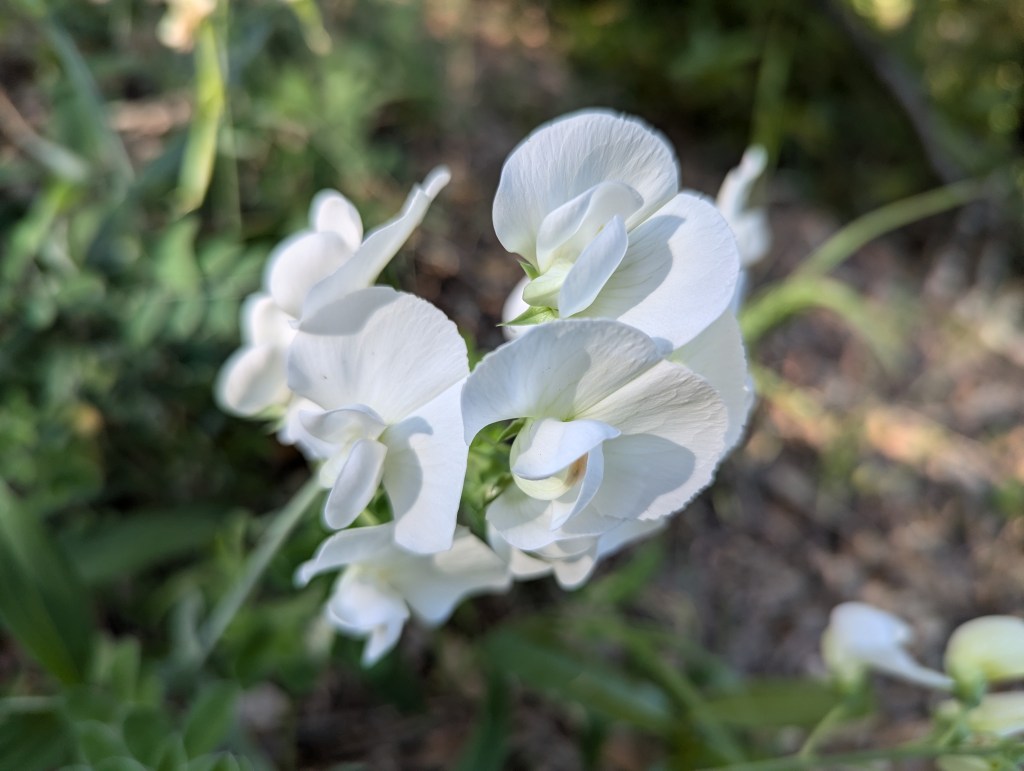
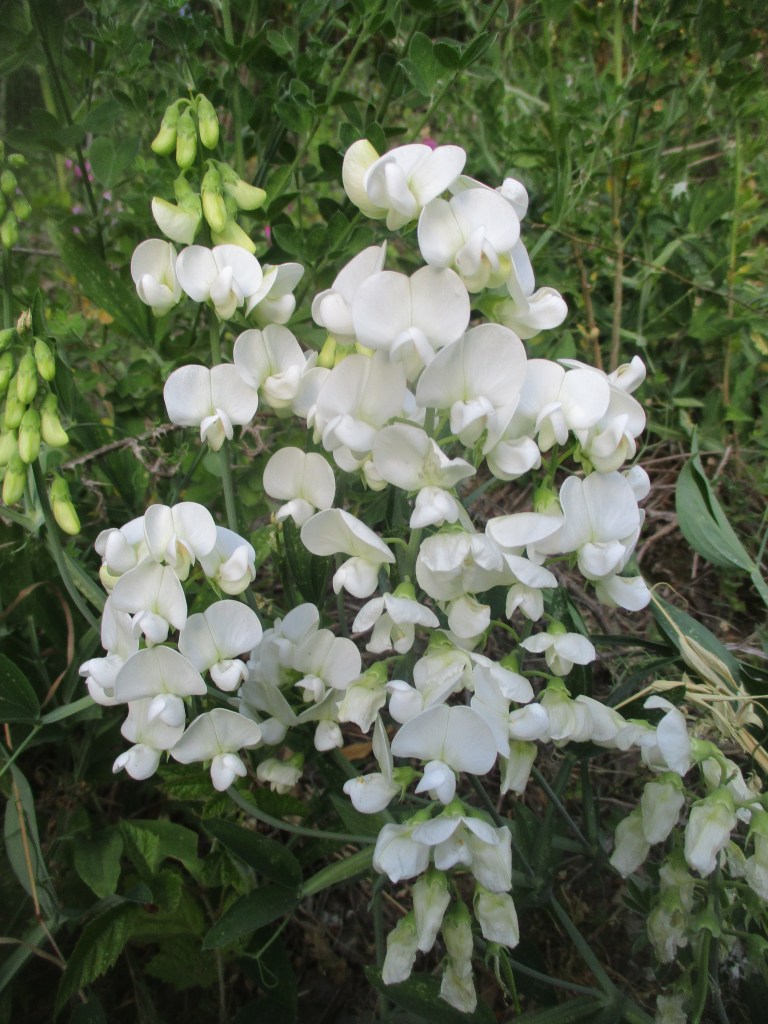
This dinky floral spike was all I needed to identify this as white Lathyrus latifolius.
P is for pea, or more specifically, perennial pea, or Lathyrus latifolius, which does not begin with P, but that is not the point. Perennial pea is a naturalized exotic species here. Within our landscapes, it is difficult to kill. I suspect that it is just as difficult to kill outside of the landscapes, although I have not tried. After all, it is quite pretty, and does not seem to be too invasive beyond situations that it finds to be favorable. Trying to kill what grows beyond the landscapes here would be futile anyway, since there is so much more of it beyond the boundaries of what we have access to. However, I would not want to add any to areas where it is not already established and interfering with local ecosystems. That leaves me with a dilemma. I just acquired a perennial pea that I want to grow more of, but there is no place to grow it. Almost all of the perennial pea here blooms obnoxiously bright purplish pink. Very few bloom lighter pink with a swirly pattern. About as few bloom white. I am told that perennial pea can bloom red, but I am getting to suspect that such red is what I consider to be obnoxiously bright purplish pink. Anyway, I found a perennial pea that blooms white a several years ago, and grew several copies of it. I shared all the copies until none were left. I thought that I could always return to the original source for more. Unfortunately, the source was buried under debris that was removed from a mudslide two winters ago. What a bummer! I had been watching for white perennial pea since then. Then, last Wednesday, I saw it! It was not much, since only one floral stalk was beginning to bloom, but it was enough for identification. I got a good bit of its upper taproot and stems for many cuttings. The base of the taproot remains as a more permanent source if I need it, and if nothing happens to it. I am so pleased with this acquisition, even though I have no idea of what to do with it, like so much of what grows out there.
This is a better picture of the original stock from three years ago.
Weeds pull up relatively easily while the soil is still damp from winter rain.
My garden may lack the sort of ‘riot of color’ that landscapers like to promote to achieve the other popular cliché of a ‘tranquil garden retreat’, but is the victim of a different kind of violence. The desirable plants and undesirable weeds are about as compatible as the terms ‘riot’ and ‘tranquil’ are. Recently, the weeds have been gaining ground in the ongoing battle between the two. In another heroic effort to help the plants that I want in my garden, I will soon venture onto the battlefield to do what I can to defeat the weeds. The native sky lupine, California poppy, California fescue and some sort of native iris would otherwise be displaced by the invading oat grass, oxalis, burclover and sowthistle.
Different weeds invade other areas. Perennial weeds like nutsedge, dandelion, Bermuda grass, bindweed and brambles (blackberry) are among the worst in most areas. Annuals like purslane and spruge can be just as troublesome though. I really dislike the various twining vetches, even though they are good for the soil. Pampas grass, giant reed, blue gum eucalyptus, black acacia and Acacia dealbata are the largest weeds and the most difficult to battle.
All of the weeds that I need to contend with pull out easily while the soil is still damp from winter rains. If I do not pull them now though, they will be difficult to pull as the soil dries. Broom, the nastiest weed in my garden, comes out relatively easily now, but is ridiculously hard to pull from dry soil. Brambles and poison oak also come out easier now like the rest of the weeds, but are of course always difficult to handle.
Sometimes, if I do not have enough time to pull all the weeds in an area, I at least like to keep them from spreading if possible. If I cut annual oat grass down with a weed whacker before it blooms and sets seed, it is unable to reproduce to replace itself before it dies at the end of its season. This also works for sowthistle. Dandelion is perennial, so does not die at the end of its season, but will not spread so aggressively without its flowers or seed.
This has not worked so well with other weeds. Spurge sets seed before I catch it. Yellow oxalis and nutsedge reproduce more profusely by offsets than by seed. Bermuda grass is a creeping perennial that does not mind if it loses its seed. Burclover and bindweed are so low to the ground that pulling them is the only option. Broom and the various weed trees may initially be deprived of their seed, but are harder to pull when they regenerate after getting cut back.
Regardless of what it takes, this is the best time of year to get weeds under control. Later in the season, they will have had time to set seed or get more established. As the soil dries and gets baked by the sun, pulling weeds, or in some cases, digging them, becomes more difficult.
Warming spring weather accelerates bloom and growth. Early spring bloom is now much more colorful than the best of winter bloom. Fresh foliage is already replacing defoliated deciduous foliage and faded evergreen foliage. Vegetation will soon be more active than they will be during any other time of year. Such vegetation unfortunately includes weeds.
Weeds are only weeds because they are unwanted. That is their only commonality. Most are exotic, or not native, but a few are native. Most are annuals, but a few are perennials, vines, shrubs or trees. Annuals grow from seed, but several of the others can perpetuate vegetatively. Some are appealing where appropriate, but migrate to where they are not.
Weeds become weeds because they are generally invasive. Many are aggressively so. They grow wherever they can, and compete with any desirable vegetation for resources. The most aggressive annual weeds begin growing before preferable species. They can overwhelm their slower victims. Several have bloomed and are already dispersing seed.
Exotic weeds are here for a variety of reasons. Some arrived inadvertently as seed in fur or digestive systems of livestock. Some were fodder for livestock. Many were originally desirable flowers for home gardens. A few were formerly useful as cover crops or erosion control. Many lack natural pathogens from their native ranges that limit their proliferation.
Regardless of their origins, weeds now necessitate weeding. They grow throughout the year, but most are most active as winter becomes spring. Obviously, they grow like their horticultural designation implies. Those that are not already dispersing seed should not get the opportunity to do so. Less weeding will be necessary later if more happens now.
Besides, weeding is easier while the soil is still evenly damp from winter rain. Roots are more pliable and less dispersed. They toughen and disperse as the season progresses. Rhizomes, stolons and other perennial weed parts are likewise easier to pull or dig now. Tilling might be more efficient for eradication of small but profuse young weed seedlings.
Wild cucumber is not a particularly substantial vine. Except for its tubers, it is quite delicate.
Wild cucumber, Marah fabacea, is also known as manroot because it develops massive tubers that can weigh as much as a man. Such tubers can supposedly weigh more than two hundred pounds, and some sources claim that they can weigh twice as much. That is a lot of storage.
Their thin leaves, slender vines, tiny flowers and fleshy fruit are not very substantial, and can not be very consumptive. They are quite watery, and leave minimal debris when cut and dried, or when they die back after frost.
So, why does wild cucumber store so much resources within their massive tubers? I have no idea. I realize that it is a survival technique, but this is major overkill. No winter is long enough to justify such extreme storage. No summer is dry enough. No wildlife is voracious enough. No forest fire burns the same place more than once in a season. Furthermore, no gardener is diligent enough.
Seriously, these things are impossible to kill. The vines pull up quite easily, with no resistance. The tuber simply makes more. Secondary vines pull up as easily as the first. The tuber simply makes more. No matter how many times the vines get pulled up, the tuber simply makes more. It never exhausts its resources. Removal of the vines deprives it of its ability to accumulate more resources, or replenish what is used to generate the vines, but it has enough to generate vines for many years.
The only way to eliminate these weeds is to dig up their massive tubers, which are fortunately not very deep underground. Even then, the tubers do not die. This one sat around through last summer, and is still viable. I suppose that we should dispose of it with the trash, since we can not compost it.
This wild cucumber tuber is bigger and much heavier than Rhody, but is smaller than average.