After three years, this remains a mystery. No one is complaining.
Weeds?

Pretty weeds do not get my attention like they do for others. They look too much like weeds to me. If I want to appreciate them, I must do so with intention. Sometimes, I do actually try. I did happen to notice these two weeds. However, now that I got their pictures, I have no use for either of them. Neither is readily useful for the gardening column. I will just share them here.
The yellow flower pictured above is most likely prickly lettuce. I really do not know. I know it as yellow chicory; but chicory does not bloom yellow. Some people think of it as dandelion, since the flowers are similar. These flowers stand much higher though, with only minimal foliage below. For the picture, I plucked this flower and stuck it in the ground to keep it still in the breeze.
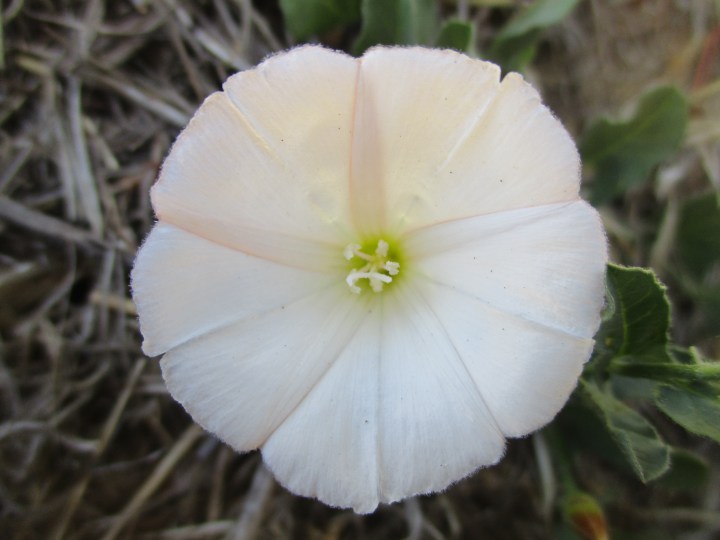
The white flower pictured below is common bindweed. When I was a kid, I knew it as morning glory. In this close up picture, it looks like a fancier garden variety of morning glory, although the flower is much smaller. Real morning glory happens to look good in white, like this one does. If it is fragrant, I have never noticed. It tends to creep along the ground more than it climbs.
It sometimes seems silly to me that others so easily notice how pretty weeds such as these are, especially while there are so many more flowers that are prettier. Then, I realize what others must think of what I consider to be pretty. For example, the pollarded blue gum with aromatic blue foliage that I enjoy so much, is the same species that gives all eucalypti a bad reputation.
Besides, these flowers were the prettiest in the otherwise bare meadow where I found them.
Too Much Oregano

Vegetation management after several weeks of neglect has been . . . interesting. While we were unable to work, and during their most active growth of the year, weeds proliferated more than they had ever gotten away with before. As most get cut down by weed whackers, I pull those that mingled with desirable plants that weed whackers must avoid. It is a tedious process.
One of the more tedious of these projects, and perhaps the most tedious so far, required the removal of abundant weeds from a dense row of carpet roses. Fortunately, it was not as bad as I expected it to be. They young man who weeded this area during winter had done a remarkably thorough job, and eradicated most of the dreaded oxalis and tougher perennial grassy weeds.
The weeds that I pulled were big and impressive, but pulled out relatively easily. A few thistles were unpleasant to handle, but even they came out easily. Mock strawberry between some of the roses was still in good condition after the weeds that mingled with them were gone. I realize that I do not adequately appreciate all the weeding that happens here that I am not aware of.
Besides mock strawberry, another species that gets to stay in parts of the area that it spreads into is some sort of oregano. It seems to be common Italian oregano, but also seems to develop leaves that are slightly larger than they should be. It is too docile to be a problem for the roses, but occupies space that would otherwise be taken by weeds. Besides, it is nice to have around.
Even oregano needs to be managed sometimes. Quite a bit of it got pulled from the roses along with the weeds. I suppose it must be dried now.
While You Were Out

Our work is the sort that could potentially continue as essential. Distancing is not a problem for us, since we generally work individually, and there are no guests here. However, work needed to be discontinued due to lack of revenue. A conference center can not generate revenue without big groups of guests. Even when groups can return, many potential guests can not afford to.
The chronology of this situation should have been documented more efficiently. We had been unable to work here for several weeks. I do not remember how long it had been. Work resumed two weeks ago, and can continue for six more weeks, for a total to two months. We will start no new projects during this time, but will primarily try to catch up on what was neglected earlier.
Salvage and preparation for resumption of neglect are presently the priorities. This entails vegetation management after weeds had been left to grow wild during their most active season. It is extreme. Most weeds either had dispersed their seed, or did so as they got removed. This is not much of a problem for areas that are not landscaped, but will be trouble within landscapes.
Weeds in areas that are not landscaped get cut down by weed whackers, and mostly left where they fall. Roots that remain within the soil, and debris dispersed over the surface, should limit dustiness later in the summer. Weeds in landscaped areas and where weed whackers can not get into must be pulled. We do not want young desirable plants to be ruined by weed whackers.
It is discouraging that no one is here to enjoy the landscapes that we put so much effort into while we can work. It is also discouraging to see how easily the landscapes can fall into disrepair.
Some Seeds Can Hurt Pets
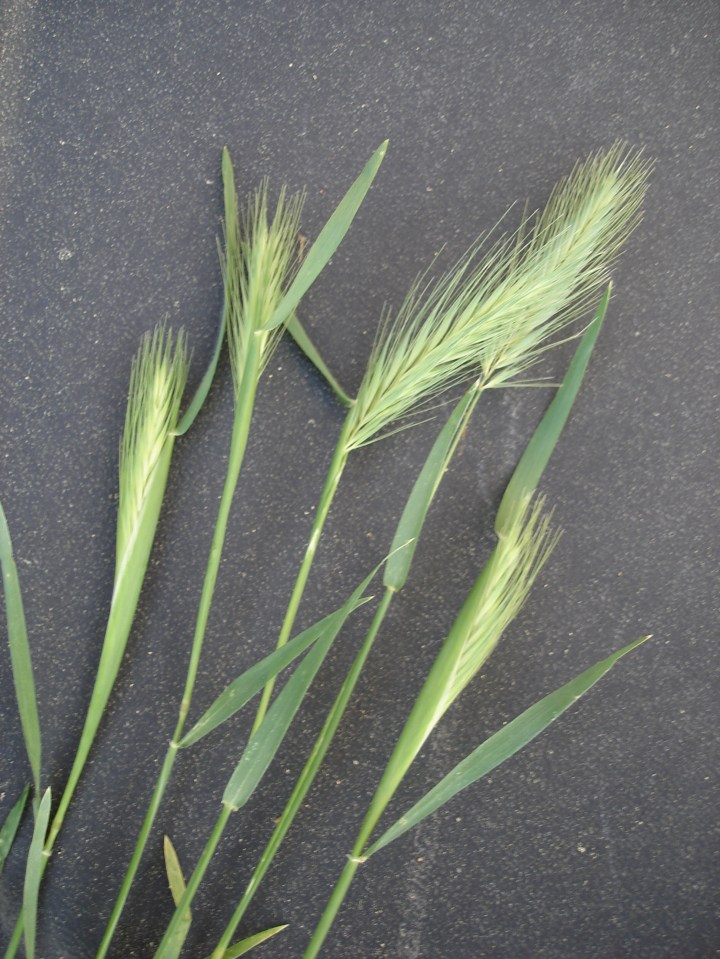
Weeds always have unfair advantages. They grow fast enough to bloom and disperse seed before the rain of early spring runs out, so they do not need any supplemental water. They seem to be able to grow anywhere. Their abundant seed seem to be able to get anywhere. Many produce seed with creative tactics for hitching rides on animals or being blown around by the wind.
This can be a serious problem for the unfortunate animals that interact with these exploitative weed seeds. Burclover and foxtail that are designed to stick to the short hair of grazing animals just long enough to get moved to greener pastures can get seriously tangled in the softer and longer fur of cats and dogs. Foxtail and other thin seeds can get lodged into noses, ears and eyes.
This is why it is so important to control these sorts of weeds, even if the landscape is not a priority. Gardens without resident cats can be visited by neighbor cats who can be hurt by dangerous weed seeds, or disperse the seed into other gardens. Mistletoe seed is not really so dangerous, but has a sneaky way of sticking to birds and squirrels for dispersion.
Thistles are more of an annoyance than actually dangerous. Their seed does not stick into fur. It just gets blown about in the wind. The problem is that the spiny foliage of some types is too painful to handle. If neglected long enough to go to seed, thistles can be seriously prolific. Because it is dispersed by wind, the seed can get anywhere without any help.
Weeds can be recycled in greenwaste, only because greenwaste gets sterilized in the recycling process. Some annual weeds can be composted if they get collected before they produce seed. If there is any seed, some of it may survive the composting process, and germinate wherever the compost gets used. It would be better to dispose of such risky biomass.
Likewise, crabgrass, dandelion, oxalis and other perennial weeds should not be composted because some of the stolons (modified stems) or roots survive the process. Just like seed, some of these surviving vegetative parts can grow into new weeds wherever the compost that contains them gets dispersed. Such resiliency is one of the qualities that makes them ‘weeds’!
Broom
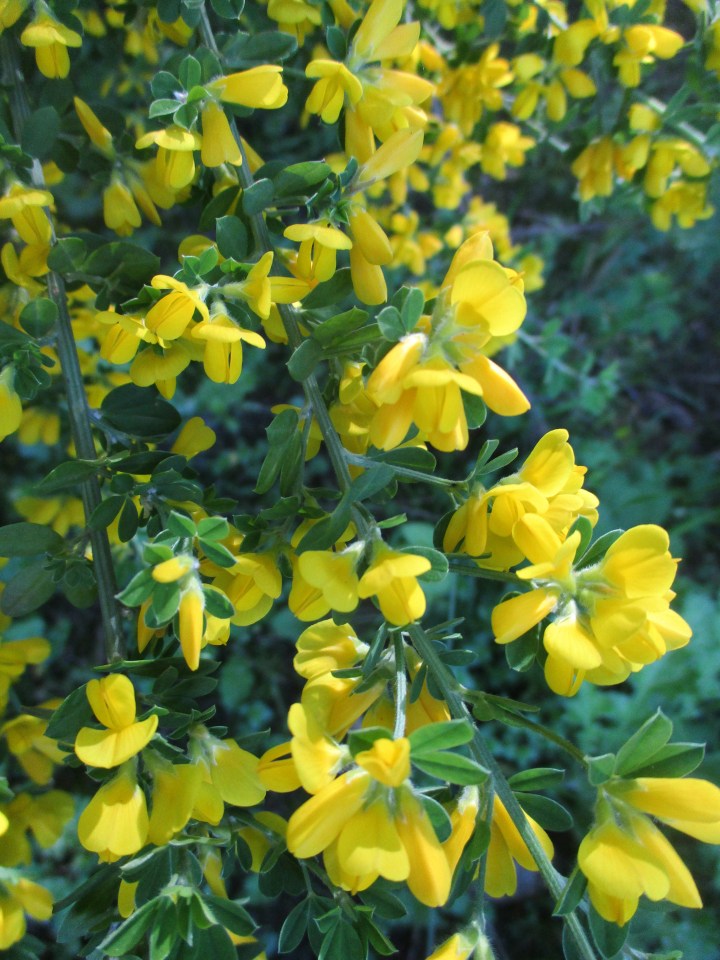
Shortly after silver wattle finishes blooming up high, any of four species of broom begin blooming down low. Brooms and silver wattle often naturalize together. All bloom with the same delightfully brilliant yellow. The four brooms are French broom – Cytisus monspessulana, Scotch broom – Cytisus scoparius, Portuguese broom – Cytisus striatus and Spanish broom – Spartium junceum.
Sadly, none are desirable species. All are exotic weeds. They are only a topic for gardening because they are so aggressively invasive. Not only do they overwhelm and displace native species, but they also enhance soil nitrogen to promote the growth of other exotic weeds! They are unpalatable to deer, and are not bothered by insects or disease. Furthermore, brooms are combustible!
It is best to enjoy their cheery bloom from a distance, where they grow wild where they really should not. The various species tend to dominate distinct regions, with some degree of mingling. Big specimens can get eight feet tall, but do not live long as they are replaced by herds of seedlings. French broom is the only evergreen species; but any can defoliate in response to hot dry weather.
Exotic Species Can Become Naturalized

Every palm tree in local landscapes is exotic. Simply put, all palms are originally from somewhere else. The desert fan palm, the only palm that is native to California, came from isolated colonies in desert regions many miles away. In fact, most plants in common landscapes are exotic. Landscapes composed of Californian plants likely include some plants from other regions of California.
With few exceptions, exotic plants are not a problem. However, some of those few exceptions have become very serious problems. Himalayan blackberry, blue gum, silver wattle, pampas grass, giant reed and broom are some of the more notorious examples. They naturalized to become prolific and aggressively invasive weeds. Some are more common than natives in many situations.
Naturalized exotic plants such as these are problems for local ecosystems, even if they do not affect refined landscapes. They compete with native plant species for limited resources, space and pollinators. A lack of pathogens from their homelands can be a distinct advantage. They alter the lifestyles of some of the native fauna. Some enhance the combustibility of the forests they inhabit.
The justifications for importing exotic species are as varied as the species themselves are. It might have been for lumber, forage, fruit, or vegetable production. Giant reed might have arrived here as packing material for cargo from southern Asia. Nonetheless, most naturalized exotic species, including the most aggressively invasive, came here simply for home gardening and landscaping.
Realistically, of all the countless exotic species that came here during the past few centuries, very few naturalized. Fewer are now aggressively invasive. Some with potential to naturalize may not have yet been able to escape the urban situations they inhabit. The problem now is that there are so many more exotic species readily available from all over the World than there has ever been!
Online marketing facilitates procurement of exotic and potentially invasive plant species from other regions, with minimal regard to regulation of such commodities.
Weeding Earlier Rather Than Later

Weeding is not much fun. Some of us might enjoy the relaxing monotony of productive weeding. Realistically though, most of us would prefer to do something else in the garden. There is certainly plenty of other chores that need to be done now, after earlier rain, and before the weather gets significantly warmer. However, such weather is why it is important to start weeding earlier than later.
By definition, weeds are weeds, because they are unwanted. They get to be unwanted by dominating space and exploiting resources more aggressively than wanted plants. Some innately grow faster and more aggressively than most other plants. Some are innately prolific with seed. Some employ multiple tactics to gain unfair advantages. Weeding is how we help our gardens compete.
Weeds grow throughout the year. Most slow down through the dry warmth of summer, and many die off then. However, there are always some weeds growing somewhere. When they die off, it is only after they have dispersed seed for their next generation. Some generate a few generation annually. Some are perennial weeds, or even shrubs, vines and trees, which survive for many years.
Weeding is more of a concern now because the majority of weeds grow so much more aggressively after the earliest rain of winter. Warming weather later in winter accelerates their proliferation. This is the time of year that weeds start to crowd desirable plants. If weeding is delayed for too long, weeds eventually bloom and toss seed. Some weeds extend stolons to disperse vegetatively.
The good news is that the same rain that promotes the proliferation of weeds also facilitates weeding. Weeds are easier to pull while the soil is still damp than they will be as the soil dries later in spring and summer. Also, while weeds are still fresh and turgid, they are less likely to leave roots or stolons behind in the soil. They are more difficult to pull intact as they begin to deteriorate later.
Furthermore, weeding should be done before weeds bloom and disperse seed for subsequent generations. Some are sneaky and quick.
Wild Strawberry?
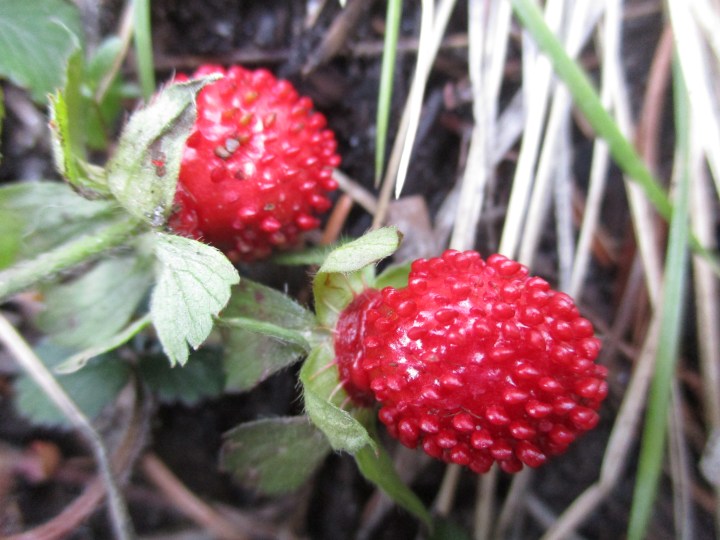
Under a bank of carpet roses that I am none too keen on, this grubby ground cover competes with more aggressive weeds. To me, it looks like common mock strawberry, Potentilla indica. I never gave it much though. It seemed to me that whoever had installed cheap and common carpet roses on that bank would have employed a comparably cheap and common ground cover.
The ground cover was more prolific in open spots that were too narrow for more of the roses, and from there, seemed to have migrated under the roses as a second layer of ground cover. It would not have been installed underneath intentionally. It did not occur to me that it may have grown from seed like so many other weeds there, or migrated in from the surrounding forest.
The white flowers did catch my attention though. I was not aware of a mock strawberry that bloomed with white flowers. I really was not concerned enough about it to investigate. This part of the landscape will be getting renovated soon anyway. The roses will be relocated to where they can not extend their thorny canes into an adjacent walkway. Agapanthus will replace them.
Now that I am seeing more of these odd strawberries, I am wondering if this low ground cover that I formerly had no regard for is actually the native wild strawberry, Fragaria californica. Not only should mock strawberry bloom with yellow flowers, but it should also produce more spherical berries. Now I will need to identify it before I either dispose of it, or merely relocate it.
I prefer to not salvage exotic species that exhibit potential to naturalize from landscaped areas into surrounding forests. If this ground cover is wild strawberry, it migrated from surrounding forests into a particular casually landscaped area.
Poison Oak Tree
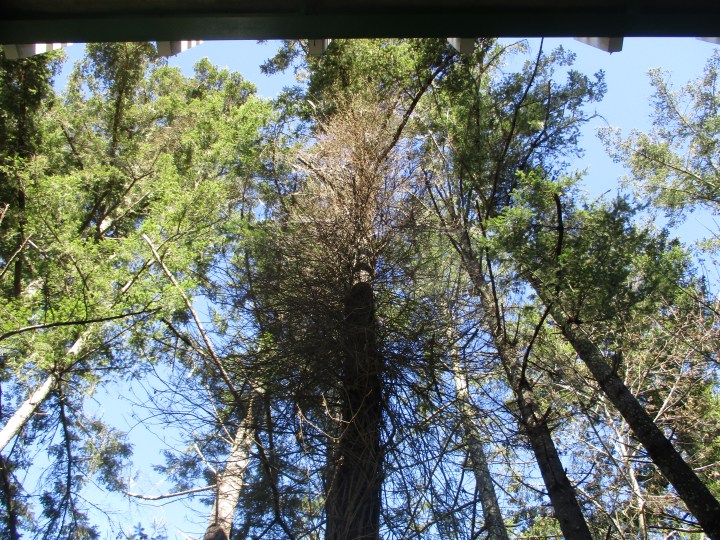 From below, this looks like a shrubby deciduous tree. It is really just a Douglas fir, like those around it. All the defoliated thicket growth is overgrown poison oak. It has likely been climbing the fir tree since it was quite young. Poison oak is not very proficient at climbing bare trunks. It typically climbs into lower limbs, and then into higher limbs before the lower limbs are shed.
No one has bothered to cut this poison oak out of the fir tree because it is not within a landscapes area. That dark margin at the top of the picture is the underside of a bridge, from which, not much of the thicket growth below is visible. The area from which this picture was taken is used for piling greenwaste and parking, where no one is concerned about wild vegetation beyond.
However, now that I sometimes park in that particular parking area, I am finding this mess of poison oak difficult to ignore. There was a similar but even bigger thicket of poison oak up in a redwood tree at the farm, from where it tossed seed into horticultural commodities below. The resulting seedlings added a whole new dimension to weeding the stock. The thicket had to go.
The problem with the thicket in the picture above, although not as serious, is that it too tosses seed into area where people work. Seedlings are likely to grow where greenwaste is processed, and where I sometimes park. Poison oak that grows on the far side of this fir grove will be uncomfortably close to the right field foul line of a ball field that will eventually be restored there.
I have no intention of cutting the poison out of the fir tree. I will merely sever the main trunk at the base, as seen in the picture below. As it deteriorates over several years, no one will mind if it is somewhat unsightly on the industrial yard side. The adjacent fir trees sufficiently obscure it from view from the ball field side. The priority will be preventing seed from proliferating.
 Tony Tomeo