Pine

P80429Redwood Glen was the ‘camp’ that we all went to in the sixth grade. It was probably our equivalent of what is now known as ‘nature camp’. For most of us, our experience at Redwood Glen was the longest time we had ever been away from our homes and families. We arrived on Monday morning, and returned home on Friday afternoon. It was something that we looked forward to with great anticipation for the few years prior.

While there, we studied nature in a variety of ways. We found animal tracks and made plaster casts of them. We went hiking through a variety of ecosystems, and went on a night hike. We searched for fossils; and I found and still have the most complete fossil of half of a fish. We studied ecology and native flora and fauna. We identified redwoods, Douglas firs, ponderosa pines, bays, live oaks, bigleaf maples and box elders. We collected a few edible herbaceous plants and made our own salads with them. The three leaves that I collected to distinguish leaves with pinnate, palmate and parallel veins was a project in one of our botanical workshops. I described it yesterday at: https://tonytomeo.wordpress.com/2018/04/28/pinnate-leaves/

For my class, that was back in November of 1978. In 1995, when I went to grow rhododendrons nearby, I became a neighbor to Redwood Glen. I always knew where it was, but never had any excuse to stop by; until now. Some of my colleagues who manage the facilities and landscapes at a nearby conference center toured the site. I was right there with them.

Some of the buildings were new since 1978. Some had been renovated. The big dining room had not changed. What was most excellent about touring the facility was finding the same old cabin I stayed in back in 1978. I think that it was simply designated as Cabin 4 back then, but is now known as ‘PINE’.

Except for a modern roof and windows, Pine looks just like it did when I was there three decades ago. The middle front door was for the counselors who stayed in their own tiny room between the two wings to the left and right. I stayed in the wing on the right. My bunk was the lower of the two just inside the front door to the right. I so wanted to see the interior of Pine, but the door was locked.

I rarely want to see places that I remember so fondly. I prefer to remember them as they were rather than find that they had been renovated disgracefully, or demolished and replaced with something new. I sort of expected to find something new here. What an excellent surprise!P80429+

Squirrel!

P80408Wildlife and domestic animals seem to follow me everywhere I go. When Brent and I lived in the dorms at Cal Poly, our room was known as the Jungle Room, not only because of all the greenery, but also because every little bird that got knocked out while trying to fly through the big windows at the dining room was brought to our room to recuperate. A baby squirrel that weaseled into my jacket while I was out collecting insects for an entomology class lived with us for a while. There were two baby ducks that need a bit more explaining.

When I moved south of town, where my roommates boarded horses, the horses worked diligently to open their gate to come to the house to eat my rare plants. The neighbor’s cattle sometimes did the same! When it rained, creepy crawdads came out of the ditch at the railroad tracks and up to my porch.

When I moved to Los Gatos, it seemed that every stray dog in town eventually arrived at my home. In fact, my home was ransacked by the FBI just because their bloodhound who was supposed to be pursuing a suspect of a crime wanted to come by! Again, that takes a bit more explaining. Birds flew through freely. A pair of some sort of small bird nested in my shower, and before I realized it, started to raise a family . . . and finished. Pigeons tried to nest repeatedly in the same spot on top of the refrigerator, but got evicted. A squirrel moved into the guest room, and refused to leave. It sometimes tried to join me for breakfast.

Then, at my second home, there was Timmy the baby deer, two feral cats, skunks, coons, squirrels and more neighborhood dogs than I can remember, as well as Bill the little terrier who actually lived there. I could go on. https://tonytomeo.wordpress.com/2018/03/14/timmy-in-the-garden/

Squirrels are a common denominator. They are everywhere.

My home in town was in the Live Oak Manor district, which, as you can guess, was dominated by huge old coast live oaks as well as comparable valley oaks. The valley oak next door was supposedly the largest in the Santa Clara Valley. Squirrels were everywhere and very well fed!

The east facing window over my desk would have had a good view of Mount Hamilton if the view had not been so cluttered with utility cables. The wildlife that used the cables could get annoying at times. Crows made their annoying noise. Pigeons just stared at me stupidly. Squirrels scurried by with bits of fruits and vegetables that they stole from the garden, and sometimes stopped to cuss at me. I sometimes cussed back, but also reminded them to be careful as they jumped from the high voltage cables into the tops of the neighbor’s hedged redwood trees below. The redwoods sometimes grew dangerously close to the high voltage cables between clearance pruning.

As you can imagine, the unimaginable but obviously predictable happened. I do not know if he was coming or going, but I would guess that he was jumping from the tree to the cable. I only heard a loud ‘ZAP’ and subsequent ‘FIZZLE’. By the time I looked out, the unfortunate squirrel was a swinging charred carcass with a death grip on the cable he was reaching for. The death grip was impressive. He stayed there for a long time, swinging in the breeze. Silent sparks could sometimes be seen at night, where his tail brushed against the tip of the redwood shoot. I do not know if a crow finally got him, or if he just fell into the neighbor’s yard. Either way, he did not get a proper burial.

Timmy in the Garden

P80314

Tim Buck II, pronounced like ‘Timbuktu’ in Mali, but known simply as ‘Timmy’, came to live with us while he was just a baby fawn. Mr. Tim Buck Senior left Mrs. Buck to raise little Timmy alone as a single mother. Mrs. Buck then vanished, leaving little Timmy enfeebled on the side of Highway 9 south of town. No one knows what happened to Mrs. Buck. She might have been hit and killed by a car. She might have been eaten by a Mountain Lion. Somehow, she was not there to raise little Timmy.

Traffic was stopped on Highway 9 as little Timmy staggered about, either anemic, or starving from the absence of Mrs. Buck. He could barely walk, and certainly could not bound up or down the steep hillsides to leave the Highway. Most of us who stopped knew that he would not survive, and just accepted it as part of nature. However, we could not just leave him there with a few concerned children also stopped in the traffic with us. I loaded him into the back seat of the pick up and took him with me so that the children would think that he would be taken care of. I expected him to be deceased by the time I got home.

Instead, like a scene straight out of ‘Tommy Boy’, Timmy survived. He got up and was looking at me in the rear view mirror. Now what? Barbecue? I took him home to ask the neighbors.

That was too much help. They gave Timmy goat milk and groomed him of ticks, and a within a few hours, Timmy was bounding about the yard and playing with Bill the terrier, and Melly and Chewy the two cats. By nightfall, the entire herd wanted to sleep in my bed!

Timmy grew very fast and consumed quite a bit of goat milk. He craved more than milk though, and started eating my roses. (This was later in spring.) When I yelled at him to stop, he just looked at me quizzically, and continued eating. The roses did not last long. Timmy then ate the leaves off the fruit trees. Then he ate some ornamental grasses. There was not much that Timmy would not eat. When I tried chasing him off to eat in the forest, he just came right back to play with his friends and eat more of the garden. When I kept the door closed, he just came in the cat door and found his way to my bed. When I took him across the creek and down the road a bit, he just followed me back.

The funny thing is that everyone liked Timmy! He was so nice and polite, even as he destroyed the garden. That was a very bad year for gardening!

By the following spring, Timmy was spending almost all of his time out in the forest. He had depleted everything in the garden, so needed to go farther out to find vegetation within reach. He had grown very fast into a tall and lanky young buck. I slowly resumed gardening in early summer, with only minimal nibbling.

I sometimes wonder how Timmy is doing. I am pleased that he is no longer in my garden. I can enjoy growing roses again. The only thing I enjoy finding in the rose garden more than a nice healthy rose is a bitten off stub where there was about to be a rose.

Bat

P80311KHe or she; let’s just go with ‘it’ – has no name that I am aware of. It might be an acquaintance of Pepe. ( https://tonytomeo.wordpress.com/2018/03/04/pepe/ )

It showed up in a conference room at work, and needed to be removed. The young lady who found it motionless on the floor did not want to handle it, so I took it outside and laid it on top of a utility panel, hoping that it might fly away. After only a few minutes, it was gone. I did not see a cat or anyone else who would have eaten it; so I am hopeful that it flew into a nearby riparian area to find some insects to eat, and to recover from being trapped inside.

I have no idea what happened to it, or how it ended up in such a bad situation. It was on the floor below a skylight window, like a dazed bird who crashed into the glass while trying to fly through the window. However, bats do not try to fly through closed windows. Their sonar informs them that the glass is there, even if they do not see it. Someone I was working with at the time said that it might have been trying to find a way out near the window just because of the sunlight there, and because it was higher than the other windows. Perhaps it just got exhausted while flapping around trying to find an exit.

Bats are mysterious here. I do not even know what kinds of bats live here. They are nocturnal, like Pepe, so they do what they do while most of us are not up and about or outside to see them doing it. Even those who are out at night do not see much of what bats do because nighttime is rather dark. I think that is what makes it nighttime. Bats are dark too, so are not easy to see without sunlight.

I know that the small bats like this one eat mosquitoes. Since mosquitoes follow people about, and bats follow mosquitoes, bats seem to follow people. We see them every once in a while as they dart about. Yet, almost all of their activity goes unnoticed, even if it is only a few feet away. They are small, dark, silent and fast. Even if we are not aware that they are about, and they are not very concerned about us, they make our time in the garden after sundown a bit more tolerable by eliminating so many of the otherwise bothersome mosquitoes.

In other regions, and perhaps here as well, bats interact with plant life as well. Some eat soft fruit, such as prickly pear, and distribute the tiny seeds within. They do what birds do for brightly colored berries. Since bats are not impressed with bright colors, the fruits that want to attract them use sweet fragrance and flavor. Unlike small brightly colored berries that birds eat whole, fruit that is designed for bats is large and squishy, with tiny seeds dispersed somewhat homogeneously throughout the pulp, so that small bats can eat the seeds just by taking small bites of fruit.

Bats also pollinate some types of flowers. Many types of cacti that live in desert regions bloom at night while their flowers are less likely to be desiccated by harsh desert weather, and also while nocturnal pollinators are active. Flowers that rely on moths are smaller and paler, although they are brightly colored and patterned with ultraviolet color that moths can see. Those that rely on bats for pollination are wide and faced upward so that bats can land on them if they want to take their time eating the abundant sweet nectar. Sweet floral fragrance is easy for bats to follow.P80311K+

Pepe

P80304Coons are not much of a problem in the garden; but they can be a problem around the home. They scatter trash, eat dog and cat food, and can be dangerous to dogs and cats. They get into places we do not want them, including basements, attics, and even our homes. Once inside, they can cause significant damage.


That is why they sometimes need to be trapped. No one wants to do it, but it is sometimes necessary.

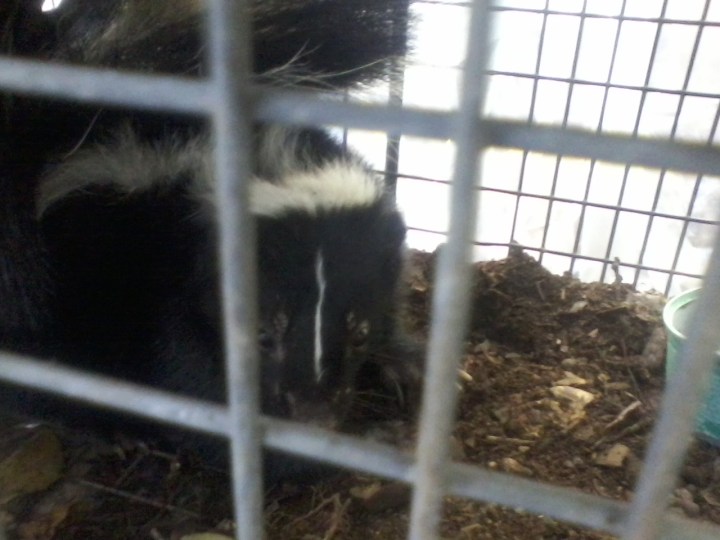
One problem that we did not consider when putting out a trap for a coon who was getting into the trash was that we might not actually catch the offending coon. Actually, not catching the coon was not as much of a problem as who we caught instead.

Pepe got to the trap first.

Pepe was none too happy about it.

Neither were we.

You see, Pepe, who is difficult to see in the picture, is a skunk.

Normally, skunks are more destructive to gardens than coons are. They dig grubs out of lawns, but damage the lawns at least as much as the grubs do. They pull out freshly planted seedlings because insects tend to congregate right underneath. Although they are good at controlling some types of plump insects among tough perennials, they are not very careful about getting to the insects that they pursue in more sensitive young plants and vegetable gardens.

However, this was in a situation where landscaping is minimal, and there is no lawn. Skunks had not been a problem . . . until now.

Once in the trap, we did not know what to do with Pepe. No one wanted to get close enough to open the trap. We could not leave Pepe trapped without food or water. Because Pepe had been harmless, we could have released Pepe on the spot, but instead decided to relocate Pepe nearly a mile away, on the far side of Zayante Creek, where there is more insects and water. It was a good distance between us and Pepe, but not so far that Pepe could not return if Pepe wanted to.

I got close enough to the trap to cover it with a trash bag, and then put the covered trap into a trash bag so that it was wrapped almost all the way around. Surprisingly, Pepe did not seem to mind the procedure, and watched calmly. The bagged trap went into the back of a pickup, and was taken to the relocation site. Of course, no one came with me to help.

Once at the relocation site, Pepe did not want to leave the trap. I had to literally dump Pepe out; and then step aside PROMPTLY. Once on the ground, Pepe, who had seemed to be about as big as a big kitten unfolded into a huge fluffy skunk with a big fluffy tail! I have no idea where all that fluff came from!

I had guessed that Pepe would be thirsty from his incarceration, and would be in a hurry to get down to the brambles near Zayante Creek. Instead, Pepe just stared at me sadly. I tried to explain the situation to Pepe, but my French is lacking. Apparently, Pepe did not understand.

As I turned and started to walk back to the pickup, Pepe ran past me and got there first. Pepe stopped at the open door, and looked back at me as if requesting help getting in. This was not good. I stayed back, which annoyed Pepe, who had been a good sport through this entire procedure so far. Pepe sort of hopped about with his fluffy tail flailing, as if frustrated that the floorboard of the pickup was just out of reach.

I tried to explain in English and really bad French with maybe a bit of Italian and Spanish mixed in where I could not remember the words, that the relocation site should be satisfactory. Eventually, Pepe seemed to agree to give it a try. Pepe slowly waddled away and downhill to Zayante Creek. In the second picture, that black and white blotch to the left of the roots of the alder tree is Pepe, looking back at me sadly.P80304+

RATS!

P80204

Remember the Beverly Hillbillies? That was a really lame sitcom; but it was somehow very popular at the time.

Each episode began with the stupid jingle that explains how and why the formerly impoverished but suddenly wealthy Clampetts left their home in Bugtussle and moved to Beverly . . . Hills that is.

As they drive their decrepit Oldsmobile down Bedford Drive just west of downtown, the palms flanking the roadway are prominently visible to the left and right. This strictly regimented collection of Canary Island date palms alternating with Mexican palms was not very big back then, in the early 1960s. By the 1980s, they were strikingly grand. Sadly, they are now deteriorating from old age. Many of the broad Canary Island date palms have succumbed to pink rot, so are now absent. Some of the Mexican fan palms are also lacking. It is saddening to see them now knowing how grand they were not too long ago. Although they are being replaced, they will never be as formal and uniform as they were as a monoculture (or biculture) that was planted all at the same time back in the late Victorian period. Even if it were possible to remove all of the trees and plant new ones at the same time, such conformity went out of style decades ago.

Arborists see these historic trees differently. They know that just one Canary Island date palm is likely infested with rats. Such a grand collection must be infested with a disturbingly large population of rats. Within a canopy of a Canary Island date palm rats, are safe from most predators, and get quite a bit to eat from the fruit produced by the female trees. (Most Canary Island date palms are female, with only a few taller and less billowy male trees for pollination.)

When a Canary Island date palm gets cut down from the base, it falls with a big SPLAT on the ground, followed by a blast of wind containing every Frisbee, baseball, tennis ball, kite and whatever got stuck in the tree over the previous few years. After a brief pause, but before the the baseballs stop rolling in the gutters, a herd of all surviving rats flees the scene. Most hide in the closest shrubbery they find. Some scurry up other nearby palms. It can really blow your image of the Canary Island date palm.

My Internship Was NOT In Australia

P80106Australia, New Zealand and South Africa were the hip and trendy places to do internships in horticulture back in the late 1980s. Everyone who was anyone was doing it; which is sort of why I was not that interested in doing what everyone else was doing already, even if I could have afforded to go to any of those exotic places. I did my internship in Saratoga.

All I knew about Australia was Olivia Newton John, Helen Reddy, eucalyptus trees, and that it is the place where summer goes when it leaves here.

Since writing online and learning a bit more about horticulture in Australia, I incidentally found that Australia is stranger than I would have imagined.

There are no Pontiacs in Australia! Seriously! When someone asked about what to do with a surplus of peaches that were too overripe and squishy to can, I suggested that they get thrown at the neighbor’s Pontiac. It was such a fun tradition among kids in the Santa Clara Valley back in the 1970s. I did not expect to be taken seriously; but I did not expect to be informed that there are no Pontiacs there! How totally primitive! I did not even ask about Buicks. If they lack Buicks, I REALLY do not want to know about it. I did happen to ask if cars were driven on the left side of the road, which they are; not that it matters. Without Pontiacs, who cares?P80106+

Then there are these terrifying animals known as wallabies! They look like humongous rats! They come out early in the morning and again in the evening, when their victims are most vulnerable. They always stare at whomever is taking their picture, as if plotting revenge. They aim their ears too, in order to hear everything that is being said. They are watching and listening right now!P80106++

The middle of Australia is known as the Red Center, which sounds rather like Oklahoma. Uluru is a huge red rock at the center of the Red Center. It really is the color of Oklahoma, and sort of shaped like the 1979 Pontiac Bonneville in the other picture above. You should have seen the pictures that another blogger posted of this fascinating place, and nearby places! The geology alone is fascinating, and mixed with it are all sorts of eucalyptus trees just growing wild. I mean wild, as in they are native there; not exotic like they are here. It is weird to see them out in their natural environments, like valley oaks and coast live oaks here. Wallabies do not seem to bother them much. Most of Australia seems rather flat. There are not many high mountains, and they are not really all that high.P80106+++

Queenslander is an architectural style developed for the climate of Australia. It is named for the northeastern state of Queensland; so has nothing to do with slandering an unpopular queen. I did not know that it was all that different from the Ranch architecture that is common here until someone explained that the homes are up off the ground to allow for air circulation underneath. Some are up high enough for another story to fit below. I suppose that the lower floor could either be at ground level, or elevated as well. Unlike Ranch architecture, Queenslander can be either one or two stories. Also, they tend to be somewhat bisymmetrical, with the front door and steps in the middle, and the left side matching the right side. Some have extra rooms, such as a solarium, on one side. Porches extend at least across the fronts of the homes. Many extend around the sides as well. Simple Queenslander homes tend to be rather square, with only four sides. Their roofs are also rather square, sloping toward all four sides, instead of just sloping to the front and back like roofs of common Ranch architecture often do. One advantage over Ranch architecture is the hood over the steps to the porch. It diverts rain to the sides if there are no gutters. Queenslander homes do not seem to have prominent garages visible from the front, perhaps because Australians lack Pontiacs or other cars that are worth showing off.P80106++++

Australia is less populous than California is, and almost everyone lives near the coast. That is something that I was sort of aware of. What I did not know is that there are FIVE cities that are more populous than San Jose! BOTH Melbourne AND Sydney are more populous than Los Angeles! How are there enough people left over to live anywhere else? Adelaide is one of the five major cities, and also has a climate remarkably similar to that of San Jose. It even sort of looks like San Jose, with the East Hills in the background. It does not look as big as San Jose though. Adelaide seems to be a bit more centralized, with more high density development, and less urban sprawl. This might be a result of a lack of Pontiacs or other nice cars to drive to suburban areas. Perhaps people just prefer to live closer to town because wallabies live on the outskirts. Queenslander homes seem to be on suburban parcels that are probably on the outskirts, but they are also outfitted with those distinctive fences.

Franklin Canyon Park

P71126Because I sometimes go to Brent’s jobs sites while in the Los Angeles area, people sometimes ask me if I see many famous actors. Well, I try to stay out of everyone’s way, so rarely see anyone at the sites. If I see anyone famous about town, I would not know it. I do not watch enough television or movies to recognize many of them.

However, I did recognize this famous actor from my childhood as the renowned Wile E. Coyote of Looney Tunes. He was just out for a stroll in Franklin Canyon Park in the Santa Monica Mountains above Beverly Hills. It happens to be one of my favorite places in the Los Angeles Area, and has an interesting history.

Even those who have never been to Franklin Canyon Park might have seen it on television and in movies. Franklin Canyon Reservoir was Myers Lake on which Opie Taylor was skipping stones on the Andy Griffith Show. It was also a pond near the Ponderosa on Bonanza, and near where Daniel Boone lived, and on various far away planets on Star Trek. Even the Creature from the Black Lagoon lived there!

There are a few exotic plants that were planted there over the years, and a few that have naturalized. The familiar deodar cedars are of course exotic. So are the few coastal redwoods from farther up the coast. Yet, most of the flora of Franklin Canyon Park is native, and shows what the Santa Monica Mountains were like before the surrounding area became so developed. Large sycamores and cottonwoods live in the riparian area at the bottom of the Canyon. The upper slopes and ridges are much more open, with smaller trees and all sorts of scrub. There were a few toyons, which are also known as ‘California holly’ scattered about. I can not help but wonder if there were more of them decades ago when Hollywood(land) was named after them. I know that there is now more vegetation than there was when fires burned the area more frequently, and some plants are less competitive than others. It is fascinating nonetheless. Sometimes, it can be difficult to imagine that there was ever anything natural in Los Angeles. I am sorry that I have no better pictures.