Cool Season Annuals Return Annually

Many warm season annuals perform late.

Warm season annuals that started late last winter should be finishing their season soon. It might seem as if they replaced their predecessors, cool season annuals, only recently. This is the nature of annual bedding plants. They perform only for their particular season. It is now about time for cool season annuals, or winter annuals, to begin another season.

There is no need to hurry, though. The several different cool season annuals operate on different schedules. Only the earliest begin as small plants now, and even they can wait. Some prefer to begin later during autumn. Cyclamen and ornamental kale can even wait until winter. Only annuals that start as seed really must do so while the weather is warm.

Besides, some warm season annuals still perform too nicely for immediate replacement. Ideally, they are only beginning to deteriorate as they relinquish their space. Sometimes, some varieties are already grungy before their replacement. This facilitates their removal without guilt. However, some warm season annuals might continue to perform until frost.

Furthermore, some annuals, both cool season and warm season, are actually perennial. They merely function as annuals because their replacement is easier than their salvage. Busy Lizzie, for example, can remain mostly dormant through winter below new pansies. As the pansies finish in spring, the older busy Lizzie can regenerate for another season.

Sweet William and various primrose are cool season annuals that are actually perennial. Both can bloom until next spring becomes too warm for them. Then, they become mostly dormant until the following autumn. Any that remained dormant through last summer can regenerate and bloom this autumn. Perhaps they take turns performing with busy Lizzie.

Pansy and viola are the most familiar and reliable of cool season annuals. Marigold and snapdragon are popular now, but only as autumn annuals. They may not perform well for winter. Wax begonias might perform almost throughout the year with grooming after frost. Stock is the most fragrant of the cool season annuals. A few short varieties are available.
Cool Season Floral Color

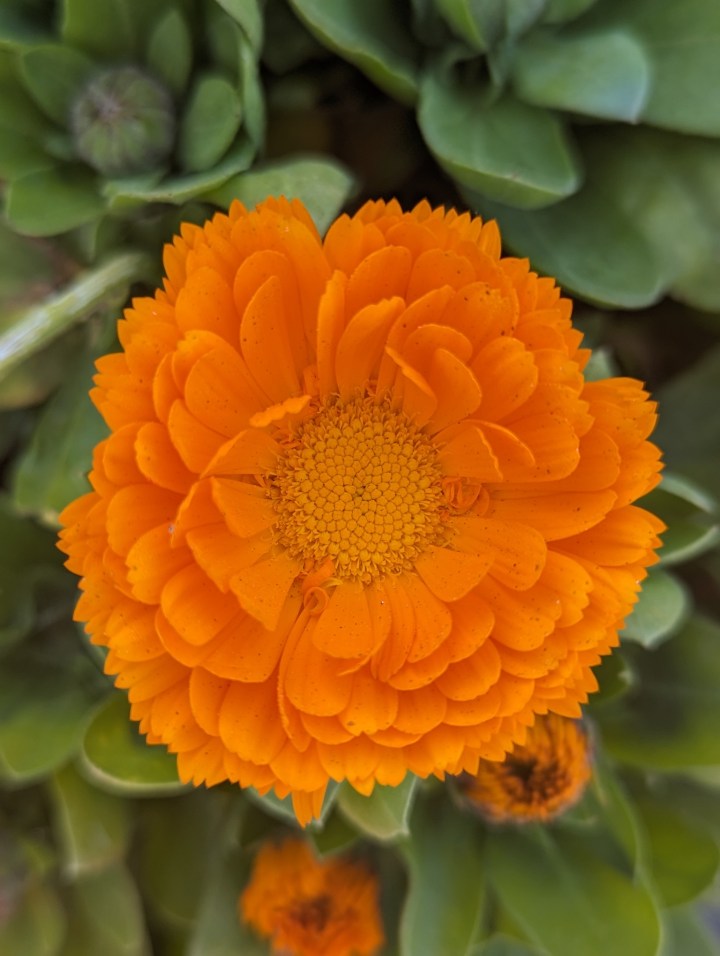
Calendula dislikes summer warmth and may not last completely through winter, but should last as long as marigold.

What was probably the last of the warm weather for the year really got the zinnias going again; but only for their leaves to become dusted with powdery mildew in the subsequent long cool nights. No matter how good the zinnia flowers still look, it is time for cool season annuals.

In mixed plantings, cool season annuals can be ‘plugged’ (as seedlings or small plants) or sown (as seed) among the warm season annuals so that they are ready to perform as the warm season annuals succumb to cooler weather. Of course in more uniform beds, warm season annuals will eventually need to be removed to make space for their cool season replacements.

Pansies and related violas are likely the two most popular cool season annuals. They fill in nicely as bedding plants or are nice components to mixed plantings. They perform best early in the season while the weather is still a bit warm, but should last until the weather gets too warm the following spring.

Primroses and Iceland poppies can take a bit more effort since they need ‘deadheading’ (removal of deteriorating flowers) to continue blooming. Primrose can also be hazardous to anyone who happens to be allergic to them, causing skin irritation comparable to that of poison oak! Some primroses are very brightly colored, while others are more subdued and elegant shades of pink and white. Iceland poppies are mostly pale shades of orange, yellow, pink and white on wiry stems.

Chrysanthemums, which are actually perennials, are the most variable of the cool season annuals, with a wild range of colors and flower forms. The varieties most popularly grown as annuals stay low and compact. Taller types make good cut flowers, but are not so practical for bedding. The related African daisies, which are incidentally similar to the ground cover of the same name, lack the variety of flower color and form, but are easier to grow; particularly as a perennial long after other cool season annuals are gone.

Calendulas are another simpler chrysanthemum relative that are more proportionate to typical annuals, since they get only a few inched deep. They would probably be more popular than they are if they provided more colors than their marigold like orange and yellow. Unlike chrysanthemums and African daisies, calendulas really are annuals, so do not last long into warm weather.

Red, white, pink and rosy pink flowers among rich green foliage can be provided by sweet William (dianthus). They not only tolerate a bit more shade than some other cool season annuals, but are also likely to survive sporadically as perennials where protected from warm exposure through spring and summer.

Stock is the best cool season annual for fragrance. It smells like carnations, but much stronger. Short varieties are good bedding annuals, and even better for mixed plantings. Taller varieties are great cut flowers.

Cool Season Bedding Plants Begin

Marigold becomes more popular for autumn.

There is no rush yet. Some cool season bedding plants can go into their gardens as late as autumn. Ornamental kale and cyclamen can be as late as winter if necessary. Locally, autumn and winter can be a bit later than elsewhere. Also, different cool season bedding plants rely on different schedules. Ornamental kale and cyclamen actually prefer to wait.

Cool season bedding plants are the same as winter bedding plants. They also qualify as cool season annuals and winter annuals. However, most have potential to be perennial, and some can perform after winter. Some are warm season bedding plants within cooler climates. Locally warm summers and mild winters limit their performance very differently.

All bedding plants provide a profusion of temporary floral color for their assigned season. Cool season bedding plants replace deteriorating warm season bedding plants. Within a few months, warm season bedding plants will become seasonal again. Most that can be perennials are disposable for simplicity. Replacement is generally simpler than salvage.

Installation of bedding plants is often contingent on performance of their predecessors. If petunias of last summer still bloom nicely, pansies for autumn may need to wait. Pansies might need to be early though, if petunias are already shabby. Most cool season bedding plants are fortunately adaptable in that regard. Merely a few must wait for cooler weather.

Scheduling for seeding of cool season bedding plants is not as adaptable. Seed can not germinate and grow faster if late. Actually, seedlings grow slower as weather gets cooler. Seedlings for some species should be growing already. Others should start about now or rather soon. Some should start in cell packs or flats. Several others prefer direct sowing.

Pansy and viola are probably the most familiar and reliable cool season bedding plants. Marigold and perhaps snapdragon are popular now, but may not perform through winter. They become seasonal again as winter ends. Sweet William and a few sorts of primrose are potentially perennial. Any that survive through summer could resume blooming soon.

Chrysanthemum paludosum

Chrysanthemum paludosum goes into the garden early here.

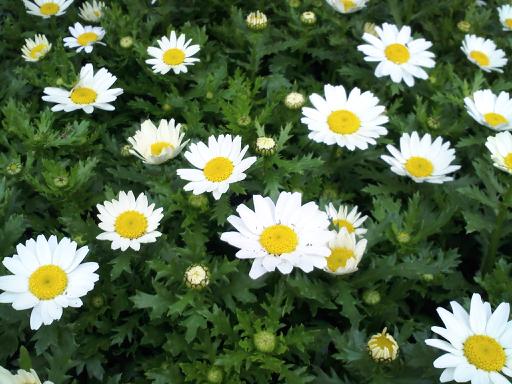
            In cooler climates, where winters are too harsh but summers are just right, Chrysanthemum paludosum is a warm season annual. Locally though, it gets planted about now like pansies, stock and Iceland poppies.  Chrysanthemum paludosum does just fine through late winter, and does even better as the weather gets warmer in spring. It can be replaced with real warm season annuals as weather eventually gets too warm and dry (lacking humidity) in summer. In cool and damp places, it can survive through summer. Chrysanthemum paludosum develops into six inch wide mounds of rich green and finely textured foliage adorned with small white daisy flowers with yellow centers.

Ornamental Kale (deferred from yesterday)

Flowering kale really seems to bloom.

Flowering cherry trees are prettier but fruitless versions of their fruiting counterparts. So are flowering peach trees. It seems only fair that some vegetables could also be prettier than culinarily useful. Gourds are ornamental squash fruit that can qualify as vegetables. Ornamental kale, Brassica oleracea, is an actual vegetable that is primarily ornamental.

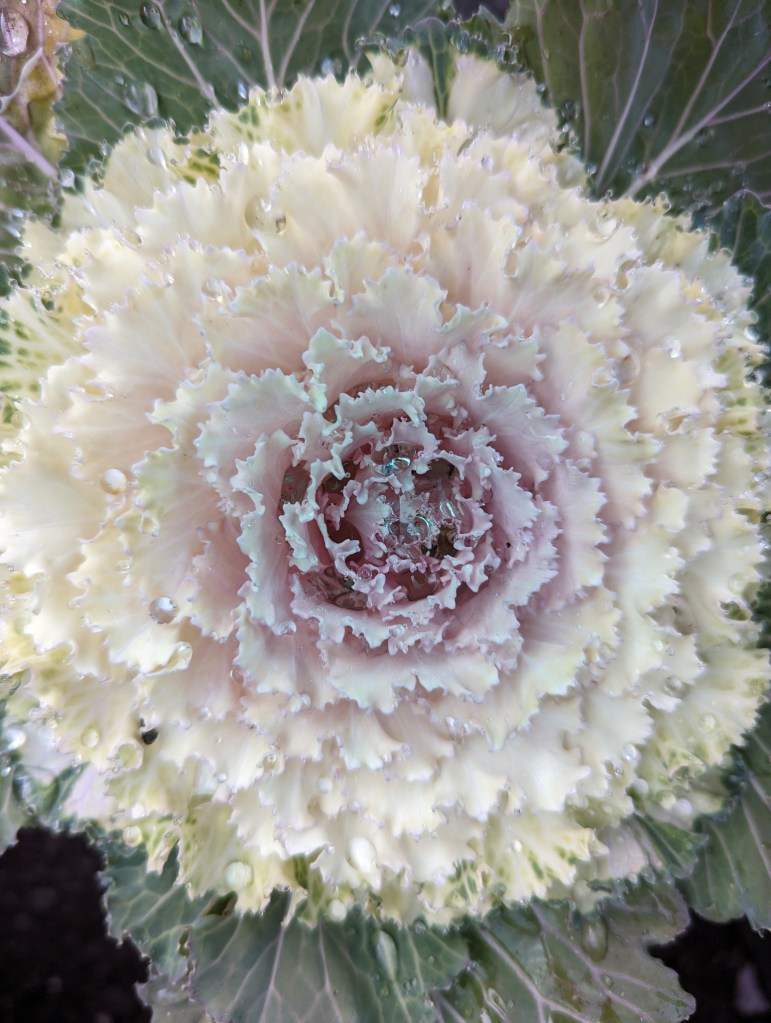
Ornamental kale is also known as flowering kale, or ornamental or flowering cabbage. It is more foliar than floral though. Its dense foliar rosettes unfurl like big ruffly roses. Some are very ruffly. Some are intricately lobed. Foliar color can be white, pink, red or purplish. Ornamental kale is as edible as culinary kale, but a bit more bitter. It is a splendid garni.

Like cool season annual flowers, ornamental kale performs between autumn and spring. It grows quite slowly though. Seed that starts in August grows into seedlings for October. Seedlings that start in October only begin to get colorful during November, a month later. Their seemingly floral but foliar display ironically ends as they actually bloom for spring.

Primrose

These sorts of primrose almost seem to be synthetic because of their bright but simple color.

The cartoon shades of red, yellow, blue, purple and nearly orange of primrose, Primula acaulis (or Primula vulgaris) are still partying strong. They do not seem to be aware that, although perennials that could regenerate next autumn, they are likely to be replaced with warm season annuals soon. The cute flat-topped trusses of half inch to inch and a half wide flowers are short, but stand up above the even shorter two to five inch long leaves.

Pansy

Pansy is one of the most familiar of cool season annuals.

All sorts of shades and combinations of yellow, orange, red, purple and blue, as well as white and monochromatic black can be found among the many varieties of pansy, Viola X wittrockiana. Pansy flowers are mostly about two inches wide, with a pair of overlapping upper petals, a pair of side petals and a single lower petal. Even though they stand only about half a foot high, flowers hover slightly above the foliage.

Here where winters are so mild, pansies get planted in autumn to bloom through winter, and then get replaced with warm season annuals in spring. They can survive through summer, but do not perform so well while weather is warm. Deadheading (removal of deteriorating flowers) promotes continual bloom. Related violas typically produce more profuse but smaller flowers, which are actually physiologically different.

Pansy

Violas are smaller versions of pansies.

This is one of the more familiar of winter annuals. Yet, pansy, Viola X wittrockiana, is not just one species. It is a diverse group of hybrids of a few species, and includes viola and Johnny-jump-up. Generally, viola and Johnny-jump-up have smaller and simpler flowers. Pansy generates relatively larger and more colorful flowers, with more intricate patterns.

The most recognizable feature of popular pansy is the distinctive floral patterns that look like floral faces. Individual flowers may display a few distinct colors within such patterns. Alternatively, flowers may be a single color. The color range includes white, blue, purple, yellow, orange, rusty red and black. Big flowers can be as wide as two and a half inches. 

Locally, pansy is a winter annual. The best bloom begins about now. If the coolest winter weather inhibits bloom, it is only temporary. Bloom is likely to resume before a lapse gets obvious. Although pansy is a summer annuals in other climates, it does not perform well in the locally arid climate during warm weather. Plants might get six inches tall and wide.

Winter Annuals Are Moving In

Chrysanthemums bloom between summer and winter.

It is inevitable. It begins at about the same time that cool season vegetable plants start to replace warm season vegetable plants. Cool season vegetables are now in season, and will grow during autumn and winter. They replace warm season vegetables of spring and summer. Winter annuals, or cool season annuals, now do the same for summer annuals. 

Some summer annuals, or warm season annuals, are already shabby by the end of their season. Their replacement is not so unpleasant. Those that continue to perform well into the end of summer or autumn are a bit more difficult to evict. No one likes to pull them up while they still bloom colorfully. Besides, new winter annuals may take a while to bloom.

Winter annuals, as well as summer annuals, require replacement because they live only for a single year. Some complete their respective life cycle within only a few months of a year. That is what their designation as ‘annual’ means. Several annuals have potential to survive as perennials, but are too unappealing to salvage through their dormant season.

Marigold and chrysanthemum are popular for autumn, but do not perform as well through winter. Cyclamen, which prefers a late start, is pleased to replace them by then. Although chrysanthemum and cyclamen are both perennials, few get the opportunity to perform as such. It is easier to simply remove and replace them with the next best seasonal annual.

Pansy, viola, Iceland poppy, sweet William, stock and various primrose are all in season now and through winter. Calendula and snapdragon are seasonable for autumn, and will be again for early spring. They survive and can even bloom through the middle of winter locally. Alyssum is technically a summer annual, but might bloom all through winter also. 

Winter annuals are not as easy to grow from seed as summer annuals are. Because they grow during cooler weather, they grow slower. They therefore need to start growing early to be ready for planting now. It is perhaps more practical to plant most types as seedlings from cell packs. Cyclamen and ornamental cabbage commonly grow from four inch pots. These are innately more expensive than other winter annuals.

Cool Season Annuals Are Cool

Warm season annuals are now passé. Cool season annuls, such as these violas, are in.

Now that it is time for cool season annuals, it is difficult to remove warm season annuals if they are still blooming and healthy. that is probably why so many of us prefer mixed plantings, where cool season annuals can be added as needed to replace warm season annuals as they deteriorate. Some warm season annuals that are actually perennials, like wax begonia and busy Lizzie (impatiens), can be cut back and overplanted with cool season annuals, so that some might regenerate next spring as the cool season annuals finish. Petunias may be looking overgrown and tired, but are at least easier to remove without guilt.

Pansies and smaller but closely related violas are probably the two most popular of cool season annuals. They work something like petunias, but for autumn and winter. They are commonly grown in uniform beds, but work just as well in mixed plantings. There are not many colors that can not be found in pansies, although only a few of the more popular varieties can be found at any particular nursery. Some are ‘solid’ colors. The most familiar varieties have those funny ‘faces’ that pansies are known for.

The various primroses require a bit more effort because deteriorating flowers need to be removed. They can also be a problem for the few who are allergic to them (like poison oak). Like the warm season annuals that can survive as perennials through winter, some primroses, particularly English primrose, can survive through summer as perennials. English primrose displays bright cartoon shades of almost any color. Fairy primrose are more commonly pastel shades.

Stock has an intense and distinctively rich fragrance. Taller types are excellent cut flowers, but are not so practical for uniform beds. Even shorter types are probably best in mixed plantings, or in borders with lower flowers in front. The single or double flowers can be white, pink, purple and almost red.

Ornamental cabbage and kale are grown for bold rosettes of colorful pink, white or pink and white foliage. The shades of pink range from soft light pink to rich purplish pink and almost red bright pink. Cabbage provides more color. Kale has more variety of foliar texture. Ironically, both look rather weedy, and should be removed as they begin to bloom in spring.

Chrysanthemum are strikingly colorful cool season flowers, but rarely bloom as uniformly as they do when first planted. Because they bloom so profusely, they need to be groomed frequently. If they get what they want, they can perform for several years, blooming all sorts of shades of yellow, orange, red, pink, purple and white. Chrysanthemum also displays a broad range of flower structures and sizes, from minute to jumbo.

Sweet William, Iceland poppy, calendula and alyssum are also in season. Yellow or orange calendula, with single or double flowers, is best through autumn, but may mildew by winter. Alyssum is white or subdued shades of pink or purple, and is actually good throughout the year, and can self sow indefinitely.