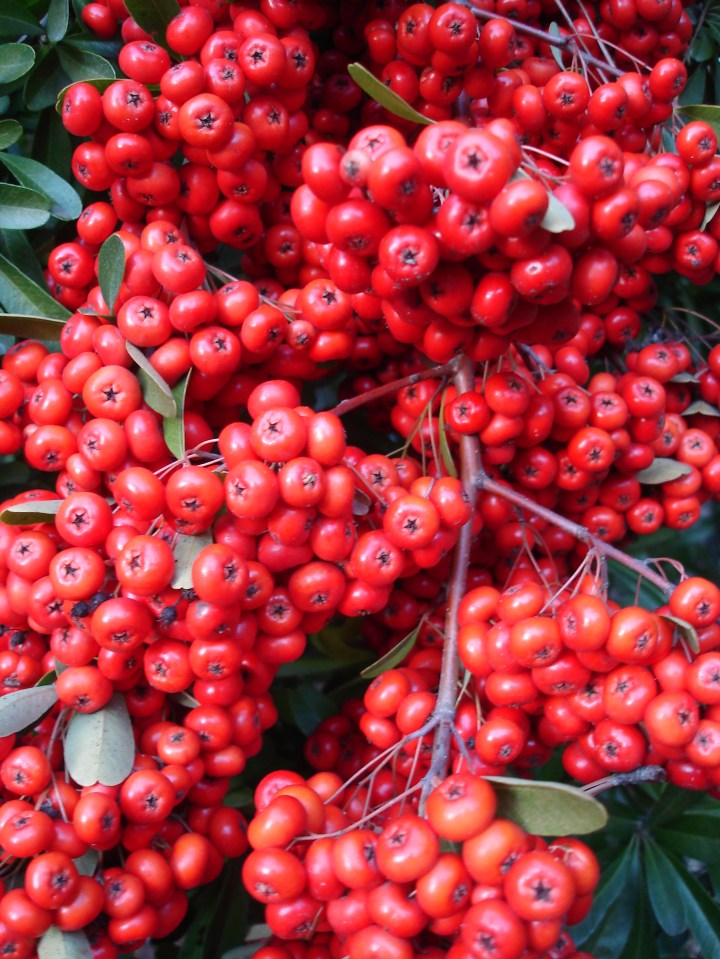
 It is probably no coincidence that certain berries and small fruits are so colorful through winter while colorful flowers are relatively scarce. Like flowers, they want to get others to do something for them. Flowers use color, aroma, flavor and sometimes even texture to attract and reward pollinators. Colorful berries and fruits do the same to attract birds and animals who disperse their seeds.
There are not many colorful flowers blooming in winter to distract anyone from colorful berries and fruit. Those who want them are pretty intent on finding them anyway. There is not much else for overwintering birds to eat. Squirrels probably have plenty of acorns and nuts stored, but might enjoy a few berries too. No matter how abundant they are, there is serious competition for berries.
Most types of berries and small fruits that are so colorful through winter contain tiny seeds that get eaten along with the fruit. In this manner, the seeds get taken away from their origin as easily as birds fly away. They then get dispersed as birds do what birds do (that can be so annoying on a freshly washed car). Digestion only scarifies these seeds, which might not germinate otherwise.
This all might be much more information than necessary for home gardening. All we really need to know is that there are several plants that can produce colorful berries through winter while other color is limited. Although, it might be useful to be aware that these colorful berries are likely to eventually be depleted by the birds and any other wildlife that they are intended to be appealing to.
Then again, winter berries are popularly grown specifically to attract birds and wildlife to the garden. Either way, if berries are grown for their color or to attract birds, they have the potential to be messy. Those that do not get eaten eventually fall onto whatever is below them. Those that do get eaten fall (in ‘another form’) all over the neighborhood, and of course, onto freshly washed cars.
Coincidentally, most plants that produce colorful winter berries are related. They are of the ‘rose’ family, ‘Rosaceae’, and produce similar ‘pomme’ fruits that look like minute apples. Firethorn (pyracantha) is the most colorful and prolific. The various cotoneasters, including some low growing ground-covers, are similar, but not so prolific. Toyon is a colorful native that works nicely in unrefined landscapes. English hawthorn is a small deciduous tree.
 The bright red berries of late cotoneaster, Cotoneaster lacteus, that ripen in autumn may not be as profuse or as bright red as those of firethorn, but they last longer, and even into winter. Birds strangely seem to avoid them. Although the clustered small berries can look just like firethorn berries, they are usually less shiny, and darker red. Clusters of tiny pale white flowers bloom in spring. The small evergreen leaves have a nice glossy and veined texture on top, with hazy gray or tan tomentum (fuzz) below. The grayish brown bark of old stems resembles that of apple or pear trees.
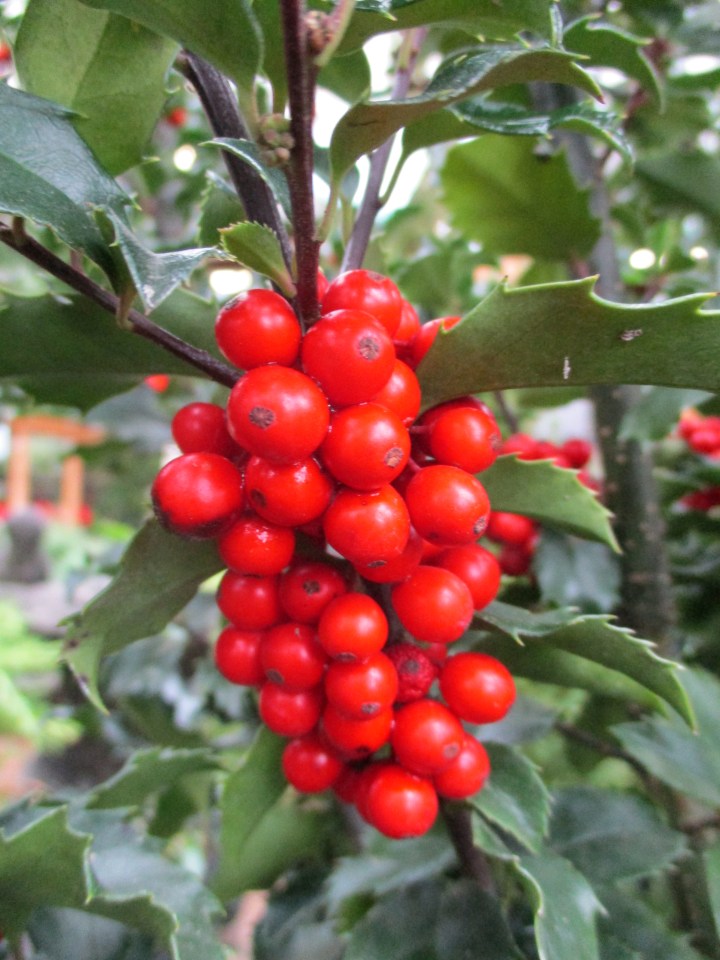 Plants compensate for their immobility by procuring the services of animals and insects. They bloom with flowers that attract pollinators with colors, fragrances and flavors. Their fruits use similar techniques to attract those who consume the fruits to disperse the seeds within. It is a pretty ingenious system. The animals and insects probably think that they are taking advantage of the plants.
 Most of the brachyscome found in nurseries nowadays are the annual Brachyscome iberidifolia. Perennial species are rare. The name is still often spelled as ‘brachycome’, without the ‘s’, as it had been spelled for decades. Although it is a warm season annual, brachyscome is also popular now because it can bloom better through the locally mild winters than the warmth of mid summer.
 Like euryops daisy, sweet pea shrub and New Zealand tea tree, the blue hibiscus, Alyogyne huegelii, blooms whenever it wants to, even if it wants to bloom sporadically through winter. It should bloom more abundantly in phases though spring and summer, but even that is difficult to predict. The three inch wide flowers are lavender blue, but can be rich purple or white. Pink is very rare.
 Tony Tomeo